

Ecommerce success today hinges on understanding customer behavior. Businesses leveraging data-driven strategies outperform competitors by personalizing experiences, improving retention, and optimizing marketing efforts. Key takeaways:
- Personalization is critical: 71% of consumers expect tailored experiences, and 76% will switch brands if disappointed.
- Data-driven decisions boost ROI: Companies using predictive analytics see 3.7x more revenue per marketing dollar.
- AI transforms ecommerce: AI-powered tools increase average order values by 369% and drive 31% of revenue through product recommendations.
- Customer retention is cheaper: Retaining a customer costs 5x less than acquiring a new one.
- Behavioral analytics improve conversions: Insights into actions like product engagement can lift conversion rates by 300%.
To thrive, focus on predictive analytics, personalization, and behavioral insights to align with customer needs and drive growth.
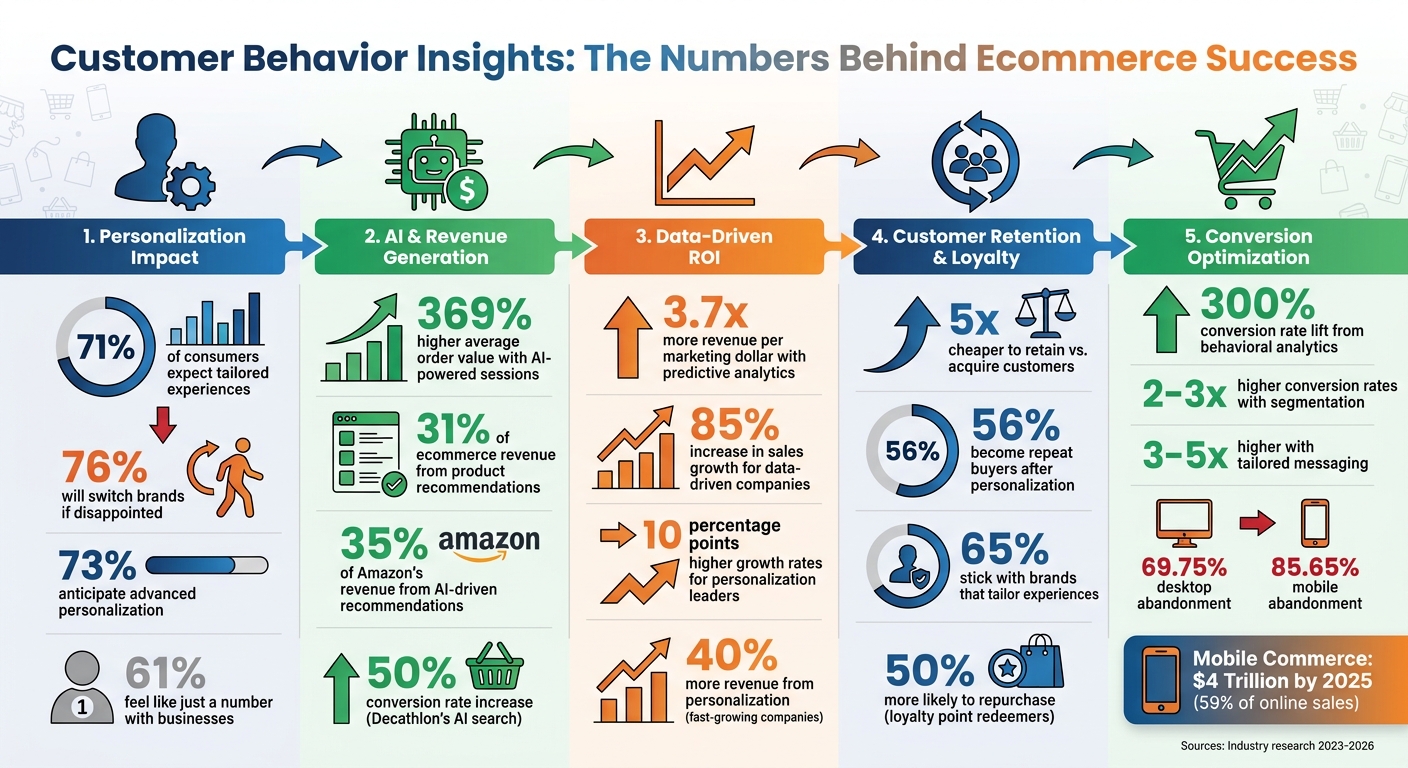
Customer Behavior Insights Impact on Ecommerce Revenue and Growth Statistics
Webinar: How to Use Customer Behavior to Boost Your E-commerce Business
sbb-itb-e2944f4
Personalization: A Key Driver of Ecommerce Success
Personalization has transitioned from being an optional feature to something customers now expect. In fact, 73% of customers anticipate advanced personalization, yet 61% feel like just a number when interacting with businesses. This disconnect offers a huge opportunity for ecommerce brands that are ready to embrace the right tools and strategies.
The financial benefits are hard to ignore. For example, product recommendations now contribute up to 31% of total ecommerce revenue. Even more impressive, sessions powered by AI generate a 369% higher average order value. Amazon’s success highlights this trend – approximately 35% of its revenue stems from its AI-driven recommendation engine. These examples underscore how personalization fuels revenue growth and sets the stage for advanced AI systems to thrive.
Using AI and Machine Learning for Product Recommendations
Modern AI systems work by analyzing behavioral, transactional, and contextual data. These systems use various methods to connect customers with products they’re most likely to purchase.
- Collaborative filtering: This approach identifies patterns, such as “customers who bought this also bought…”.
- Content-based filtering: Matches product attributes (like color, price, or category) to a shopper’s preferences.
- Deep learning models: Predict future actions based on sequential customer behavior.
One major development is the move from "retrieval" to "decisioning." Instead of simply suggesting items similar to what a customer has browsed, modern AI focuses on actions that maximize a customer’s lifetime value. For example, in April 2026, fashion retailer Ivet adopted value-optimized personalization across its 48,000+ SKUs. The result? A 6.2% conversion rate on influenced traffic (a 130% increase) and a 2.5× boost in repeat purchases.
Real-time adaptability is another game-changer. AI systems can update product suggestions in milliseconds during live sessions, responding to subtle cues like pauses or product comparisons. Take Decathlon, for instance – their AI-powered search engine led to a 50% jump in conversion rates for search queries by better understanding customer intent. These tools don’t just drive immediate sales; they also build stronger, long-term connections with customers.
How Personalization Builds Customer Loyalty
Personalization doesn’t just drive sales – it’s also essential for building loyalty. Research shows that 56% of shoppers become repeat buyers after experiencing a personalized shopping journey, and 65% of consumers stick with brands that tailor their experiences. Personalized follow-ups also make an impact, increasing second-purchase rates by 45%.
Loyalty programs play a big role here. Customers who redeem loyalty points are 50% more likely to make repeat purchases, compared to just 10.7% among non-redeemers. This creates a feedback loop: better personalization drives higher loyalty engagement, which, in turn, provides richer data to refine personalization efforts even further.
A great example comes from Carsome, a car marketplace in Southeast Asia. In 2026, they implemented a unified personalization strategy across email and web channels. The results? Email open rates skyrocketed from 1.2% to 18% (a 15× increase), click rates jumped from 6.1% to 36% (a 6× increase), and they generated MYR 36.8M in monthly attributed revenue.
Over time, businesses that focus on customer lifetime value rather than short-term clicks can achieve a 3–5× increase in CLV by month 12. Fast-growing companies also see 40% more revenue from personalization compared to slower competitors. On top of that, businesses leading in personalization enjoy compound annual growth rates that are 10 percentage points higher than those lagging behind.
Improving Customer Experience Through Behavioral Analytics
While personalization focuses on tailoring what customers see, behavioral analytics dives into the why behind their actions. By analyzing qualitative interactions – like mouse movements, scrolling patterns, and clicks – businesses can uncover hesitation points that traditional metrics often miss. And the results speak for themselves: companies prioritizing behavioral analytics alongside UX design report revenue boosts of 10-15% within just one year.
Here’s the catch: 73% of ecommerce teams don’t have access to actionable analytics dashboards. Without this deeper understanding, it’s hard to move beyond surface-level numbers. For example, data shows that customers who spend over 90 seconds on product pages and engage with product variants convert at rates 300% higher than average. Insights like these highlight hesitation points and pave the way for refining the user experience through A/B testing and targeted adjustments.
A/B Testing for Customer Experience Improvement
A/B testing is a powerful tool, but its success often hinges on reducing friction first. This means simplifying user flows and optimizing mobile experiences before adding features like urgency indicators or social proof. For instance, product comparison pages show a 37% win rate with a +3.5% lift, while homepage optimizations win 31% of the time with a +3.1% lift.
Take Lenovo’s 2023 Mobile UX Transformation program as an example. This initiative, led by product analysts like Yash Singh, included 36 A/B tests targeting mobile-specific friction points, such as improving above-the-fold messaging and streamlining checkout flows. The results? A 5% boost in overall conversion rates, a 19% drop in bounce rates, and a 12% increase in accessory attach rates through market basket analysis. On top of that, 120+ B2B customer interviews during the same period helped optimize workflows, adding $400,000 in revenue.
With mobile abandonment rates at 85.65% compared to 69.75% on desktops, focusing on mobile-specific tests is critical. These tests have a 38% win rate and deliver an average lift of +2.9%. By addressing mobile-specific challenges, businesses can turn behavioral insights into actionable strategies for improving conversions.
Using Behavioral Data to Increase Conversion Rates
Behavioral data also plays a key role in funnel analysis, which maps the customer journey to identify where revenue leaks occur – like during shipping or payment steps. This approach allows businesses to fix real problems instead of relying on guesswork.
For example, in 2025, Chris Sherman, CEO of Island Creek Oysters, used Shopify analytics to tackle high cart abandonment rates. The data revealed customers were fine with higher product prices but hesitated over shipping costs. By embedding shipping fees into product prices, the company reduced abandonments and tripled its annual revenue.
Similarly, Nate at Original Grain used Heatmap.com’s element-level revenue data to pinpoint high-impact website areas for testing. This behavioral-driven strategy resulted in a 17% lift in Revenue per Session while increasing site traffic by 43%. These examples show how turning raw behavioral data into actionable insights can directly drive revenue.
| Behavioral Pattern | Conversion Rate Impact | Average Order Value Impact |
|---|---|---|
| Extended product engagement | +300% | +45% |
| Cross-category browsing | +180% | +65% |
| Trust signal interaction | +150% | +25% |
| Comparison behavior | +220% | +55% |
| Mobile-optimized interactions | +190% | +30% |
Source: Heatmap.com behavioral impact analysis
Customer Segmentation: Understanding and Targeting Key Audiences
Customer segmentation takes the insights from personalization and behavioral analytics and fine-tunes them, focusing on distinct customer behaviors. Treating every customer the same often leaves potential revenue on the table. Research shows that companies leveraging segmentation see 2–3x higher conversion rates, while tailored messaging can boost those rates by 3–5 times compared to generic approaches. By grouping customers based on actions rather than just demographics, behavioral segmentation allows businesses to address specific motivations, such as price sensitivity, product preferences, or shopping frequency.
Identifying Customer Segments and Behavior Patterns
Segmentation transforms broad marketing strategies into focused, actionable plans. The eRFM model (Engagement, Recency, Frequency, Monetary Value) has become a leading tool for behavioral segmentation. Unlike traditional RFM analysis, which focuses solely on purchase history, eRFM incorporates an engagement layer. This tracks activities like email clicks, site visits, and app usage, making it easier to spot high-intent customers who are actively browsing but haven’t completed a purchase.
"eRFM segmentation becomes the gold standard for ecommerce customer segmentation by combining purchase and engagement data to identify high-intent, high-value customers."
– Maryna Shulzhenko, Marketing Content Specialist, Maropost
The most effective stores categorize customers into groups such as Champions/VIPs (the top 5–10% based on spending), At-Risk High-Value (previously big spenders who’ve gone quiet), One-Time Buyers (a major growth opportunity), and Discount-Dependent shoppers (those who purchase mainly during promotions).
Segmentation should remain dynamic. For example, customers should immediately leave "at-risk" groups after making a purchase. To keep things manageable, start with 5–10 impactful segments. Each segment should align with specific automated workflows, such as routing "At-Risk" customers into a win-back email campaign.
With these insights, businesses can craft strategies tailored to each segment’s unique behaviors.
Using Segmentation to Improve Marketing Strategies
Once customer segments are defined, targeted marketing strategies can drive better engagement and retention. A suppression strategy, for instance, excludes VIP customers from heavy discount promotions, protecting profit margins and maintaining brand value.
"Suppression is as strategically valuable as targeting. Most stores use segmentation only to include. The best stores use it to exclude as well."
– FluentCRM
The results speak volumes. In 2022, ASOS adopted predictive behavioral segmentation to identify disengaged customers, cutting its churn rate by 17% in six months. Similarly, Sephora’s "Beauty Insider" program uses purchase history and online behavior to segment customers into three tiers. This program now accounts for nearly 80% of annual sales, while targeted campaigns have reduced marketing costs by 17%.
For one-time buyers, the focus should be on driving that critical second purchase, as the likelihood of a third purchase increases significantly once a customer buys twice. Strategies like post-purchase education and complementary product recommendations can help move these customers toward loyalty. For discount-sensitive shoppers, reserve deep discounts for clearance events or win-back campaigns, while offering VIPs perks like early access or exclusive benefits instead of price reductions.
| Segment Type | Marketing Strategy | Impact |
|---|---|---|
| Champions/VIPs | Exclusive early access, loyalty rewards, no heavy discounting | Protect margins, increase lifetime value |
| At-Risk High-Value | Proactive personal outreach, feedback surveys, relevant content | 10–20% improvement in retention |
| One-Time Buyers | Post-purchase education, complementary products, social proof | 3–5x higher conversion on second purchase |
| Discount-Dependent | Targeted clearance alerts, bundles, gift-with-purchase offers | Maintain engagement without eroding margins |
Driving Growth Through Data-Driven Ecommerce Strategies
Ecommerce businesses are increasingly turning to data-driven strategies to fuel growth. By analyzing customer behavior, companies can create targeted advertising and promotions that not only engage their audience but also boost sales. This approach shifts the focus from simply tracking past actions to predicting future behaviors and making informed decisions. In fact, businesses that utilize customer behavior insights see an 85% increase in sales growth compared to their competitors.
Implementing Targeted Advertising and Promotions
Using behavioral data, businesses can fine-tune their advertising to reach the right audience at the right time. For example, campaigns can be tailored to address specific actions like cart abandonment, recent purchases, or browsing patterns. Machine learning further enhances this process through lookalike audience expansion, which identifies potential customers who share traits with high-value segments, making customer acquisition more efficient.
A standout example is Billy Footwear, a Shopify-based brand specializing in adaptive footwear. By leveraging the LayerFive Axis platform, the company achieved 72% revenue growth with only a 7% increase in ad spend and a 34% reduction in customer acquisition costs (CAC).
"Dashboards don’t drive growth. Decisions do."
– Sushil Goel, CEO, LayerFive
Another key tactic is intelligent discounting. Instead of offering blanket promotions that cut into profits, businesses can use behavioral data to determine which customers respond to price incentives and which value perks like free shipping or early access. For example, price-sensitive shoppers might prefer percentage-off deals, while premium customers may prioritize exclusivity.
Personalization also plays a critical role in advertising. Customizing ad content and landing pages based on where a customer is in their buying journey – whether they’re in the awareness, consideration, or purchase stage – can lead to 50–200% higher conversion rates compared to generic ads. Additionally, sessions featuring AI-driven recommendations can result in a 369% increase in average order value.
These strategies enable businesses to stay agile and responsive to changing market conditions.
Adapting to Trends and Changing Customer Preferences
Keeping up with evolving consumer behavior is essential. Tools like real-time behavioral tracking, website analytics, and heatmaps help businesses quickly identify pain points and adapt their strategies. This agility is crucial, as 71% of consumers expect personalized interactions, and 76% are willing to switch brands if they don’t receive them.
Predictive modeling takes adaptation a step further by forecasting customer actions. Machine learning can predict purchase likelihood, churn risks, and seasonal trends, allowing businesses to act proactively. For example, Decathlon utilized AI-driven search personalization to boost conversion rates by an impressive 50%.
Another powerful tool is social listening and sentiment analysis. By analyzing social media mentions and product reviews with Natural Language Processing (NLP), businesses can identify emerging trends and address customer concerns before they escalate.
The rise of mobile commerce underscores the need for adaptability. Mobile sales are projected to hit $4 trillion by 2025, accounting for 59% of online sales. During Cyber Week 2024, mobile devices contributed to 35% of sales, marking a 7% year-over-year increase. To capture this growing segment, businesses should prioritize mobile-friendly experiences, such as streamlined, easy-to-use checkout processes.
Looking ahead, agentic commerce – where AI-powered agents assist customers by finding products and comparing options – represents a major shift. By 2028, 60% of brands are expected to adopt agentic AI for personalized customer interactions. Staying competitive will require businesses to monitor these advancements and experiment with new approaches before they become mainstream.
Conclusion
Understanding customer behavior is the backbone of staying competitive in ecommerce. Research highlights that companies excelling in personalization see annual growth rates that outpace their competitors by 10 percentage points. Even more striking, fast-growing businesses can generate up to 40% more revenue through personalization efforts. The key difference between thriving and merely surviving often lies in transforming raw data into meaningful, actionable insights.
The move from reactive strategies to predictive ones is reshaping the game. Businesses are now equipped to anticipate purchase intent, pinpoint potential churn, and fine-tune every customer interaction in real time. This shift doesn’t just boost conversion rates – it also ensures smarter resource allocation. By leveraging these insights, companies are turning what once seemed like obstacles into opportunities for growth.
Consider this: nearly 70% of shopping carts are abandoned, with 26% of shoppers citing overly complicated checkout processes as the reason. Every small friction point can cost a sale. Behavioral insights empower businesses to eliminate these hurdles, creating smoother, more intuitive experiences for their customers.
This predictive approach demands decisive action. Success hinges on investing in the right tools and prioritizing accurate, high-quality data. Whether it’s through RFM analysis, predictive modeling, or refining mobile experiences, the mission remains clear: harness customer behavior data to make faster, smarter decisions. With rising acquisition costs and declining conversion rates, businesses that embrace this strategy will position themselves to not only survive but thrive in an increasingly competitive landscape.
FAQs
What customer data should I track first?
To get a clear picture of your ecommerce performance, start by keeping an eye on purchase frequency and customer lifetime value (CLV). These metrics reveal how often customers return to buy and how much they contribute over time. With this information, you can fine-tune your marketing strategies – whether that’s rewarding your most loyal customers or finding ways to bring back those who shop less frequently.
Also, pay attention to product affinity and cart abandonment rates. Understanding which products are often purchased together opens up opportunities for cross-selling, while tackling cart abandonment can help boost your conversion rates. When combined, these insights create a solid framework for driving your ecommerce growth.
How do I start personalization without AI?
To personalize shopping experiences without relying on AI, start by leveraging customer insights. Dive into purchase history, browsing habits, and customer feedback to identify distinct segments. From there, you can craft tailored offers, targeted promotions, and customized communication. This approach mirrors the personal touch of in-store interactions, creating a more engaging customer experience – even without advanced automation tools. Begin with straightforward data analysis and practical strategies to lay a solid groundwork.
Which segments should I create first?
Start by targeting customer segments that can deliver noticeable results right away. Focus on groups like recent buyers or those actively engaging with your brand – they’re already showing interest and are more likely to respond. At the same time, make an effort to reconnect with inactive customers who haven’t interacted in a while. Key segments to prioritize include loyal customers, high spenders, or frequent shoppers. Tailoring your marketing efforts to these groups can drive growth and boost your ROI.