

Customer reviews can make or break your Amazon sales. Here’s why:
- 96% of shoppers read reviews before purchasing, and 79% trust reviews more than price or brand loyalty.
- A one-star rating increase boosts sales by up to 26%, while a single one-star review can cut conversions by 30%.
- Products with at least 15 reviews sell 4x more, and just five reviews can increase conversions by 270%.
- Star ratings above 4.3 dominate search results and convert 68% better than ratings below 4.2.
- High review counts (e.g., 50+ reviews) improve trust and drive up conversions by 4.6x.
Amazon’s algorithm prioritizes products with steady review growth, high ratings, and verified purchases. Sellers who actively manage reviews – by addressing negative feedback, encouraging verified reviews, and analyzing trends – gain better search visibility and higher sales.
Key takeaway: Reviews don’t just reflect customer opinions – they directly impact your rankings, conversions, and revenue.
Amazon Reviews Impact. Profitero Report: The power of consumer reviews
How Star Ratings Affect Conversion Rates
How Amazon Star Ratings Impact Conversion Rates and Sales Performance
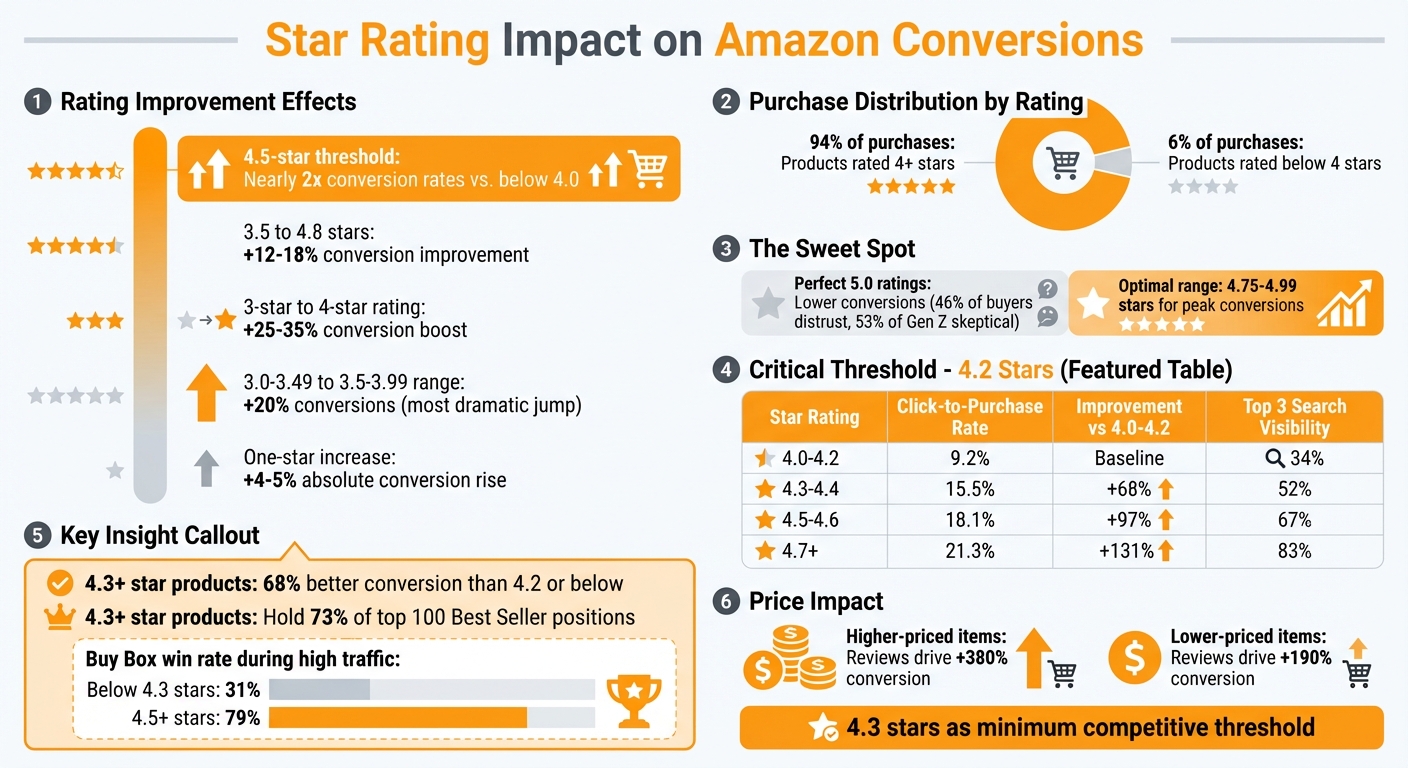
Star ratings act as trust signals for Amazon shoppers, influencing their buying decisions in a split second. The difference between a 3-star and 4-star rating isn’t just about appearances – it directly impacts sales. Studies reveal that moving from a 3-star to a 4-star rating can lead to a 25–35% boost in conversion rates. Products hitting the 4.5-star threshold can experience nearly double the conversion rates compared to those stuck below 4.0. These effects are even more pronounced when factoring in product price.
For higher-priced items, reviews can drive conversion rates up by 380%, while lower-priced products see a 190% increase. This disparity makes sense – shoppers tend to scrutinize expensive purchases more closely, relying heavily on reviews to feel confident about their choice.
Interestingly, about 94% of purchases are made on products rated 4 stars or higher, leaving only 6% for products rated below that.
Small Rating Changes and Their Sales Impact
Even minor shifts in star ratings can lead to noticeable results. A one-star increase often translates into a 4–5% absolute rise in conversion rates. For example, moving from 3.5 to 4.8 stars can improve conversion rates by 12–18%.
The most dramatic jump happens when a product crosses from the 3.0–3.49 range to the 3.5–3.99 range, resulting in a 20% increase in conversions. Another key milestone is reaching the 4.0 mark, where conversion rates typically climb by over 4%.
"A 4.5-star rating signals safety. It says, ‘Most people like me took the risk and didn’t regret it.’ A 3.2-star rating says, ‘Proceed at your own risk.’" – David Chamberlain
Interestingly, products with perfect 5.0 ratings often convert less effectively than those rated between 4.7 and 4.9. Why? Many shoppers are skeptical. 46% of all buyers (and 53% of Gen Z) distrust perfect scores, suspecting them to be fake. The sweet spot for peak conversions lies between 4.75 and 4.99 stars.
Rating Thresholds That Influence Buying Decisions
Amazon’s display thresholds also play a big role in shaping customer perceptions. One of the most critical thresholds is 4.2 stars – the point where visual stars round down to 4.0 instead of up to 4.5.
"The biggest impact appears at the 4.2 threshold, most likely due to this being the point the stars visible next to the listing round to 4 as opposed to 4.5." – Andrew Waber
Products rated 4.3 stars or higher convert at rates 68% greater than those rated 4.2 or below. These products also dominate Amazon’s search results, holding 73% of the top 100 Best Seller Rank positions. During high-traffic periods, sellers with ratings below 4.3 win the Buy Box only 31% of the time, compared to 79% for those rated 4.5 or higher.
| Star Rating Band | Click-to-Purchase Rate | Improvement vs. 4.0–4.2 | Top 3 Search Visibility |
|---|---|---|---|
| 4.0–4.2 | 9.2% | Baseline | 34% |
| 4.3–4.4 | 15.5% | +68% | 52% |
| 4.5–4.6 | 18.1% | +97% | 67% |
| 4.7+ | 21.3% | +131% | 83% |
This data highlights the importance of maintaining high ratings. Aiming for 4.3 stars as the minimum target is essential for staying competitive. Falling below this threshold can significantly hurt both conversions and visibility.
Review Volume and Social Proof
Star ratings might tell shoppers how good a product is, but the number of reviews signals how trusted it is. When a product has hundreds – or even thousands – of reviews, it taps into the power of social proof. High review volumes often lead shoppers to view the product as legitimate and widely accepted.
And the numbers back this up. 99.9% of consumers read reviews, and 80% of buying decisions on Amazon are influenced by them. The impact becomes even more striking as review numbers climb. For instance, products with 50+ reviews convert 4.6 times better than those with fewer than 10.
"It’s all about sample size. The more reviews, the more likely the comments will reflect the product’s true quality." – Dr. Sungsik Park, Marketing Professor, University of South Carolina
The effect of review volume varies by category, but the results are compelling. For example:
- In furniture, products with 101+ reviews see a 1,326% boost in conversions.
- In consumer packaged goods, the lift is 686%.
- In health and beauty, the increase is 275.7%.
- Even in electronics, reaching the 31–50 review range results in a 224.7% boost.
Consumer expectations also reflect these trends. 65% of shoppers prefer products with at least 51 reviews, and 68% want to see at least 26 reviews before taking a product seriously. These psychological benchmarks highlight why building a solid base of reviews is crucial for staying competitive. High review counts don’t just reflect trust – they directly impact sales performance.
Reviews-to-Sales Ratio (RTR)
The Reviews-to-Sales Ratio (RTR) is a key metric for sellers, measuring how many reviews a product generates relative to its sales. Since only 1% to 2% of Amazon buyers leave reviews, a strong RTR indicates steady feedback, signaling to Amazon’s algorithm that the product is both relevant and well-received.
Sellers often track RTR by comparing review growth to sales trends. If sales are climbing but reviews aren’t, it could mean customers aren’t being encouraged effectively to leave feedback. On the flip side, a healthy RTR builds Amazon’s confidence in the product, improving its organic ranking and creating a "virtuous cycle" of visibility and sales.
The link between review volume and sales growth is clear. Products with:
- 16–25 reviews see a 25% sales increase over those with zero reviews.
- 101–200 reviews experience a 320% jump in sales.
- 501–1,000 reviews see sales growth soar to 856%.
Interestingly, after reaching 1,000 reviews, the incremental benefits tend to level off. This suggests there’s an optimal threshold for maximizing social proof.
How Review Counts Affect Search Rankings
Amazon’s A9 algorithm treats review volume as a popularity signal. Since products with more reviews are more likely to convert, higher review counts lead to better rankings. This creates a snowball effect: better rankings drive more impressions, which lead to more clicks, increased sales, and even more reviews.
For example, products with 1,000+ reviews rank 67% higher in search results, boosting both visibility and credibility. A higher review count also improves a product’s Click-Through Rate (CTR), as shoppers are more likely to click on listings with a strong social proof foundation. Amazon interprets a higher CTR as a sign of relevance, further improving the product’s ranking.
"A bigger review count doesn’t just make you look more credible, it directly impacts where your product appears in search." – Bob Norberg, eComEngine
Review velocity – the speed at which new reviews come in – is another critical factor. Amazon rewards listings that consistently gather fresh feedback, as this signals the product is active and relevant. Additionally, Verified Purchase reviews and Vine reviews carry more weight in the algorithm than unverified feedback. For sellers, building a steady stream of authentic, verified reviews is key to climbing Amazon’s search rankings.
Responding to Negative Reviews
Negative reviews might feel like a blow to your business, but they can actually be an opportunity to strengthen buyer trust and improve sales. With 98% of consumers reading reviews before purchasing and 89% closely examining business responses, how you handle criticism can matter more than the review itself. A thoughtful, well-crafted response can sometimes build more trust than a flawless rating.
Amazon sellers, however, face specific challenges. Since late 2020, public replies to reviews are no longer allowed. Brand Registered sellers must now address concerns privately through the Buyer-Seller Messaging Service [22,2]. While this limits public visibility, resolving issues privately often encourages customers to revise or even remove negative feedback, restoring your product’s credibility [22,23]. This makes quick and effective responses essential to maintaining trust.
How Public Responses Build Trust
Even without direct public replies, the principle remains: businesses that respond to their reviews thrive. Studies reveal that companies addressing at least 25% of reviews see a 35% revenue boost, and 73% of dissatisfied customers are willing to give a brand another chance if their concerns are addressed. Speed also plays a crucial role – 66% of consumers expect a response within three days, while 59% won’t return if their issues are ignored.
Responsive businesses are perceived as 1.7 times more trustworthy, showing that acknowledgment and action can make a huge difference.
When Apple faced the "Batterygate" controversy, they issued a public apology and offered discounted battery replacements without conditions. This transparent approach helped rebuild trust with their customers.
Turning Negative Feedback into Positive Outcomes
Negative reviews can act as a mirror, helping you identify areas for improvement. For example, TNG Worldwide used SalesDuo‘s Vine Program and automated tools to reduce negative reviews by 30% while increasing customer satisfaction by 20%.
On Amazon, you can use the "Contact Customer" feature to address low-star reviews (1-3 stars). Offering solutions like refunds or replacements can resolve issues effectively [23,2]. However, avoid generic, automated replies – 60% of consumers distrust them. Instead, craft personalized responses that directly address the buyer’s concerns.
"A well-handled response can turn dissatisfied customers into loyal ones and demonstrate your brand’s commitment to excellent service." – Arjun Narayan, Founder of SalesDuo
Feedback can also highlight recurring problems. If you notice repeated complaints about sizing or unclear descriptions, update your A+ content, product images, or bullet points immediately [22,23]. Dell’s "Voice of Customers" program is a great example of this. By analyzing customer feedback, they refined their products, leading to a 50% improvement in their customer score and making their PowerStore product the top-rated for "Ease of Use".
Here’s how responsiveness impacts key metrics:
| Metric | Responsive Businesses | Non-Responsive Businesses |
|---|---|---|
| Revenue Impact | +35% (at 25% response rate) | -9% below average |
| Customer Retention | 73% second-chance rate | 59% won’t return |
| Trustworthiness | 1.7X higher perceived trust | Significant trust erosion |
| Customer Churn | Lower through active recovery | Up to 15% increase |
sbb-itb-e2944f4
Review Authenticity and Customer Trust
Fake reviews are a major issue on Amazon, skewing purchasing decisions and undermining trust. Customer reviews influence over 70% of buying decisions, but around 40% of Amazon reviews are believed to be fake, with this figure climbing to 45% during Prime Day. In categories like electronics, beauty, and supplements, over 60% of reviews show signs of manipulation. These fake reviews mislead shoppers, disrupt fair competition, and often lead to poor purchases and higher return rates.
The tactics behind fake reviews have become more sophisticated. Instead of flooding reviews all at once, bad actors now spread them over 30–40 days using private Facebook groups or encrypted apps. Generative AI is even being used to craft reviews that seem more genuine. Brokers behind these schemes typically charge sellers $5 per fake review, plus the cost of reimbursing the reviewer for the product. In one extreme case, a bot farm targeted BeltBro, a Florida-based belt company, on January 19, 2026. The attack involved flooding their products with 1-star reviews and creating over 430 duplicate infringing listings in a single day.
To combat these challenges, Amazon has significantly ramped up its detection and enforcement measures.
Amazon’s Review Integrity Policies
Amazon has implemented advanced systems to tackle fake reviews. Every review is analyzed before publication using tools like machine learning, large language models, and deep graph neural networks. These technologies identify patterns and networks of bad actors. Additionally, a global team of over 15,000 employees investigates flagged reviews manually. In 2022, Amazon blocked over 200 million suspected fake reviews, a number that rose to 250 million in 2023 before dropping back to 200 million in 2024. Thanks to these efforts, more than 99% of products viewed by customers now feature only genuine reviews.
"Our sophisticated machine learning methods help Amazon go well beyond surface-level information to uncover hidden differences between authentic and fake reviews." – Josh Meek, Senior Data Science Manager, Amazon
Beyond detection, Amazon takes legal action against those behind fake reviews. In 2023, the company acted against over 150 bad actors across the U.S., China, and Europe. For instance, Amazon sued Tahoevine, a global broker network running over 20 websites that offered refunds for five-star reviews. Nearly all the websites named in the lawsuit shut down by 2023. In another case, a broker known as Mr. Wu, based in China, was sentenced to two years in prison in September 2023 after a criminal referral from Amazon. More recently, Amazon and the Better Business Bureau jointly sued ReviewServiceUSA.com in July 2024 for selling fake reviews through fraudulent accounts.
Verified Purchase Badges and Credibility
Amazon also builds trust through its "Verified Purchase" badge, which confirms that a reviewer bought the product on Amazon at a standard price. Verified reviews carry extra weight in Amazon’s algorithms, influencing star ratings and search rankings. Industry analysis suggests they count 2 to 3 times more than unverified reviews. Not surprisingly, 74% of Amazon shoppers filter or prioritize these verified reviews when evaluating products.
The badge doesn’t just boost credibility – it can directly impact sales. For instance, in early 2024, a private label seller launching a smart home device saw their conversion rate jump from 4% to 11% after accumulating 100 reviews, 70% of which were verified. This improvement helped the product reach the first page of search results and earn "Amazon’s Choice" status. However, some bad actors attempt to manipulate this system by having real people buy products at full price, only to refund them later through platforms like PayPal or Venmo.
| Review Type | Verification Method | Algorithmic Weight | Consumer Trust Level |
|---|---|---|---|
| Verified Purchase | Linked to confirmed Amazon order at standard price | High (2-3x weight) | High |
| Unverified Review | No confirmed Amazon transaction link | Low/Minimal | Low/Skeptical |
| Vine Review | Invitation-only "Vine Voice" program | Moderate/High | Moderate (Disclosed incentive) |
For balanced and honest feedback, focus on 3- and 4-star reviews rather than extreme 1- or 5-star ratings. Watch out for sudden spikes in review volume or repetitive language, as these are often signs of manipulation. If you suspect a review is fake, use Amazon’s "Report abuse" link to trigger a manual investigation by their team.
Tracking and Improving Review Trends
Using Analytics to Monitor Review Performance
Tracking review trends goes beyond simply checking star ratings each week. One key metric to watch is review velocity – the speed at which new reviews come in. Since only about 1% to 2% of Amazon buyers leave reviews, a noticeable drop in this rate can hint at declining sales before it shows up in revenue reports.
Tools like Rainforest API help pull real-time review data into platforms like Snowflake or Tableau, making it easier to spot patterns in customer feedback. AI-powered platforms are also changing the game. For instance, Thunderbit, an award-winning tool, uses natural language processing to group similar phrases – like “lid broke” and “hinge snapped” – into broader themes such as “packaging issues”. Amazon itself offers tools like the Customer Review Insights feature in the Product Opportunity Explorer, which organizes feedback into positive and negative themes while tracking their impact on star ratings over time.
"Ratings and review analysis helps quickly understand the pulse of the market and then figure out whether some of the benefits aren’t perceived in the right way by the consumers." – Kaushik Boruah, Business Head of CPG and Hospitality, LatentView Analytics
Real-time alerts from tools like FeedbackFive provide immediate notifications for negative reviews. These centralized dashboards track metrics like review velocity, average ratings, and order-to-review ratios. For sellers enrolled in Amazon’s Brand Registry, these alerts are particularly useful, as they allow direct communication with unhappy customers through Amazon’s Customer Reviews tool. For example, a kitchen gadget brand noticed a spike in complaints about products being “difficult to clean.” By analyzing keywords, they redesigned the product and reduced negative reviews by 20% in just three months.
With insights like these, sellers can take specific actions to maintain and improve their review performance.
Strategies to Maintain Positive Review Trends
Once you’ve analyzed the data, the next step is using it to shape strategies that keep reviews trending positively. A big part of this is managing customer expectations. For example, using high-quality images, size comparison visuals, and clear, detailed bullet points in product listings can help prevent misunderstandings that lead to poor reviews. Including product inserts with QR codes linking to setup videos or FAQs can also address common issues before they escalate into negative feedback. One home goods brand tackled recurring “arrived damaged” complaints by improving its packaging and publicly sharing its updated review response strategy. This approach led to a significant increase in positive follow-up feedback.
Timing review requests properly can also make a difference. Sending requests 5–7 days after delivery tends to yield better response rates. Automated tools can help by syncing review requests with delivery dates. For brand-registered sellers, Amazon Vine offers up to 30 reviews from trusted Vine Voices, though there’s an enrollment fee. It’s also important to monitor the verified purchase ratio, as Amazon gives more weight to verified reviews – up to 2–3 times more – when calculating star ratings.
Regularly benchmarking your reviews against competitors is another effective tactic. For instance, if the top sellers in your category consistently maintain over 100 reviews with a 4.7-star average, that sets a clear target to aim for. Additionally, incorporating specific phrases from positive reviews – like “easy assembly” – into your marketing copy can boost conversions. A supplement brand used weekly review dashboards to identify a surge in “expired product” complaints, allowing them to quickly issue a recall and limit brand damage.
These proactive strategies not only enhance review quality but also strengthen overall sales performance on Amazon.
Conclusion
Customer reviews are a critical driver of Amazon sales, playing a key role in both conversions and search rankings. In fact, products with at least 15 reviews are four times more likely to be purchased compared to those without any reviews. Additionally, nearly all shoppers read reviews before making a purchase, with many adjusting their decisions based on the feedback they find.
High ratings don’t just attract more buyers – they also improve search visibility and click-through rates. This creates a positive cycle where better reviews lead to higher conversions and even greater pricing leverage. To keep this momentum going, sellers need to actively manage their reviews.
Staying on top of review management is essential for maintaining steady sales. Whether it’s monitoring review velocity to address issues quickly, responding to negative feedback within 48 hours, or using customer insights to refine listings, every effort counts. Sellers who invest in their review profiles position themselves for long-term success on Amazon.
The takeaway is clear: focusing on review trends isn’t optional – it’s a necessity for sustained growth. If you’re looking for a comprehensive way to enhance your reviews and boost sales, Emplicit offers tailored strategies designed to help you thrive on Amazon.
FAQs
What’s the fastest way to raise my Amazon star rating?
To boost your Amazon star rating quickly, focus on a few key strategies. Start by addressing customer concerns as soon as they arise – quick responses can turn negative experiences into positive ones. Make sure your product listings are detailed and include high-quality images to set clear expectations for buyers. Additionally, use automated tools to send polite review requests, encouraging satisfied customers to leave feedback. Managing reviews thoughtfully and resolving issues effectively can lead to a steady improvement in your ratings over time.
How many reviews do I need before sales noticeably improve?
Research indicates that having 16–25 reviews can boost sales by approximately 25%. As the number of reviews increases, the impact becomes even more striking. For instance, 101–200 reviews might lead to a 320% increase in sales, while accumulating 501–1,000 reviews could result in an 856% surge. Once you surpass 1,000 reviews, the social proof becomes incredibly compelling, driving sales performance to new heights.
How can I spot and report fake reviews on my listing?
To spot fake reviews on your Amazon listing, pay attention to certain patterns. These can include generic or vague language, a sudden influx of reviews in a short period, or feedback that’s excessively positive but lacks specific details about the product.
You can also use review analysis tools to identify unusual trends or anomalies in the review data. If you suspect fake reviews, report them using Amazon’s “Report Abuse” feature or through Seller Central, making sure to provide any supporting evidence.
It’s also important to regularly monitor your reviews. This not only helps you stay in line with Amazon’s policies but also ensures your listing remains credible and trustworthy.