

Selling on Amazon? VAT compliance is non-negotiable. Here’s what you need to know:
- VAT (Value Added Tax) is a consumption tax collected on sales and reclaimed on expenses. As an Amazon seller, you’re responsible for collecting and reporting it.
- Triggers for VAT registration:
- Storing inventory in foreign warehouses (e.g., Amazon FBA).
- Exceeding the €10,000 annual EU-wide sales threshold for cross-border B2C sales.
- Consequences of non-compliance: Account suspension, frozen payouts, fines up to 60% of unpaid taxes, and loss of features like the Buy Box or Prime eligibility.
- Key compliance tools: The One-Stop Shop (OSS) simplifies VAT filing for cross-border sales, but separate registrations are still required for inventory storage locations.
- New rules in 2026: DAC7 mandates Amazon share seller data with tax authorities quarterly, increasing audit risks, while penalties across the EU are rising.
Bottom line: Stay compliant to avoid penalties and protect your growth potential. Use Amazon’s VAT services or professional tools to simplify the process and focus on scaling your business.
From Amazon FBA to Europe: VAT Compliance Playbook | VATAi x Velocity Sellers Podcast EP105
sbb-itb-e2944f4
What Triggers VAT Registration for Amazon Sellers
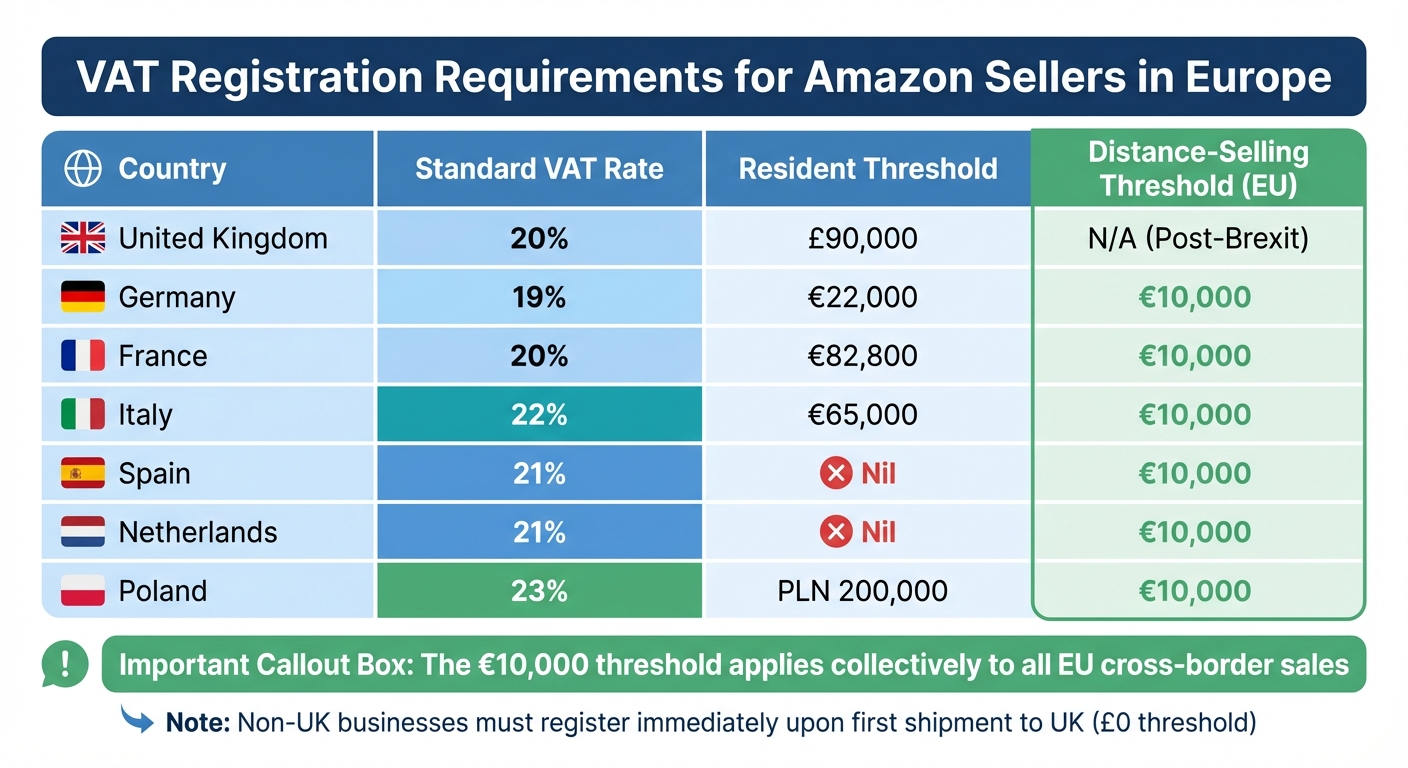
VAT Registration Requirements and Thresholds for Amazon Sellers Across EU Countries
Knowing what activates VAT registration is essential to avoid fines and account suspensions. The rules are clear: inventory location often matters more than sales volume. Whether you store goods in a foreign warehouse or surpass specific sales thresholds, VAT registration becomes mandatory. Here’s a closer look at how these factors come into play.
Using FBA Warehouses in Different Countries
The moment your inventory enters a warehouse in another country, you establish a taxable presence, triggering VAT registration. This obligation kicks in even before you make a single sale. As amavat® highlights:
"VAT registration in Germany begins when your first shipment crosses its border, not with your first sale."
For sellers utilizing Pan-European FBA, Amazon distributes inventory across multiple EU countries, and each location requires separate VAT registration. Common storage locations include Germany, France, Italy, Spain, Poland, and Czechia.
In the UK, the VAT registration threshold for domestic businesses is £90,000. However, non-UK businesses must register immediately upon their first shipment, with no threshold at all. To stay compliant and avoid penalties, sellers must provide a valid VAT number in Amazon Seller Central within 90 days of placing stock in UK warehouses.
To keep track of where your inventory is stored, regularly check Amazon’s "FBA Inventory Ledger" and "FBA Storage Location" reports. Staying on top of these details can save you from unexpected tax issues.
Reaching Sales Thresholds in Different Markets
For cross-border sales within the EU, a unified threshold of €10,000 per calendar year applies to all B2C transactions across member states. Once your total EU-wide sales exceed this amount, you’ll need to start charging VAT based on the customer’s country. At this point, you can either register for VAT in each country where your customers are located or opt for the One-Stop Shop (OSS) system to simplify compliance.
This €10,000 threshold is calculated excluding VAT and includes all sales across EU platforms over the calendar year. Before the OSS system, sellers had to monitor individual country thresholds, which ranged from €35,000 to €100,000. This created what many sellers referred to as an "administrative nightmare", requiring management of up to 27 different VAT systems.
Even though the OSS system simplifies VAT reporting for sales, physical inventory presence still requires separate registrations, adding another layer of responsibility.
Distance Selling Rules and the One-Stop-Shop System
The One-Stop Shop (OSS) system is designed to simplify VAT compliance for cross-border B2C sales. Instead of registering and filing VAT in every EU country where you have customers, you can register in just one EU member state and submit a single consolidated quarterly return. This system allows you to:
- Charge the correct VAT rate based on your customer’s country at checkout.
- File one quarterly return and make a single payment to your "Member State of Identification."
For EU businesses, the Member State of Identification is typically your home country. For non-EU businesses, it’s the country from which you dispatch goods.
Key limitation: While OSS simplifies cross-border B2C VAT filing, it doesn’t cover VAT obligations related to stored inventory or B2B transactions. If you’re using Pan-European FBA, you’ll still need to register separately in every country where Amazon warehouses your products.
Additionally, sellers must keep detailed electronic records of all OSS transactions for at least 10 years. OSS returns are due quarterly, with submission deadlines on April 30, July 31, October 31, and January 31.
What Happens When You Don’t Comply with VAT Rules
Failing to meet VAT requirements can lead to serious consequences that disrupt your business. From account suspensions to hefty financial penalties, the risks are real and can severely impact your operations.
Account Suspension and Financial Penalties
Amazon takes VAT compliance very seriously. Sellers without valid VAT documentation in storage regions face immediate account suspensions. This happens because EU and UK laws hold platforms like Amazon jointly responsible for unpaid VAT. Until sellers provide verified VAT numbers, accounts can remain blocked, and payouts frozen.
Aleksandar Delic, an Indirect Tax Researcher at 1stopVAT, highlights the severity of this issue:
"The suspended account can be exceedingly hurtful for SMEs and sometimes lead the firm to bankruptcy due to the lost revenue."
Tax authorities also impose harsh financial penalties. For unpaid VAT, penalties can climb to 30% of the owed tax, plus interest. In cases of significant non-compliance, fines may reach up to 20% of a seller’s total EU turnover. Late filings for One-Stop Shop returns come with a 5% late fee, in addition to interest charges.
The situation is further complicated by the new e-invoicing rules under the VAT in the Digital Age (ViDA) initiative. Starting in 2026, countries like France and Poland will enforce strict fines for incorrect invoices – $15,000 and $50,000 per invoice, respectively. Beyond monetary penalties, non-compliance could lead to losing access to key Amazon features like the Buy Box, Prime eligibility, and the Amazon Business (B2B) segment.
To make matters worse, regulatory frameworks like DAC7 add additional layers of enforcement, increasing the risks for sellers.
Higher Audit Risk Under DAC7 Reporting
Beyond immediate penalties, DAC7 significantly raises the chances of audits. Since 2024, the DAC7 directive requires Amazon to report seller details – including identity, income, and bank information – directly to tax authorities every quarter. This enables tax authorities to cross-check sales data with VAT filings and even conduct joint audits across multiple EU countries for sellers with inconsistent records .
Penalties for non-compliance have surged by 40–60% in many EU countries since DAC7’s implementation. Even small discrepancies, like mismatched legal names or addresses between Seller Central and tax authority databases, can trigger automated account blocks.
Additionally, sellers are required to maintain detailed digital records for 7 to 10 years to meet audit demands . These heightened risks make proactive VAT compliance essential for sustaining and growing your Amazon business long-term.
How to Stay VAT Compliant on Amazon
Avoiding penalties, suspensions, and audits on Amazon starts with understanding and meeting your VAT obligations. Here’s how you can stay ahead.
Check If You Need to Register for VAT
Determining whether you need to register for VAT is the first step. If you’re storing inventory in any EU country or the UK – whether through Amazon FBA or another method – you must register for VAT in that country immediately, regardless of your sales volume. Using local fulfillment centers eliminates any VAT registration thresholds.
For sellers using Pan-European FBA, Amazon now mandates VAT registration in at least five countries – Germany, France, Poland, Italy, and Spain – starting January 2026. Additionally, the EU has a €10,000 unified distance selling threshold for cross-border B2C sales. If your sales exceed this limit, you must register in the destination countries or use the One-Stop Shop (OSS) system.
UK-based businesses face a domestic threshold of £90,000 over a rolling 12-month period. However, non-UK sellers storing goods in UK warehouses must register for VAT immediately upon making their first sale, as the threshold is £0.
Diana from Amazon Global Selling highlights the importance of preparation:
"The vast majority of these issues could have been avoided if they had spent some time planning ahead of time and understanding their VAT obligations."
To track where your inventory is stored, review Amazon’s "Inventory Event Detail" report. If you’re importing goods, you’ll also need an EORI (Economic Operators Registration and Identification) number for customs clearance.
| Country | Standard VAT Rate | Resident Threshold | Distance-Selling Threshold (EU) |
|---|---|---|---|
| United Kingdom | 20% | £90,000 | N/A (Post-Brexit) |
| Germany | 19% | €22,000 | €10,000 |
| France | 20% | €82,800 | €10,000 |
| Italy | 22% | €65,000 | €10,000 |
| Spain | 21% | Nil | €10,000 |
| Netherlands | 21% | Nil | €10,000 |
| Poland | 23% | PLN 200,000 | €10,000 |
Note: The €10,000 threshold applies collectively to all EU cross-border sales.
Once you’ve identified your VAT obligations, it’s time to update your Amazon Seller Central account.
Add Your VAT Information to Seller Central
After registering for VAT, it’s crucial to ensure the information in Amazon Seller Central matches your official tax records. Any discrepancies can lead to account suspension.
Here’s how to add your VAT details:
- Log into Seller Central and go to Settings > Account Info.
- Under Tax Information (or VAT Information), click Add VAT/GST Registration Number.
- Select the country and input your VAT registration number exactly as it appears on your certificate.
- Upload any required supporting documents.
Additionally, enable Amazon’s VAT Calculation Service under Settings > VAT Calculation Settings. This tool calculates VAT for your sales and displays VAT-inclusive prices to customers, which can help you win the Buy Box and serve B2B buyers. Ensure your business address in Settings > Business Address matches your tax registration to avoid issues like incorrect tax charges or account suspension.
When you provide a valid VAT number, Amazon applies a "Reverse Charge" on seller fees. This means Amazon stops charging 20% VAT on fees, and you account for it in your VAT return.
Emplicit offers ecommerce services to help streamline VAT management across platforms.
Once your VAT details are in place, focus on filing returns and maintaining accurate records.
File VAT Returns and Keep Records
Filing your VAT returns on time and keeping thorough records is crucial. VAT collected from customers belongs to tax authorities, so ensure you set aside these funds to avoid cash flow problems.
Here’s what you need to track:
- Output VAT: The tax you charge customers on sales.
- Input VAT: The tax you pay to suppliers and Amazon.
Your VAT bill is the difference between these two. VAT-registered businesses can reclaim VAT on eligible expenses like stock, packaging, and Amazon FBA fees.
To minimize errors, consider automating reconciliation with tools like A2X or Link My Books, which integrate with accounting software like Xero or QuickBooks. Monthly bookkeeping, instead of waiting until year-end, can also help reduce last-minute tax preparation stress.
For EU sellers, the OSS system simplifies VAT filing by allowing a single quarterly return for all EU sales. If you’re importing goods valued below €150 into the EU, the Import One-Stop Shop (IOSS) can also reduce administrative burdens.
Keep detailed digital records for 7 to 10 years to meet audit requirements. This includes sales transactions, purchase invoices, VAT invoices, and Amazon settlement reports. Under DAC7, Amazon reports your sales data quarterly to tax authorities, and discrepancies between these reports and your VAT filings can trigger audits.
Jeniffer Alexander from SellerApp warns:
"If you get the VAT wrong, you risk fines, product seizures, or your Amazon seller account being shut down completely."
If managing VAT compliance feels overwhelming, you can seek professional help. Amazon VAT Services charges around €39 per month (plus VAT) per country for registration and filings. Alternatively, third-party automated software costs between $200 and $500 per month. Emplicit also offers tailored VAT management strategies to help you navigate compliance as you grow across platforms like Amazon, TikTok Shops, and Walmart.
Getting Professional Help with VAT Management
Managing VAT across multiple countries is no small feat. Regulations change frequently, and even minor mistakes can lead to suspensions or hefty fines. While earlier sections covered compliance requirements and potential risks, partnering with professionals can make all the difference. Expert ecommerce service providers take on the complexities of VAT management, letting you focus on growing your business. Here’s how tailored VAT solutions can simplify compliance and help secure your business’s growth.
Custom VAT Solutions and Automated Compliance
Providers like Emplicit offer customized VAT management services that go far beyond Amazon’s built-in tools. For example, while Amazon’s VAT Services currently cover only seven European countries, companies like Emplicit provide global support, including Canada, Mexico, Australia, and the entire EU.
These services rely on automation to keep you compliant. For instance, they track your sales in real time against the €10,000 EU-wide distance selling threshold, helping you avoid accidental registration triggers. They also monitor where Amazon stores your inventory across various fulfillment programs – Multi-Country Inventory, European Fulfillment Network, and Pan-European FBA – since storing inventory in a particular country can instantly create a VAT obligation.
Emplicit’s "Stonehenge" platform is an example of how advanced tools can simplify operations. This dashboard consolidates data like brand performance, marketing insights, and compliance updates across all your international stores in one place. It integrates directly with Amazon to calculate VAT at checkout, generate compliant invoices tailored to each country, and even file returns automatically – cutting down manual errors by as much as 60–80%.
Beyond routine filings, professional services handle more complex challenges, such as Import VAT regulations, Postponed VAT Accounting (PVA) to improve cash flow, and the EU’s new e-invoicing requirements under the ViDA initiative. They also assist with voluntary disclosures for past VAT issues, reducing penalties by addressing problems proactively.
For sellers looking to expand into new markets, expert VAT management ensures you can navigate technical requirements with confidence.
Focus on Growth While Experts Handle Compliance
Outsourcing VAT management does more than just keep you compliant – it frees up your time to focus on scaling your business. Sellers who outsource typically save 15 to 25 hours per month that would otherwise be spent on administrative tasks. Instead of juggling deadlines, language barriers, and different filing formats, you can channel that energy into areas like product development, pricing strategies, or localized marketing.
This becomes even more crucial if you’re using Pan-European FBA, which will require VAT registration in at least five countries – Germany, France, Poland, Italy, and Spain – starting January 2026. Professional providers handle these registrations and ongoing compliance, enabling faster local delivery and lower fulfillment costs without the added administrative workload.
For businesses operating in multiple countries, automation often offsets traditional accountant fees while delivering better accuracy and efficiency. Emplicit, for example, offers a full suite of ecommerce services, including VAT management, inventory tracking, account health monitoring, and tailored strategies for platforms like Amazon, Walmart, Target, and TikTok Shops. This comprehensive approach helps sellers achieve international growth without the stress of managing every detail themselves.
Jenny Longmuir from Taxually sums it up well:
"By handling VAT compliance on behalf of sellers, VAT Services on Amazon reduces the administrative burden of VAT compliance, allowing sellers to focus on growing their business".
With the technical aspects of compliance in trusted hands, you can direct your efforts toward reaching Amazon’s nearly 600 million shoppers worldwide and unlocking your ecommerce potential.
Conclusion
Staying on top of VAT compliance is crucial for safeguarding your account, revenue, and opportunities for international growth. As Arishekar N, VP of Marketing at AMZ Prep, aptly states:
"VAT compliance isn’t just a box to tick off – it’s a key part of running a successful Amazon business in the UK and EU".
One key point to remember: FBA inventory triggers VAT registration, no matter your sales volume. And with the DAC7 directive requiring Amazon to report seller sales data to tax authorities every quarter, non-compliance is harder than ever to hide. Starting in 2026, penalties across most EU countries will increase by 40–60%, and in the UK, HMRC can impose "Failure to Notify" penalties of up to 100% of the tax owed for historical arrears. Ignoring VAT obligations could result in account suspensions, frozen funds, and the loss of crucial features like the Buy Box or Prime badge.
On the flip side, meeting VAT requirements offers more than just peace of mind – it can give you a competitive edge. Registering for VAT allows you to take advantage of Pan-European FBA for faster delivery, tap into high-value B2B customers through Amazon Business, and improve cash flow with Postponed VAT Accounting. By implementing the right tools – whether automated solutions, expert guidance, or a mix of both – you can turn VAT compliance from a challenge into an opportunity for growth.
FAQs
Do I need VAT registration before my first sale if Amazon stores my inventory abroad?
If Amazon stores your inventory in another country, like the UK or EU, you’ll need to register for VAT before making your first sale. Simply storing goods in these regions triggers VAT requirements, no matter how much you sell. Staying on top of this is crucial to avoid penalties and ensure compliance.
When should I use OSS, and when do I still need country-by-country VAT registrations?
Using the One Stop Shop (OSS) can make it easier to handle VAT compliance for cross-border sales of goods and certain B2C services within the EU. With OSS, you can streamline reporting and avoid registering for VAT in multiple countries.
However, there are situations where OSS alone won’t cover your needs. For example, if you store inventory in specific EU countries or decide not to use OSS, you’ll need to register for VAT directly in each country involved. In these cases, you’ll have to comply with the individual VAT rules of each nation.
What records should I keep to stay safe with DAC7 audits and 2026 rule changes?
To keep up with DAC7 audits and the 2026 rule updates, it’s essential to maintain thorough records of seller and transaction data. Key areas to focus on include:
- Trader Information: Keep documentation of seller details submitted to platforms like Amazon.
- Sales Data: Track all transaction details, revenue figures, and the jurisdictions where sales occur.
- VAT Records: Maintain records of VAT registration, sales thresholds, and any communication with tax authorities.
By staying meticulous with your records, you can ensure compliance and make it easier to align marketplace reports with your tax filings.