

Free Trade Agreements (FTAs) reduce or eliminate tariffs between member countries, making international trade more cost-effective. For businesses, this means lower customs duties, competitive pricing, and improved profit margins. However, to qualify for these benefits, businesses must meet strict Rules of Origin (ROOs) that verify products are produced or transformed within FTA territories. Here’s a quick breakdown:
- Tariff Reductions: FTAs phase out tariffs over time, with some goods becoming duty-free immediately and others over 5–15 years.
- Rules of Origin (ROOs): Products must meet specific criteria, such as being wholly obtained, undergoing a tariff shift, or meeting regional value content thresholds.
- Documentation: Accurate records, certifications of origin, and compliance with direct shipment rules are required to claim preferential treatment.
- Key FTAs: Agreements like the USMCA, EU–India FTA (effective 2026), and others provide significant cost advantages and streamlined customs processes.
FTAs are a powerful tool for eCommerce businesses to lower costs, expand globally, and remain competitive. Understanding and leveraging these agreements can lead to long-term growth and savings.
How to Determine Tariff Rates Under a Free Trade Agreement (FTA)
sbb-itb-e2944f4
How FTAs Affect Customs Duties
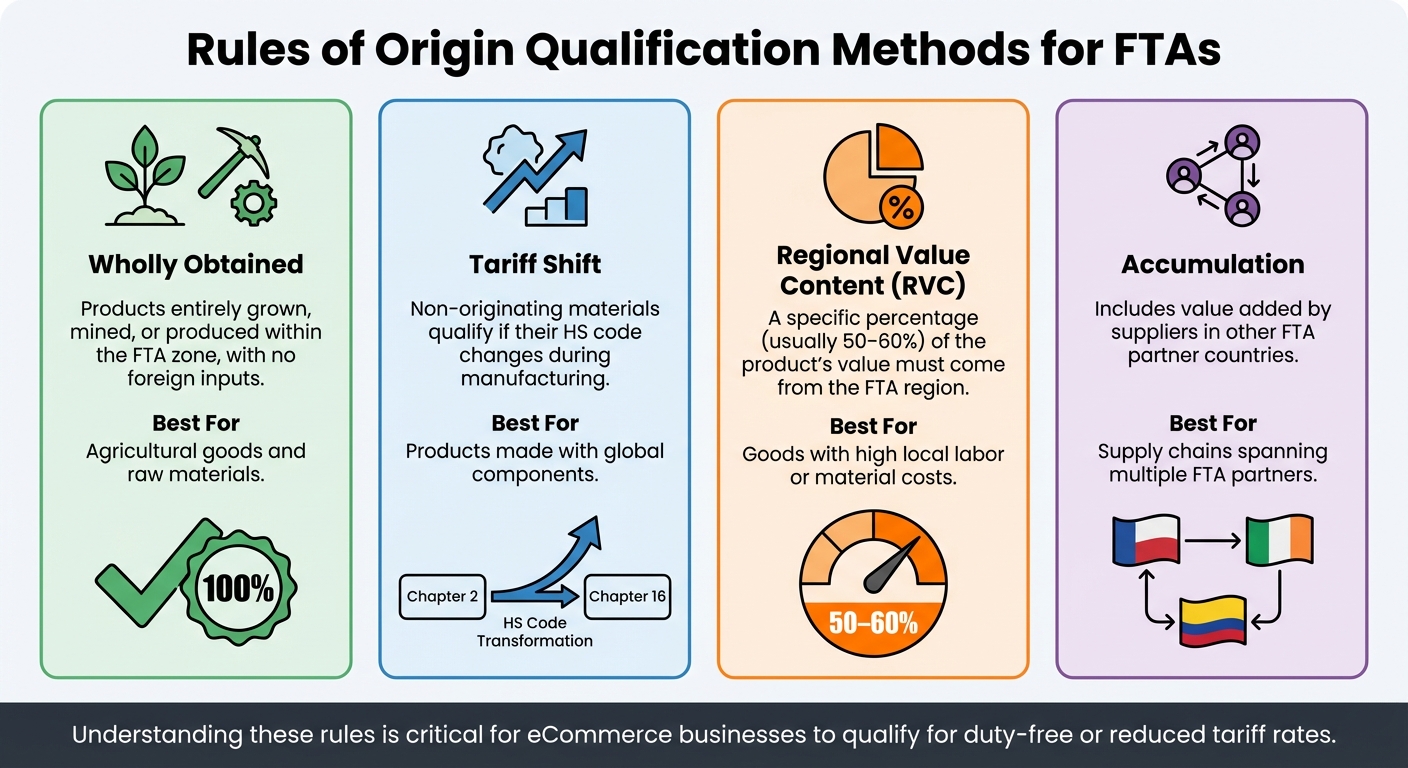
Rules of Origin Qualification Methods for Free Trade Agreements
FTAs are designed to eliminate or lower tariffs for products that meet strict origin rules. This ensures that only member countries enjoy the benefits of the agreement. However, the tariff reduction process isn’t immediate – it typically follows a phase-out schedule. This means duties gradually decrease over several years (often 5, 10, or even 15 years) until they hit zero. For example, under NAFTA (now USMCA), tariffs on most qualifying goods were completely removed by 2003, after a transition period that started in 1994.
To qualify, products must strictly adhere to the agreement’s rules. Failing to meet these criteria means businesses face standard tariff rates, which can significantly increase landed costs and hurt pricing competitiveness. A common mistake some eCommerce businesses make is assuming that shipping between FTA member countries automatically guarantees preferential treatment.
"Rules of origin (ROOs) are used to verify that products are eligible for duty-free or reduced duties under U.S. trade preference programs even though they may contain non-originating (non-FTA) inputs." – Trade.gov
Tariff Reductions and Eliminations
Lower tariffs can make a big difference for eCommerce businesses. When duties drop from double-digit percentages to zero, it can dramatically reduce total landed costs. This allows businesses to price their products more competitively or improve profit margins. However, some items, especially sensitive ones, have longer phase-out periods of up to 15 years, so timing is an important factor when planning international growth.
Check if the MFN rate is already zero. If the Most Favored Nation (MFN) rate is zero, there’s no need to pursue FTA qualification – it will enter duty-free regardless. Tools like the FTA Tariff Tool can help businesses identify current duty rates and determine when a product will qualify for duty-free status.
Rules of Origin Requirements
Rules of Origin determine whether a product qualifies as originating from the FTA zone. These rules rely on four main qualification methods, each tailored to different types of products and supply chains:
| Qualification Method | Description | Best For |
|---|---|---|
| Wholly Obtained | Products entirely grown, mined, or produced within the FTA zone, with no foreign inputs. | Agricultural goods and raw materials |
| Tariff Shift | Non-originating materials qualify if their HS code changes during manufacturing. | Products made with global components |
| Regional Value Content (RVC) | A specific percentage (usually 50–60%) of the product’s value must come from the FTA region. | Goods with high local labor or material costs |
| Accumulation | Includes value added by suppliers in other FTA partner countries. | Supply chains spanning multiple FTA partners |
Understanding these rules is critical for eCommerce businesses expanding globally. For instance, the Tariff Shift rule benefits businesses using global components. It allows products with non-FTA materials to qualify if those materials undergo a “substantial transformation” that changes their Harmonized System (HS) classification. A practical example: U.S.-produced pork sausage (HTS 16.01) can qualify under USMCA, even if it contains frozen pork from Hungary (HTS 02.03) and Caribbean spices (HTS 09.07). This is because the materials shift from Chapters 2 and 9 to Chapter 16 during production.
Regional Value Content (RVC) rules offer flexibility but require precise calculations. For example, a Mexican manufacturer of electric hair curling irons (HTS 8516.32) using Japanese parts (HTS 8516.90) initially failed to meet the 60% RVC threshold under the Transaction Value method, achieving only 59.1%. By switching to the Net Cost method, which excludes shipping and packing costs, the regional value rose to 50.7%, meeting the requirement for duty-free status.
De Minimis provisions provide additional leeway. These allow businesses to disregard small amounts (typically 7–10%) of non-originating materials that don’t meet tariff shift rules. This flexibility can make the difference between qualifying for reduced duties and paying the full rate.
Strict documentation is required. Businesses must keep records proving how a product meets FTA criteria for up to five years. Additionally, most FTAs mandate that goods be shipped directly between FTA member countries. Transshipment through a third country, if it involves more than minimal processing, can disqualify the product. For uncertain cases, businesses can request a binding advanced ruling from the destination country’s customs authority.
These details highlight how FTAs shape eCommerce operations and the importance of understanding their requirements thoroughly.
Major FTAs for U.S. eCommerce Businesses
Trade agreements play a key role in shaping how U.S. eCommerce businesses handle costs and compliance. They influence everything from tariff reductions to customs procedures, directly impacting pricing strategies and operational efficiency. Among these, three trade arrangements stand out: the USMCA, the EU–India FTA, and the trade frameworks with Taiwan and India. Each comes with its own rules and benefits, requiring businesses to adapt their strategies to maximize savings and ensure compliance.
USMCA: North American Trade Benefits
The USMCA, which replaced NAFTA in July 2020, introduced provisions to support the digital economy. For instance, Chapter 19 bans customs duties on digital goods like software and e-books. It also prohibits measures that would force businesses to store customer data within specific countries, reducing operational hurdles for cross-border eCommerce.
The agreement also establishes de minimis thresholds for duty-free shipments, making low-value cross-border sales more profitable. The U.S. allows up to $800 duty-free, while Canada permits C$150 for duty-free shipments (with C$40 exempt from taxes), and Mexico allows $117 duty-free (with $50 exempt from taxes). Structuring shipments to stay below these thresholds can eliminate duties altogether.
Additionally, simplified customs procedures help reduce administrative costs. The USMCA mandates faster processing of express shipments and encourages electronic customs declarations and payments. However, businesses must provide a certification of origin with nine required data points, as outlined in Annex 5-A, to claim preferential tariff treatment. Industries like textiles and apparel face stricter compliance rules under Chapter 6, so companies in these sectors should carefully review the relevant regulations.
EU–India FTA: Phased Tariff Reductions
Set to take effect in January 2026, the EU–India FTA offers promising opportunities for U.S. eCommerce businesses operating or sourcing in Europe. India will eliminate tariffs on 86% of its tariff lines, representing 93% of trade value, while the EU will remove tariffs on over 90% of its lines, covering 91% of trade value. For U.S. companies with EU subsidiaries, this means easier access to India’s market at reduced costs, especially since current tariffs on industrial goods average over 16%.
"The FTA, often described as ‘the mother of all deals’, seeks to strengthen economic and political ties between the world’s second and fourth largest economies." – Official Statement via Mint
Key sectors like textiles, leather, and jewelry will see immediate duty eliminations, while tariffs on cosmetics, machinery, and wine will phase out over 5–10 years. For instance, cosmetics tariffs will drop from 22% to 0% in 5–7 years, machinery duties will decrease from 44% to 0% over 10 years, and wine tariffs will gradually fall from 150% to 30%. Once fully implemented, roughly €33 billion in exports currently subject to duties between 4% and 26% will become duty-free.
The agreement also introduces an SME chapter with a centralized digital platform for market access information. This platform can help U.S. businesses identify tariff-saving opportunities and navigate local requirements more efficiently. Additionally, the shift toward self-certification – where exporters upload origin statements to digital portals – reduces paperwork and streamlines compliance.
U.S.–Taiwan and U.S.–India Trade Deals
Unlike the USMCA or the EU–India FTA, the U.S. lacks comprehensive trade agreements with Taiwan and India. As a result, businesses trading with these markets must rely on standard tariff frameworks. To determine product-specific duties, companies can consult the CustomsInfo database. While some initiatives aim to ease trade barriers, these markets still operate under Most Favored Nation (MFN) rates, which lack the preferential treatment seen in FTA-covered regions.
This means higher landed costs and more complex customs procedures are common challenges. Without streamlined processes like those under the USMCA, businesses must navigate each country’s standard import requirements, often requiring detailed tariff research and compliance with local regulations.
What FTAs Mean for eCommerce Businesses
Free trade agreements (FTAs) are game-changers for eCommerce companies looking to expand internationally. By reducing financial hurdles, simplifying regulatory requirements, and opening up new markets, FTAs create opportunities to grow while maintaining healthy profit margins.
Cost Savings from Lower Duties
One of the most immediate benefits of FTAs is the elimination or reduction of tariffs, which can significantly lower the overall cost of goods. This reduction allows businesses to either increase their profit margins or offer more competitive pricing. For example, if customs duties are reduced or removed, you can pass those savings on to your customers or reinvest them into your business. Either way, it helps you stand out on global platforms like Amazon and Walmart, where price comparisons are a key factor for shoppers.
FTAs also provide stability by protecting businesses from sudden tariff increases. Unlike standard tariff rates, which can fluctuate unexpectedly – such as the jump from 10% to 50% in August 2025 – preferential rates under FTAs remain consistent, thanks to legally binding agreements. This predictability makes it easier to plan and avoid unexpected cost spikes that could hurt your margins.
Take the UK-India FTA as an example: 90% of UK exports to India are now duty-free, covering items like high-value electronics and automobiles. Similarly, 99.9% of EU exports to Chile no longer face duties, making these agreements incredibly impactful. For eCommerce businesses, such duty reductions mean fewer surprise charges at checkout, which can help reduce cart abandonment.
FTAs also encourage regional production and distribution. For instance, manufacturing within USMCA (United States-Mexico-Canada Agreement) countries allows for duty-free, faster shipping. This supports just-in-time inventory models, an essential strategy for eCommerce companies that prioritize efficiency and cost control.
Meeting Compliance Requirements
To take advantage of FTA benefits, businesses must meet specific compliance standards, including proper Harmonized System (HS) code classification and adherence to Rules of Origin (ROO). Products must either be entirely produced within the FTA region, undergo substantial transformation (Tariff Shift), or meet specific regional value content thresholds. For instance, some agreements with countries like Israel, Jordan, and Oman use a 35% appraised value method to determine eligibility.
Accurate documentation is critical. This includes HS codes, certificates of origin, and records maintained for up to five years. For smaller shipments, a straightforward statement on the commercial invoice may be enough. Larger shipments, however, often require formal certifications on company letterhead. Blanket certifications, which can cover multiple shipments, are valid for up to a year.
Before diving into the paperwork, compare the Most Favored Nation (MFN) rate with the FTA rate. If the MFN rate is already zero, there’s no need to pursue FTA qualification. Tools like the U.S. Census Bureau’s Schedule B Search Engine or the ITC’s HTS Online Reference Tool can help approximate HS codes, but final confirmation should always come from the importing country’s customs authority.
It’s also worth noting that products generally need to be shipped directly between FTA partner countries to qualify for preferential treatment.
Expanding to Global Marketplaces
FTAs do more than just cut costs – they also make global expansion more accessible. With FTA partner markets accounting for about 40% of all U.S. exports, these agreements create a fertile ground for growth on platforms like Amazon, Walmart, and TikTok Shops.
"FTAs offer U.S. companies greater market access through reduced trade barriers such as tariff reduction and other provisions." – International Trade Administration
Modern FTAs often include provisions tailored to digital commerce. For example, the USMCA prohibits data localization requirements, ensuring that commercial data can flow freely across borders. This is crucial for eCommerce businesses that rely on centralized databases and analytics to manage operations efficiently.
"The USMCA includes a commitment by the partner countries to provide greater transparency and clarity around the requirements governing cross-border ecommerce." – International Trade Administration
Simplified customs procedures also play a big role in supporting eCommerce. Higher de minimis thresholds reduce the complexity of cross-border transactions, while expedited customs processes for express shipments and support for electronic documentation save time and cut administrative costs. Features like electronic signatures and paperless customs declarations streamline operations even further, making it easier to fulfill international orders.
For businesses using fulfillment networks like Amazon FBA, these FTA benefits integrate seamlessly with existing logistics setups. This allows you to scale globally without needing to establish separate operations in every country, keeping things efficient and cost-effective.
Using FTAs to Grow Your Business
Free Trade Agreements (FTAs) can lower landed costs, giving your business a pricing edge that boosts competitiveness. By reducing these costs, you can either increase profit margins or offer more appealing prices compared to competitors who aren’t taking advantage of FTA benefits.
This pricing advantage is especially important when selling to FTA partner countries:
"When selling to a U.S. Free Trade Agreement partner country, check to see if your product is eligible for duty-free or reduced duties… it will make your product more competitive to your foreign buyer." – International Trade Administration
FTAs serve as a strategic tool for long-term growth. The first step is identifying which of the 14 U.S. Free Trade Agreements, covering 20 countries, align with your product category and target markets.
To fully capitalize on these agreements, align your supply chain with FTA requirements. Start with markets where your current supply chain already meets the Rules of Origin standards, as this simplifies the qualification process. Use tools like the FTA Tariff Tool to compare standard tariff rates against preferential rates, focusing on markets where the difference is most significant. Additionally, adopting technology to ensure FTA compliance can set you apart – currently, only 33% of businesses are leveraging this approach.
Thomson Reuters highlights the broader benefits of FTAs:
"FTAs can help mitigate tariff exposure, diversify sourcing strategies, and maintain competitive advantage in an era where supply chain disruption is no longer a sporadic event but a structural challenge."
To maximize the impact, combine duty savings with strategies like streamlined fulfillment, efficient inventory management, and targeted marketing. This approach transforms regulatory advantages into tangible market share growth.
For more tailored support in integrating these strategies into your eCommerce operations, consider exploring Emplicit‘s comprehensive eCommerce services.
FAQs
How do I know if my product qualifies under Rules of Origin?
To determine if your product meets the Rules of Origin (ROO), you’ll need to check its eligibility under the applicable free trade agreement (FTA). This usually means confirming that the product was either fully produced within the FTA region or has undergone a significant transformation there. Documentation, such as certificates of origin, is often required to prove compliance. Since each FTA has its own set of rules, be sure to review the specific requirements for your product and its category.
What documents do I need to claim FTA duty savings?
To take advantage of FTA duty savings, you’ll need to provide an FTA Certificate of Origin or similar supporting documents. This could be a statement included on the invoice or a formal certificate of origin. Make sure all your paperwork aligns with the specific FTA requirements to ensure eligibility for duty reductions.
When is it not worth using an FTA (e.g., MFN duty is already $0)?
If the Most Favored Nation (MFN) duty rate is already set at $0, using a Free Trade Agreement (FTA) doesn’t offer any extra benefits. Since there are no tariffs to save on, the FTA doesn’t add any customs duty advantages in these situations.