

Counterfeit products are a growing threat to ecommerce sellers, impacting revenue and brand reputation. If you’re battling fake goods on platforms like Amazon or TikTok Shops, understanding legal remedies can be your best defense. Here’s what you need to know:
- Injunctive Relief: Quickly stop counterfeiters through court orders under the Lanham Act.
- Statutory Damages: Claim up to $2 million per counterfeit mark without proving actual losses.
- Ex Parte Seizure: Seize counterfeit goods and evidence without alerting infringers.
- Attorney Fees: Recover legal costs in cases involving willful infringement.
- Criminal Prosecution: Work with federal authorities to impose fines and prison sentences on counterfeiters.
To protect your business, combine legal actions with tools like Amazon Brand Registry and expert support. Counterfeiting isn’t just a nuisance – it’s a direct threat to your bottom line. Stay ahead by acting decisively and leveraging these strategies.
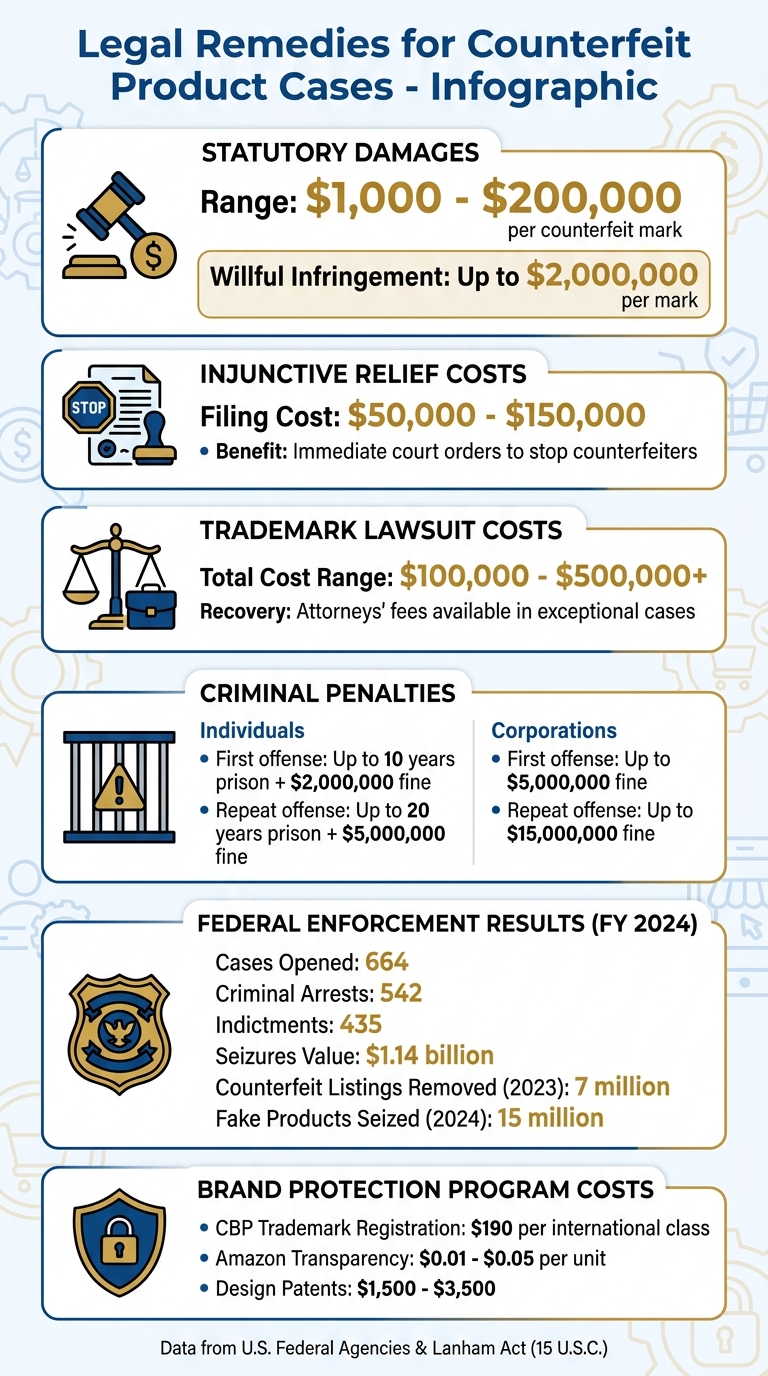
Legal Remedies for Counterfeit Products: Damages, Penalties, and Costs
Legal Remedies for Counterfeit Product Cases
Injunctive Relief Under the Lanham Act
When counterfeit products hit the market, injunctive relief offers a quick way to stop the harm. Under the Lanham Act (15 U.S.C. § 1116), courts can issue orders that prevent counterfeiters from making, distributing, or selling fake goods. A 2020 amendment made it easier for plaintiffs to secure an injunction by introducing a rebuttable presumption of irreparable harm. This applies when pursuing either a preliminary injunction (based on a likelihood of success) or a permanent injunction (after proving infringement). In short, you don’t have to spend months proving irreparable harm to get immediate relief.
However, these motions aren’t cheap. Filing one can cost anywhere from $50,000 to $150,000. Still, the expense is often worth it to protect your market share and prevent further damage.
Next, let’s look at statutory damages, another effective tool for fighting counterfeiting.
Statutory Damages for Counterfeit Marks
Tracking counterfeit revenue is nearly impossible – counterfeiters don’t exactly keep detailed financial records. Thankfully, under 15 U.S.C. § 1117(c), trademark owners can choose statutory damages instead of proving actual losses or the infringer’s profits. The law allows awards ranging from $1,000 to $200,000 per counterfeit mark per type of good sold. And if the counterfeiting is willful, the maximum jumps to $2,000,000 per mark.
"Because evidence of actual sales or profits is often difficult, if not impossible, to obtain in counterfeiting cases, federal law permits trademark owners to elect statutory damages in lieu of actual damages." – Kristina Montanaro Schrader and Maia T. Woodhouse
This approach is especially helpful for ecommerce sellers, who often face challenges proving actual losses.
Ex Parte Seizure and Destruction of Counterfeit Goods
To prevent counterfeiters from hiding evidence, courts can issue an ex parte seizure order under 15 U.S.C. § 1116(d). This allows authorities to seize counterfeit goods, manufacturing tools, and related records without notifying the defendant beforehand. To qualify, you need to show that the defendant is likely to destroy, move, or conceal the goods if alerted.
The application must include a detailed affidavit or verified complaint, and you’ll need to post a security bond in case the seizure is later deemed wrongful. Once approved, a federal law enforcement officer will carry out the seizure within seven days. A hearing is then held within 10 to 15 days to decide whether the seized items should remain in custody.
It’s critical to keep your plans for a seizure order confidential. If word gets out, the court may deny your request.
Recovery of Attorneys’ Fees in Counterfeiting Cases
Trademark lawsuits can be expensive, often costing between $100,000 and $500,000 or more. Fortunately, the Lanham Act allows courts to award reasonable attorneys’ fees in exceptional cases, such as those involving willful infringement (15 U.S.C. § 1117(a)). This provision helps level the playing field, making it financially feasible for sellers to take legal action against counterfeiters.
Additionally, courts can order the destruction of all counterfeit materials, including packaging, labels, and signage bearing the fake mark (15 U.S.C. § 1118). This ensures counterfeit goods are permanently removed from circulation.
sbb-itb-e2944f4
Working with Federal Authorities and Criminal Prosecution
Reporting Counterfeiters to Federal Agencies
In addition to pursuing civil lawsuits, ecommerce sellers can work with federal authorities to crack down on counterfeiters. U.S. Customs and Border Protection (CBP) plays a key role by intercepting counterfeit goods before they enter the country. To take advantage of this protection, you’ll need to register your trademarks with the USPTO and record them through CBP’s e‑Recordation program. The fee is $190 per international class for trademarks and $190 per copyright. After registration, CBP officers can seize infringing imports before they reach the U.S. market.
The National Intellectual Property Rights Coordination Center (IPR Center) leads the government’s efforts to combat intellectual property theft online. You can report suspicious listings or import activities using their reporting tool. Additionally, Homeland Security Investigations (HSI) provides a 24/7 tip line (1‑877‑4‑HSI‑TIP) for reporting criminal activity related to counterfeiting. In fiscal year 2024, these federal initiatives led to 664 cases being opened, 542 criminal arrests, and 435 indictments, with seizures valued at $1.14 billion.
To improve enforcement, consider providing CBP with detailed product guides to help officers differentiate between authentic and counterfeit goods. It’s also helpful to designate a contact person who can verify product authenticity through digital images within 24 hours. Some brands go a step further by conducting in-person training sessions at ports of entry, teaching officers how to identify their products’ specific security features. These collaborative efforts with federal agencies lay the groundwork for imposing criminal penalties that act as a strong deterrent to counterfeiters.
How Criminal Penalties Deter Counterfeiters
Criminal prosecution under the Trademark Counterfeiting Act (18 U.S.C. § 2320) adds another layer of deterrence by imposing strict penalties. First-time offenders can face up to 10 years in prison and fines of up to $2,000,000. Repeat offenders may see penalties increase to 20 years in prison and fines of up to $5,000,000. Corporations are subject to even higher fines: up to $5,000,000 for a first offense and $15,000,000 for repeat violations.
These penalties have delivered results. For example, in October 2024, a New Jersey federal court sentenced Israfil Demir to 364 days in prison for trafficking $1.5 million in counterfeit Cisco products. This case followed a joint criminal referral from Amazon and Cisco. Similarly, in May 2024, Onur Aksoy was sentenced to six years and six months in prison for operating online storefronts that sold thousands of fake Cisco products. Another notable case occurred in July 2025, when Vall Iliev received a 63-month prison sentence and was ordered to pay $32.4 million in restitution for smuggling counterfeit body armor, which was sold to law enforcement agencies.
Federal agencies also organize large-scale operations to combat counterfeiting. For instance, in February 2026, just before Super Bowl 60, authorities seized over 276,392 counterfeit sports items valued at $33.4 million as part of "Operation Team Player". These efforts send a strong message: counterfeiting isn’t just a civil matter – it comes with serious criminal consequences.
Caught a Counterfeit? Here’s What to Do!
How Ecommerce Sellers Can Protect Their Brand
Taking proactive steps to protect your brand is crucial for ecommerce sellers, especially when it comes to preventing counterfeiting and safeguarding your reputation.
Using Brand Protection Programs
The first step in brand protection is securing federal trademark registration. Without a registered trademark from the USPTO, you can’t access key tools like Amazon Brand Registry, Project Zero, or Transparency, which are essential for enforcing your rights on major marketplaces. Once your trademark is in place, these programs provide access to advanced, AI-driven monitoring systems that can block suspicious listings before they become a problem.
For instance, Amazon’s automated systems successfully blocked over 99% of suspicious listings in 2024, often before brand owners even noticed them. The platform also removed over 7 million counterfeit listings in 2023 and seized more than 15 million fake products globally in 2024 – double the previous year’s total. To maximize protection, sellers can combine tools like Transparency’s serialization (costing $0.01 to $0.05 per unit) to keep counterfeits out of fulfillment centers, along with Project Zero’s self-service removal feature for instantly deleting counterfeit listings without waiting for marketplace reviews.
Ongoing vigilance is key to staying ahead of counterfeiters. Conduct weekly checks for violations using marketplace search tools to identify infringers by ASIN, keywords, or image recognition. Keep an eye on customer reviews, especially those mentioning “poor quality” or “fake,” as they can signal unauthorized sellers targeting your listings. Switching to FNSKU labeling instead of manufacturer UPCs can also help prevent “commingled inventory fraud,” where counterfeit products from other sellers end up being shipped to your customers. While automated tools provide a strong defense, combining them with expert strategies can further strengthen your brand.
Partnering with Ecommerce Experts
Relying solely on automated systems might not be enough. Partnering with ecommerce experts can take your brand protection efforts to the next level. Managing brand protection across multiple platforms requires specialized knowledge and constant attention – something many sellers don’t have the resources to handle on their own. Experts bring tools like AI-driven image recognition and web crawling technology to detect counterfeit products at scale, identifying threats before they cause serious damage. They also handle the tedious tasks of filing DMCA notices, cease-and-desist letters, and takedown requests, often achieving better results through professional documentation.
Take Emplicit, for example. This company offers comprehensive ecommerce services, including account health management and brand protection strategies for platforms like Amazon, Walmart, and TikTok Shops. They help sellers secure trademarks, register them with U.S. Customs for $190 per class, and obtain design patents (costing $1,500–$3,500) to guard against look-alike products. Success stories include Trtl Travel, which partnered with Emplicit to create a custom strategy that led to 400% growth in one year, transforming a $3 million brand while keeping agency fees flat. Another example is AllGood, a consumer health company that saw monthly revenue jump from $35,000 to $165,000 in just three months – a 500% increase – thanks to expert marketplace management.
Experts also help protect your account from false counterfeit claims and competitor attacks that can lead to suspensions. They conduct test purchases when suspicious sellers emerge, documenting differences in packaging and quality to provide clear evidence for takedown requests. With global counterfeiting projected to cost businesses $4.2 trillion by 2025, professional brand protection isn’t just a good idea – it’s essential for maintaining your market share and customer trust.
Conclusion
Safeguard your ecommerce business by combining solid legal measures with proactive strategies. The remedies highlighted here – such as injunctive relief, statutory damages, ex parte seizures, and criminal prosecution – offer effective ways to stop counterfeiters and recover potential losses.
The fight against counterfeiting demands constant vigilance. With counterfeiters leveraging AI to replicate listings faster than traditional legal methods can keep up, the stakes are higher than ever. As AiPlex puts it:
"Counterfeits don’t just steal sales – they steal certainty".
Counterfeiting isn’t just a nuisance; it’s a direct threat to your revenue and reputation. To combat it effectively, keep detailed sourcing records for each SKU, ensure your trademarks are registered with U.S. Customs, and conduct test purchases to turn suspicions into actionable evidence. Once a threat is identified, take swift action by coordinating takedown efforts across online marketplaces, social platforms, and infringing websites. This multi-pronged approach helps dismantle counterfeit networks. Consistent enforcement and constant monitoring are your best defenses.
Combining federal trademark registration with tools like Amazon’s Brand Registry and expert support can help you identify, document, and remove counterfeit threats before they erode customer trust. Today’s AI systems already block over 99% of suspicious listings.
For a stronger defense, consider collaborating with ecommerce specialists like Emplicit (https://emplicit.co) to ensure comprehensive marketplace and brand protection.
FAQs
What evidence do I need to prove a listing is counterfeit?
To demonstrate that a listing is counterfeit, you need to collect evidence that highlights problems with its authenticity. Some effective ways to do this include:
- Using visual recognition tools: These can help compare the listing’s images with those of genuine products, identifying discrepancies.
- Conducting test purchases: Buying the item allows you to directly verify its authenticity through inspection.
- Examining packaging and branding: Look for inconsistencies in logos, labels, or other details that differ from the original product.
Additionally, leveraging findings from investigations by organizations like Amazon’s Counterfeit Crimes Unit can strengthen your case.
When should I file a Lanham Act lawsuit instead of just doing marketplace takedowns?
Filing a Lanham Act lawsuit can be a powerful step when you’re seeking broader legal options. This approach is particularly useful when you need remedies like injunctive relief, monetary damages, or a clear establishment of liability in cases of ongoing trademark counterfeiting. It’s especially critical if the infringement involves contributory infringement or continues to occur despite efforts like marketplace takedowns.
How can I get U.S. Customs to block counterfeit imports of my products?
To combat counterfeit imports, partner with U.S. Customs and Border Protection (CBP) by registering your federally recognized trademarks and copyrights through the CBP’s e-Recordation program. This step enables CBP to spot and confiscate counterfeit products more effectively. Beyond registration, share detailed information about your products and actively participate in CBP’s enforcement programs to bolster protection against unauthorized imports.