
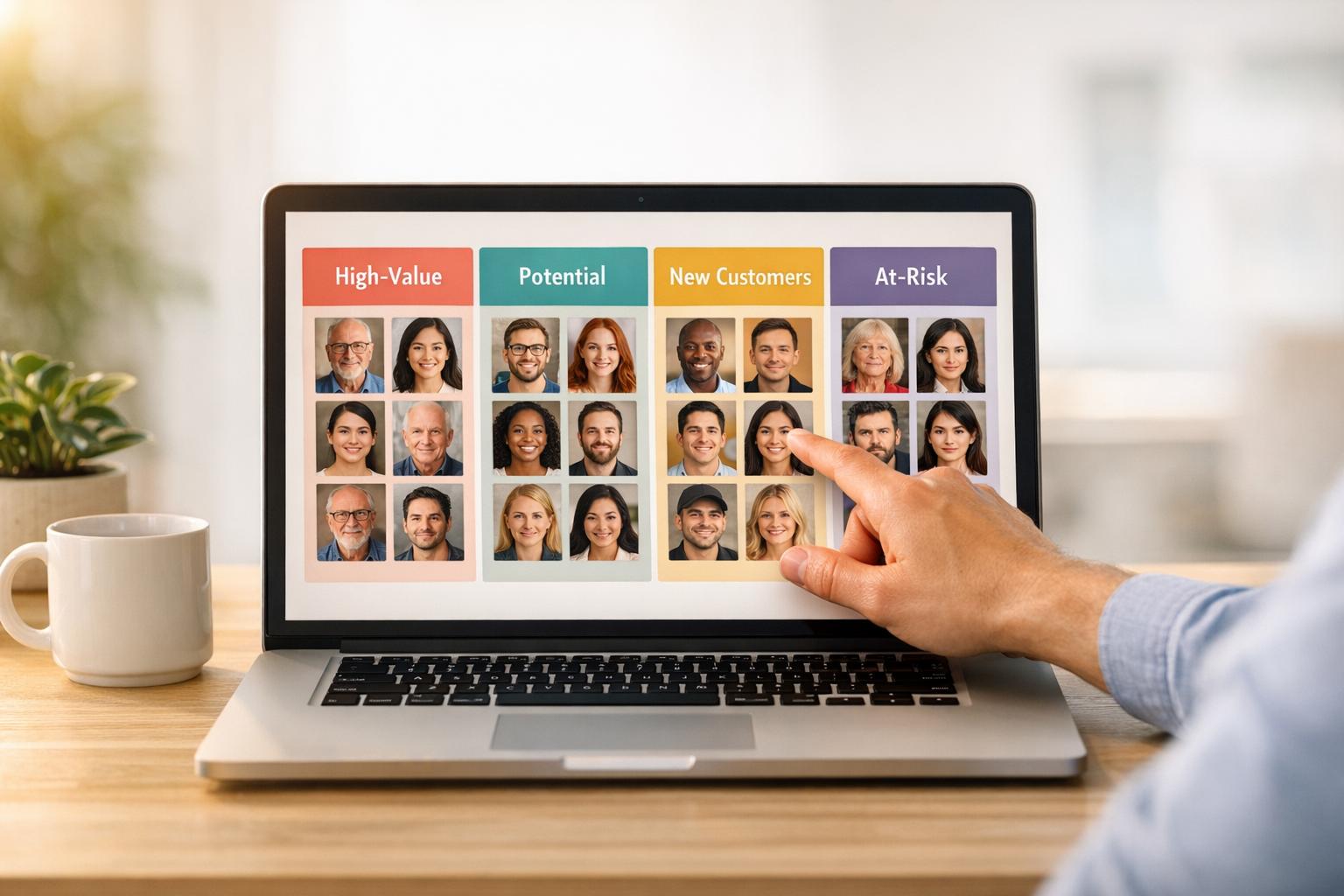
AI-powered segmentation transforms how eCommerce businesses grow by using machine learning to predict customer behavior and improve lifetime value (CLV). Unlike traditional methods that rely on static data, AI dynamically analyzes customer actions in real-time, allowing businesses to:
- Identify high-value customers early and focus resources effectively.
- Predict and reduce churn by acting on early warning signs.
- Personalize offers to drive upsells and repeat purchases.
- Boost marketing ROI by 20–30% within the first year.
Key benefits include real-time updates, micro-segmentation, and targeted campaigns that increase revenue and retention. With clean data and coordinated execution across channels, AI segmentation ensures every marketing dollar is spent on customers most likely to deliver long-term value.
Basics of AI-Driven Customer Segmentation | Exclusive Lesson
sbb-itb-e2944f4
What Is AI-Powered Segmentation?
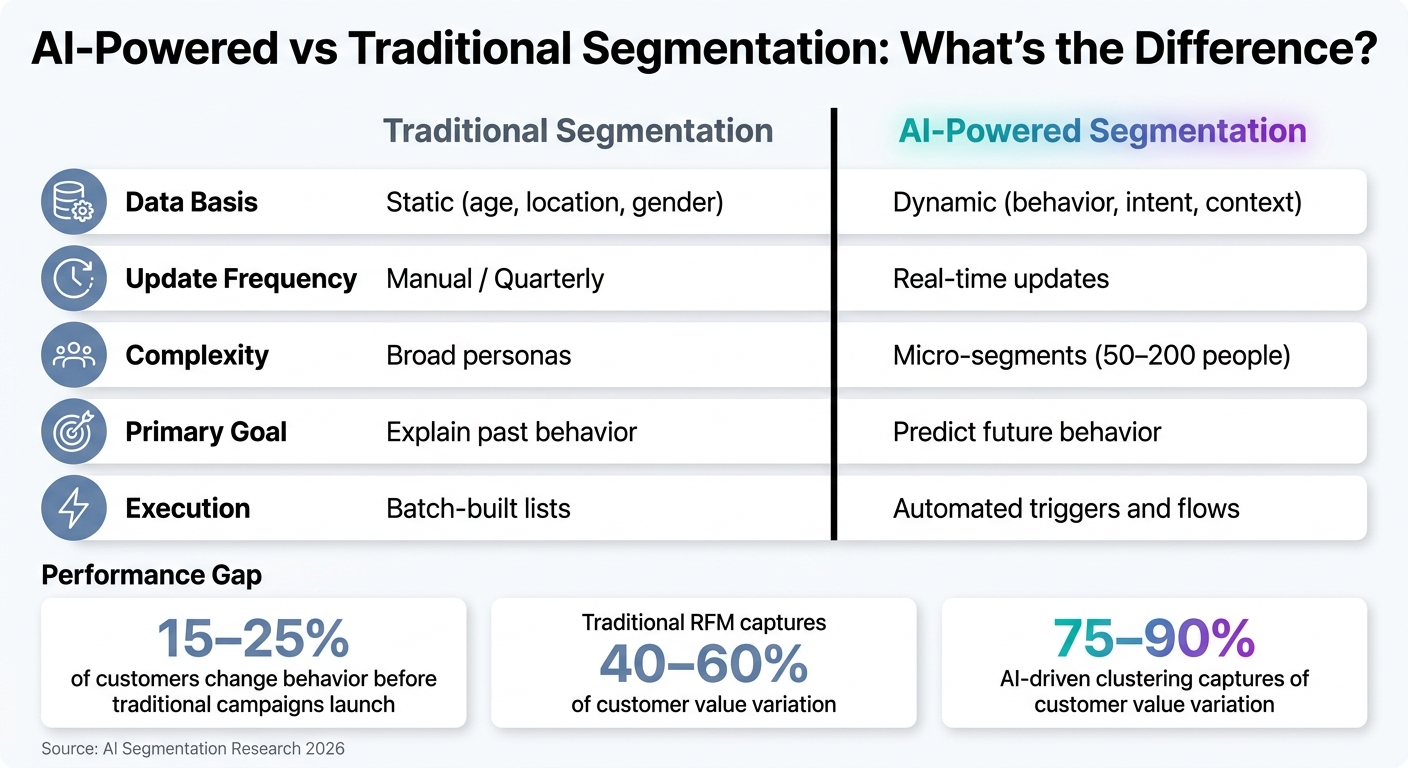
AI vs Traditional Segmentation: Key Differences & Performance Stats
AI-powered segmentation uses machine learning to analyze customer behaviors and traits, uncovering patterns that might be missed with manual methods. Instead of categorizing customers into broad groups like "new customer" or "repeat buyer", AI creates highly specific segments based on actual behaviors – what people browse, buy, when they interact, and how their habits change over time. This results in a constantly updated, dynamic view of your customers rather than a static snapshot that quickly becomes outdated. This dynamic nature highlights why AI segmentation offers clear advantages over traditional methods. Let’s dive into how it compares to standard segmentation techniques.
How AI Segmentation Differs from Standard Segmentation
Traditional segmentation typically relies on fixed characteristics like age, location, or gender, which describe past behavior. However, by the time campaigns are launched using these manually created lists, 15%–25% of customers may have already changed their behavior. In contrast, AI segmentation focuses on predicting future actions, identifying customers likely to churn, those about to make significant purchases, or new high-value buyers.
"Predictive segmentation tells you who is about to churn, who is about to upgrade, and who is about to buy again. Descriptive segmentation only tells you what already happened." – Ryan Whitton, Senior Content Strategist, Tested Media
| Feature | Traditional Segmentation | AI-Powered Segmentation |
|---|---|---|
| Data Basis | Static (age, location, gender) | Dynamic (behavior, intent, context) |
| Update Frequency | Manual/quarterly | Real-time updates |
| Complexity | Broad personas | Micro-segments (50–200 people) |
| Primary Goal | Explain past behavior | Predict future behavior |
| Execution | Batch-built lists | Automated triggers and flows |
Key Inputs That Power AI Segmentation
Effective segmentation starts with strong data signals, which are essential for increasing customer lifetime value. AI models rely on a layered approach to build accurate customer profiles. Key inputs include purchase history (recency, frequency, and monetary value), browsing habits (page views, cart activity, session length), email and SMS engagement (open rates, click-throughs), and customer service interactions.
More advanced systems, by 2026, are expected to use a framework called eRFM – Engagement, Recency, Frequency, and Monetary Value. This adds behavioral engagement metrics to traditional transactional data. Why does this matter? A customer who is recently inactive but still engaged behaves very differently from one who has gone completely silent. Traditional RFM segmentation captures about 40%–60% of customer value variation, while AI-driven clustering achieves 75%–90%. That’s a significant difference when deciding where to allocate marketing budgets.
How AI Segmentation Affects Lifetime Value
AI segmentation can significantly boost revenue by connecting customer behaviors to timely, targeted actions. Here’s how it helps businesses allocate resources effectively, reduce churn, and create upsell opportunities to maximize customer lifetime value.
Focusing Resources on High-Value Customers
AI makes it easier to identify and prioritize high-value customers. By segmenting customers into groups like Champions (top 5–10%) and Loyal Customers (next 10–15%), businesses can focus their efforts on those who bring the most value. These groups require more attention than inactive customers who haven’t engaged in months.
For instance, targeting "High LTV lookalikes" with acquisition campaigns can reduce customer acquisition costs (CAC) by up to 50%. This ensures that marketing budgets are spent on customers most likely to provide long-term value.
| RFM Segment | % of Base | Recommended Action |
|---|---|---|
| Champions | 5–10% | VIP programs, early access, referral requests |
| Loyal Customers | 10–15% | Upsell, cross-sell, loyalty rewards |
| At Risk | 10–15% | Win-back campaigns, feedback requests |
| Hibernating | 15–25% | Deep discount reactivation or suppression |
Using Predictive Insights to Reduce Churn
AI doesn’t just help identify high-value customers; it also predicts when customers are at risk of leaving. Instead of reacting after a customer churns, predictive models can flag early warning signs, such as declining email engagement, longer gaps between purchases, or reduced browsing activity. These signals can indicate a 70–80% chance of churn within 60 days.
When a customer is flagged as “likely to churn,” automated campaigns kick in immediately. These could include personalized win-back offers, requests for feedback, or loyalty rewards. Acting quickly can boost retention rates by 30%, as win-back campaigns are triggered in real-time rather than delayed by weeks. Plus, preventing churn is 5–7 times cheaper than reactivating a lost customer.
Personalized Offers and Upsell Opportunities
AI segmentation isn’t just about protecting existing revenue – it’s also about driving growth. By analyzing product preferences and purchase patterns, AI can identify which customers are ready for an upsell and which ones might need a replenishment reminder. For example, consumable goods companies can send personalized "Time to restock?" messages based on each customer’s buying habits.
Some businesses have seen impressive results with this approach. In 2026, Willow Tree Boutique used Klaviyo AI to predict customer lifetime value (CLV) and target high-spending customers with exclusive collection previews. This strategy led to a 53.1% increase in HoH revenue from these campaigns. Similarly, Force of Nature leveraged behavioral data to create automated email and SMS flows, achieving 140% year-over-year revenue growth.
Behavior-based campaigns deliver higher returns, generating $0.33 per email compared to $0.08 for traditional batch sends. These targeted efforts not only drive immediate sales but also contribute to long-term customer value.
How to Apply AI Segmentation in eCommerce
Making AI segmentation work in eCommerce boils down to having clean data, executing it correctly, and ensuring your systems can scale.
Data Requirements for Accurate Segmentation
AI models are only as effective as the data they rely on. The reality is, poor data – not the technology – is the culprit behind 63% of failed personalization projects. So, before diving in, ensure your data is clean, unified, and up-to-date.
A Customer Data Platform (CDP) is often the best starting point. It consolidates information from your eCommerce platform (like Shopify), CRM, email tools, and ad channels into a single, unified customer profile. Without this comprehensive view, your AI model will be working with incomplete data, leading to subpar results.
"Without clean, unified customer data, even the most sophisticated AI models produce irrelevant results." – Growth Engines
For AI clustering to work well, you typically need at least 1,000 customers and 6 months of transaction history. Beyond purchase data, behavioral insights like page views, search queries, and cart additions, along with engagement metrics like email click-through rates and SMS responses, are incredibly valuable. These "derived features" allow AI to uncover patterns that simpler methods, like RFM scoring, might overlook.
Before investing in new tools, take a step back and audit your existing data. Are your analytics, email platform, and storefront operating in silos? If so, focus on unifying them first. Adding more technology without addressing this issue will only complicate things.
Once your data is unified and organized through a robust CDP, you’ll be ready to power your marketing strategies effectively.
Connecting Segmentation to Marketing Execution
With a solid data foundation, the next step is to apply your AI-driven segments across all your marketing channels. The key is consistency – customers should receive cohesive messaging whether they’re reading an email, seeing a paid ad, or browsing your site.
This involves syncing AI segments across platforms like email, SMS, and paid social. For example, you could export your "VIP Loyalist" segment to Facebook or Google to create high-quality lookalike audiences for customer acquisition. At the same time, you can suppress these VIPs from broad prospecting ads, avoiding wasted ad spend on people who already buy from you. This kind of coordinated effort pays off: brands that personalize across four or more channels see 126x more sessions per user.
Email campaigns also benefit significantly from segmentation. Segmented email campaigns generate 760% more revenue compared to generic, one-size-fits-all emails. Take the example of a DTC skincare brand that, in 2025, identified eight distinct behavioral segments – ranging from $30 first-time buyers to $150+ monthly loyalists. By tailoring their messaging to each group, they boosted revenue per customer by 31% in just six months.
To make this process efficient, use dynamic content blocks within email templates. This allows you to customize messaging for different segments without creating separate campaigns. As Anna Sophie Fokdal Christensen, Head of Email and Retention at FABO, explains:
"If you already know your subscribers’ preferences from your data touchpoints, there’s no reason not to activate them consistently across campaigns and flows."
By integrating AI segmentation into your marketing strategy, you can drive higher customer lifetime value and improve overall performance.
Scaling AI Segmentation with Emplicit
While larger in-house teams might manage data infrastructure and segmented campaigns across multiple channels, many brands find this overwhelming. That’s where specialized eCommerce partners come in.
Emplicit helps brands implement AI segmentation at scale. Their services cover PPC campaign optimization, listing optimization, and omnichannel marketing across platforms like Amazon, TikTok Shops, Walmart, and Target. This ensures that segmentation insights aren’t confined to one channel. Instead, high-value segments can inform PPC strategies, listing approaches, and content planning simultaneously – creating a ripple effect that boosts lifetime customer value across the board.
For brands struggling to juggle data management, campaign execution, and marketplace performance, Emplicit’s full-service model provides the support needed to turn AI segmentation into a practical, actionable strategy – not just a theoretical concept.
Measuring the Results of AI Segmentation
Once your AI segmentation strategy is up and running, the next step is figuring out if it’s actually delivering results. Knowing which metrics to monitor – and how to interpret them – can mean the difference between refining your approach for better outcomes or letting it stagnate. With AI segmentation integrated into your marketing channels, measuring its performance becomes essential for sustained growth.
Key Metrics to Track
Instead of focusing solely on Revenue CLV, shift your attention to Profit CLV. Revenue CLV simply shows how much a customer spends, but Profit CLV accounts for your cost of goods sold (COGS) and servicing expenses, offering a clearer picture of a customer’s real contribution to your bottom line.
"A ‘good’ CLV is one that comfortably exceeds your total cost to acquire and serve that customer. If it doesn’t, growth is unsustainable regardless of how your number compares to a competitor." – Ellie Quacquarelli, Strategic Consultant, SAP Engagement Cloud
In addition to Profit CLV, four key metrics can help you evaluate whether your segmentation efforts are making an impact:
| Metric | What It Measures | Why It Matters |
|---|---|---|
| CLV:CAC Ratio | Profit CLV ÷ Customer Acquisition Cost | A 3:1 ratio is considered a benchmark for sustainable growth |
| Repeat Purchase Rate | How often customers in a segment return to buy | Shows whether personalized engagement is driving customer loyalty |
| Churn Rate | Customers lost ÷ customers at start of period | A critical indicator of product–market fit and retention health |
| AOV Lift | (New AOV − Baseline AOV) ÷ Baseline AOV | Evaluates the success of cross-sell and upsell strategies |
It’s essential to measure these metrics at the micro-segment level, rather than relying on blended averages. For example, beauty brand Luminous Skin implemented micro-segmentation for its 85,000 customers in 2026, creating 340 distinct segments. By targeting a specific group of 127 customers who bought serums on Sundays and engaged with educational content, they delivered tailored bundles. This approach boosted overall CLV from $180 to $1,240 over 18 months and increased retention from 23% to 71%.
Track CLV on a quarterly basis – monthly tracking can be too erratic, and annual tracking is too slow. Also, be sure to flag customers acquired during heavy discount periods separately; they often show lower long-term CLV and can distort benchmarks if mixed with organic buyers.
Beyond monitoring metrics, regularly reviewing your AI model’s performance is key to maintaining its effectiveness over time.
Evaluating and Adjusting Model Performance
To ensure your AI model delivers accurate and actionable segmentation, start with a manual audit. Randomly sample customers from each segment and verify that they align with the segment’s profile. For instance, if a segment labeled “likely to convert” includes inactive customers, it’s time to check your data freshness and model logic. If more than 8% of your segments are inaccurate, it’s a sign that your model needs adjustments.
In addition to audits, establish a structured review process:
- Weekly: Monitor segment sizes and campaign results to spot immediate trends.
- Monthly: Conduct a deeper analysis to identify behavioral shifts or overlapping segments.
- Quarterly: Retrain your models with fresh data to account for seasonal changes and evolving customer behavior.
For example, if two segments consistently respond the same way to campaigns over three months, consider merging them. On the other hand, if one segment shows divided behavior – like an 8% conversion rate in one group and 1% in another – it may be time to split it.
"The model is not magic. It is pattern matching on signals you already have. If your data is bad, the predictions are bad." – Ryan Whitton, Senior Content Strategist, Tested Media
Lastly, keep an eye on the segment migration rate, which tracks customers moving into higher-value tiers over time. A migration rate above 5% per quarter suggests that your engagement strategies are successfully encouraging customers to climb the value ladder. Automating tier transitions can help you maintain responsiveness without adding manual workload. Regularly refining your segments ensures that every customer interaction is informed by up-to-date and actionable insights.
Conclusion: Building Long-Term Growth with AI Segmentation
AI-powered segmentation isn’t just about improving targeted email campaigns – it’s about redefining how eCommerce businesses grow. By shifting from simply analyzing past behavior to predicting future actions, brands can connect with customers at the perfect moment. Whether it’s stopping churn before it starts or timing an upsell when interest is at its peak, this approach transforms customer engagement into a science.
The stats tell a compelling story. Companies leveraging AI-driven segmentation report up to a 15% boost in revenue, a 23% increase in customer lifetime value through personalized campaigns, and an average ROI of 11:1 within the first year. Predictive email campaigns, for example, generate about $0.48 in revenue per email sent, compared to just $0.04 when using a generic broadcast list.
"The 2018 marketer spent 40 percent of the day building lists. The 2026 marketer spends 5 percent. The model builds the lists. The marketer reviews them, briefs the journeys, and approves the content." – Ryan Whitton, Senior Content Strategist, Tested Media
This shift is transformative. With AI taking over the heavy lifting of segment management, marketing teams can focus on strategy and creativity instead of manual tasks. The results? Better-targeted campaigns, reduced customer acquisition costs, and higher retention rates – all working together to amplify customer lifetime value.
To scale this approach successfully, businesses need clean data, well-connected systems, and a clear plan. This is where having the right partner can make all the difference. Emplicit collaborates with eCommerce brands across platforms like Amazon, TikTok Shops, Walmart, and more to build the marketing infrastructure that turns AI-powered segmentation into measurable success.
FAQs
How do I know if I have enough data for AI segmentation?
To get dependable AI segmentation, it’s best to have at least 1,000 customers with 6–12 months of transaction history. The cornerstone here is data quality – your data needs to be complete, accurate, consistent, and up-to-date. While smaller datasets can handle simpler methods like RFM (Recency, Frequency, Monetary) analysis, more advanced AI models rely on larger, high-quality datasets to deliver precise outcomes. If your data quality is lacking, it can seriously impact the success of your segmentation efforts.
What’s the fastest way to use AI segments in email, SMS, and ads?
The quickest method is to leverage real-time behavioral tracking and predictive analytics to launch personalized campaigns automatically as customers move in or out of specific segments. To make this happen, connect your customer data platform with your marketing tools, ensuring a seamless flow of real-time data. Then, set up automated workflows tailored to each segment.
For instance, you could send early access offers to VIP customers or win-back messages to customers showing signs of disengagement – all triggered instantly based on their behavior.
How can I prove AI segmentation is increasing profit CLV (not just revenue)?
To show that AI segmentation is boosting customer lifetime value (CLV) and profits, focus on tracking crucial metrics like CLV, retention rates, and revenue growth within specific customer segments. Pay attention to measurable gains, such as higher revenue for every dollar spent or better retention rates, that directly connect to AI-powered strategies like personalized marketing or automated segmentation. These numbers can help illustrate how profits – not just overall revenue – are increasing over time.