
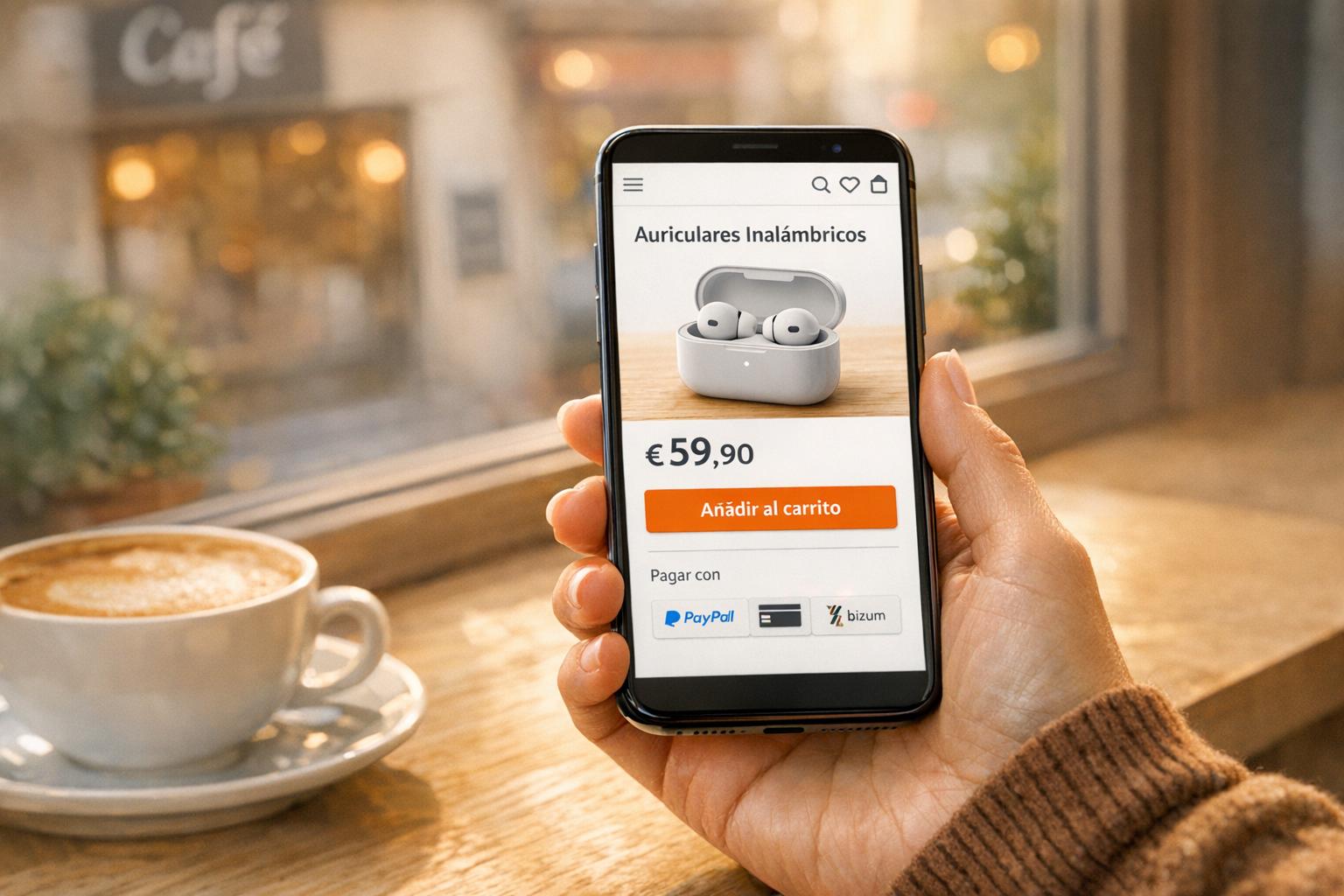
Localization isn’t just about translating text – it’s about creating a shopping experience that feels native to each market. By tailoring elements like language, currency, payment options, and even visuals, businesses can dramatically improve sales and customer trust. Here’s why localization matters:
- 40% of global consumers won’t shop on websites that don’t offer information in their native language.
- Displaying local currencies can boost conversion rates by 40%.
- Personalizing content increases conversions by 10–15% and customer satisfaction by 20%.
- Companies like Petal & Pup saw 20% of their revenue come from international markets after localizing their stores.
Localization also builds trust by addressing regional preferences – like using familiar payment systems or culturally relevant product descriptions. Brands that invest in this approach can tap into the projected $8 trillion global ecommerce market by 2028.
To succeed, start by analyzing your current offerings, adjust product listings for each market, and ensure compliance with local regulations. Combine this with tailored marketing strategies and multilingual customer support for maximum impact.
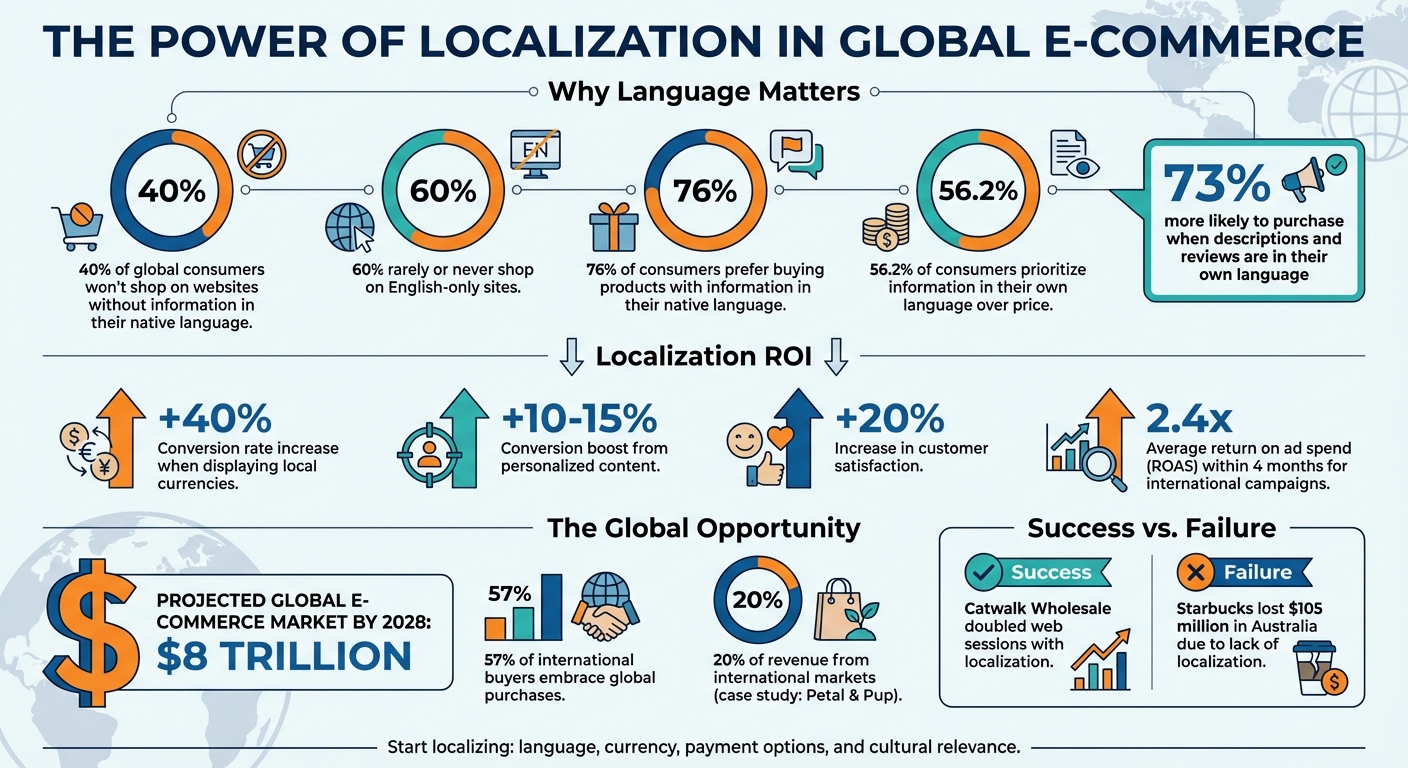
Key Localization Statistics: Impact on Global E-commerce Sales and Conversions
How to Translate and Localize Your Online Store for Global Customers (Step-by-Step)
How Localization Affects Global Sales
Localization improves sales by creating a shopping experience tailored to international customers. When buyers see product details in their own language, prices in their local currency, and payment options they recognize, they’re far more likely to complete their purchase. The numbers back this up: 40% of global consumers won’t buy from websites that don’t offer information in their native language, and 60% rarely or never shop on English-only sites.
How Language and Culture Influence Buying Decisions
Language does more than just convey product details – it builds trust. When customers read product descriptions in their native language, they can process the information more easily, a concept researchers call "cognitive fluency." This ease of understanding fosters trust and makes buying decisions simpler.
Cultural relevance is just as important as language. For example, Kit Kat became wildly popular in Japan because its name sounds like "Kitto Katsu", which translates to "you will surely win." This made the chocolate bar a symbol of good luck. Similarly, Coca-Cola adjusted its brand name to "Ke Kou Ke Le", meaning "delicious happiness", to resonate with Chinese audiences rather than relying on a direct translation.
Beyond product names, culturally appropriate terms can trigger different emotional responses. For instance, the phrase "peace of mind" (安心) in Japanese and Chinese contexts evokes emotional comfort, while "safe and reliable" in English appeals to logical reasoning. These subtle differences influence how customers perceive your brand and decide whether to trust it.
Localization also involves practical adjustments, like converting sizing standards (e.g., UK size 6 to US size 8), using familiar measurement units, and offering local payment methods. In the Netherlands, for instance, 7 out of 10 transactions rely on the domestic payment system iDEAL. These small but meaningful changes reduce barriers to purchase and build trust with customers.
These efforts to adapt language and culture not only enhance trust but also lead to measurable improvements in conversion rates.
Localization Data and Conversion Rates
Localization’s impact on trust directly translates into higher sales. Websites that display local currencies and personalized content see conversion rates rise by 40%. Adding personalized interfaces can boost conversions by another 10–15% while increasing customer satisfaction by 20%.
A great example is Catwalk Wholesale, which doubled its web sessions and significantly improved conversions after tailoring its shopping experience for international buyers. Brands selling on Amazon can also benefit: advertisers achieve an average return on ad spend (ROAS) of 2.4 within just four months of launching Sponsored Products campaigns in international markets.
Ignoring localization can come at a steep price. Starbucks, for instance, lost $105 million in Australia because they failed to adapt their offerings to local coffee preferences. On the other hand, 76% of consumers prefer buying products with information in their native language, and 73% are more likely to purchase when descriptions and reviews are in their own language. In FY2023, 20% of new fashion customers in certain markets came through local-language interfaces, proving how language accessibility can unlock new customer segments.
How to Localize Your Marketplace Presence
Start by examining your current offerings, then adjust your listings to align with regional preferences and meet local requirements.
Review Your Current Marketplace Content
Before diving into changes, take a step back and evaluate what’s working and what needs improvement. Identify which brand elements should remain consistent globally – like your logo – and which can be adjusted for local audiences. For example, product descriptions and images may need to be tailored to connect with regional customers effectively.
Analytics can be your best friend here. Use tools like Google Analytics to segment data by region. Look for markets with high traffic but low conversion rates – this often signals that while people are finding your products, they might not trust or relate to the localized experience. Many marketplaces also offer built-in tools to help you gauge sales potential by country.
Pay close attention to visuals, like images and colors, to ensure they align with local norms. For instance, purple might symbolize wealth in the Middle East but could signify mourning in parts of Latin America. Language is another crucial area – don’t just rely on literal translations. Consider local slang, humor, and even spelling differences (like "color" in the U.S. versus "colour" in the U.K.) to make your messaging feel natural.
On the technical side, convert measurements, weights, sizes, and address formats to local standards. Also, make sure your product categories and attributes are correctly mapped to each marketplace’s taxonomy. As Business.gov.uk warns, incorrect categorization can make your products "invisible" to customers during searches.
Once you’ve identified the strengths and weaknesses of your current content, it’s time to adapt your product listings for local markets.
Adjust Product Listings for Local Markets
After pinpointing what needs tweaking, focus on tailoring your listings to match local preferences. Instead of relying solely on translation tools, collaborate with native-speaking copywriters who understand the nuances of how people search for and talk about products in their region.
Research local search terms and incorporate them into your product titles and descriptions. For instance, what Americans call "sneakers" might be "trainers" in the U.K. or "runners" in Ireland. These small tweaks can make a big difference in search visibility.
Accuracy in measurements and sizes is equally important. A women’s U.K. size 6, for example, translates to a U.S. size 8. Localized pricing also plays a key role – show prices in the local currency and round them to numbers that feel natural, avoiding awkward exact conversions. Be sure to factor in international costs like import duties, VAT, and shipping fees, deciding whether to include these in the product price or list them separately. This is critical, as nearly 50% of online shoppers abandon their carts when faced with unexpected fees at checkout.
Visuals should also reflect local consumer preferences. For example, mattress brand Simba discovered in 2025 that German customers often preferred two single beds pushed together instead of one large mattress. This insight led to changes in their product photography. Similarly, when Irish period care brand Riley expanded into Germany in October 2025, cofounders Fiona Parfrey and Áine Kilkenny learned the importance of tailoring their messaging:
"Our biggest learning is that you can’t just copy-paste the same message everywhere and expect it to resonate. The key is to really listen and adapt how you communicate, without also losing sight of what makes your brand unique."
Once your listings feel culturally and linguistically appropriate, ensure they also meet the legal and regulatory standards of each region.
Meet Local Compliance Requirements
Compliance is the backbone of successful international selling. Each region has its own rules when it comes to product offerings, labeling, and taxes.
Start with taxes. For example, Europe requires Value-Added Tax (VAT), while countries like Australia, India, and Singapore use a Goods and Services Tax (GST). Use tools that automatically calculate and collect duties and taxes at checkout. In the Netherlands, where nearly 70% of transactions rely on the domestic payment method iDEAL, offering familiar payment options is a must.
Make sure your product formulations, health claims, and sustainability messaging align with local regulations. Riley’s cofounder Fiona Parfrey explained their approach when expanding into Germany:
"Sustainability is non-negotiable for us. However, we are very conscious that different jurisdictions can have different rules and regulations when it comes to sustainability claims. We are completely anti-greenwashing, so we researched this heavily to ensure that our messaging is transparent and clear across markets."
Also, check that your labeling and packaging meet local requirements, such as ingredient disclosures, safety warnings, and environmental certifications. Some marketplaces even require a local returns address. Determine who will act as the "Importer of Record" to manage customs and legal responsibilities for international shipping.
If you’re juggling localization across multiple marketplaces like Amazon, Walmart, or Target, partnering with a full-service ecommerce provider like Emplicit can help ensure your listings comply with local regulations while being optimized for search and conversions.
Adapting Marketing for Regional Markets
Once your localized listings are ready, the next challenge is tailoring your marketing strategies to resonate with regional audiences. The key is striking a balance – connecting authentically with local markets while preserving your brand’s identity.
Crafting Messaging and Visuals That Speak to Local Audiences
Translation alone won’t cut it. Your messaging needs to align with how people in a specific region think and communicate. Take Coca-Cola’s "Share a Coke" campaign as an example. In Australia, they printed individual names on bottles to reflect the culture’s focus on individuality. But in China, they swapped names for phrases like "Classmate" or "Best Friend", which better align with the collective values of the region.
Visuals also play a crucial role. Colors and symbols can mean vastly different things depending on the culture. For instance, purple is associated with wealth in the Middle East but signifies mourning in parts of Latin America. Netflix goes even further by A/B testing thumbnails based on regional preferences. For a romantic comedy, Western viewers might see a couple embracing, while audiences in other regions might see a local celebrity featured prominently.
Lifestyle imagery should also reflect local habits. When Simba entered the German market, they updated their product photos to show two single beds pushed together – mirroring the common sleeping arrangement there – instead of one large mattress. These small yet thoughtful adjustments build trust and show you genuinely understand local preferences.
To maintain consistency, define the core elements of your brand – such as your logo, values, and personality – that remain constant across markets. Then, allow flexibility in aspects like ad copy, imagery, and tone to adapt to regional tastes. This approach ensures your brand stays recognizable while feeling relevant to diverse audiences. Personalized e-commerce experiences, for example, can lead to 10%-15% higher conversion rates and 20% greater customer satisfaction.
Finally, timing is everything. Aligning your campaigns with local events can deepen your connection with regional audiences.
Leveraging Regional Holidays and Events
Timing your campaigns around local shopping events can drive significant engagement. Beyond global events like Black Friday and Cyber Monday, consider region-specific occasions such as Singles’ Day in China (November 11), El Buen Fin in Mexico, Diwali in India, White Friday in the Middle East, or Japan’s Golden Week.
Start early – over half of consumers begin holiday shopping in October or earlier. An "always-on" strategy, where you engage shoppers before, during, and after major holidays, keeps your brand visible even when competitors fade out.
Social media is increasingly a go-to source for gift ideas, especially among Gen Z and Millennials. Connected TV is also gaining traction, with 59% of viewers finding TV ads helpful for holiday shopping. To maximize reach, coordinate messaging across platforms like search, social media, Connected TV, and retail media networks. With culturally relevant messaging and well-timed campaigns in place, the next step is choosing the right advertising channels for each region.
Picking the Best Advertising Channels for Each Market
Advertising platforms perform differently across regions, so it’s essential to tailor your approach. For instance, while Google dominates search in the U.S. and U.K., Baidu is the go-to search engine in China. Use tools like automatic targeting to identify high-performing local keywords. On average, advertisers see a ROAS of 2.4 within four months of using this strategy.
Setting up a Brand Store early in your expansion is also a smart move. It allows you to introduce your mission and values to new audiences. Shoppers who visit a Brand Store are 53.9% more likely to make a purchase and spend 71.3% more per order on average. Sponsored Brands video campaigns that link to Brand Stores instead of product pages enjoy a 23% higher conversion rate.
For your first campaigns in a new market, consider using "dynamic bids – down only" to control costs while collecting performance data. Start with a minimum daily budget of $10 and adjust as you analyze results. If managing campaigns across multiple regions feels overwhelming, services like Emplicit can help streamline your PPC efforts and scale effectively across platforms like Amazon, TikTok Shops, Walmart, and Target.
sbb-itb-e2944f4
Localizing Customer Service
Even if your marketing and product listings are perfectly tailored to different regions, a lackluster customer service experience can quickly erode trust. While localized marketing and product descriptions help establish initial confidence, responsive and culturally aware customer support is what builds lasting loyalty. Here’s a telling statistic: 40% of consumers won’t buy from websites in a foreign language. The same logic applies to support – customers expect to communicate in their own language and in a way that feels natural to them. Let’s dive into how to set up multilingual support, train teams to meet regional expectations, and handle feedback effectively across markets.
Setting Up Multilingual Support
Providing support in local languages isn’t just nice to have – it’s an absolute must for winning over global customers. Consider this: 75% of consumers prefer to buy products in their native language, and 76% choose products with information available in their language when comparing similar options. To meet these expectations, establish chat, email, and phone support staffed by native speakers who understand not only the language but also the regional nuances and idioms. Language is more than just words – it carries emotion, culture, and identity.
For example, in 2025, BSC Education transitioned from English-only marketing to localized Arabic landing pages and email campaigns. The results were striking: a 2.5x increase in conversion rates for Arabic pages, a 9.4% uptick in email open rates, and a 10% rise in clickthrough rates. The same principle applies to customer service. When customers feel comfortable communicating in their language, they’re more likely to make purchases – and come back for more.
Training Teams for Regional Customer Expectations
While translation tools can help with basic communication, they fall short when it comes to capturing cultural subtleties. That’s why training your support teams on regional etiquette and communication styles is essential. For instance, a formal tone might be seen as authoritative in some regions, while a more casual approach could foster trust in others. Native speakers are especially adept at picking up on these nuances, making transcreation – adapting messages to fit cultural contexts – a critical part of the process.
Here’s an example: In the U.S., emphasizing "efficiency" in a support response might resonate, but in some Asian markets, a focus on "family time" or "community" could be more compelling. To ensure consistency, create market-specific glossaries that outline preferred terminology, product names, and stylistic conventions. Regularly review performance analytics and gather customer feedback to fine-tune your team’s approach to regional customer service.
Managing Reviews and Feedback in Multiple Languages
Customer feedback doesn’t just inform your service – it’s also a powerful trust-building tool. Engaging with reviews in the customer’s native language demonstrates that you genuinely value their experience.
Dan Lee, Head of Marketing at Sealions, explains: "The number of product reviews published by your customers in their local language can also help to boost the amount of confidence that purchasers have in your site’s products".
Encourage customers in each market to leave reviews – they’ll naturally use language, tone, and regional expressions that feel authentic to other buyers. Use customer service platforms that support multiple languages, but ensure high-profile responses are reviewed by native speakers to maintain accuracy and empathy. Feeling overwhelmed by the complexity of managing multilingual support across platforms like Amazon, Walmart, and Target? Services like Emplicit specialize in marketplace management, including optimizing customer service to meet regional expectations.
Maintaining Localization at Scale
Once you’ve tailored your marketplace listings and customer service to meet the needs of local markets, the next step is scaling your localization efforts. As you expand across multiple marketplaces, the real challenge lies in keeping your content up-to-date and consistent. Localization isn’t a "set it and forget it" task – it requires ongoing updates, testing, and fine-tuning. Derek Gleason, Senior Lead of Content at Shopify, explains it well:
"Localizing is not only translation to different languages but also semantics like spelling, idioms, date formatting, currency symbols – plus design that considers the cultural context".
The goal here is to build on your localized foundation, ensuring every market gets timely and relevant updates.
Using Technology for Localization
Managing translations manually just doesn’t cut it when you’re scaling. This is where Translation Management Systems (TMS) like Smartling, Lokalise, or Crowdin come in. These tools streamline workflows by centralizing translations and automating processes between content creation and localized output. They also help maintain brand consistency with terminology databases and style guides tailored for each language.
Ecommerce platforms offer built-in tools to simplify localization. For instance, Shopify’s "Managed Markets" and "Markets Pro" handle international payments, duties, and region-specific storefronts – all from one dashboard. Amazon provides features like the Seller Central Language Switcher and Global Sponsored Products campaigns, which make cross-border advertising more efficient. On average, advertisers see a return on ad spend (ROAS) of 2.4 within just four months of launching Sponsored Products campaigns in a new market. Using Amazon’s preset recommendations can even boost ROAS by 24%.
For customer support, platforms like Zendesk, Gorgias, and Salesforce offer multilingual help desk options. On the technical SEO side, tools that automatically redirect users to the correct localized domain and implement hreflang tags can ensure your site serves the right audience.
Tracking Localization Performance
To improve, you need to track your progress. Segment analytics by country and language to pinpoint which markets are thriving and which need extra attention. Keep an eye on metrics like conversion rates, average order value (AOV), and cart abandonment rates for each region.
Localized currencies on product pages can make a huge difference – ecommerce sites that implement this see an average 40% jump in conversion rates. Dive into search term reports on marketplaces to identify high-performing local keywords and refine your strategies. Customer surveys and social media monitoring can also uncover areas where cultural nuances might be causing friction. Regular A/B testing of localized elements, such as call-to-action buttons, images, and translated headlines, can help you figure out what resonates most with local audiences. Interestingly, 65% of consumers prefer content in their native language, even if the translation isn’t perfect. For critical content like product descriptions and CTAs, professional native translators are a must, while machine translation can be a cost-effective solution for less prominent pages.
Updating Localized Content
Markets and products are constantly evolving, and your localized content needs to keep pace. Instead of handling translations as a one-off project, adopt a continuous localization model. This approach ensures that localized sites are updated in real time alongside your primary language version, so global customers always have access to the latest product details and promotions.
To maintain consistency, create detailed glossaries and style guides for each target language. When launching new products or updating existing listings, integrate your ecommerce platform with your TMS to automate updates. Strategically plan updates around regional events like Singles Day, Diwali, or Epiphany Day to capitalize on local shopping trends. It’s also essential to stay on top of local regulations, such as data privacy laws and consumer protection requirements, to remain compliant.
Scaling localization across markets is no small task. Companies like Emplicit specialize in managing marketplace content and optimizing listings across platforms like Amazon, Walmart, Target, and TikTok Shops, helping brands maintain consistent and high-performing localized content at scale.
Conclusion
Localization has the power to turn global marketplaces into trusted shopping hubs. By showing prices in local currencies, offering familiar payment methods, and speaking to customers in their native language, you show that your brand truly understands their needs. In fact, 56.2% of consumers prioritize having information in their own language over price. And ecommerce sites that localize currencies often see a 40% boost in conversion rates.
The potential here is enormous. Online shoppers are projected to spend $8 trillion annually by 2028, with 57% of international buyers already embracing global purchases. Brands that focus on localization stand out by offering personalized experiences that resonate, giving them a clear edge in capturing market share.
Start by analyzing your site’s regional engagement and testing global demand on platforms like Amazon or Walmart before diving into full localization. Choose a pilot market that aligns with your brand values, then expand based on proven results. As Fiona Parfrey, Cofounder of Riley, wisely notes:
"Our biggest learning is that you can’t just copy-paste the same message everywhere and expect it to resonate. The key is to really listen and adapt how you communicate, without also losing sight of what makes your brand unique."
This strategy allows you to test the waters and validate demand before committing significant resources. Managing localized content across multiple marketplaces can be tricky, especially when it comes to keeping listings, compliance, and support consistent. Companies like Emplicit specialize in marketplace management and optimization on platforms like Amazon, Walmart, Target, and TikTok Shops, helping brands scale their reach while maintaining strong performance and compliance across regions.
Start small, monitor your results, and refine your approach as you grow. Localization is an ongoing effort, but the rewards – higher sales, stronger customer loyalty, and expanded global reach – are well worth it.
FAQs
How does localization enhance customer trust and drive sales?
Localization helps businesses connect with customers and boost sales by offering a shopping experience that feels personal and relevant to local audiences. By adapting product listings, marketing materials, and customer service to reflect local languages, currencies, and preferences, companies demonstrate an understanding of their customers’ needs. This approach builds trust and encourages people to make purchases.
When businesses address challenges like unfamiliar payment options or confusing product descriptions, they make the buying process easier and more comfortable. Adjusting content to meet local expectations not only enhances customer satisfaction but also drives engagement and conversions, ultimately increasing sales in international markets.
What should I focus on when localizing for international markets?
When expanding into international markets, it’s essential to do more than just translate your content. You need to adapt it to reflect local customs, preferences, and subtle cultural differences. This might mean tweaking product descriptions, marketing campaigns, or even branding elements to better connect with your target audience. For instance, incorporating region-specific terms or references can go a long way in building customer trust and engagement.
Practical details matter too. Make sure that currency formats (like $1,234.56), measurement systems (imperial or metric), date formats (e.g., MM/DD/YYYY), and temperature units (such as Fahrenheit) match local norms. It’s also important to double-check product names or imagery to avoid any cultural missteps and ensure they resonate with the audience. By paying attention to these details, you can create a smoother shopping experience, strengthen customer trust, and boost sales in global markets.
What’s the best way to manage localization for global marketplaces?
To manage localization effectively in global marketplaces, businesses should aim to deliver a consistent yet locally relevant experience for their customers. This means tailoring product descriptions, marketing materials, and customer support to align with local languages, currencies, measurement systems, and cultural preferences. Instead of simply translating text, consider using transcreation – a process that adapts messaging to resonate deeply with local audiences. This approach can increase engagement and reduce issues like cart abandonment.
Simplifying localization can be achieved with tools that automate adjustments for language and currency while keeping branding consistent across regions. It’s also important to consider local shopping habits, preferred payment methods, and legal requirements. By regularly analyzing data and gathering customer feedback specific to each market, businesses can refine their strategies to meet local expectations more effectively. A thoughtful localization strategy not only improves the customer experience but also helps boost sales across various platforms.