

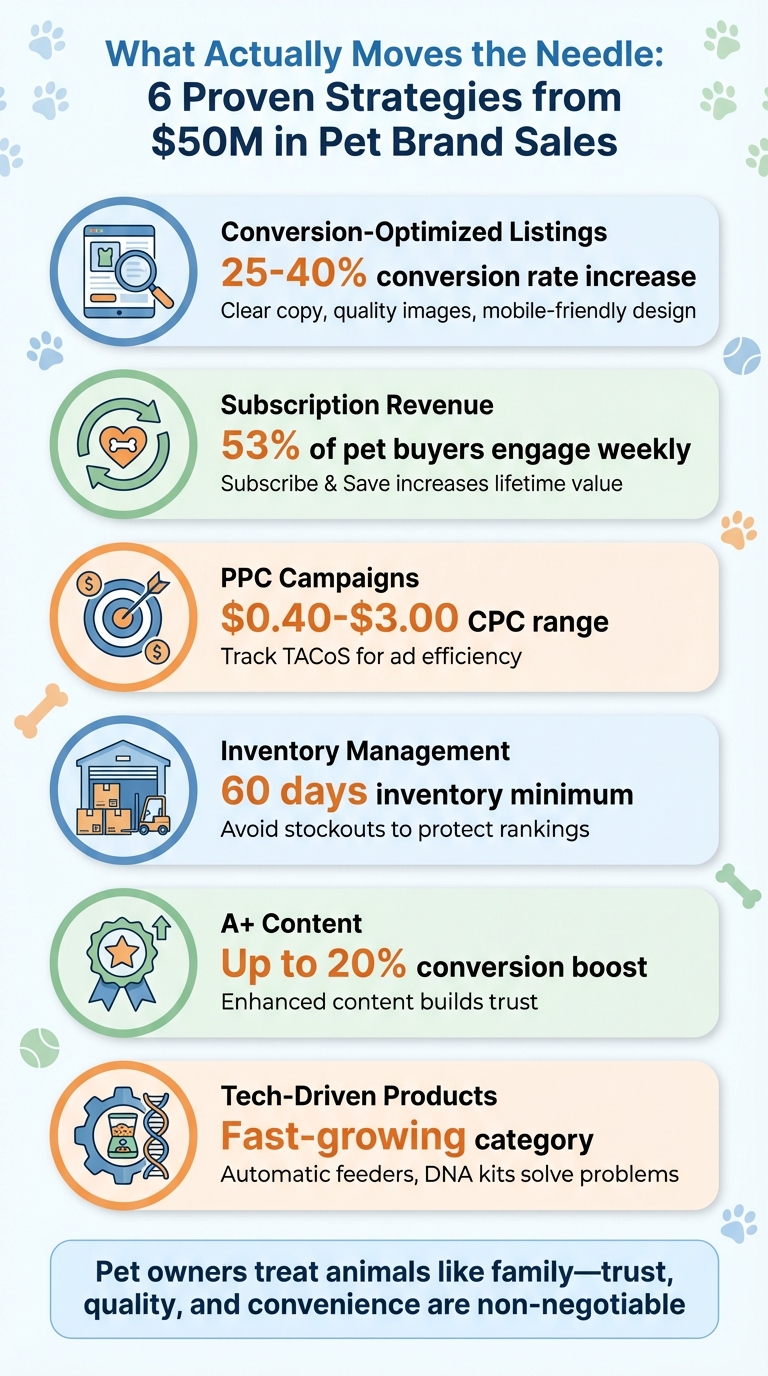
Managing $50M in pet product sales reveals one key insight: Amazon success is about creating a system where listings, ads, and inventory work together. Here’s what matters most:
- Conversion-Optimized Listings: Use clear, benefit-focused copy, high-quality images, and mobile-friendly designs. Highlight safety, quality, and details pet owners care about.
- Subscription Revenue: Programs like Subscribe & Save increase customer loyalty and lifetime value, with 53% of pet buyers engaging weekly.
- Effective PPC Campaigns: Start with automatic ads to find keywords, then shift to manual campaigns. Use TACoS to measure ad efficiency against total sales.
- Inventory Management: Avoid stockouts to protect rankings. Keep 60 days of inventory on hand and monitor sell-through rates.
- Tech-Driven Products: Items like automatic feeders and DNA kits are growing fast. Focus on solving specific pet owner problems.
- A+ Content and Visuals: Enhanced content boosts conversions by up to 20%. Use infographics, lifestyle images, and videos to build trust.
Pet owners treat their animals like family, so trust, quality, and convenience are non-negotiable. These strategies help brands thrive in Amazon’s competitive pet category.
6 Key Strategies That Drive Amazon Pet Brand Sales
How Can I Sell My Pet Product On Amazon [and WIN]
How to Optimize Product Listings for Pet Owners
Boosting your product listing’s conversion rate by 25–40% is achievable if you focus on what pet owners care about most: safety, quality, and clear details about materials and sizing. These elements build trust, which is essential in the pet product market. If your listing falls short, potential buyers will simply move on. Once you’ve nailed these basics, the next step is aligning your keywords with the intent of your buyers.
Finding Keywords That Match Buyer Intent
Start by targeting long-tail keywords that reflect specific buyer needs. For example, instead of using a broad term like "dog bed", opt for something more precise, like "orthopedic dog bed for large dogs with arthritis." These phrases often lead to higher conversions. Tools like Helium 10’s Cerebro can help you perform a Reverse ASIN Lookup to uncover competitor keywords that are driving traffic.
Don’t forget to regularly download your Search Term Reports from Amazon Advertising. These reports provide valuable insights into the exact customer queries that are already converting into sales. For instance, Guy Arad, Co-Founder of thefitguy, achieved a 40% quarterly sales increase by refining his search terms using Amazon Brand Analytics.
Focus on keywords with at least 1,000 monthly searches to ensure enough demand. Use the Amazon search bar’s autocomplete feature to discover high-volume search phrases. For example, typing "dog toy" might reveal trending terms. In your backend search terms, make use of synonyms, common misspellings, and even Spanish translations to maximize your reach within the 250-byte limit.
"If your listing doesn’t contain the search term, you won’t rank for it."
– Chuck Kessler, Content and SEO Manager, Canopy Management
| Keyword Type | Purpose | Best Placement |
|---|---|---|
| Short-tail | High volume, brand awareness | Title, first bullet point |
| Long-tail | High conversion, specific intent | Bullet points, product description |
| Backend/Hidden | Misspellings, synonyms, Spanish | Backend Search Terms field (250 bytes) |
| Competitor | Capturing market share | PPC targeting, comparison charts in A+ Content |
Writing Titles, Bullets, and Descriptions That Convert
A proven title structure works wonders:
Brand Name + Product Type + Key Feature + Pet Type/Size + Quantity/Size.
Make sure your most important keywords are within the first 80 characters since mobile devices truncate longer titles. For example, in 2024, Jungle Creations optimized its "Washable Pee Pads for Dogs" listing using a 186-character title that highlighted the product’s purpose, use cases, and pet sizes. By leveraging Review Automation, the product garnered over 400 positive reviews in under a year, significantly improving its Best Seller Rank.
Use all five bullet points to your advantage. Start each one with a 1–2 word capitalized power phrase like "PREMIUM MATERIALS" or "CHEW-PROOF DESIGN", followed by a concise explanation. Focus on benefits, not just features. For instance, instead of merely stating "stainless steel bowl", emphasize its practicality: "Dishwasher-safe, saving you time scrubbing stuck-on food". Pet owners value safety and quality, so highlight details like non-toxic materials, natural ingredients, or precise sizing.
Address potential objections head-on. If your competitors’ reviews mention issues like leaking or durability, counter these concerns in your bullet points with assurances such as "leak-proof guarantee" or "reinforced stitching for aggressive chewers." Use your 2,000-character description to tell your brand’s story, explain the product’s care instructions, and highlight what sets it apart.
"A feature describes an aspect of a product or what it does, whereas a benefit demonstrates the impact of that feature in the users’ lives or what it does for them."
– Brand Builder University
Optimizing Listings for Mobile Shoppers
Your listing needs to shine on both desktop and mobile, but mobile optimization is key. Amazon truncates titles on mobile after about 80 characters, so prioritize your brand name, product type, and key details like size or quantity within this limit. Mobile shoppers often decide based on what’s visible "above the fold", which includes your title, image stack, and the first two bullet points.
Make the most of all seven image slots. Your main image should fill at least 85% of the frame and have a pure white background to stand out in search results. Ensure images are at least 1,600 pixels on the longest side to enable zoom functionality. Advertisers who made at least 25% of their images zoomable saw an average sales increase of 64%.
A+ Content is especially impactful on mobile because it often appears more prominently than standard descriptions. Use large, high-contrast text overlays in infographics to ensure readability on small screens. If you’re creating product videos, include close-up shots and bold text to make features clear even on a handheld device.
"Only first 80 characters are visible on mobile."
– Brand Builder University
Amazon PPC Strategies That Increase Pet Brand Sales
If your Amazon ads aren’t structured well, they can quickly drain your budget. With 79% of Amazon sellers using some form of advertising and 77% relying on Sponsored Products ads, the competition is fierce. Pet brands, in particular, face steep costs, with CPCs ranging from $0.40–$0.80 in less competitive niches to $1.50–$3.00 or more for sought-after categories like treats and supplements. To succeed, you need campaigns that uncover profitable keywords, scale successful strategies, and cut out underperforming terms.
How to Structure Automatic and Manual Campaigns
A solid approach is the 2:1 mirrored structure: one automatic campaign to identify high-performing keywords and one manual campaign to target those keywords as exact matches. When a keyword drives sales at a reasonable cost, move it to your manual campaign as an exact match and mark it as a negative keyword in the automatic campaign to avoid competing with yourself.
For more control, try the "Four-Pack" strategy, which includes campaigns for Automatic, Broad, Phrase, and Exact match types. Pair this with Single-Product Ad Groups (SPAGs) to track performance by ASIN. This setup ensures one product variation, like a specific flavor or size, doesn’t monopolize your budget without converting. It also helps pinpoint which products are driving sales.
"Throwing ad dollars at unprofitable products is like trying to polish a stone into a diamond. Expensive and futile."
– Angela Apolonio
Before launching PPC, ensure your listing has at least 15–20 reviews and a rating above 4.0 – ads can’t salvage a poor conversion rate. Start with daily budgets of $10–$50 to gather 20–30 clicks for optimization. During the first two weeks, bid 50–100% higher than Amazon’s suggestions to win auctions and collect data. For high-traffic events like Prime Day, switch from "Dynamic Bids – Down Only" to "Up and Down" to maximize conversions.
| Bidding Strategy | Best For | Function |
|---|---|---|
| Dynamic – Down Only | Beginners/Budget Control | Adjusts bids down in real time when a sale seems unlikely |
| Dynamic – Up & Down | Scaling/Peak Seasons | Raises bids (up to 100%) when a sale seems likely |
| Fixed Bids | Precise Control | Keeps bids steady regardless of conversion potential |
As your campaigns mature, tweak them to align with seasonal trends.
Adjusting Campaigns for Seasonal Demand
Pet products often follow seasonal patterns – flea prevention sells more in spring and summer, while holiday bundles and cold-weather gear peak in winter. Increase budgets and bids several weeks before these spikes, not at the last minute.
Take this example: In April 2025, Bennie Valencia from Incrementum Digital prepared a pet treats brand for Amazon Pet Day (May 13–14). He launched low-bid discovery campaigns on April 29, moved high-performing keywords to exact match campaigns, and used Sponsored Display ads to retarget cart abandoners. The result? The brand tripled its revenue while keeping TACoS under 23%. Key tactics included focusing on larger pack sizes and leveraging Amazon Marketing Cloud (AMC) insights to strategically allocate ad spend during the event.
"What happens before May 13 is what determines if you’re buried – or breaking through – when the event goes live."
– Bennie Valencia, Incrementum Digital
To prepare for major events, activate Sponsored Display campaigns at least two weeks in advance to build a retargeting audience of shoppers who browsed but didn’t buy. During high-traffic periods, promote larger packs or bundles, as shoppers are more likely to stock up when deals are available. Pair your ads with influencer content, email campaigns, and social media promotions in the week leading up to the event to drive branded searches on Amazon.
Planning for seasonal trends doesn’t just boost short-term sales; it also builds customer loyalty, which is critical for pet brands.
Tracking ROAS and ACoS to Improve Performance
Monitor your campaign’s profitability with ACoS (Advertising Cost of Sales) and ROAS (Return on Ad Spend), but don’t overlook TACoS (Total Advertising Cost of Sales) for a broader view of ad spend versus total revenue (both organic and paid). A declining TACoS alongside rising total sales indicates your ads are improving organic rankings, creating a "flywheel effect".
Before launching, calculate your break-even ACoS. For instance, if your pre-ad profit margin is 40%, your break-even ACoS is 40%. Any campaign below this threshold generates direct profit. Use Search Term Reports weekly to identify high-performing keywords to add to exact match campaigns and irrelevant terms to exclude as negatives. A healthy Click-Through Rate (CTR) usually falls between 0.3% and 0.5%, though this varies by category.
"Amazon rewards relevance + performance. So your ad success depends not just on bidding higher, but on converting more."
– Manish Chandwani, Growwithba
Track New-to-Brand (NTB) metrics to measure sales from first-time customers. This is especially important for pet brands looking to expand their customer base rather than relying solely on repeat buyers. On average, small businesses that advertise on Amazon see a 26% increase in sales, but success hinges on tracking the right metrics and making data-driven adjustments.
sbb-itb-e2944f4
Using A+ Content and Images to Increase Conversions
Once you’ve perfected your listing’s text and keywords, the next step is to focus on visuals and enhanced content to drive conversions. On Amazon, your product images and A+ Content serve as your product’s first impression and help build trust. Since customers can’t physically examine your product, these elements answer their questions visually. Research shows that basic A+ Content can increase sales by 8%, while Premium A+ Content can boost sales by up to 20%. Additionally, 93% of shoppers say that visual appearance plays a major role in their purchasing decisions. These enhancements are the bridge between optimized listings and higher conversion rates.
Creating A+ Content That Highlights Product Features
Pair your optimized text with A+ Content that clearly showcases your product’s features and builds trust with potential buyers. For example, pet owners often need detailed information to feel confident about their purchases. Comparison charts can be a great way to explain product differences, such as the distinction between a puppy formula and a senior dog formula, or how a medium-sized bed compares to a large one. Including size guides with breed-specific recommendations (like noting that an orthopedic bed is ideal for Labradors but not for Great Danes) can also help reduce returns and negative reviews.
The Brand Story module offers an opportunity to connect emotionally with your audience. Take Uproot Clean, for instance – they share how their frustration with cleaning pet hair led to the creation of their product line. They follow this up with videos, carousels, and a Q&A section to address customer concerns, creating a relatable and engaging narrative.
"HexClad is a premium product, so A+ Content is where we convey the story of how our product adds value, showcase content that demonstrates how to use our product and point out unique features."
– Jason Panzer, President, HexClad
When creating A+ Content, avoid embedding text directly into images. Amazon’s algorithm can’t index text within images, and mobile users may find it difficult to read. Instead, use Amazon’s text modules to ensure keywords related to your product – like pet health, ingredients, or benefits – are properly indexed. Video is another powerful tool, with 96.3% of customers saying video is essential for product research. Viewers are also 3.6 times more likely to make a purchase after watching a video. If you’re eligible for Premium A+ Content, consider adding product demonstration videos to engage your audience further.
Testing Images to Find What Works Best
Your main image is critical – it should feature a pure white background with the product filling at least 85% of the frame. But don’t overlook your secondary images, as they play a key role in driving conversions. Use all available image slots – typically seven – and include at least one video. Ensure each image is at least 1,000 pixels on its longest side to enable Amazon’s zoom functionality.
Here are some effective types of secondary images:
- Lifestyle shots: Show real pets using your product in natural settings.
- Infographics: Highlight benefits with text callouts, such as "Superior Joint Support", instead of relying solely on technical details.
- Instructional photos: Show how easy your product is to clean, assemble, or use.
In November 2025, Safariland USA used detailed images and A+ Content for 9,000 SKUs, resulting in a 37% increase in conversion rates within just one month.
| Image Type | Purpose | Best Practice |
|---|---|---|
| Main Image | Earn the click | Pure white background; product fills 85% of the frame; follow Amazon’s guidelines |
| Lifestyle | Emotional connection | Show pets interacting naturally with the product |
| Infographic | Education | Use text callouts to explain product benefits |
| Instructional | Reduce returns | Demonstrate setup or cleaning to set clear expectations |
Pairing strong visuals with detailed content helps build buyer confidence. Use Amazon’s "Manage Your Experiments" tool to test different images and see what resonates most with your audience. For products targeting both dogs and cats, consider creating separate main images for each species – this approach often performs better. Don’t forget to optimize the 100-character ALT text for each image by including high-volume keywords and even Spanish translations like "perro" or "gato" to improve indexing.
"Use real pet images instead of shadows or logos since shoppers connect better with actual pets."
– Noah Wickham, VP of Sales and Marketing, My Amazon Guy
Managing Inventory and Product Variations
Once you’ve nailed your Amazon listings and PPC strategies, the next big task is managing your inventory and product variations. These two elements are critical for maintaining rankings and profitability. Poor inventory management can lead to stockouts, which hurt your Best Seller Rank, or excess stock, which racks up storage fees. In the pet category, where 70% of shoppers abandon a brand after experiencing three or more stockouts, keeping your products available isn’t just important – it’s essential. On the other hand, smart variation strategies can amplify your visibility by appearing in more searches and pooling reviews across your product family.
Adding Variations to Increase Product Visibility
Product variations can be a game-changer for pet brands on Amazon. A variation family consists of a Parent ASIN (a placeholder that isn’t buyable) and Child ASINs (the actual products customers purchase), all tied together by a Variation Theme like size, flavor, or quantity. In the Pet Supplies category, Amazon displays the best-selling child product in search results, meaning your top performer drives traffic to the entire variation family.
The real advantage? Variations allow reviews and sales history to stack across all child ASINs, boosting the Best Seller Rank and organic search ranking for the entire listing. For example, if you’re launching a new chicken-flavored dog treat, add it as a variation to your best-selling beef-flavored treat with 200 reviews. This strategy avoids starting from scratch with zero reviews and gives your new product instant credibility.
"Adding variations to your listings can significantly improve your customer’s experience. By providing customers with various buying options in one place, you are making it much easier for them to find what they’re looking for on your listing instead of browsing through the crowded search results."
– Brian Connolly, Ecommerce Expert, Jungle Scout
You can use Seller Central’s Variation Wizard to create parent-child relationships in bulk or add new variations to existing families. Just make sure your variations are for fundamentally the same product – Amazon doesn’t allow unrelated items, like pairing a pet bed with a pet toy, under the same listing. Each child ASIN must also have unique attributes, so you can’t list two "Small" options in the same color.
While variations can boost visibility, keeping your inventory in check is just as important to capitalize on that visibility.
Preventing Stockouts with Demand Forecasting
Stockouts are a major problem. When your product goes out of stock, Amazon penalizes your listing, making it harder to recover your rank once you restock. Plus, any advertising spend during this period is wasted. To avoid this, aim to keep around 60 days of inventory on hand – enough to meet demand without triggering hefty storage fees.
Track your sell-through rate; a rate above 7 indicates you’re moving inventory quickly. Tools like Jungle Scout’s Inventory Manager can help you predict reorder dates based on your sales velocity and supplier lead times. Here’s a simple formula to calculate your reorder point: (Daily Sales Velocity × Lead Time) + Buffer Stock.
If you’re running low on inventory and waiting for a shipment, slow demand by raising prices and pausing PPC campaigns. This helps you avoid stockouts and protects your Best Seller Rank. On the flip side, if you’re overstocked, consider promotions like coupons or BOGO deals to clear inventory before Amazon’s aged inventory surcharges kick in – $1.50 per cubic foot for units stored 271–365 days, and $6.90 per cubic foot for units over 365 days.
"Never go out of stock because it hurts your Best Seller Rank. A great way to stay in stock when you’re running low on inventory and waiting on a shipment is to slow things down on the demand side."
– Eva Hart, Amazon Expert, Jungle Scout
Stay in close contact with your suppliers, especially during high-demand periods like holidays when pet product sales tend to spike. Regularly monitor your Inventory Performance Index (IPI) score – accounts older than 39 weeks need a strong IPI to secure higher storage limits. Don’t forget to check Amazon’s "Fix Stranded Inventory" tool monthly to ensure sellable units aren’t stuck in limbo, racking up unnecessary fees.
Conclusion: What Actually Drives Pet Brand Growth on Amazon
After managing $50M in pet brand sales, one thing becomes clear: success on Amazon comes from creating a self-sustaining flywheel. When you fine-tune listings for higher conversions, run targeted PPC campaigns to boost sales velocity, and maintain a steady inventory, each piece strengthens the others. Paid ads spark initial momentum, lifting organic rankings and reducing reliance on advertising over time. A key metric to watch here is TACoS (Total Advertising Cost of Sales). If your TACoS is dropping, it’s a sign that your ads are successfully driving organic growth.
Amazon’s market thrives on this integrated approach, rewarding brands that combine quality with genuine care for their customers. Pet owners, in particular, view their animals as family members. They’re willing to invest in high-quality products and expect honesty, reliability, and solutions that enhance their pets’ well-being. To compete, your listings need to feature benefit-driven copy, be mobile-friendly, and include A+ Content that builds trust – these are no longer optional; they’re essential.
"The most successful Amazon brands diagnose first. They know exactly where the leak is… Scaling only works once the foundation is rock solid."
– John Upton, Ecommerce Account Manager, Amplifi
Another growth lever? Subscribe & Save. This program helps turn one-time buyers into long-term customers, increasing customer loyalty and boosting lifetime value – a major win for sustainable growth.
Emplicit specializes in managing every aspect of Amazon for pet brands. From PPC strategies and listing optimizations to inventory planning, we handle the heavy lifting so you can focus on creating exceptional products. Our proven systems align with the strategies outlined in this guide, helping brands thrive in Amazon’s competitive landscape.
FAQs
How can I manage inventory effectively to avoid running out of stock on Amazon?
To keep your Amazon store running smoothly and avoid stockouts, it’s all about smart inventory management. Start by diving into your sales data from the last 4–6 weeks. This will help you predict demand more accurately. Don’t forget to account for supplier lead times and add a safety stock buffer – around 10% for steady-selling products or 20% during busy seasons. Using inventory management tools can simplify these calculations and save you time.
Set clear reorder points using this formula: (average daily sales × lead time) + safety stock. Keep a close eye on Amazon’s Inventory Performance Index (IPI) and restock limits to stay compliant and maintain a strong in-stock rate. Make weekly audits part of your routine – compare actual sales with your forecasts and tweak reorder points or shipments as needed. By staying on top of these details and using the right tools, you’ll be better equipped to maintain stock levels and avoid costly stockouts.
What are the best ways to optimize Amazon product listings for pet products?
To make your Amazon listings for pet products stand out, start by crafting a keyword strategy tailored to pet owners. Focus on terms they’re likely searching for, such as breed-specific phrases (like "large-breed"), product benefits (like "joint support"), and even common misspellings. Incorporate these keywords into your product title, keeping it concise – ideally under 80 characters – for better readability on mobile devices. Use bullet points to clearly communicate key benefits in relatable language, such as: "Durable, chew-proof material keeps your Labrador entertained and safe." Don’t forget to mention any relevant certifications, like "USDA Organic" or "vet-approved", to enhance credibility.
For visuals, high-quality images are a must. Show real pets interacting with your product to create an emotional connection. A/B test your main image to see which version drives more clicks, and include additional photos with ALT text to boost search indexing. When it comes to your product description and A+ content, stick to crawlable text instead of embedding key details in images. This ensures your content is indexed by Amazon’s algorithm. Use this space to emphasize unique benefits, address common concerns, and include lifestyle photos of pets using the product to build trust with potential buyers.
Lastly, keep your inventory well-stocked and pricing consistent – aim for shopper-friendly prices like $19.99. This not only helps you stay eligible for the Buy Box but also ensures smooth account performance, keeping your listings competitive and reliable.
How can I use Amazon PPC campaigns to boost sales for my pet brand?
To make the most of Amazon PPC campaigns for your pet brand, start by focusing on products that are in high demand, offer strong profit margins (aim for at least 25%), and have shipping costs that won’t eat into your earnings. Begin with Sponsored Products campaigns, using a mix of automatic campaigns (to gather search term data) and manual campaigns that target your best-performing keywords.
Use Amazon’s search term reports to uncover high-converting keywords. Add these to your manual campaigns as exact or phrase matches. Start with competitive bids – somewhere in the range of $0.30 to $0.80 for pet-related keywords – and set a daily budget of $20 to $30. Keep an eye on metrics like ACoS (Advertising Cost of Sale) to guide your adjustments. For keywords with an ACoS below 15%, consider increasing your bids to capture more traffic. On the other hand, reduce bids or pause keywords with an ACoS above 30%.
To keep your campaigns running efficiently, regularly optimize them. Add negative keywords to filter out irrelevant traffic, fine-tune your bids, and consider branching out to Sponsored Brands or Sponsored Display ads once your Sponsored Products campaigns are yielding strong results. By consistently monitoring and refining your approach, you can turn Amazon PPC campaigns into a reliable driver of sales and growth for your pet brand.