
Selling online? Here’s what you need to know about sales tax in 2026:
- Marketplace Facilitator Laws: All 45 states with sales tax (plus D.C.) require platforms like Amazon and Walmart to collect and remit sales tax for you. But you’re still responsible for tax on direct sales (like your Shopify store or phone orders).
- Economic Nexus: Most states set a $100,000 revenue threshold, but some states like California and Texas set it at $500,000. States like New York also require a minimum number of transactions (e.g., 100).
- Marketplace Sales Count: States like Texas and California count your marketplace sales toward these thresholds, even if the platform handles the tax. Others, like Florida and Alabama, don’t.
- Physical Nexus: Using services like Fulfillment by Amazon (FBA)? Stored inventory in a state can trigger tax obligations, even if you don’t sell directly there.
- Changing Rules: States are phasing out transaction thresholds – e.g., Illinois eliminated its 200-transaction rule in January 2026.
Key takeaway: Even with marketplace tax collection, you may still need to register, file, and monitor thresholds. Tools like Emplicit can help streamline compliance across states and platforms.
Sales Tax Is Killing Amazon & Shopify Sellers (Here’s Why)
sbb-itb-e2944f4
1. State-by-State Breakdown of Marketplace Tax Rules
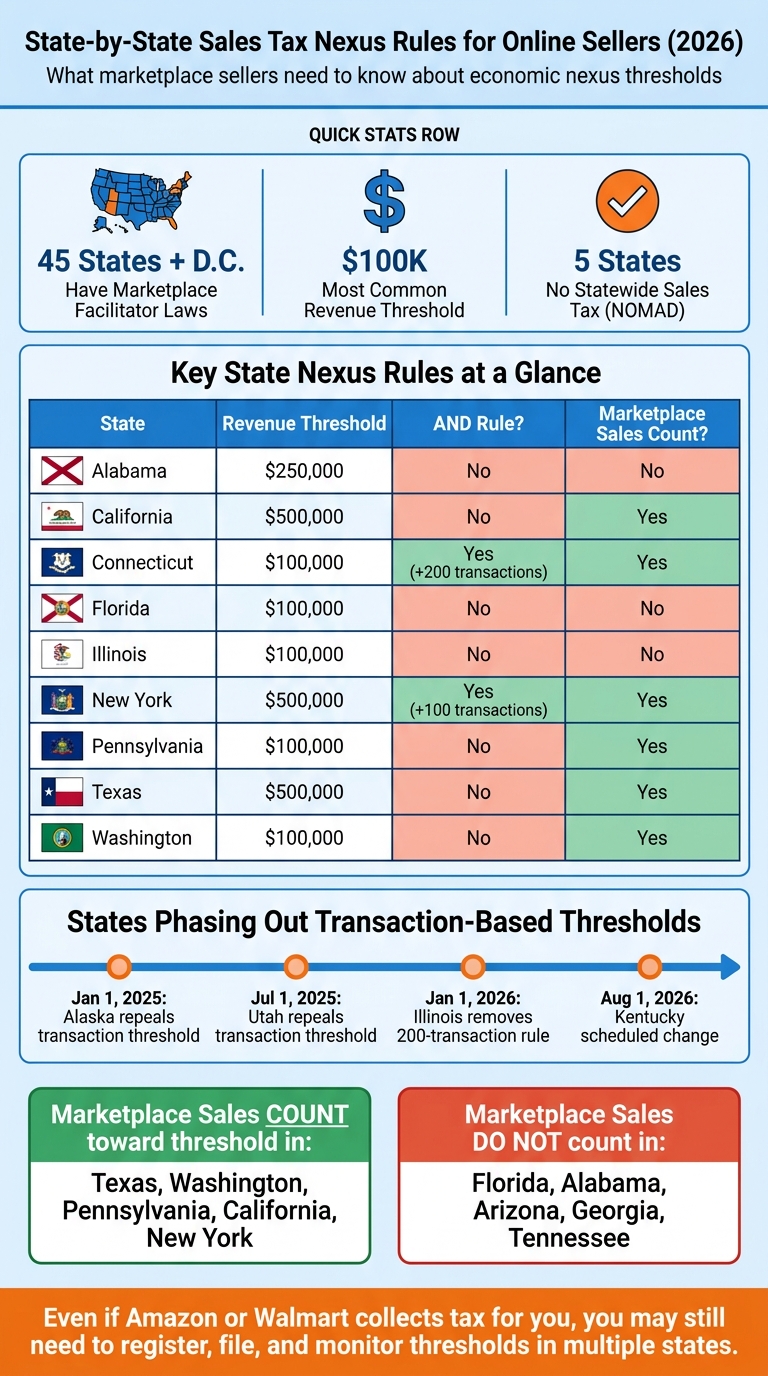
State-by-State Sales Tax Nexus Rules for Online Sellers 2026
Sales tax rules vary widely across states, creating potential compliance challenges for sellers. While all 45 states with a statewide sales tax (plus Washington D.C.) have marketplace facilitator laws, the differences in their requirements can leave sellers navigating a maze of regulations.
Economic Nexus Thresholds
Economic nexus thresholds play a key role in determining tax obligations. Most states set their threshold at $100,000 in annual revenue, but some states use higher limits. For example:
- California, New York, and Texas: Threshold is $500,000
- Alabama and Mississippi: Threshold is $250,000
States also differ in how they enforce these thresholds. Many follow an "OR" rule, meaning nexus is triggered if either the revenue limit or transaction count is met. However, Connecticut and New York require both conditions to apply. In New York, for instance, sellers must meet $500,000 in gross sales and 100 transactions within the previous four quarters before they are required to register.
"Texas and Washington count marketplace sales toward your threshold. Even when Amazon, Walmart, or eBay collect sales tax on your behalf, those sales still count toward your individual threshold." – Brian Miller, CPA, NexusRegister
Which States Count Marketplace Sales Toward Your Threshold?
Some states include marketplace sales – like those from Amazon or Walmart – when calculating your economic nexus threshold, even if the platform handles tax collection. This means sellers may need to register in these states without directly collecting sales tax themselves. States that include marketplace sales in the threshold include:
- Texas, Washington, Pennsylvania, California, and New York
Other states, such as Florida, Alabama, Arizona, Georgia, and Tennessee, exclude these sales from the seller’s threshold calculation.
| State | Revenue Threshold | "AND" Rule? | Marketplace Sales Count Toward Threshold? |
|---|---|---|---|
| Alabama | $250,000 | No | No |
| California | $500,000 | No | Yes |
| Connecticut | $100,000 | Yes (+ 200 transactions) | Yes |
| Florida | $100,000 | No | No |
| Illinois | $100,000 | No | No |
| New York | $500,000 | Yes (+ 100 transactions) | Yes |
| Pennsylvania | $100,000 | No | Yes |
| Texas | $500,000 | No | Yes |
| Washington | $100,000 | No | Yes |
These differences emphasize the importance of staying updated on each state’s specific rules.
A Shifting Landscape: Transaction Thresholds Are Disappearing
States are gradually moving away from transaction-based triggers to simplify compliance. Recent changes include:
- Alaska: Repealing its transaction threshold on January 1, 2025
- Utah: Following suit on July 1, 2025
- Illinois: Removing its threshold on January 1, 2026
- Kentucky: Scheduled change on August 1, 2026
"States continue to simplify economic nexus rules by moving away from transaction-based thresholds and relying primarily on revenue thresholds." – Tom Hoopes, TaxCloud
Physical Nexus: The FBA Factor
For sellers using Fulfillment by Amazon (FBA), tax requirements can become even more complex. When Amazon stores your inventory in warehouses across multiple states, this creates a physical nexus, which can override economic thresholds. Even if you have no direct sales in a state, you may still need to register because your products are stored locally. Regularly reviewing your FBA inventory placement reports is critical to avoid unexpected tax obligations.
Five states have no statewide sales tax – New Hampshire, Oregon, Montana, Delaware, and Alaska (often called the NOMAD states). However, Alaska allows local jurisdictions to enforce their own marketplace facilitator rules through the Alaska Remote Seller Sales Tax Commission, making it an exception worth noting.
2. How Emplicit Helps Marketplace Sellers Stay Compliant
Navigating state-specific tax rules is a major hurdle for sellers on platforms like Amazon and Walmart. Emplicit simplifies the process by breaking down each layer of tax obligations, ensuring your business stays on track.
Even though Amazon and Walmart handle sales tax as marketplace facilitators, sellers are still responsible for tax compliance on direct sales – like those made through Shopify storefronts, phone orders, or in-person transactions.
Emplicit takes compliance a step further by generating 12-month and year-to-date (YTD) sales reports by state, comparing them against each state’s economic nexus thresholds. This is especially critical in states like New York and California, where marketplace sales contribute to a seller’s economic nexus – even when the platform itself remits the taxes.
For FBA sellers, Emplicit keeps an eye on physical nexus exposure by tracking inventory locations using Amazon’s "Inventory Event Detail" reports in Seller Central. Since moving inventory to a warehouse in a new state can instantly create a tax obligation, constant inventory monitoring becomes a must.
Emplicit doesn’t stop at setup – it offers ongoing support to help sellers adapt to evolving state regulations. This is especially important as more states shift from transaction-based thresholds to revenue-only triggers. Their continuous assistance ensures businesses remain compliant as rules change.
Pros and Cons
Marketplace facilitator laws have made it easier for sellers on platforms like Amazon and Walmart to handle sales tax, but they aren’t a catch-all solution. Understanding the advantages and drawbacks can help you avoid unexpected complications.
One of the biggest perks is that these laws shift the responsibility for collecting sales tax to the marketplace itself. This change means you no longer have to worry about calculating taxes for various local jurisdictions. As of 2026, all 45 states with statewide sales tax, along with Washington, D.C., and Puerto Rico, have adopted these laws. If you sell exclusively through these platforms, you’re spared from managing thousands of tax rates and regulations.
That said, there are some downsides. If you sell through multiple channels – like a Shopify store, phone orders, or other direct methods – you’re still responsible for collecting sales tax on those transactions. Additionally, marketplace sales contribute to economic nexus thresholds, which could require you to register and collect taxes for your direct sales. These pros and cons are crucial to shaping your compliance strategy.
"The marketplace collecting tax does not always mean it has discharged every filing obligation tied to those sales." – Ilya Kisel, Co-Founder & COO, Synder
Here’s a breakdown of how marketplace tax collection laws stack up:
| Factor | Pros | Cons |
|---|---|---|
| Tax Collection | Platforms handle tax calculation and remittance for marketplace sales | Sellers remain responsible for collecting and remitting taxes on direct/non-platform sales |
| Thresholds | Many states simplify thresholds to $100,000 in revenue only | 18 states still factor transaction counts; thresholds range from $100,000 to $500,000 |
| Filing Duties | Some states allow marketplace-only sellers to skip registration | States like Washington, New Jersey, and Texas still require filings even if the platform remits tax |
| Audit Risk | Platforms shield sellers from liability for their tax calculation errors | Sellers are still responsible for ensuring accurate product taxability codes and tracking nexus |
| Nexus | Simplifies compliance for small, single-channel sellers | Marketplace sales count toward thresholds, potentially creating obligations for direct sales |
Another challenge to watch out for is the risk of double taxation. If you don’t properly track the taxes collected by the marketplace, you might overstate your liability and pay taxes twice. Penalties for late filing can range from 5% to 25% of the tax owed, and unpaid tax penalties can tack on an extra 5% to 10%. When compounded over three to five years, these costs can add up quickly.
Conclusion
Marketplace facilitator laws have indeed streamlined the process of managing sales tax, but staying compliant still requires close attention to detail. By 2026, all 45 states that impose statewide sales tax will have adopted these laws. However, the specifics vary significantly from state to state. For example, California and Texas set their economic nexus threshold at $500,000, while most states stick to $100,000. New York takes it a step further, requiring both $500,000 in revenue and 100 transactions to establish nexus. Meanwhile, Illinois has done away with its 200-transaction threshold as of January 1, 2026. These differences directly impact when and where sellers must register, file, and collect taxes.
Beyond marketplace platforms, sellers also need to keep an eye on direct sales channels like Shopify stores, wholesale orders, and even in-person transactions. It’s worth noting that even minimal storage of inventory in an FBA warehouse can create physical nexus.
"Marketplace facilitator laws simplified sales tax – but they didn’t eliminate your responsibility. In 2026, the risk isn’t misunderstanding the rules. It’s assuming they don’t apply to you." – The Sales Tax People
Remaining compliant across multiple states and sales channels requires ongoing effort. This includes monitoring nexus thresholds, filing zero returns when necessary, and ensuring your product taxability codes are accurate. Partnering with a knowledgeable ecommerce provider can make navigating these complexities more manageable. For instance, Emplicit offers support for brands selling on platforms like Amazon and Walmart, helping with everything from inventory management to tax compliance across all channels.
The key takeaway: understand your thresholds, monitor all your sales channels, and don’t assume marketplace coverage will handle every tax obligation. By staying proactive and informed, you can maintain a strong compliance strategy and avoid costly mistakes.
FAQs
Do I still need to register if a marketplace collects the tax?
Yes, registration might still be necessary. Many states have marketplace facilitator laws that impose additional responsibilities on sellers. These can include filing tax returns, monitoring nexus thresholds, or reporting sales made outside of the marketplace. The specifics often depend on the state, particularly if you have other nexus triggers or sell through multiple channels.
Which states count my marketplace sales toward nexus thresholds?
Marketplace sales may or may not count toward economic nexus thresholds – it all depends on the state. States like Texas and Washington typically include marketplace-facilitated sales when calculating thresholds, but some states might exclude them. To stay compliant, it’s essential to consolidate sales data from all your channels and check if you’ve crossed a threshold. While marketplace platforms handle sales tax collection and remittance, that doesn’t mean those sales are ignored in most states’ calculations.
Can FBA inventory create sales tax nexus by itself?
Yes, keeping inventory in an Amazon fulfillment center can create a physical sales tax nexus in a state, even if you don’t have any other operations there. Because Amazon moves inventory across its network, this could mean establishing nexus in several states simultaneously. While marketplace facilitator laws require Amazon to handle tax collection, you might still be responsible for registering and filing taxes. Emplicit assists brands in managing these challenges effectively.