
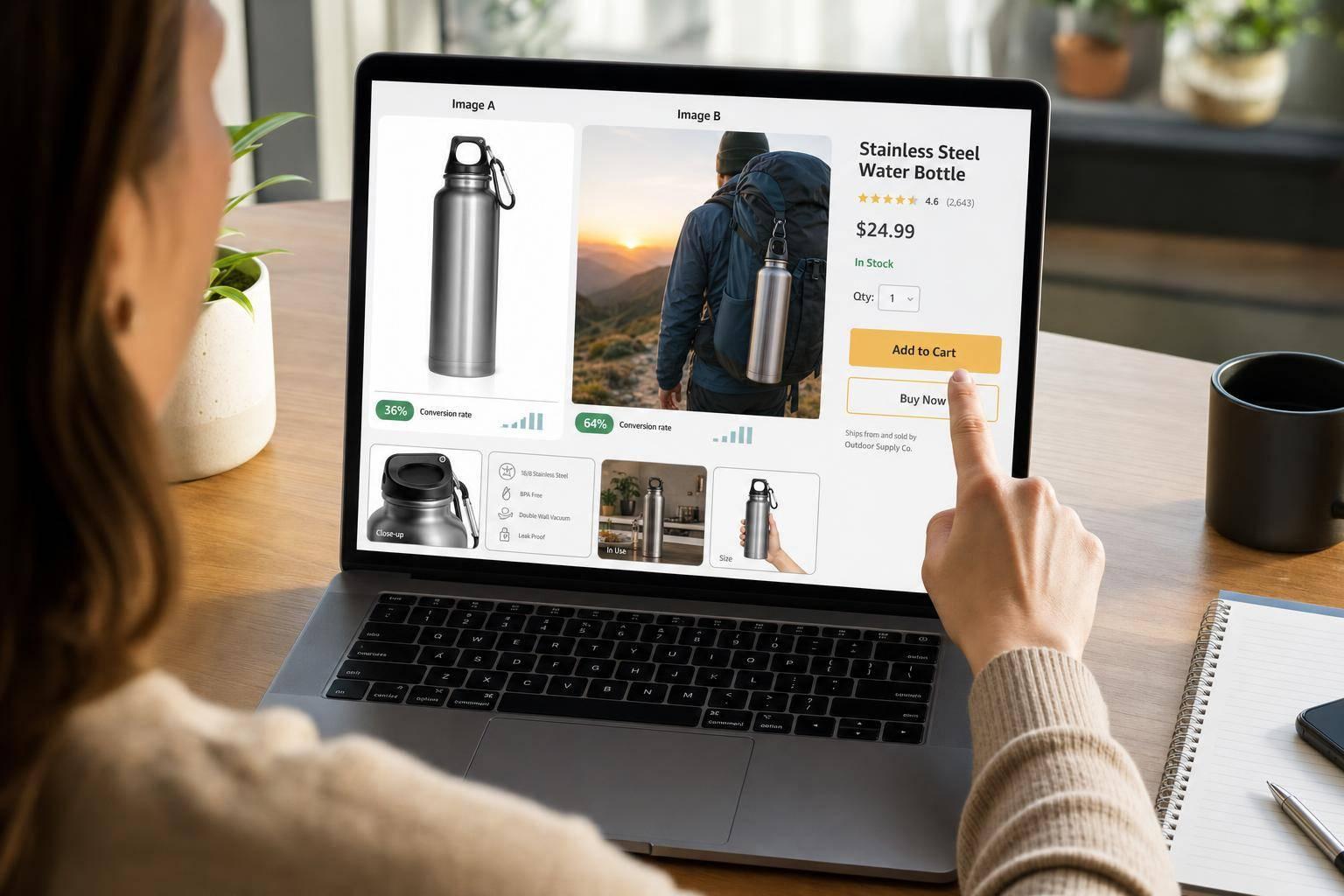
Amazon sellers often spend months refining PPC, pricing, and reviews while treating product images as a finishing touch. That is a costly mistake.
On Amazon, images do two jobs at once: they win the click in search results, and they help close the sale on the listing page. If your visuals are generic, unclear, or disconnected from buyer intent, stronger traffic alone will not solve the conversion problem.
In a recent discussion on Amazon image optimization, creative strategist Kamaljit Singh argued that high-converting images are not mainly about "better design." They are about better customer communication. That distinction matters for brands trying to scale efficiently. A polished image stack that says the same thing as every competitor will still underperform.
This article unpacks the most useful ideas from that conversation and adds practical context for eCommerce operators who want to improve Amazon conversion rates without turning creative production into chaos.
Why Amazon Product Images Matter More Than Most Sellers Think
On Amazon, shoppers make decisions quickly and visually. Before they read bullets or compare technical specs, they react to what they see.
That makes product images one of the highest-leverage assets in your listing because they affect two critical stages:
- Click-through rate (CTR) from search results
- Conversion rate (CVR) once the shopper lands on the detail page
If the main image fails, your listing may never earn the click. If the supporting images fail, shoppers may click but still not buy.
Many sellers understand this in theory, but their creative approach still defaults to category clichés:
- "Durable"
- "Waterproof"
- "BPA-free"
- "FDA approved"
Those claims may be true, but they rarely persuade. In crowded categories, sameness is invisible. A feature that appears on nearly every competing listing is not a differentiator unless it is framed in a way that matters to a specific buyer.
sbb-itb-e2944f4
The Core Principle: Images Should Speak to a Specific Buyer
The strongest insight from the discussion is simple: Amazon images should be built around a customer avatar, not around the seller’s internal view of the product.
That means asking:
- Who is buying this item most often?
- What problem are they trying to solve?
- What objections might stop the purchase?
- What outcome are they really paying for?
A gym-focused customer, for example, may care less about a bottle being "durable" and more about whether it fits a fast-paced, performance-oriented lifestyle. A food delivery driver may care less about dimensions and more about how many orders a bag can carry in one trip.
This is where many Amazon listings go wrong. They describe the product, but they do not translate features into a buyer-relevant story.
A strong image stack creates a moment where the shopper thinks: this was made for someone like me.
That is when conversion improves.
Start With Strategy, Not Design Software
One of the most useful reframes in the discussion is that image optimization is not primarily a graphic design task. It starts earlier, with market understanding.
Before updating your listing images, clarify these inputs:
Customer avatar
Define the most commercially important buyer type for the product.
Pain points
What friction or frustration exists before the purchase?
Decision drivers
What will make this shopper choose your offer over a similar one?
Objections
What uncertainty needs to be resolved visually?
Context of use
Where, when, and under what conditions is the product used?
Without those answers, even expensive creatives can become decorative rather than persuasive.
Optimize the Main Image for Click-Through Rate
The video makes an important distinction: your main image should be judged differently from your secondary images.
That is exactly right.
The main image has one primary purpose: earn the click in a crowded search environment. It is not there to tell the full story. It needs to work at thumbnail size, often on mobile, in seconds.
According to the framework shared in the discussion, sellers should evaluate the main image using three tests.
1. Does it break the visual pattern?
If every competitor’s image looks the same, your product disappears into the page.
"Breaking the pattern" does not mean violating Amazon image rules. It means creating a clean but distinctive visual presence within what the platform allows. In practice, that may come from:
- Product angle
- Packaging inclusion, if compliant
- Color contrast
- Product arrangement
- Cropping and fill of the frame
The goal is not to look strange. The goal is to become easier to notice.
2. Can a shopper understand it in under two seconds?
This is a strong litmus test. If five strangers cannot quickly identify what the product is, the image is probably too complicated or unclear.
For mobile-heavy traffic, this is especially important. Tiny details and subtle design choices often disappear on smaller screens.
3. Have you tested alternatives?
This point deserves emphasis. Many teams treat the first approved main image as "done." That mindset leaves revenue on the table.
There is almost always room to test:
- Different angles
- Different crops
- Product-only vs. product-plus-package
- Single-unit vs. multi-unit display
- Slight visual hierarchy changes
In conversion-focused environments, assumptions are not enough.
Build Secondary Images Around Buyer Questions
If the main image wins the click, the secondary image stack must help win the sale.
The discussion recommends grounding those images in actual search behavior and product priorities, including insights from Amazon performance data where available. That is a smart approach because secondary images should not simply rotate through random features. They should answer the most commercially important questions.
Think of your secondary image stack as a visual sales sequence.
A strong sequence often includes:
- Core value proposition
- Most important feature set
- Context of use
- Proof or credibility
- Scale, size, or quantity clarification
- Lifestyle or emotional reinforcement
The order matters. Put the strongest, most decision-relevant information early in the stack.
Don’t Show Dimensions Only. Show Meaning.
One of the most practical examples from the discussion compared two ways of communicating size for a delivery bag:
- Listing the dimensions numerically
- Showing how many large pizza boxes fit inside
That illustrates a powerful principle: buyers understand outcomes faster than measurements.
Dimensions are useful, but they are abstract. A real-world visual comparison is immediate.
For many categories, image optimization improves when you replace technical description with situational meaning.
Weak visual communication
- 24" x 18" x 16"
- "Extra large capacity"
Stronger visual communication
- Holds multiple large food orders at once
- Fits a specific number of commonly recognized items
- Supports a money-making use case for the target buyer
This applies across categories:
- Storage bins: show what fits inside
- Kitchen tools: show the task being completed
- Travel gear: show what can be packed
- Organizers: show before-and-after use
- Fitness products: show performance context, not just isolated features
The more concrete the visual reference, the less cognitive work the shopper has to do.
Use "Dramatic Demonstration" in Lifestyle Images
Another standout idea from the conversation is what Singh described as using more extreme or dramatic examples in lifestyle imagery.
This is worth adopting carefully.
Many Amazon lifestyle images are too safe. They show a product sitting in a pleasant setting without proving why the product matters. That style may look polished, but it often under-sells utility.
A more effective lifestyle image demonstrates the product under meaningful conditions:
- An outdoor camera working during a stormy night
- A waterproof item being used in actual wet conditions
- A rugged product shown in heavy-use scenarios
- A night-vision feature displayed in darkness, not daylight
- A cold-weather item shown in winter conditions, not a studio mockup
The idea is not to be sensational for the sake of it. The idea is to show the product succeeding where the buyer most needs reassurance.
This works because buyers do not just want to know what a feature is. They want confidence that it will perform in real life.
Why Generic Feature Claims Usually Underperform
The discussion criticized overused claims like "durable" and "waterproof", and that criticism is justified.
These claims underperform for three reasons:
1. They are expected
If nearly every listing says it, the claim stops adding persuasive value.
2. They are vague
A term like "durable" means different things to different buyers.
3. They lack proof
Without a visual demonstration or contextual framing, the claim becomes copy filler.
Instead of stating a feature, ask how to visualize it in a way that reduces doubt.
For example:
- Don’t just say "waterproof." Show the product functioning in rain.
- Don’t just say "large." Show what fits inside.
- Don’t just say "easy to clean." Show the surface after messy use.
- Don’t just say "strong grip." Show the product in action under load.
Specificity converts better than generality.
The Subjectivity Trap in Creative Decisions
One of the most important warnings in the conversation is that design preferences are subjective.
That point is especially relevant for growing brands where image approvals often get stalled by internal opinion:
- The founder likes one version
- The agency prefers another
- A team member gives taste-based feedback
- No one is using actual performance data
This is a common bottleneck in eCommerce operations. Teams confuse aesthetic preference with commercial effectiveness.
A creative direction can look "better" and still convert worse.
That is why image optimization should be managed like any other growth lever: with testing, not preference.
A/B Testing Is Not Optional if You Care About ROI
The strongest operational takeaway from the video is that split testing should be part of the image optimization process, not an afterthought.
Singh referenced large-scale testing experience and argued that failing to test means leaving revenue unclaimed. That aligns with how mature Amazon operators think: creative is not a fixed asset; it is a variable to improve.
For business owners and eCommerce managers, this matters because image optimization should not end when new assets go live. It should continue in cycles:
- Research buyer behavior
- Create image concepts
- Launch improved visuals
- Test performance
- Keep winning versions
- Repeat
This matters even more in mature or stagnant listings. If your traffic is stable but sales are flat, image testing may be one of the fastest ways to improve unit economics without changing the product itself.
A Practical Framework for Amazon Image Optimization
For teams that want a cleaner process, here is a simplified framework based on the ideas from the discussion.
Step 1: Identify the primary buyer
Choose the most valuable customer persona for the listing.
Step 2: List the top purchase drivers
Pinpoint the top reasons that person buys.
Step 3: Clarify the top objections
What uncertainty could stop the conversion?
Step 4: Optimize the main image for CTR
Focus on clarity, distinctiveness, and testable alternatives.
Step 5: Build secondary images around decisions
Prioritize benefits, use cases, comparisons, and visual proof.
Step 6: Replace abstract specs with visual references
Translate measurements into real-world meaning.
Step 7: Use stronger lifestyle scenarios
Show the product in relevant and demanding conditions.
Step 8: Test and iterate
Let conversion data, not internal opinion, guide the next round.
Where AI Fits and Where Human Judgment Still Matters
The discussion also touched on AI-powered image creation and listing workflows. The larger point is not that AI replaces strategy. It is that AI reduces production friction.
That distinction is important for resource-constrained teams.
AI can help with:
- Drafting creative concepts
- Generating variants faster
- Reducing turnaround time
- Supporting larger catalog updates
But AI does not remove the need for:
- Customer understanding
- Category nuance
- Compliance review
- Testing discipline
- Clear conversion goals
In other words, AI can speed up execution, but it cannot decide what message matters most unless the seller understands the buyer first.
For SMB brands, this is good news. The production barrier is lower than it used to be. The competitive advantage now comes less from simply making images and more from making the right images.
Key Takeaways
- Treat product images as a conversion lever, not a design task. They influence both click-through rate and purchase decisions.
- Build images for a specific customer avatar. Generic visuals rarely persuade anyone strongly.
- Judge the main image by CTR performance. It should stand out, communicate instantly, and be tested against alternatives.
- Use secondary images to answer buyer questions. Lead with the features and use cases that matter most to purchase decisions.
- Translate specs into visual meaning. Show what "large", "durable", or "waterproof" actually looks like in real life.
- Make lifestyle images prove the product works. Demonstrate it in realistic or high-stakes conditions, not just attractive settings.
- Do not rely on internal taste. Creative choices are subjective; performance data is more reliable.
- A/B test image changes consistently. If you are not testing, you are likely missing easy gains in conversion.
- Use AI to accelerate execution, not replace strategy. Faster creative production only helps if the messaging is right.
Final Thoughts
Amazon image optimization is often misunderstood as a cosmetic update. In reality, it is closer to visual sales engineering.
The best-performing listings do not just look professional. They communicate quickly, reduce hesitation, and make the shopper feel understood. They also recognize that the main image and the rest of the image stack serve different jobs.
For brands trying to scale efficiently, that distinction can unlock meaningful gains. Better images will not fix every listing problem, but when traffic exists and conversion is lagging, they are one of the most practical places to improve performance.
The simplest way to think about it is this: stop asking whether your images look good, and start asking whether they help the right buyer say yes faster.
Source: "Amazon Seller Podcast | Image Optimisation for Amazon Products (Ep 195 )" – Online Seller UK – Amazon & Beyond, YouTube, Aug 2, 2026 – https://www.youtube.com/watch?v=MzrqFbMYRig