
Performance metrics directly impact your ability to sell on platforms like Amazon, Walmart, and TikTok Shops. Poor metrics can lead to reduced visibility, lost sales, and even account suspension. To maintain a healthy account, sellers must meet strict thresholds for metrics like Order Defect Rate (ODR), Late Shipment Rate (LSR), and Valid Tracking Rate (VTR). Platforms like Amazon use tools like the Account Health Rating (AHR) to evaluate compliance and performance in real time.
Key takeaways:
- Amazon’s AHR system: Scores range from 0–1,000. A score of 200+ is required to stay in good standing.
- Critical thresholds: ODR < 1%, LSR < 4%, VTR > 95%, and OTDR > 90%.
- Consequences of poor metrics: Reduced Buy Box eligibility, lower search rankings, and possible account suspension.
- Prevention tools: Regularly monitor dashboards, resolve issues quickly, and maintain inventory to avoid stockouts.
Meeting these thresholds ensures your account remains active and competitive in crowded marketplaces.
Amazon Account Health overview
Key Performance Metrics That Affect Account Health
Amazon Seller Performance Metrics Thresholds and Requirements
Core Metrics to Monitor
Your account’s standing on Amazon hinges on several key metrics tied to customer service, shipping, and policy compliance.
For customer service, the Order Defect Rate (ODR) is the primary metric to watch. It factors in negative feedback (1- or 2-star ratings), unresolved A-to-Z Guarantee claims, and credit card chargebacks. This rate is calculated over a rolling 60-day period.
Shipping performance metrics apply to seller-fulfilled orders. These include:
- Late Shipment Rate (LSR): Tracks orders confirmed after the expected ship date, measured over 10- and 30-day periods.
- Pre-Fulfillment Cancel Rate (CR): Measures the percentage of orders canceled before shipping.
- Valid Tracking Rate (VTR): Requires at least 95% of shipments to include functional tracking numbers.
- On-Time Delivery Rate (OTDR): Introduced on September 25, 2024, this ensures packages arrive by the estimated delivery date.
For sellers operating under Amazon Business, there’s an additional metric to consider: the Invoice Defect Rate (IDR), which measures invoice-related issues.
These metrics set the foundation for Amazon’s performance standards.
Thresholds and Consequences
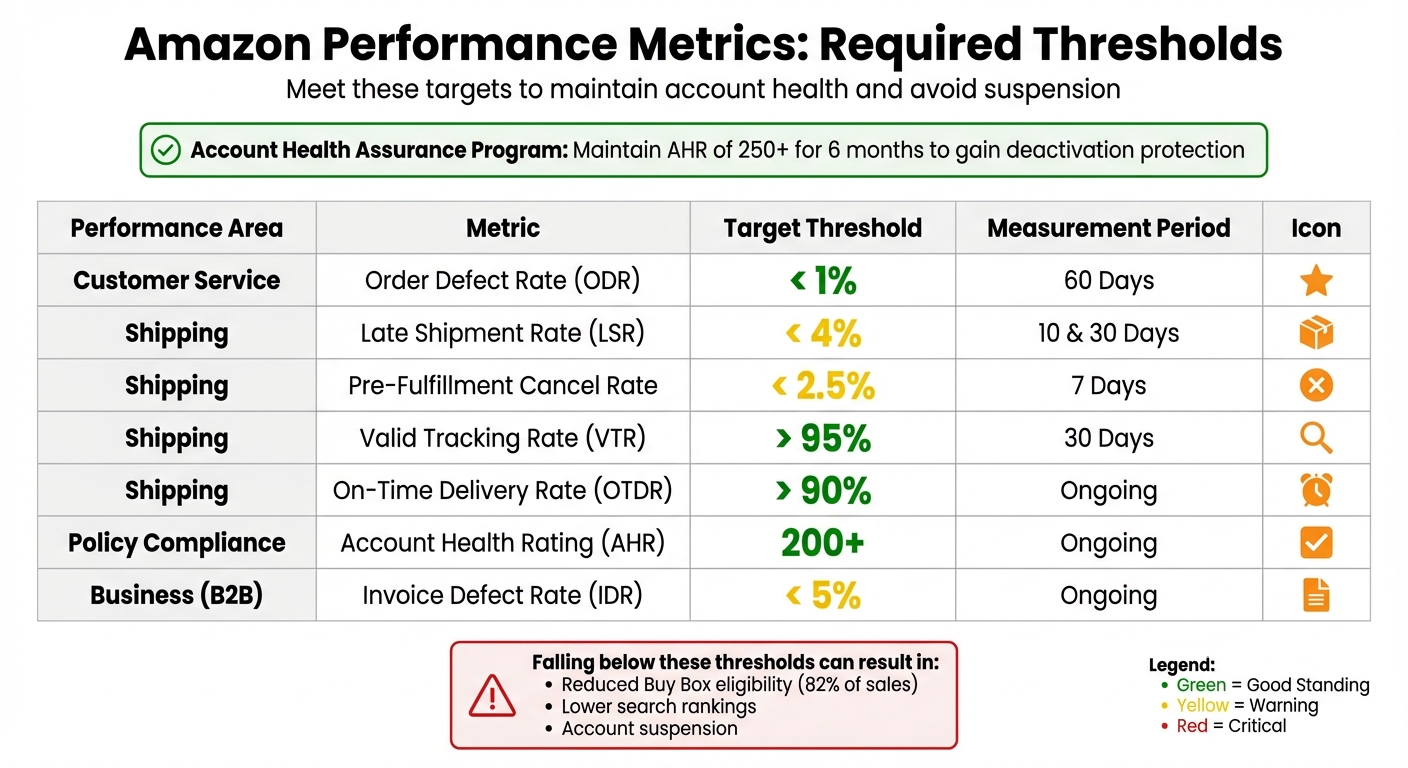
Amazon enforces strict performance thresholds. Sellers need to meet the following targets to maintain a healthy account:
- ODR: Below 1%
- LSR: Under 4%
- CR: Below 2.5%
- VTR: Above 95%
- OTDR: Above 90%
- Account Health Rating (AHR): 200 or higher
- IDR (for B2B sellers): Below 5%
Here’s a quick summary of these targets:
| Performance Area | Metric | Target Threshold | Measurement Period |
|---|---|---|---|
| Customer Service | Order Defect Rate (ODR) | < 1% | 60 Days |
| Shipping | Late Shipment Rate (LSR) | < 4% | 10 & 30 Days |
| Shipping | Pre-Fulfillment Cancel Rate | < 2.5% | 7 Days |
| Shipping | Valid Tracking Rate (VTR) | > 95% | 30 Days |
| Shipping | On-Time Delivery Rate (OTDR) | > 90% | Ongoing |
| Policy Compliance | Account Health Rating (AHR) | 200+ | Ongoing |
| Business (B2B) | Invoice Defect Rate (IDR) | < 5% | Ongoing |
Falling short of these thresholds can lead to serious consequences, including reduced visibility in search results, suspension of listing privileges, or even account deactivation.
"The most common suspension we see based on seller metrics is for late ship rate. While most suspensions are triggered after a manual investigation, late ship rate results in an auto-suspension in Q4." – Leah McHugh, Listing Compliance Investigator, ecommerceChris
To help sellers navigate these risks, Amazon offers the Account Health Assurance (AHA) program. Sellers who maintain an AHR of 250+ for six consecutive months gain protection from deactivation, provided they resolve flagged issues within 72 hours.
Meeting these thresholds isn’t just about avoiding penalties – it’s about protecting your sales and keeping your account in good standing. Every metric directly impacts your business performance and reputation.
What Happens When Performance Metrics Decline
Impact on Sales and Visibility
When performance metrics drop, the effects are immediate and far-reaching. Amazon’s algorithm sees poor metrics as a sign that your products might not meet customer expectations. As a result, your listings get pushed down in search results. This is a big deal because most shoppers don’t look beyond the top three search results.
Then there’s the Buy Box, which is where the majority of sales happen. In fact, about 82% of all Amazon sales go through the Buy Box. But if your Order Defect Rate (ODR) exceeds 1% or your Late Shipment Rate (LSR) goes over 4%, you’re automatically disqualified from the Buy Box. Without access to the Buy Box, your sales can take a significant hit.
Declining metrics also hurt your reputation. A staggering 94% of online shoppers avoid products with negative reviews. Issues like high defect rates or late shipments lead to bad feedback, which creates a downward spiral: poor metrics lead to bad reviews, and bad reviews scare off potential buyers.
For sellers using Fulfilled by Amazon (FBA), the consequences can be even more disruptive. If your Inventory Performance Index (IPI) drops below 450, Amazon imposes storage restrictions and increases overstock fees. This makes it harder to keep popular items in stock, which further impacts your visibility and sales.
And it doesn’t stop there – poor performance metrics also increase the risk of account suspension.
Risk of Account Suspension
When metrics continue to fall, your account could be at risk of suspension. Amazon typically starts with warnings, but repeated violations can lead to temporary or even permanent deactivation. Suspension means your listings are removed, orders can’t be processed, and your revenue comes to a halt.
Amazon uses its Account Health dashboard to notify sellers of potential risks. The dashboard uses color codes: green means you’re in good standing, yellow signals you’re "At-Risk", and red indicates a "Critical" status. If your account moves into the yellow or red zones, you usually have 60 days to fix the issues before Amazon takes action. However, some problems, like a high late shipment rate, can trigger immediate penalties. As Leah McHugh, a Listing Compliance Investigator at ecommerceChris, explains:
"The most common suspension we see based on seller metrics is for late ship rate. While most suspensions are triggered after a manual investigation, late ship rate results in an auto-suspension in Q4."
Certain categories also come with additional rules. For example, if your Valid Tracking Rate drops below 95% in a specific category, Amazon might prohibit you from selling non-FBA products in that category. Similarly, if your On-Time Delivery Rate falls below 90%, your seller-fulfilled offers could be disqualified.
If your account is suspended, you’ll need to act fast. Amazon requires you to submit a Plan of Action within 17 days, explaining the root cause of the issues and outlining how you’ll fix them. On the bright side, sellers enrolled in Amazon’s Account Health Assurance program – which requires maintaining an Account Health Rating of 250+ for at least six months – get some extra protection. If they respond to Amazon specialists within 72 hours, they can avoid immediate deactivation.
sbb-itb-e2944f4
How to Monitor and Improve Performance Metrics
Monitoring Tools and Dashboards
To stay on top of your performance metrics, start with the Account Health Dashboard (found under Performance > Account Health). This tool gives you real-time updates on critical metrics like Order Defect Rate (ODR), Late Shipment Rate (LSR), and compliance data. Make it a habit to check this dashboard weekly to catch and address potential issues early.
For inventory-related concerns, the Inventory Performance Dashboard is your go-to resource. It tracks your Inventory Performance Index (IPI) and highlights problem areas like excess inventory (anything over 90 days of supply), stranded inventory, and sell-through rates. Keeping your IPI above 450 is crucial to avoid storage restrictions.
If you want even more detailed insights, third-party tools like FeedbackFive, SellerPulse, RestockPro, and Sifted Marketplace Intelligence can be game-changers. These tools provide automated alerts, 24/7 monitoring, demand forecasting, and advanced analytics to flag problems before they escalate.
The better you monitor your metrics, the easier it becomes to implement targeted strategies to manage and improve them.
Management Strategies for Better Metrics
To keep your performance metrics in check, aim to stay within these thresholds: ODR below 1%, LSR under 4%, and a Pre-fulfillment Cancellation Rate below 2.5%. Additionally, ensure your Valid Tracking Rate (VTR) is at least 95% and your On-Time Delivery Rate (OTDR) is 90% or higher.
Quick responses to customer issues are critical. Responding to messages or claims within 24 hours can significantly reduce A-to-Z claims and improve customer satisfaction. Using Fulfillment by Amazon (FBA) is another effective way to boost metrics like LSR and VTR.
Beyond customer service, refining your shipping and inventory processes is equally important. For example, set realistic handling times in Seller Central that align with your actual capabilities, especially during high-demand periods like Q4. Regularly auditing your listings to ensure product descriptions match what customers receive can help minimize returns and negative feedback. Tools like SellerPulse and FeedbackFive can send automated alerts to help you address issues quickly.
To prevent stockouts (and the cancellations they cause), aim to maintain 30–60 days of inventory. Demand forecasting tools can help you plan ahead. Additionally, the "Voice of the Customer" dashboard is an excellent resource for reviewing customer complaints and return reasons. Use this feedback to refine your listings and address recurring issues.
If your metrics slip below the required thresholds, act fast. Draft a detailed Plan of Action to tackle the problems and get back on track.
How Emplicit Helps Maintain Account Health

Emplicit’s Account Health Services
Emplicit keeps a close eye on your Account Health Rating (AHR) to ensure it stays out of the "At Risk" or "Critical" zones. By catching potential problems early, they help safeguard your selling privileges and maintain your product visibility.
On the operational side, they use tools like automated stock tracking and demand forecasting to prevent stockouts, which can lead to high pre-fulfillment cancellation rates. Their inventory management approach focuses on maintaining an optimized Inventory Performance Index (IPI) while minimizing excess or stranded inventory.
Emplicit also prioritizes customer interactions by ensuring all responses are handled within 24 hours. This quick action helps avoid A-to-Z Guarantee claims and negative feedback. They enhance product listings with accurate descriptions and clear images, reducing the chances of returns and keeping order defect rates low.
For sellers using Fulfillment by Amazon (FBA), Emplicit works to maintain a valid tracking rate above 95% and ensures delivery standards are consistently met. Regular dashboard audits help identify potential issues early, and they perform root cause analyses before submitting a Plan of Action when necessary.
This level of attention to detail provides a solid foundation for businesses looking to scale effectively.
Solutions for Growing Businesses
Emplicit offers tailored solutions through its Growth and Enterprise plans, designed for businesses at different stages. The Growth plan covers inventory management, account health oversight, and marketplace strategies for up to three platforms. The Enterprise plan takes it further with full-service omnichannel marketing and dedicated USA-based account managers.
"Maintaining a healthy account is essential for any Amazon seller who wants to succeed in the competitive online marketplace… Failing to meet these standards can result in penalties, reduced visibility, or even account suspension." – Marketplace Valet (Emplicit)
Both plans include strategic negotiations and Seller Central optimization to help brands navigate scaling challenges while staying compliant with marketplace policies. Whether you’re expanding to platforms like TikTok Shops, Walmart, or Target, Emplicit ensures your performance metrics stay strong across all channels.
Conclusion: Maintaining Long-Term Account Health
Performance metrics aren’t just numbers – they’re the backbone of your ability to sell on marketplaces like Amazon. Keeping an Order Defect Rate below 1%, a Late Shipment Rate under 4%, and a Valid Tracking Rate above 95% does more than just avoid penalties. It ensures your products gain the visibility they need to thrive.
The stakes couldn’t be higher. With 82% of Amazon sales happening through the Buy Box and 64% of users not venturing beyond the top three search results, your metrics directly impact your revenue. Falling into "At Risk" status can mean reduced visibility, losing Buy Box eligibility, or even suspension.
The key to staying ahead? Consistent monitoring. Regularly reviewing your Account Health Rating helps catch potential issues early and can even qualify top-performing sellers for a 72-hour resolution window. This proactive habit is a cornerstone of maintaining a strong and resilient account.
Industry professionals often highlight the advantages of keeping a healthy account:
"A ‘good’ account health status is not only required for operational rights, but it also adds up to certain benefits such as boosted rankings and improved Buy-Box winning chances."
- Shaival Choksi, YourSeller
Beyond monitoring, expert management services can take the pressure off by handling the technical details – whether it’s drafting Plans of Action or fine-tuning inventory levels. This lets you focus on growth while staying compliant. Expanding to platforms like TikTok Shops, Walmart, or Target becomes a smoother journey when your performance metrics are solid, protecting your business and opening doors for long-term growth. These practices aren’t just about survival – they’re about building a foundation for sustainable success.
FAQs
What are the best ways to improve my Order Defect Rate (ODR) on Amazon?
Improving your Order Defect Rate (ODR) on Amazon means paying close attention to a few critical factors. Start by addressing A-to-Z claims, chargebacks, and negative feedback as soon as they arise. Quick action can prevent these issues from negatively affecting your account health. It’s also crucial to ship orders on time, provide accurate tracking details, and ensure your products meet customer expectations in terms of quality.
Keep a close eye on your listings to catch potential problems, like incorrect product details or pricing mistakes, and fix them immediately. Staying on top of these tasks helps maintain your ODR within Amazon’s acceptable range. If you need extra support, Emplicit offers specialized account health management and fulfillment services to help you stay ahead and grow your business.
What happens if I don’t meet Amazon’s performance metrics?
Failing to meet Amazon’s performance metrics can put your account health at risk. This might lead to warnings, reduced visibility in search rankings, account restrictions, or, in severe cases, suspension or permanent deactivation.
To steer clear of these issues, keep a close eye on key metrics such as order defect rate, late shipment rate, and valid tracking rate. Taking swift action to resolve problems and consistently upholding strong performance standards can safeguard your account and support your long-term success on the platform.
How does my Account Health Rating (AHR) affect sales on Amazon?
Your Account Health Rating (AHR) is a crucial factor in keeping your Amazon seller account in good standing and ensuring steady sales. A poor AHR can lead to serious setbacks, such as reduced product visibility, lower rankings in search results, or even account restrictions and suspensions. These challenges can directly limit your ability to connect with customers and impact your revenue.
To safeguard your account and sales, keep a close eye on important performance metrics like your order defect rate, late shipment rate, and adherence to policies. Quickly resolving any potential issues can help you maintain a strong AHR and keep your business running without interruptions.