

Personalization drives revenue growth and customer loyalty. Businesses that prioritize tailored experiences for high-value customers (HVCs) – those who spend more, buy frequently, and stay loyal – see major financial gains. Here’s why personalization matters and how it delivers results:
- Revenue Impact: Companies excelling at personalization generate 40% more revenue. AI-powered recommendations alone deliver an average 340% ROI within two years.
- Customer Expectations: 73% of consumers expect brands to understand their needs, and 72% engage only with personalized messaging.
- HVC Insights: The top 10%-15% of customers contribute 40% of revenue, with HVCs spending 3x-3.5x more than average customers.
- Retention Benefits: Retaining an existing customer costs far less than acquiring a new one, and personalization boosts repeat purchase rates by 25%-40%.
- Key Metrics: Personalization improves conversion rates by 15%-35%, increases average order value (AOV) by 15%-20%, and enhances customer lifetime value (CLV) by 31%-45%.
Why it works: Personalization reduces friction, delivers relevant offers, and makes HVCs feel valued. For example, McDonald’s saw a 12.89% increase in AOV, and Samsung achieved a 275% rise in conversion rates with tailored campaigns.
How to succeed: Start with clean data, integrate across channels, and leverage AI tools for real-time recommendations. Companies like ECCO and StyleHub have seen 7.4x ROI and 45% revenue growth using these strategies.
Personalization isn’t optional – it’s a proven way to drive growth and loyalty, especially for high-value customers.
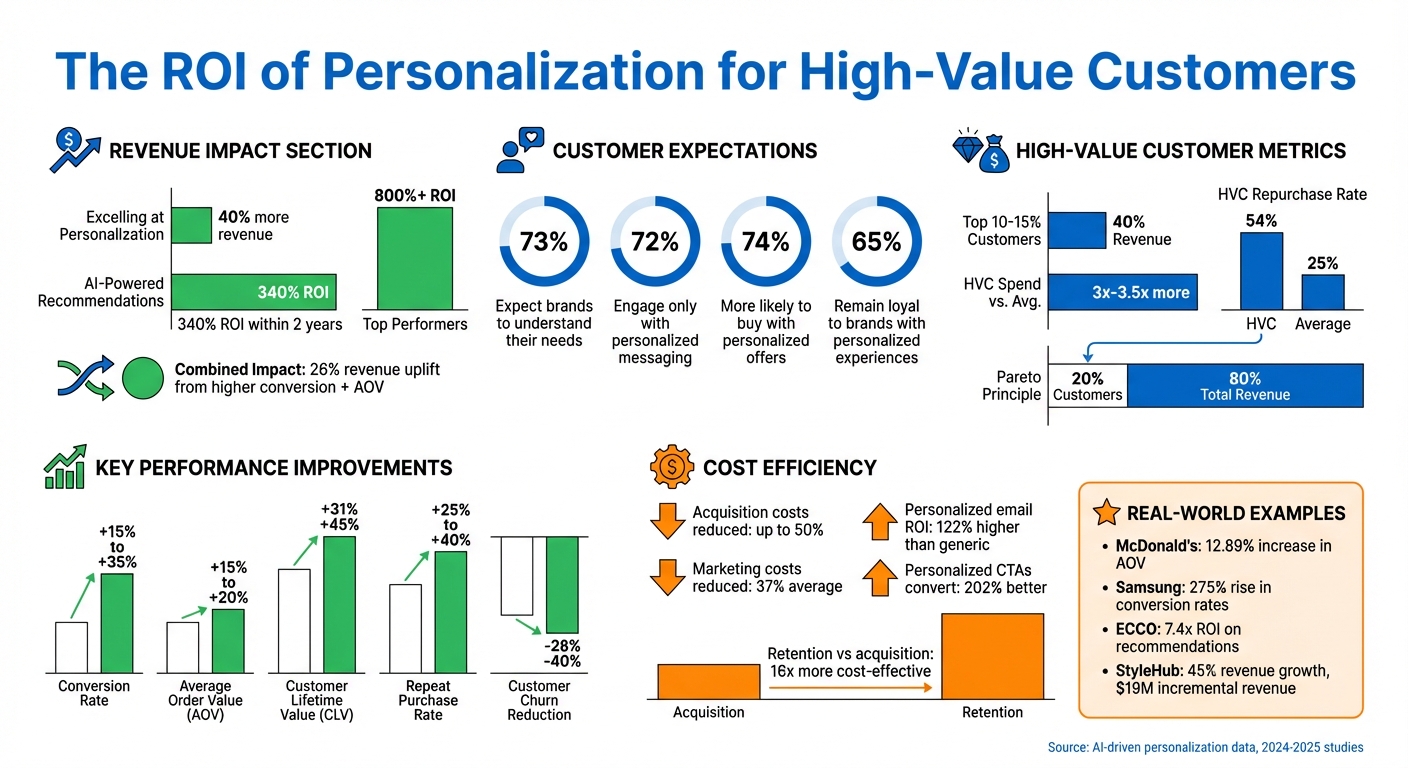
ROI of Personalization: Key Statistics and Revenue Impact for High-Value Customers
The $2 Trillion Personalization Prize Nobody’s Winning
sbb-itb-e2944f4
What Are High-Value Customers and Why Do They Matter?
High-value customers (HVCs) are those who bring the most value to your business over time. These are the shoppers who keep coming back, spend a lot more than the average customer, and stay loyal to your brand. In fact, for many eCommerce businesses, 20% of customers drive 80% of total revenue. This is a classic example of the Pareto Principle, which shows just how important it is to identify and focus on these key customers.
Here’s why they’re so important: retaining a customer is far more cost-effective than acquiring a new one. Studies show it costs 16 times more to form a long-term relationship with a new customer than to retain an existing one. For businesses, particularly those with tight profit margins, catering to HVCs is a smart way to grow sustainably. And it’s not just about their spending – these customers also promote your brand through word-of-mouth, referrals, and user-generated content, essentially making them unpaid advocates for your business.
Characteristics of High-Value Customers
To pinpoint your HVCs, RFM analysis is one of the most reliable tools. This method evaluates customers based on:
- Recency: How recently they’ve made a purchase.
- Frequency: How often they buy.
- Monetary Value: How much they spend during these purchases.
This approach helps you separate casual shoppers from your most loyal and high-spending customers. For instance, while average customers have just a 25% chance of making another purchase, HVCs boast a 54% repurchase rate. Moreover, the top 10% to 15% of your customer base can account for up to 40% of your total eCommerce revenue.
Here’s a snapshot of how HVCs compare to the average customer:
| Metric | High-Value Customers | Average Customers |
|---|---|---|
| Repurchase Rate | 54% | 25% |
| Spending Multiplier | 3x – 3.5x higher | Baseline (1x) |
| Revenue Contribution | ~40% (from 10–15% of base) | ~60% (from 85–90% of base) |
A great example of RFM analysis in action comes from JD Crouse, founder of Bolder Band. By focusing on his high-value segments, he scaled his business to $6.5 million in revenue within three years. The secret wasn’t finding more customers – it was recognizing which ones mattered most and giving them the attention they deserved.
Why Personalization Matters for This Customer Segment
Today’s consumers expect brands to know them. In fact, 73% of consumers want tailored experiences, and high-value customers – who already spend more – expect even greater attention. They want to feel like VIPs, not just another entry in your database.
Personalization meets these expectations while delivering measurable results. For example:
- 74% of consumers are more likely to buy when offers or recommendations are personalized.
- 65% of consumers remain loyal to brands that provide personalized experiences.
- Personalized email campaigns see a 122% higher ROI than generic ones.
- Personalized calls-to-action convert 202% better than standard ones.
For HVCs, personalization isn’t just a nice touch – it’s a necessity. It streamlines their shopping experience, saves them time, and makes them feel like insiders. When you consider that 80% of businesses report increased consumer spending through personalized shopping experiences, it’s clear why this strategy is so effective.
Neil Hoyne, Google’s Chief Strategist for Data and Measurement, sums it up perfectly:
"If my wife ever asked me, ‘Well, how much do you love me?’ The worst answer I can give her is that I love her as much as everyone else."
The same principle applies to your top customers. Treating them like everyone else could mean losing them.
Measuring the ROI of Personalization: Key Metrics
Once you’ve embraced personalization, the next challenge is proving its impact. The key lies in tracking metrics that highlight both immediate results and long-term benefits. On average, AI-driven recommendation systems deliver a 340% ROI within the first two years, with top performers surpassing 800%.
Revenue Metrics Affected by Personalization
Personalization directly influences the numbers that matter most to your business. Three critical metrics to monitor are Conversion Rate (CR), Average Order Value (AOV), and Customer Lifetime Value (CLV).
By reducing friction and offering customers exactly what they need, personalization typically boosts conversion rates by 15% to 35%. For example, personalized calls-to-action convert 202% better than generic ones. Additionally, 98% of online retailers report an increase in AOV due to personalization.
Real-world examples show just how effective this approach can be. McDonald’s saw a 12.89% increase in AOV and a 7.64% boost in conversion rates by introducing personalized upsell messages at checkout. Similarly, Samsung’s multi-channel personalized campaign for the Galaxy Note 9 launch achieved a 275% increase in conversion rates, with the device accounting for 9% of total website sales within 20 days.
Here’s a breakdown of how personalization typically impacts revenue metrics:
| Metric | Expected Impact |
|---|---|
| Conversion Rate (CR) | +15% to +35% |
| Average Order Value (AOV) | +15% to +20% |
| Customer Lifetime Value (CLV) | +31% to +45% |
| Repeat Purchase Rate | +25% to +40% |
When combined, higher conversion rates and increased AOV can drive a 26% revenue uplift. Add to that the boost from repeat purchases – since 49% of consumers become repeat buyers after a personalized experience – and the long-term advantages become even more compelling. For high-value customers, these metrics not only signal immediate revenue growth but also predict loyalty and sustained profitability. These gains, along with reduced costs, highlight personalization’s dual role in driving income and cutting expenses.
Retention vs. Acquisition Costs
Personalization delivers value on two fronts: it simplifies retaining existing customers and makes acquiring new ones more efficient.
On the retention side, the results are impressive. AI-driven personalization can lower customer churn by 28% to 40%. This isn’t just about keeping customers – it’s about maximizing their value. For example, Customer Lifetime Value increases by an average of 31% with personalization, ensuring you gain more from your existing customer base.
When it comes to acquisition, personalization sharpens your strategy. Instead of relying on broad promotions, predictive targeting focuses on high-intent users. Pegasus Airlines used AI-powered Predictive Ad Audiences in 2018 to target likely buyers, achieving a 16% increase in ROAS and a 93% lift in conversion rates within two months. Led by Digital Acquisition Specialist Zeynep Nur Kaya, this campaign highlighted how targeted personalization outperforms one-size-fits-all promotions.
Personalization also cuts costs. It can reduce customer acquisition expenses by up to 50% and lower overall marketing costs by an average of 37%. For instance, personalized email campaigns deliver 122% higher ROI compared to generic ones.
Neeraj Manivannan, Senior Product Marketing Manager at Insider One, sums it up:
"Personalization will, hands-down, give you the most bang for your marketing buck. Not only will it open up new ways to boost revenue… but it will help you get more out of your existing marketing spend, too."
Returns on personalized offers are up to three times higher than those from mass promotions. Yet, most retailers allocate less than 5% of their promotional budgets to personalization. This gap presents a huge opportunity, especially since 65% of consumers remain loyal to brands that provide personalized experiences. For businesses, this means not only stronger relationships with high-value customers but also sustained profitability over time.
How to Implement Personalization at Scale
Implementing personalization effectively requires a strong foundation. Did you know that 68% of personalization efforts fail because of poor data quality – not bad algorithms? Before diving into advanced AI tools, it’s essential to spend 4–8 weeks cleaning up your data. This means merging duplicates, standardizing attributes, and ensuring event tracking works seamlessly across devices.
AI-Powered Recommendations and Dynamic Content
Today’s personalization techniques depend on "relevancy scores." These scores are calculated in real time based on micro-behaviors like hover time, scroll depth, and search intent. This method has largely replaced older collaborative filtering models (think, "customers who bought this also bought that") because it focuses on what customers want right now, rather than relying on outdated historical trends.
"The core of AI personalization is the relevancy score – moving beyond historical data to capture the pulse of the current session." – Vinod Sivagnanam, Senior Product Manager, Adobe
Take Saks Global, for example. They introduced AI-driven homepages that adapted in real time to user behavior, leading to a 7% boost in revenue per visitor. Similarly, Sephora launched an AI Beauty Assistant that offered personalized skin-tone matching and product suggestions, resulting in a 20% increase in online sales. Both companies moved away from rigid, rules-based systems to adaptive models that improve with every interaction.
The tools you use matter. Leading brands often pair a Customer Data Platform (CDP) with a Vector Database to store user preferences and semantic data. Platforms like Dynamic Yield and Nudge use self-retraining models that automatically adjust traffic toward high-performing content variations in real time. This eliminates the delays of manual A/B testing and reduces human bias, which can often lead to less effective outcomes. This kind of setup is key to driving measurable revenue growth, especially for high-value customer segments.
To get the most out of these advanced models, it’s critical to integrate customer data across all channels.
Data Integration and Customer Behavior Analysis
Personalization engines only work as well as the data they rely on. If your system doesn’t know that an online shopper already bought an item in-store, your recommendations will fall flat. Seamless data integration ensures a complete picture of customer behavior by linking mobile ad clicks, desktop browsing, email interactions, and in-store purchases into a single, unified profile.
Showmax is a great example of this in action. In December 2025, they used Braze to build a segmentation system with 600+ metadata tags based on lifecycle stage and content preferences. This effort led to a 204% increase in subscribers and a 71% retention rate. Grubhub also saw success when they used the Braze API in 2020 to pull 32 custom attributes per user for their "Taste of 2020" campaign. This personalized year-in-review effort resulted in a 100% jump in social media mentions and an 18% increase in word-of-mouth referrals.
Real-time data pipelines are non-negotiable. If your system processes data in daily batches, your recommendations will reflect yesterday’s activity – not what your customer wants right now. Brands in retail and eCommerce that add a second messaging channel see 4.5X more purchases per user, but only when those channels share a unified view of customer behavior. Regular monthly audits can ensure your tracking events fire correctly, and server-side tracking can help maintain accuracy despite privacy updates like iOS 14+.
For new visitors who lack historical data, contextual signals like referral source, device type, and location can help. Combine this with first-party consent data to deliver personalized experiences from the very first pageview. This way, even anonymous users can receive tailored recommendations while you build their behavioral profiles.
Case Studies: Results from Personalization Strategies
Real-world examples show how personalization strategies can lead to measurable business results.
Improvements in Conversion Rates and Revenue
ECCO, the global footwear brand, introduced AI personalization across six European domains in Q4 2024. By using Insider’s "Smart Recommender" tool on product listing, detail, and cart pages, they achieved a 7.4x ROI on product recommendations and a 95.6% increase in conversion rates. To combat high mobile cart abandonment, ECCO implemented a Floating Cart Template, which boosted conversion rates by an average of 23.25%, with some regions seeing increases of up to 41%. Additionally, exit-intent overlays with countdown timers reduced bounce rates by 7% and increased click-through rates by 32%.
Karol Kowalski, E-commerce Content Manager at ECCO, shared:
"Insider’s platform impressed us with available tools, mechanism in scenarios that are ready to use. Implementation was fast and seamless, enabling us to achieve ROI fast… They are helping us drive growth at a whole new level."
Other companies have also experienced impressive outcomes with AI-driven personalization. For example, StyleHub, an online fashion retailer serving 2.5 million customers, partnered with Ademero in 2024. Over a 15-week period, StyleHub saw a 45% year-over-year revenue increase, adding approximately $19 million in incremental revenue. Conversion rates improved by 3.8x, and average order values climbed 68%, rising from $127 to $213.
Increasing Customer Lifetime Value
StyleHub’s personalization efforts also led to long-term gains. Customer Lifetime Value surged by 66%, increasing from $285 to $472. Personalized email campaigns delivered dramatic results, with click-through rates up 425%, open rates rising 183%, and customer satisfaction improving from 71% to 92%.
Jennifer Martinez, Chief Marketing Officer at StyleHub, highlighted:
"The AI doesn’t just recommend products – it understands our customers better than they understand themselves. We’ve seen customers discover products they didn’t know they needed, leading to genuine delight and loyalty."
Marc Jacobs provides another example of how personalization drives results. In November 2024, the fashion house implemented Nosto’s AI personalization under the guidance of Director of Ecommerce Laura Gerundo. They launched a "Curated for You" personal storefront and segmented existing handbag customers to encourage cross-category purchases in accessories and footwear. During the Black Friday Cyber Monday 2024 period, these strategies accounted for 22% of total site sales, with product recommendations driving a 137% increase in average revenue per session.
Laura Gerundo noted:
"At any given point during the year, Nosto generates 7-10% of our sales. During the holidays, it can go up to around 20%."
Conclusion
Personalization has shifted from being a luxury to an expectation. Today, 73% of consumers expect brands to understand their individual needs. Ignoring this demand comes at a steep cost, as businesses that excel at personalization generate 40% more revenue than those that don’t. On top of that, 89% of marketers report seeing positive ROI from their personalization efforts.
The numbers speak for themselves: a 10% boost in conversions and 15% higher order values can translate to a 26.5% increase in revenue. Beyond revenue, personalization strengthens loyalty, with 65% of consumers staying committed to brands that provide tailored experiences. AI-powered recommendation systems further amplify these benefits, delivering an average 340% ROI within two years.
For businesses managing high-value customers across multiple channels, the stakes are even higher. Poor personalization cost U.S. retailers a staggering $330 billion in 2021. Meanwhile, personalized email campaigns drive 122% higher ROI compared to generic ones. The gap between leaders and laggards is widening, with companies excelling in personalization achieving revenue growth 10 percentage points higher than those falling behind. These stats underline the urgency of adopting a robust personalization strategy.
The path forward is straightforward: start with impactful initiatives like homepage personalization and cart recovery, focus on integrating first-party data, and use AI to identify customers most likely to purchase. With 92% of companies already leveraging AI for personalization, the time to act is now. For brands catering to high-value customers, delivering tailored experiences isn’t just a strategy – it’s the foundation for long-term success.
FAQs
How do I identify my high-value customers?
High-value customers are the ones who consistently spend more and demonstrate loyalty through frequent purchases. To pinpoint these individuals, examine their purchase history, buying frequency, and spending habits. These customers are ideal candidates for personalized strategies, as customized experiences can strengthen their connection to your brand and increase their overall lifetime value. By focusing on their behaviors, you can separate them from occasional or less engaged buyers.
Which personalization metrics should I track first?
Tracking customer engagement, purchase relevance, and conversion rates is crucial. These metrics reveal how well your personalization efforts are connecting with your audience. They also play a direct role in improving customer satisfaction and boosting your return on investment (ROI).
What’s the quickest personalization win to prove ROI?
If you’re looking to prove the value of personalization quickly, start by sending targeted messages that align with your customers’ preferences. Why? Because it works. Studies reveal that 96% of consumers are more likely to purchase from brands that personalize their messaging, while 81% tend to ignore messages that don’t feel relevant.
This means prioritizing relevance isn’t just a nice-to-have – it’s a direct path to improving engagement and driving conversions.