

A single 1-star review nearly ruined a pet brand selling dog harnesses on Amazon. Sales plummeted, returns surged, and their product disappeared from top search results. But instead of giving up, they tackled the issue head-on with a simple 3-step plan:
- Addressed customer concerns: Public apology, refund, and updated product information.
- Improved product listings: Clear sizing guides, better images, and precise descriptions.
- Optimized advertising: Targeted PPC campaigns and retargeting ads to regain visibility.
The result? An 88.5% revenue increase, 513.31% more 5-star reviews, and their best sales month ever. This shows how turning criticism into action can transform a crisis into growth.
Fix Bad Amazon Reviews Without Breaking the Rules
The Challenge: What the 1-Star Review Did to the Business
One unhappy customer claimed the dog harness didn’t fit properly, and that single complaint snowballed into a full-blown crisis for the brand. The product description lacked enough detail about sizing, leaving room for confusion. What started as one issue quickly spiraled into falling sales and plummeting search rankings.
The damage wasn’t limited to just one dissatisfied customer. Caroline Powell, Marketing Coordinator at Seller Labs, highlighted the broader impact:
"It takes upwards of 20 five-star reviews to counter the effects of a single bad review, as shoppers are more likely to share negative experiences than positive ones".
For this pet brand, years of hard work building a solid reputation were suddenly at risk.
How Sales and Rankings Dropped Immediately
The 1-star review hit hard. Conversions dropped, returns increased, and revenue took a nosedive. A product that had been thriving now struggled to attract new buyers.
The drop in performance pushed the product further down in organic rankings. Fewer shoppers saw it, leading to fewer clicks and purchases. Amazon’s algorithm compounded the problem, creating a vicious cycle that deepened the crisis.
How Amazon’s Algorithm Made Things Worse
Amazon’s algorithm, which prioritizes reviews marked as "helpful", gave the negative review a prominent spot in the "Top Reviews" section. This meant nearly every potential buyer saw it first. The algorithm also factors in conversion rates and recent sales, so as sales dropped, visibility declined even further.
The consequences were severe. A similar situation occurred with Beau & Belle Littles, a family-owned swim diaper brand. A single 1-star review – complete with photos of a soiled diaper that Amazon mistakenly resold – stayed at the top of their reviews for four years. High engagement metrics kept the review prominently displayed, overshadowing hundreds of positive ones. The result? The business fell $600,000 into debt.
This crisis underscored the urgent need for a strategic recovery plan.
The Strategy: A 3-Phase Recovery Plan
To tackle the crisis head-on, the pet brand rolled out a structured, three-phase recovery plan. Their approach focused on addressing customer concerns, revamping product listings, and fine-tuning their PPC campaigns.
Phase 1: Responding to Customer Feedback
The first step was to directly address the customer complaint that sparked the issue. The brand issued a public apology, personally addressing the reviewer by name, thanking them for their feedback, and apologizing sincerely for their poor experience. Instead of offering excuses, they acknowledged the problem, validated the customer’s concerns, and took full responsibility for the confusion caused by their sizing information.
To make things right, they proposed a clear solution: a full refund and a replacement harness in the correct size. They also provided direct contact details to continue the conversation privately, showing their commitment to resolving the issue.
The response didn’t stop there. They assured customers that steps were being taken to prevent future issues. Specifically, they promised updates to their sizing charts and product images. This proactive approach reassured potential buyers that the brand was taking real action to improve.
With the immediate customer concerns addressed, the next step was to make product details clearer for all shoppers.
Phase 2: Updating Product Listings
The product listing received a complete makeover. High-quality images were added, showing the harness from multiple angles and in real-life situations on dogs of varying sizes. To tackle sizing confusion directly, the brand included visuals comparing the harness to a ruler and common household items.
The text on the listing also got a refresh. Vague phrases like "adjustable fit" were replaced with precise details such as "Chest girth adjusts from 16 to 24 inches; suitable for dogs weighing 20–40 lbs." They also clearly outlined the product’s limitations to help manage customer expectations.
Once the listings were updated and clear, the focus shifted to driving traffic back to the product page.
Phase 3: Adjusting PPC Campaigns
With the improved listing ready, the brand revamped its PPC strategy to regain momentum. They launched Sponsored Product campaigns highlighting well-reviewed variations, directing traffic to the parent page where the main product was prominently displayed.
To regain market share, they also ran competitor conquest campaigns targeting searches for similar harnesses. This strategy helped attract shoppers who might otherwise have chosen a competitor.
The brand expanded their efforts by combining Amazon Marketing Services with Demand Side Platform (DSP) ads. These ads reached customers both on and off Amazon, using retargeting campaigns over 30-, 60-, and 90-day intervals. This approach re-engaged shoppers who had been deterred by the earlier issues. With the updated, more trustworthy product page in place, many of these shoppers returned and converted.
Here’s an example of how this strategy can work: a recycled pet litter brand faced a similar challenge when their top-selling ASIN, which accounted for 81% of their revenue, became ineligible for Sponsored Product ads. By running campaigns on other pack sizes and using Amazon DSP to target customers of a competitor that had gone out of business, they achieved a 45.73% increase in ordered revenue and a 30% boost in units sold year-over-year.
sbb-itb-e2944f4
Execution: Rebuilding Trust Through Customer Engagement
After refining their product listings and pay-per-click (PPC) strategy, the next essential step for the brand was to rebuild trust through direct and thoughtful customer engagement.
Reaching Out to the Original Reviewer
The brand decided to address the issue head-on by reaching out privately to the dissatisfied customer. Through Amazon’s Message Center, they sent a personalized message, verified with the customer’s order ID. They offered a full refund, a replacement harness, and direct phone support to resolve the issue.
This private effort was complemented by a public response, which served two purposes: resolving the customer’s concerns and signaling to potential buyers that customer satisfaction is a top priority. Ben Salomon, Growth Marketing Manager at Yotpo, highlights the importance of this approach:
"When you respond to negative feedback, you’re publicly signaling that you value your customers’ experiences and aren’t afraid to face issues. This transparency is vital".
Instead of relying on generic templates, the brand crafted a thoughtful response. They acknowledged the problem, explained the steps being taken to prevent similar issues, and emphasized their commitment to improvement.
Once the individual issue was resolved, the brand expanded its focus to engage with its broader customer base.
Connecting With the Broader Customer Base
Beyond addressing the single review, the brand turned its attention to managing Amazon’s Q&A section. They actively answered customer questions about sizing, materials, and proper usage, often preempting the need for customers to contact support. This proactive approach mirrors a strategy used by K&H Pet Products from 2013 to 2016. Under the leadership of eCommerce Manager Kyle Berg, they tackled misinformation about product dimensions and colors. Their efforts not only reduced customer service inquiries by 50% but also generated over $500,000 in revenue within 28 months.
These actions helped restore trust across their customer base. With 98% of consumers reading online reviews before making a purchase, and 94% of purchases going to products with 4- or 5-star ratings, the brand knew the importance of maintaining a positive reputation. By demonstrating their dedication to transparency and product quality, they successfully shifted the narrative from complaints about "sizing problems" to one of reliability and customer care.
To further enhance their responsiveness, the brand implemented real-time review alerts. This system allowed them to catch and respond to new 1- to 3-star reviews within hours rather than days. Meeting the expectation – held by over 50% of customers – that businesses respond to negative reviews within one week, they turned every interaction into an opportunity to showcase their commitment to standing behind their products.
The Results: From Crisis to Record Sales
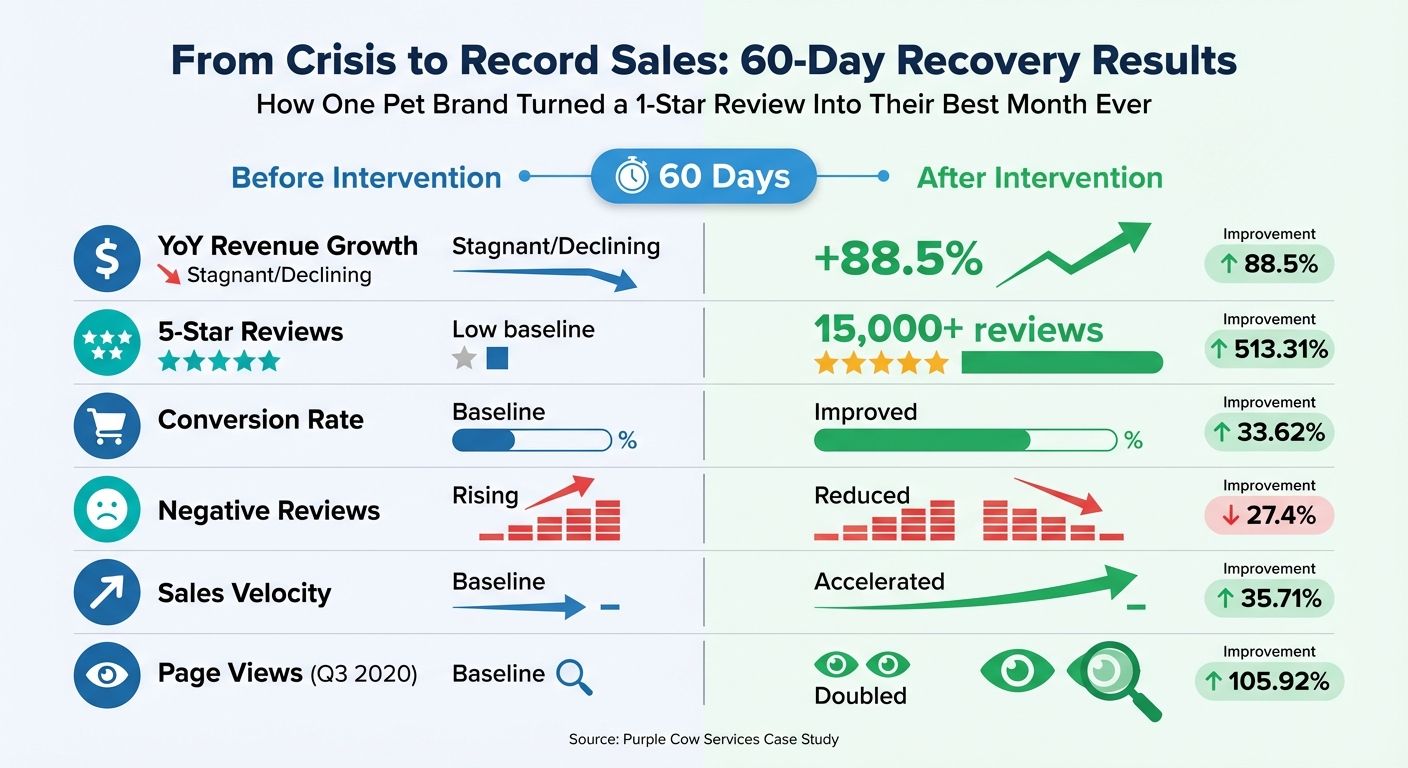
Pet Brand Amazon Recovery: Before vs After Metrics
The recovery plan delivered impressive results. In just 60 days, conversion rates jumped by 33.62%, 5-star reviews skyrocketed by 513.31% to surpass 15,000, and negative reviews decreased by 27.4%, thanks to improved product listings.
Key Metrics Comparison
Every key performance indicator showed measurable improvements. From 2019 to 2020, the brand experienced an 88.5% year-over-year revenue growth. Sales velocity climbed by 35.71%, while page views more than doubled, increasing by 105.92% during Q3 2020. Reflecting on this turnaround, the Chief Digital Officer of the pet products brand shared:
"Working with Purple Cow gave our Amazon presence a serious upgrade. The A+ content, keyword targeting, and inventory insights turned our listings into high-converting assets. We saw our average order value grow by 15%, and our sales have never looked better."
- Chief Digital Officer, Pet Products Brand
| Metric | Before Intervention | After Intervention | Improvement |
|---|---|---|---|
| YoY Revenue Growth | Stagnant/Declining | +88.5% | Significant increase |
| 5-Star Reviews | Low baseline | +513.31% (exceeding 15,000) | Major improvement |
| Conversion Rate | Baseline | +33.62% | Strong lift |
| Negative Reviews | Rising | –27.4% | Substantial reduction |
| Sales Velocity | Baseline | +35.71% | Solid growth |
| Page Views (Q3 2020) | Baseline | +105.92% | Doubled visibility |
Source: Purple Cow Services Case Study
Maintaining Growth: What Worked Long-Term
The brand didn’t just stop at hitting record numbers – they worked to sustain and build on their success. Introducing a Subscribe & Save program helped secure recurring revenue and stabilize cash flow. Real-time review monitoring became a cornerstone of their strategy, allowing them to address negative feedback promptly. They also kept their A+ Content fresh by incorporating new lifestyle images and detailed size guides, ensuring that previous issues didn’t reemerge. By combining proactive customer service, well-optimized listings, and strategic advertising, they managed to maintain momentum well beyond their record-breaking achievements.
Conclusion: How to Turn Problems Into Growth
Even a single 1-star review can spark a transformation. Take this pet brand as an example: instead of ignoring negative feedback, they saw it as a chance to improve. By digging into the root causes of complaints, updating product listings with clearer details, and personally engaging with dissatisfied customers, they turned criticism into meaningful change – and it paid off.
The results? An impressive 88.5% year-over-year revenue growth, a 513.31% surge in 5-star reviews, and a 27.4% drop in negative feedback. These numbers highlight how addressing problems head-on can lead to significant wins. Considering that up to 98% of consumers read reviews before purchasing, every effort to respond and improve becomes a visible signal to potential buyers.
Think of complaints as a guide to betterment. For instance, Dell’s "Voice of Customers" program turned negative reviews into actionable insights, leading to a 50% boost in customer satisfaction scores.
To make this approach work for your brand, set up instant alerts for critical feedback so you can respond quickly. Use timely review requests to encourage more positive ratings . Simple updates, like adding size comparisons and "what’s in the box" visuals to product images, can prevent many "not as expected" complaints before they happen.
The most successful brands on Amazon don’t shy away from negative reviews – they embrace them as opportunities to grow. Often, a customer whose issue is resolved becomes a stronger advocate than one who never had a problem in the first place. That’s the service recovery paradox at work, and it’s exactly how this pet brand turned their worst review into their best sales month.
FAQs
How can a single negative review impact sales on Amazon?
A single 1-star review on Amazon can have a noticeable impact on a product’s success. Amazon’s algorithm tends to favor items with strong ratings and steady streams of positive feedback. So, when a low rating pops up, it can drag down the product’s average score. This could knock the item out of coveted filters like “top-rated,” which many shoppers heavily rely on. The result? Reduced visibility in search results and recommendation sections, leading to fewer clicks and, ultimately, fewer sales.
For many shoppers, even one bad review can raise red flags about a product’s quality, eroding trust and potentially increasing return rates. Over time, this can spiral into a bigger problem: declining sales push the product further down in rankings, making it even harder to bounce back. To counter this, brands need to act fast – responding to the reviewer, addressing their concerns, and making necessary improvements to the product. These steps can help restore trust and keep sales from slipping further.
How can brands effectively recover from negative Amazon reviews?
Brands can transform a 1-star Amazon review into a chance to grow by addressing the issue promptly and showing a commitment to customer satisfaction. Start by responding publicly within 24 hours to acknowledge the problem, apologize sincerely, and propose a solution – whether that’s a refund, replacement, or clear instructions. Use Amazon’s messaging tools to follow up privately with the customer. This approach often leads to updated reviews and stronger customer relationships.
After resolving the immediate issue, dig deeper to find and fix the root cause. Was it a product defect, unclear descriptions, or misleading images? Updating your product listings with accurate details and better visuals not only prevents similar complaints in the future but can also improve your conversion rates. To rebuild your ratings, encourage happy customers to leave reviews using Amazon-approved methods, like compliant post-purchase emails or programs. If the negative review violates Amazon’s guidelines, you can request its removal through Seller Central.
Lastly, turn this negative experience into a story of improvement. Share how you resolved the issue and made changes as a brand through your Amazon Storefront, social media, or email newsletters. Being transparent about how you handle challenges shows customers that you’re committed to their satisfaction, which can ultimately boost trust, loyalty, and sales.
Why should brands respond to negative customer reviews publicly?
Publicly addressing negative reviews plays a key role in maintaining trust and safeguarding your brand’s reputation. When you respond openly, it shows that you value honesty, take responsibility when things go wrong, and are committed to making things right. This approach not only helps mend relationships with dissatisfied customers but also sends a strong message to potential buyers that your brand genuinely listens and cares.
A well-crafted response can turn a challenging situation into a chance to shine. By acknowledging the issue and offering solutions – whether it’s a refund, a replacement, or a sincere apology – you can often win back the trust of unhappy customers. In some cases, these customers might even become your most loyal supporters. Plus, negative reviews often provide valuable insights into areas where your business can improve, helping you refine your products or services.
In today’s world, where reviews can make or break a business, responding to complaints isn’t just about good manners – it’s a smart strategy for building trust, strengthening customer loyalty, and boosting sales.
Related Blog Posts
- Why 73% of Pet Brands Fail on Amazon Before Year Two (And How to Be the Exception)
- The Humanization of Pet Care Is Changing Amazon. Is Your Brand Keeping Up?
- The Real Reason Your Amazon Pet Product Has 4.8 Stars and Still Isn’t Selling
- Why the Fastest-Growing Pet Brands on Amazon Are Spending Less on Ads, Not More