
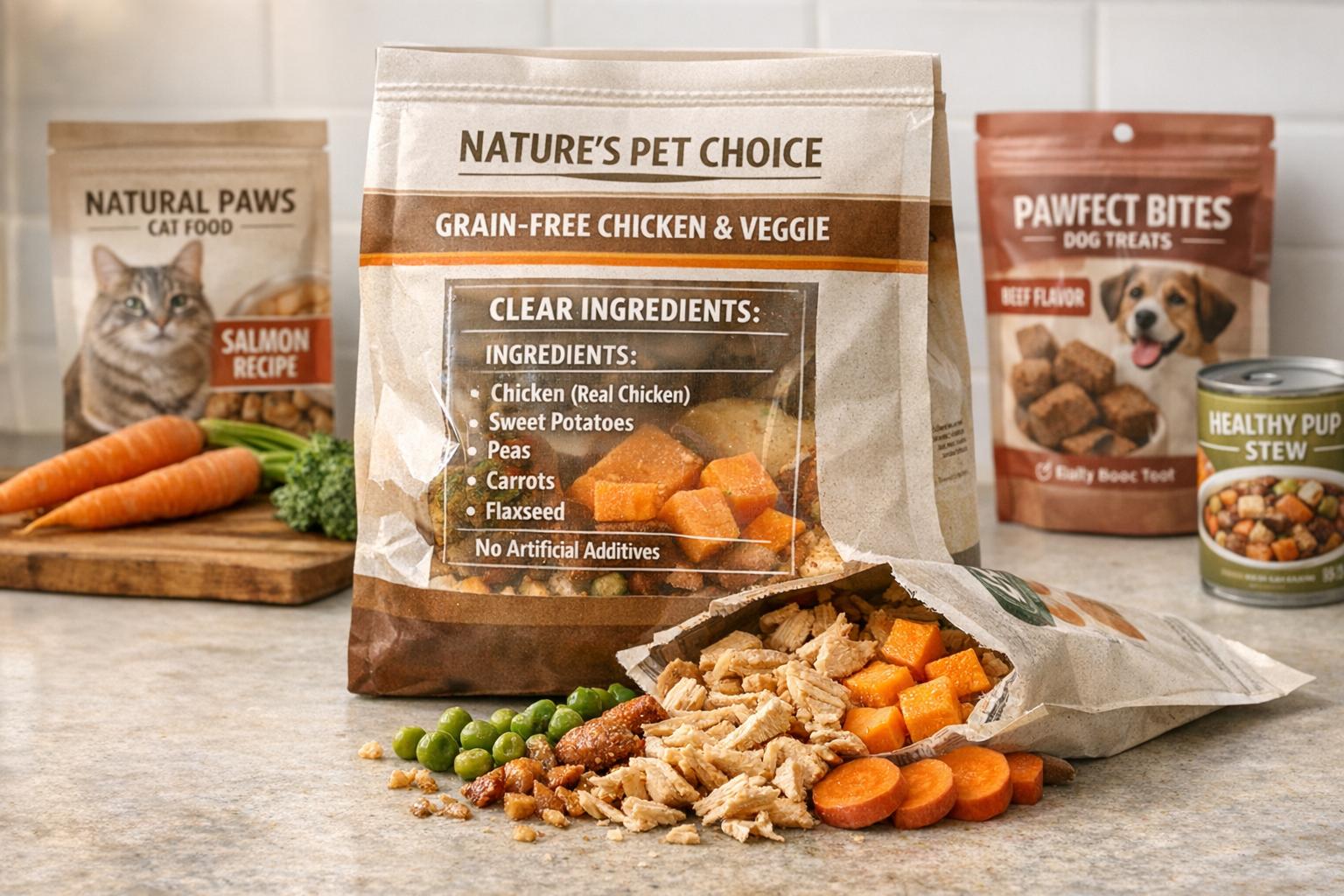
Amazon‘s stricter ingredient transparency rules for pet products demand detailed documentation, including ingredient lists, GMP certification, and Certificates of Analysis. Non-compliance results in immediate product removals, account suspensions, and financial losses. Brands must adhere to rigorous testing standards to verify ingredient safety and avoid banned substances.
Key points:
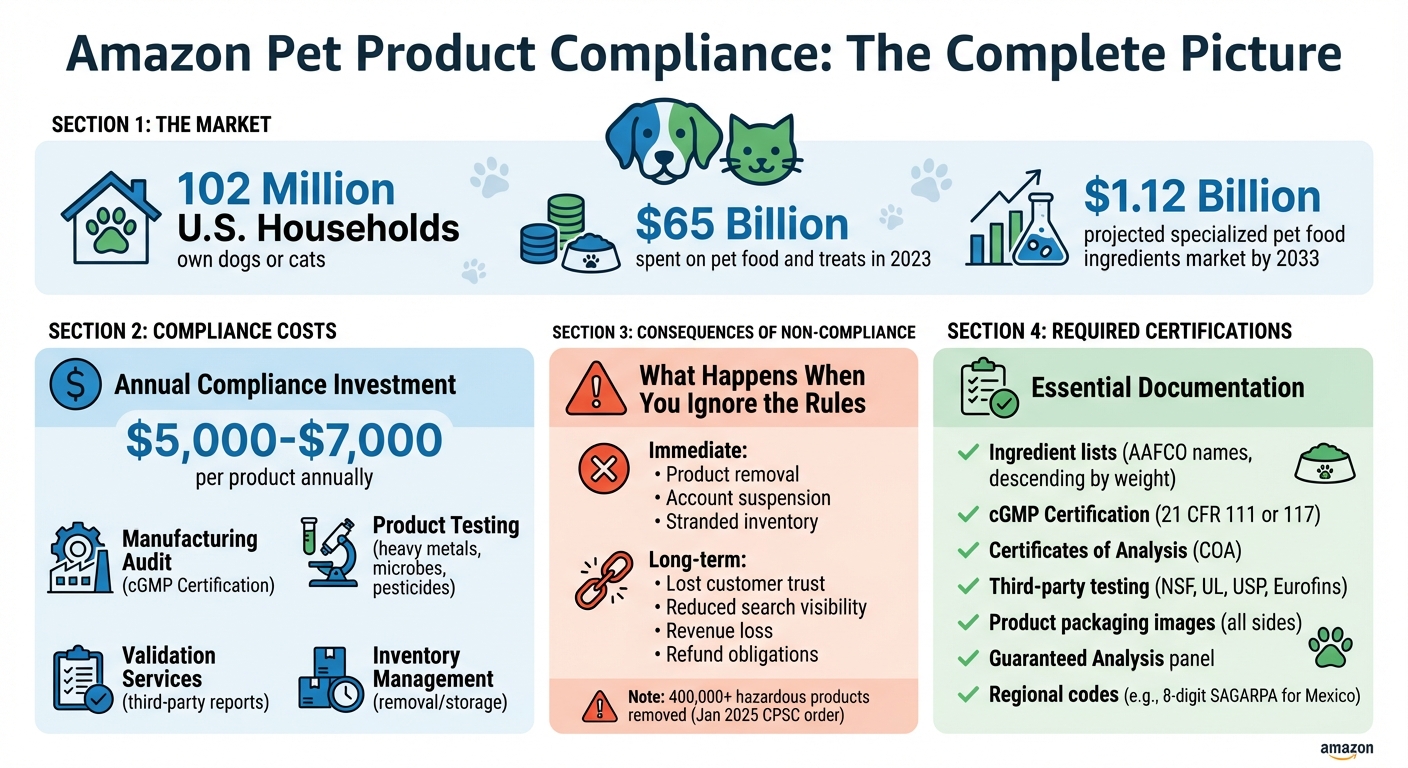
- Costs: Compliance costs $5,000–$7,000 per product annually.
- Consequences: Non-compliance leads to stranded inventory, revenue loss, and damaged brand reputation.
- Testing Requirements: Ingredients must be verified for accuracy and screened for contaminants.
- Banned Claims: Disease treatment claims like "cures anxiety" are prohibited.
- Customer Trust: Transparency builds trust with pet owners prioritizing safety and nutrition.
Compliant brands gain a competitive edge, while those ignoring these rules risk long-term harm to their business.
Amazon Pet Product Compliance: Costs, Consequences & Requirements
How to Avoid Amazon Product Compliance Issues
What Happens Right Away When Brands Don’t Comply
When pet brands fail to meet Amazon’s ingredient transparency requirements, the consequences are swift and severe. Non-compliant listings are removed from the marketplace without delay, cutting off revenue streams almost instantly. This immediate action not only halts sales but also sets the stage for further financial challenges. Amazon’s enforcement of these rules aligns with regulatory pressures, such as the FDA‘s March 2025 Warning Letter (CMS 695821) directed at Amazon for distributing unapproved products through Fulfillment by Amazon.
Suspended Accounts and Removed Listings
If a brand cannot provide the required documentation – like ingredient lists, product labels, or compliance certifications – Amazon takes immediate action by removing the product listings. Once removed, sales stop entirely.
"If you don’t provide the required information… we reserve the right to take any further actions in accordance with the Amazon Services Business Solutions Agreement, including, but not limited to, removing the relevant product listings."
– Amazon Seller Central
These removed products become "stranded inventory". Brands then face two options: pay removal fees to retrieve their products or resolve the compliance issues to restore the listings. Repeated violations tracked through Amazon’s Account Health Rating program can escalate to a full account suspension, cutting off access to the entire Amazon platform.
In January 2025, the U.S. Consumer Product Safety Commission finalized an order against Amazon concerning over 400,000 hazardous products sold by third-party sellers. Effective January 26, 2025, this order required Amazon to take immediate steps, such as notifying customers and issuing refunds to those who could prove product destruction. This established Amazon’s legal role as a "distributor" responsible for third-party compliance failures.
The financial impact of non-compliance doesn’t end with account suspensions – it often leads to significant additional costs.
Higher Costs from Last-Minute Corrections
Rushing to address compliance issues comes with a hefty price tag. Brands must rely on certified third-party TIC (Testing, Inspection, and Certification) providers, as self-submissions are not accepted. These accredited organizations – such as NSF, UL, USP, and Eurofins – charge premium rates for expedited testing of contaminants like heavy metals, microbes, pesticides, and other adulterants.
Additionally, brands need Current Good Manufacturing Practice (cGMP) certifications from recognized accreditation bodies. Amazon does not accept private or consulting audits for this purpose. If a brand’s certification has expired or is not in "good standing", a full re-audit is required before the listing can be reinstated. On top of these costs, brands may face removal fees, stranded inventory storage charges, and even refund obligations to customers. The financial toll can quickly add up.
| Cost Category | What It Covers | Who Provides It |
|---|---|---|
| Manufacturing Audit | cGMP Certification (21 CFR 111 or 117) | NSF, UL, USP, Eurofins, SGS, Intertek |
| Product Testing | Testing for heavy metals, microbes, pesticides | Standards such as NSF/ANSI 173-2024 or USP standards |
| Validation Services | Third-party validation of testing reports | Amazon Service Provider Network |
| Inventory Management | Removal or storage of stranded products | Amazon fulfillment centers |
Delays in providing complete documentation prolong the time it takes to reactivate listings, further extending revenue losses. Prolonged inactivity also affects search rankings, making it harder to recover sales. These immediate and costly challenges highlight why following Amazon’s transparency rules is essential for maintaining success on the platform.
Long-Term Problems from Ignoring the Rules
Ignoring Amazon’s transparency requirements doesn’t just lead to immediate financial losses – it creates long-term challenges that can permanently harm a brand’s reputation and profitability. These issues often stack up over time, making recovery even harder.
Damaged Brand Reputation and Lost Customer Trust
When products fail to meet compliance standards, Amazon issues immediate, highly visible notifications. Under recent regulatory changes, Amazon is now required to directly inform customers when products are deemed hazardous or non-compliant. These notifications are sent via email and appear on the customers’ "Your Orders" pages.
"Amazon must notify the public by posting the recall releases to Amazon.com; notify original purchasers directly via email and by providing information regarding the recalls on each purchaser’s ‘Your Orders’ page."
– U.S. Consumer Product Safety Commission
In January 2025, the U.S. Consumer Product Safety Commission (CPSC) issued a Final Order against Amazon, holding the platform accountable as a "distributor" for over 400,000 hazardous products sold by third-party sellers. This order required Amazon to issue full refunds for unsafe items, including faulty carbon monoxide detectors and flammable children’s sleepwear. As a result, Amazon has become far more vigilant about removing brands that pose regulatory risks.
With federal oversight of pet food safety becoming less reliable due to staffing cuts, consumers are increasingly relying on platforms like Amazon to ensure products meet safety standards. Brands that fail Amazon’s transparency checks lose the trust associated with being sold on a major retail site. Considering Americans spent $65 billion on pet food and treats in 2023 alone, losing consumer confidence can shut brands out of a massive market.
"Regulation of pet food in the U.S. is spotty… FDA oversight of the sprawling industry is shrinking thanks to mass federal layoffs."
– Katherine O’Malley, Senior Policy Analyst, Boston University School of Public Health
Beyond the blow to customer trust, non-compliance also impacts how visible your products are on Amazon.
Reduced Visibility in Amazon Search Results
Amazon’s search algorithm gives priority to compliant listings. If your products fail to meet transparency standards, they can be flagged, resulting in stranded inventory or outright removal from search results. Even after addressing compliance issues, recovering lost visibility is not guaranteed.
Compliant brands, on the other hand, gain a competitive advantage by showcasing certifications from trusted organizations like Eurofins, NSF, or UL. These certifications act as trust signals, improving both customer confidence and search rankings. Non-compliant brands risk becoming invisible to the 102 million U.S. households that own a dog or cat.
Amazon’s stricter policies now require brands to provide testing data and certificates of analysis from authorized labs upfront, rather than simply responding to complaints after the fact. Brands that can’t meet these demands may find themselves overshadowed by competitors who can.
Declining Sales and Limited Growth Potential
Non-compliance doesn’t just hurt visibility – it also eats into revenue. Products that fail to meet standards often end up as "stranded inventory" in Amazon’s fulfillment centers, racking up storage fees without generating sales. In some cases, Amazon may issue full refunds to customers, resulting in a total loss of revenue for those products.
For example, in March 2025, the FDA issued a Warning Letter (CMS 695821) to Amazon CEO Andy Jassy regarding the sale of unapproved injectable drug products like "LemonBottle Ampoule Solution" through the Fulfillment by Amazon service. The FDA flagged these products for making unauthorized medical claims, warning that failure to address these issues could lead to legal actions such as product seizures or injunctions. Such enforcement actions create significant barriers for brands trying to grow on the platform.
When brands fail to comply voluntarily, the FDA escalates enforcement through measures like seizures, injunctions, and even criminal prosecution. These actions can freeze product expansion, limit customer access, and strip brands of opportunities like the coveted Buy Box. Without compliance, growth potential vanishes, leaving brands locked out of a marketplace that’s projected to reach $1.12 billion in specialized pet food ingredients by 2033.
sbb-itb-e2944f4
How Pet Brands Can Meet Amazon’s Requirements
Staying compliant with Amazon’s ingredient transparency rules is no longer optional – it’s essential for avoiding suspensions and protecting your revenue. While the process might seem daunting, breaking it into clear steps can make it much easier to manage.
Review All Product Ingredients Against Amazon’s Lists
Start by thoroughly auditing your product ingredients against Amazon’s banned lists. For instance, any CBD-based products, even those derived from hemp, are prohibited and will be removed immediately. This includes oils, treats, and any formulations containing CBD.
When listing ingredients, use the names established by AAFCO and arrange them in descending order by weight. For example, a product labeled "Beef Dog Food" must contain at least 70% beef (95% excluding water), while products labeled "With Chicken" need to include at least 3% chicken. Mislabeling products can lead to legal issues under both state and federal laws.
Avoid making drug claims that suggest curing, treating, or preventing diseases. Instead, use structure/function claims like "supports joint comfort" or "promotes coat health." Be sure to include the FDA disclaimer: "This statement has not been evaluated by the FDA. This product is not intended to diagnose, treat, cure, or prevent any disease".
Additionally, your product labels must feature a Guaranteed Analysis that details the minimum crude protein and fat content, as well as the maximum crude fiber and moisture levels. If your product is a complete food, include a Nutritional Adequacy Statement.
Get Required Certifications from Third Parties
Amazon now requires sellers in certain high-risk categories to work with accredited third-party testing, inspection, and certification (TIC) service providers. You can find these providers through Amazon’s Service Provider Network (SPN) in Seller Central.
For pet supplements, ensure your manufacturing facilities comply with Current Good Manufacturing Practice (cGMP) regulations under 21 CFR 111 or 21 CFR 117. Accredited organizations like NSF, UL, or USP must conduct these audits, and only valid, up-to-date certificates are accepted.
You’ll also need Certificates of Analysis (COA) from your suppliers to confirm the purity and potency of active ingredients. Conduct third-party testing for microbial safety, potency, and stability for every batch to avoid contamination risks like Salmonella.
If you’re selling in specific regions, additional certifications may apply. For example, in Mexico, pet food and supplements require an 8-digit authorization code from SAGARPA/SENASICA, which must appear on your product packaging. For European markets, compliance with EU regulations on additives and marketing often requires an establishment approval number.
| Requirement Type | Accepted Certification Programs / Standards |
|---|---|
| cGMP Audits | Eurofins, NSF/ANSI 455-2, UL GMP, USP GMP, SGS, Intertek, TGA, SQF, GFSI |
| Product Testing | NSF/ANSI 173-2024, USP <2022>, <2021>, <561>, <62> |
| Regional Codes | SAGARPA 8-digit authorization (Mexico) |
| EU Compliance | FEDIAF Labeling Code, FEFAC Labeling Code |
Once you’ve secured the necessary certifications, update your product listings to reflect your compliance.
Update Product Listings with Clear Ingredient Information
After verifying your ingredients and obtaining certifications, ensure your Amazon product listings clearly communicate this compliance. Start by including an ingredient list in descending order of weight, using AAFCO-approved names. This meets regulatory standards and helps prevent misbranding.
Include high-resolution images of your product packaging, showing all sides, especially the Supplement Facts or Composition panel. These images should display the ingredient list, usage instructions, and any hazard warnings. For EU listings, add the "Analytical constituents" (crude protein, crude fat, crude fiber) under a dedicated header.
Remove any claims that suggest diagnosing, curing, or preventing diseases. Avoid using the FDA logo in your images, as it can imply false government approval. Additionally, ensure that QR codes or links in your product descriptions don’t lead to unapproved medical claims.
All required labeling information, including safety warnings and instructions, must be in the official language of the country where the product is sold. For the U.S., that means English; for Mexico, it’s Spanish.
Finally, clearly indicate the unit count in your listing, such as "60 Soft Chews" or "12 oz". Avoid misleading claims, like stating 10,000mg of a raw herb when the actual extract amount is only 500mg. Transparency is key – especially when you consider that 94 million U.S. families now own pets and are paying more attention than ever to ingredient labels.
Examples: Brands That Failed or Succeeded with Compliance
Example: A Brand That Lost Revenue from Non-Compliance
The consequences of non-compliance can be harsh, as highlighted by the CPSC’s final order, which led to widespread product deactivations. Pet products were hit especially hard, with many brands seeing their ASINs deactivated and inventory destroyed. In some instances, companies managed to recover sales after addressing compliance issues, but the financial toll was undeniable.
For pet brands, even small oversights like missing allergen labels or unapproved claims such as "antibacterial" can result in immediate listing removal and inventory destruction. Amazon’s updated ingredient transparency rules leave little room for error, making it critical for sellers to stay vigilant.
For example, pet products using claims like "kills germs" without proper EPA documentation are flagged almost immediately. When this happens, listings disappear, FBA inventory is wiped out, and accounts may even face suspension. These scenarios underline how failing to meet compliance standards can lead to significant revenue losses.
However, it’s worth noting that companies that take proactive steps to meet these requirements can turn these challenges into opportunities for growth.
Example: A Brand That Grew by Meeting the Requirements
On the flip side, brands that embraced compliance measures saw tangible growth. For instance, success often came from submitting all necessary documentation upfront. This included providing the 8-digit SAGARPA authorization code, clear images of packaging from all angles, and detailed ingredient lists arranged by weight. Meeting these requirements not only ensured compliance but also built trust with customers.
Brands that updated their listings with high-quality images of their product packaging, removed unapproved drug claims, and included safety information in the local language noticed a boost in customer confidence and fewer product returns. These updates aligned perfectly with Amazon’s compliance standards, linking transparency and certification directly to business success.
Conclusion: Meeting Amazon’s Standards to Protect Your Business
Failing to comply with Amazon’s rules can lead to immediate product removals, account suspensions, and long-term harm to your brand – especially in the highly competitive $65 billion pet food industry. With over 102 million U.S. households owning dogs or cats, the market potential is enormous. However, this opportunity is only available to brands that align with Amazon’s strict standards. Simply put, following these rules isn’t optional – it’s critical.
The urgency of compliance was underscored in March 2025 when the FDA issued a warning to Amazon CEO Andy Jassy, highlighting the growing regulatory focus on transparency and safety. This heightened scrutiny makes it clear: meeting these requirements is no longer just about avoiding penalties; it’s about securing your business’s future.
One key area to focus on is ingredient labeling. The FDA’s proposed 2026 mandate will require formal GRAS (Generally Recognized As Safe) notifications for all food ingredients. Without accurate and transparent labeling, products risk being classified as "unapproved new drugs", which can lead to seizures or legal actions.
To ensure your listings are protected, take immediate action. Start by auditing your product labels to eliminate prohibited claims, verify ingredient safety, and include clear, detailed packaging images that show all sides of your product. Additionally, partner with accredited third-party testing providers to validate your documentation and meet regional requirements, such as displaying the 8-digit SAGARPA code for international sales.
Transparency isn’t just a regulatory requirement – it’s a way to build trust and stand out in a crowded marketplace. By taking these steps now, you not only avoid potential penalties but also strengthen consumer confidence. Brands that prioritize compliance today are setting themselves up for long-term success tomorrow.
FAQs
What documents are required to comply with Amazon’s ingredient transparency rules for pet products?
To comply with Amazon’s ingredient transparency rules for pet products, sellers need to submit detailed and verified documentation. Here’s what you’ll need to provide:
- Complete ingredient list: Clearly list every ingredient by its exact name, including percentages or weights if required. This must align with the product’s label and adhere to FDA and AAFCO guidelines.
- Proof of regulatory compliance: Include documents such as an FDA-approved label or an AAFCO compliance checklist to show the product meets both federal and state pet food regulations.
- Third-party testing or Certificates of Analysis (COA): Supply evidence that ingredients are pure, effective, and free of banned substances. For pet supplements, annual third-party lab verification is mandatory.
- Manufacturing facility documentation: Confirm that the production facility follows FDA’s current Good Manufacturing Practices (cGMP).
Providing these documents not only ensures your listings meet Amazon’s standards but also safeguards your account and builds trust with customers.
What are the risks for pet brands that don’t follow Amazon’s new ingredient transparency rules?
Failing to meet Amazon’s ingredient transparency requirements can lead to serious setbacks for pet brands. One of the most immediate consequences is account suspension, which halts your ability to sell on the platform until the issue is addressed. Beyond that, today’s consumers are placing a high value on transparency. If your listings don’t clearly outline ingredient details, you risk losing their trust – and with it, their loyalty. This can directly impact your sales and long-term growth.
To steer clear of these challenges, it’s essential to ensure your product listings fully align with Amazon’s standards. This means providing precise and thorough ingredient information for each product you sell. Staying compliant doesn’t just help you avoid penalties; it also safeguards your brand’s reputation, strengthens customer trust, and keeps you competitive in a crowded marketplace.
How can pet brands comply with Amazon’s new ingredient transparency rules?
To meet Amazon’s updated ingredient transparency requirements, pet brands need to ensure their product labels are accurate, complete, and aligned with federal regulations. This means including a full list of ingredients, detailed nutritional information, and any required warnings. It’s crucial that your Amazon listings reflect the exact details found on the product’s physical labels – this includes avoiding any unapproved claims.
Regular third-party testing is another must. It helps confirm the quality and safety of your ingredients. Additionally, maintaining detailed records of your formulations and ingredient sourcing is key to staying compliant. Keep an eye on Amazon’s policy updates to ensure you’re always up to date. By sticking to these practices, you can avoid account suspensions, maintain customer trust, and keep your sales on track.
Related Blog Posts
- Why 73% of Pet Brands Fail on Amazon Before Year Two (And How to Be the Exception)
- The Humanization of Pet Care Is Changing Amazon. Is Your Brand Keeping Up?
- Amazon Just Changed How Pet Food Ranks. Most Brands Won’t Notice Until It’s Too Late.
- The Pet Brands Winning on Amazon in 2025 Aren’t Playing the Same Game You Are