

If you’re focused only on keywords, you’re leaving money on the table.
Amazon’s pet category hit $22.6 billion in 2024, growing 25.3% year-over-year. While many brands rely on keyword strategies for visibility, top performers go further by analyzing customer behavior data. This approach helps them understand why and when customers buy, leading to higher conversions, better product bundling, and stronger customer loyalty.
Key takeaways:
- Keywords alone won’t drive sales: High visibility doesn’t guarantee purchases.
- Behavior data matters: Tools like Amazon Brand Analytics reveal buying habits, repeat cycles, and cart trends.
- Real results: Brands like PETKIT grew 45% by using data-driven strategies, while Hartz increased revenue by 450%.
If you want to grow on Amazon, focus on customer behavior – not just search terms.
1. Traditional Keyword Optimization
Strategy
Traditional keyword optimization focuses on aligning product listings with customer search terms (relevance) and evaluating sales velocity (performance). For pet brands, this often means cramming listings with broad terms like "dog food" or "cat toys" to cast a wide net for search traffic. The primary goal? Visibility – often at the expense of understanding what truly drives purchases.
Key Tactics
To identify impactful keywords, brands rely on tools like Amazon Autocomplete to see what shoppers are typing into the search bar. They also conduct reverse ASIN lookups to analyze competitor listings and use PPC data from Search Term Reports to pinpoint queries that lead to sales.
Keyword placement plays a massive role in Amazon’s rankings. The algorithm assigns the most weight to keywords in the Title, followed by Bullet Points, Backend Search Terms, and the Product Description. To maximize visibility – especially on mobile devices, which account for over 85% of Amazon purchases – brands aim to front-load titles with critical keywords within the first 50–80 characters.
While these tactics can improve search rankings, they don’t necessarily guarantee conversions.
Visibility Impact
Amazon has become the starting point for over 60% of online shoppers, surpassing Google. More importantly, over 70% of Amazon sales happen on the first page of search results. Guy Arad, Co-Founder of thefitguy, highlighted the potential gains from keyword optimization:
"quarterly sales jumped over 40% after optimizing for best search terms using the Amazon Brand Analytics Search Terms and Search Query Performance dashboard".
However, high visibility doesn’t always translate into sales. If a listing isn’t "retail ready" – lacking engaging visuals, competitive pricing, or strong reviews – keyword-focused traffic can lead to wasted ad spend. Amazon’s algorithm places heavier importance on performance metrics like conversion rates and actual sales, making these factors more influential than keyword relevance alone.
Key Limitations
Despite its benefits, traditional keyword strategies come with notable challenges. Short-tail keywords like "dog bed" are fiercely competitive, making it tough for smaller brands to achieve profitable results. Backend keywords are also limited to 250 bytes, meaning brands must avoid duplicating terms already used in the title to maximize space. Worse, overloading listings with keywords (keyword stuffing) can hurt rankings and make descriptions harder to read.
Another major drawback is the lack of deeper customer insights. Without data on cart abandonment, product bundling, or repeat purchases, brands are left making educated guesses. This limits their ability to refine strategies for long-term success.
sbb-itb-e2944f4
2. Customer Behavior Data Optimization
Strategy
Optimizing customer behavior data shifts the focus from simply tracking what people search for to understanding how they shop. Instead of relying solely on keywords, top pet brands analyze purchase habits, demographics, and loyalty trends using Amazon Brand Analytics – a free toolset available to members of the Brand Registry. This method prioritizes key performance factors like sales velocity and conversion rates, which Amazon’s algorithm values more than keyword relevance alone.
Knowing who your customers are and why they keep coming back is far more impactful than just ranking for generic keywords. This understanding lays the groundwork for actionable strategies that follow.
Key Tactics
Brands rely on the Search Catalog Performance dashboard to uncover where customers drop off in the buying journey – from initial impressions to cart additions and final purchases. By analyzing this funnel, companies can determine whether updates like better images or more competitive pricing can reduce cart abandonment.
The Market Basket Analysis tool reveals which products are commonly purchased together, enabling brands to create virtual bundles that boost average order value without increasing inventory costs. Jason Panzer, President of HexClad, shared how his team uses this insight:
"It [Market Basket Analysis] helped us determine which items we should try to cross-sell or upsell because we can identify typical purchase combinations".
The Customer Loyalty Analytics dashboard categorizes shoppers into four groups: Top Tier (high spenders), Promising (recent buyers), At Risk (infrequent purchasers), and Hibernating (inactive customers). This segmentation helps brands re-engage at-risk groups with targeted promotions. Additionally, the Demographics dashboard provides details like age, income, education, and gender, which can guide more personalized A+ Content and advertising strategies.
These tools transform customer insights into actionable steps that drive better conversions.
Conversion Boost
Using behavior-driven insights can spark Amazon’s "flywheel effect", where improved conversion rates and faster sales velocity lead to higher organic rankings. Data-informed A+ Content alone can increase conversion rates by 3%–10%, with some cases reaching up to 20%. Similarly, Amazon Storefronts designed with customer behavior in mind have seen conversion rates rise by as much as 41%.
For example, HawaiiPharm achieved over 700% growth in 2025 compared to market leaders by leveraging data-driven strategies to expand its dog supplement market share by 240%. PETKIT also saw impressive results, capturing 28% of the self-cleaning litter box market while achieving 45% year-over-year growth by addressing specific customer needs identified through behavior data.
Examples
Hartz, a cat treat brand, used market data in 2025 to significantly grow its presence, increasing market share by 127% and revenue by over 450%. By analyzing product pairings and demographic preferences, Hartz developed targeted bundles and messaging that resonated with its audience.
Programs like Amazon’s Subscribe & Save also play a key role, delivering an additional 13% wallet share. Tracking repeat purchases enables brands to adjust ad spending and build a loyal customer base. With 65% of pet owners citing ingredient quality as their top priority when choosing pet food, behavior data helps brands emphasize the features that matter most to their audience.
Pros and Cons
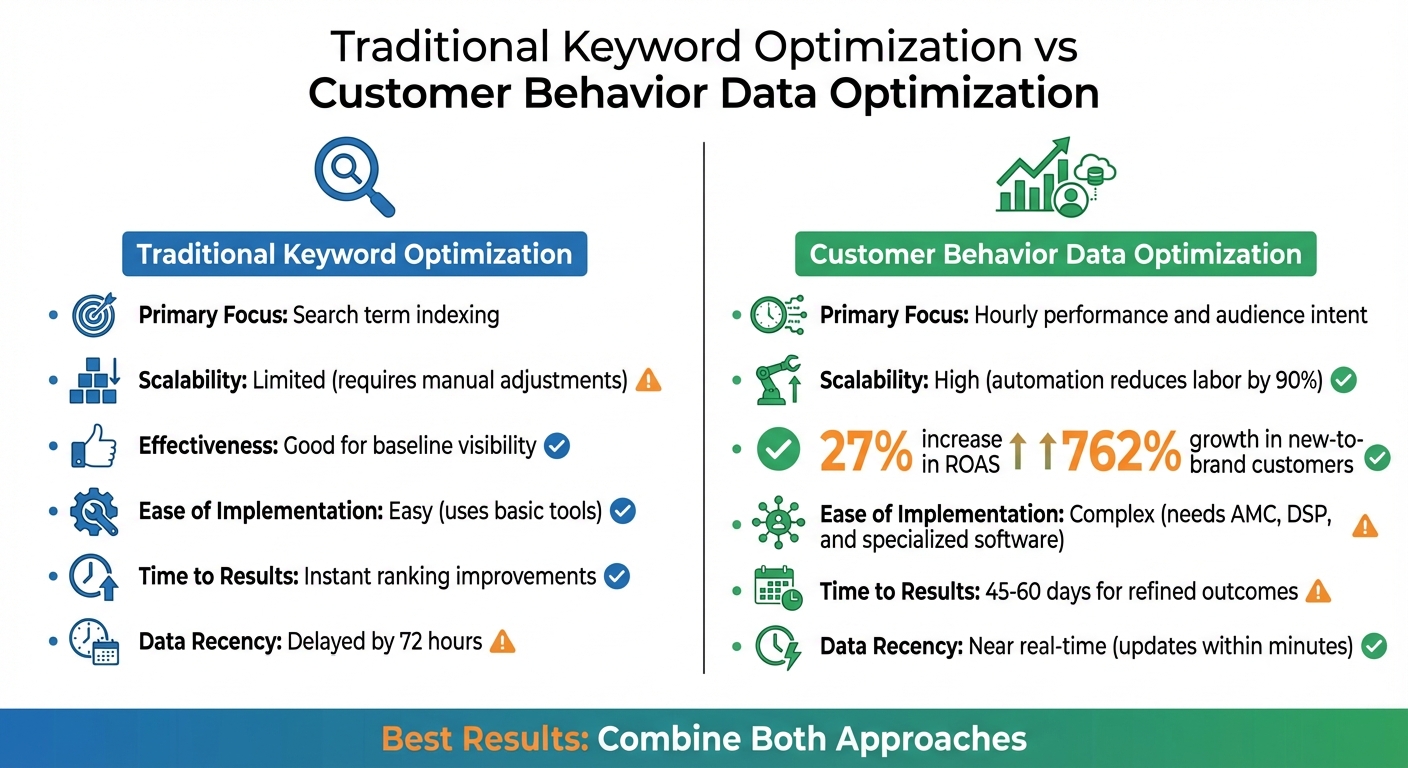
Traditional Keyword Optimization vs Customer Behavior Data Optimization for Amazon Pet Brands
Let’s take a closer look at how traditional keyword optimization and customer behavior data optimization stack up when it comes to efficiency, scalability, and overall effectiveness.
Traditional keyword optimization relies on Seller Central’s basic tools to achieve quick visibility gains. While this method works well for immediate exposure, it has limitations. Search volume constraints and competition for popular terms often make it challenging to stand out. Additionally, manual keyword research and frequent bid adjustments make scaling labor-intensive and time-consuming.
On the other hand, customer behavior data optimization offers more impactful, long-term outcomes. For instance, brands leveraging rapid retail analytics in Q1 2023 saw a 27% increase in return on ad spend (ROAS) and an astounding 762% growth in new-to-brand customers through full-funnel strategies. This method thrives on automation, cutting campaign setup time from 10 hours to under an hour. However, it’s not without challenges – advanced tools like Amazon Marketing Cloud require technical expertise, and meaningful results often take 45–60 days to materialize.
Here’s a side-by-side comparison of the two approaches:
| Criterion | Traditional Keyword Optimization | Customer Behavior Data Optimization |
|---|---|---|
| Primary Focus | Search term indexing | Hourly performance and audience intent |
| Scalability | Limited; requires manual adjustments | High; automation reduces labor by 90% |
| Effectiveness | Good for baseline visibility | Excels in ROAS (27% boost) and customer acquisition (762% growth) |
| Ease of Implementation | Easy; uses basic tools | Complex; needs AMC, DSP, and specialized software |
| Time to Results | Instant ranking improvements | 45–60 days for refined outcomes |
| Data Recency | Delayed by 72 hours | Near real-time (updates within minutes) |
From the table, it’s clear that traditional keyword optimization is indispensable for building initial visibility, while behavior data optimization takes results to the next level by driving conversions and organic growth. The best-performing brands don’t choose one or the other – they combine both. Keywords create the foundation for discoverability, while behavioral data works as a multiplier, boosting conversions and improving organic rankings over time.
As Ross Caveille, Co-founder of Acorn-i, explains:
"Rapid retail analytics has helped Acorn-i develop enhanced measurement, reporting, and optimization solutions for advertisers, resulting in improved operational efficiencies and performance uplifts".
Before diving into advanced behavioral strategies, it’s crucial to ensure "retail readiness." This means having high-quality product images, strong reviews, and conversion-optimized listings. Without these basics, ad spend can easily go to waste. Once this foundation is solid, scaling into more advanced tactics becomes much more effective.
Conclusion
Traditional keyword optimization might help get your products noticed, but it’s understanding and leveraging customer behavior data that turns casual browsers into loyal buyers. This shift highlights Amazon’s emphasis on conversion metrics over basic search term alignment. Metrics like conversion rates, sales velocity, and customer retention carry far more weight than simply stuffing your listings with keywords. With the category growing at 25.3% year-over-year and representing a $22.6 billion market opportunity, the brands that succeed are those focusing on how customers act – not just what they search for.
To make the most of customer behavior data, consider these actionable steps:
- Analyze key metrics: Use Amazon Brand Analytics to review Repeat Purchase Behavior and Customer Loyalty Analytics dashboards. Identify which products deliver the highest lifetime value.
- Leverage Market Basket Analysis: Discover products frequently purchased together and create bundles that boost your average order value.
- Optimize for Subscribe & Save: Position your listings to take advantage of this program, capturing a greater share of customer spending.
- Refine your organic listings: Use insights from your Search Term Reports to identify high-performing keywords and integrate them into your listings – not just your PPC campaigns.
These strategies elevate your approach from basic keyword tactics to a comprehensive, data-driven method.
Top-performing pet brands, for example, combine visibility through keywords with conversions driven by behavior data. Start by ensuring your listings are retail-ready – complete with high-quality images, competitive pricing, and strong reviews. From there, scale your efforts using advanced behavioral strategies. This shift takes you from simply competing on keywords to thriving through a deeper understanding of your customers.
FAQs
How can analyzing customer behavior data help pet brands boost Amazon sales?
Understanding customer behavior on Amazon gives pet brands a chance to do more than just refine their keywords – it opens the door to uncovering how shoppers truly engage with their products. Tools like brand analytics offer a treasure trove of information, from repeat-purchase habits to frequently paired items and even demographic trends. Armed with this data, brands can craft smarter strategies, such as creating bundled product listings, offering personalized recommendations, or fine-tuning subscription deals.
Take, for instance, the ability to spot complementary products – like treats and grooming tools – that customers often buy together. Brands can then adjust their ads or rewrite product descriptions to align with popular search intents. Considering that over half of pet owners shop for pet products weekly, with many turning to platforms like Amazon, these insights become invaluable. They not only boost product visibility but also drive conversions. In fact, brands leveraging such data-driven strategies often see sales growth soar by over 40%.
What tools can pet brands use to understand customer shopping behavior on Amazon?
Pet brands participating in the Amazon Brand Registry gain access to Amazon Brand Analytics, a feature-packed tool within Seller Central. This resource offers a deep dive into customer behavior, covering everything from search trends to repeat purchases and product bundling patterns. For instance, reports like Search Query Performance and Top Search Terms show the exact keywords shoppers are using, while the Market Basket Analysis reveals frequently paired purchases, such as treats and chew toys.
One standout feature is the Repeat Purchase Behavior dashboard, which helps identify products with strong subscription potential. This allows brands to zero in on items that drive consistent, recurring sales. Armed with these insights, pet brands can refine their product listings, uncover cross-selling opportunities, and sharpen their marketing strategies – all directly within Amazon’s ecosystem, eliminating the need for third-party tools.
Why is analyzing customer behavior more effective than focusing only on keywords?
Understanding customer behavior goes beyond simply knowing what shoppers search for on Amazon – it dives into what they actually do. By studying factors like repeat-purchase rates, market-basket trends, and demographics, pet brands can identify patterns such as which items are often purchased together, who their most loyal customers are, and how buying habits evolve over time. These insights empower brands to create custom bundles, fine-tune pricing strategies, and develop content that speaks directly to their most loyal shoppers, ultimately boosting both sales and customer loyalty.
While traditional keyword optimization helps improve visibility by aligning product listings with search terms, it falls short in explaining why customers make specific purchasing decisions. It also doesn’t reveal opportunities to grow revenue through complementary products or high-value customer segments. This is where customer behavior data stands out – it captures real purchasing actions, offering a more effective way to grow your brand and stay ahead in the competitive pet market.
Related Blog Posts
- Why 73% of Pet Brands Fail on Amazon Before Year Two (And How to Be the Exception)
- 5 Amazon Search Terms Your Pet Brand Competitors Haven’t Found Yet
- The Humanization of Pet Care Is Changing Amazon. Is Your Brand Keeping Up?
- Why the Fastest-Growing Pet Brands on Amazon Are Spending Less on Ads, Not More