

Pet supplement brands on Amazon are losing millions due to compliance errors. The main issue? Failing to keep required documentation, like Certificates of Analysis (COAs), updated under Amazon‘s strict Testing, Inspection, and Certification (TIC) policy. Since 2024, Amazon mandates annual COA renewals from accredited labs. Missing or outdated paperwork leads to immediate listing suppression, halting sales and damaging account health – especially during peak seasons like Q4.
Key takeaways:
- COA Requirements: Must be from ISO/IEC 17025-accredited labs and renewed every 9–12 months.
- Prohibited Claims: Words like "treats" or "cures" can get listings flagged.
- Consequences: Listing suppression, lost revenue, and account risks.
- Solution: Stay vigilant with documentation renewals and compliance audits.
To avoid these pitfalls, brands must integrate compliance into their workflow, track expiration dates, and utilize Amazon’s "Manage Your Compliance" dashboard.
Amazon‘s Compliance Rules for Pet Supplements
Required Documentation
Selling pet supplements on Amazon involves meeting stringent documentation requirements. First, you’ll need a GMP certificate from a recognized third-party organization like NSF, UL, or USP. This certificate must confirm compliance with 21 CFR 111/117 regulations – private audits won’t cut it.
For each product listing, Amazon requires a Certificate of Analysis (CoA) from a lab accredited under ISO/IEC 17025. The CoA must include precise quantitative data that aligns with the supplement facts panel. A generic approval or blanket certification for multiple products won’t be accepted.
Alternatively, you can submit third-party quality certifications from programs such as NSF/ANSI 173 Product Certification, BSCG Certified Drug Free, or Informed-Choice/Informed-Sport.
Additionally, sellers must upload high-quality product images showing all sides of the packaging. These images need to clearly display the supplement facts panel, ingredient list, manufacturer’s contact details, and any required safety warnings. CoAs must also be recent – issued within the past 9 to 12 months, depending on the product category.
Amazon’s Testing, Inspection, and Certification (TIC) Policy
Starting in April 2024, Amazon requires sellers to use the "Manage Your Compliance" dashboard for verification through approved Testing, Inspection, and Certification (TIC) providers, such as NSF or Eurofins. Direct CoA submissions are no longer allowed.
"Amazon’s move aims to safeguard consumers against illegal products containing undisclosed ingredients."
– Duffy MacKay, Senior Vice President of Dietary Supplements, Consumer Healthcare Products Association (CHPA)
The TIC policy enforces annual testing for contaminants like heavy metals (lead, mercury, arsenic, cadmium) and microbial hazards, following NSF/ANSI 173 or USP standards. For joint health supplements – popular in the pet category – additional adulterant screening under NSF/ANSI 173-2024 is required. All testing must be conducted by labs accredited under ISO/IEC 17025. Compliance certifications must be renewed every 12 months. Sellers with similar product formulas may want to explore "Product Bracketing" to potentially lower testing costs.
What Happens When You Don’t Comply
Failing to meet Amazon’s compliance standards can lead to serious consequences. Non-compliance often results in immediate removal of product listings, suspension of new product additions, and even payment holds. For international brands, violations of the FDA‘s Foreign Supplier Verification Program (FSVP) could lead to shipment detentions at U.S. ports and make products ineligible for Fulfillment by Amazon (FBA).
Amazon keeps a close eye on compliance issues through the Account Health dashboard. Ongoing violations can escalate to broader account risks, including permanent suspension or even legal action. Staying compliant isn’t just about maintaining your listings – it’s about safeguarding your entire business.
How Much Money Brands Lose from Compliance Mistakes
Case Study: Suppressed Listings in High-Volume Categories
A simple error, like an expired or incorrectly labeled Certificate of Analysis (COA), can lead to immediate listing suppression and the removal of the Buy Box. For pet supplement brands operating in high-demand categories such as joint health or multivitamins, this translates to instant revenue loss – especially during peak sales periods.
"Nov/Dec is typically when I do over half my yearly sales"
– Seller_mIs92krSxnwtf, Amazon Seller
In one instance, a listing was suppressed because the lab report was labeled "Technical Report" instead of "Test Report." This seemingly minor mistake resulted in a six-month suspension while Amazon reviewed appeals. Even after reinstatement, the listing faced prolonged ranking setbacks. For brands in competitive spaces like joint supplements, which require additional testing for heavy metals and adulterants, an expired COA can easily cost tens of thousands of dollars in lost revenue.
The timing of these compliance issues makes the financial impact even worse, particularly during critical sales periods.
Missing Peak Season Sales Due to Compliance Issues
Timing is everything when it comes to e-commerce, and compliance mistakes can hit hardest during the holiday season. November and December often account for more than 50% of a brand’s annual revenue. For small-to-medium sellers, who average $11,671 in monthly sales (about $140,052 annually), a suspension during Q4 could result in losses ranging from $50,000 to $100,000 – or even more – for those earning over $10,000 per month.
Amazon’s compliance system doesn’t provide advance warnings. Sellers typically discover their listings are suppressed only after checking their Performance Notifications dashboard. By the time they gather updated documentation and complete Amazon’s review process – which can stretch on for weeks or months – the holiday shopping season is over. And there’s no recovering those lost Q4 sales in January. The financial hit is permanent.
Dietary supplements policy and compliance
sbb-itb-e2944f4
How Emplicit Helps Brands Stay Compliant
Compliance on Amazon isn’t just about fixing problems after they arise – it’s about staying ahead of them. Emplicit helps brands avoid costly compliance issues by auditing documentation, keeping track of renewals, and tailoring strategies to ensure listings stay active and revenue flows smoothly. Here’s how their services make compliance more manageable.
Audit and Verify Key Documentation
Emplicit takes a deep dive into your compliance documentation to ensure everything checks out. They verify that your Good Manufacturing Practice (GMP) certificate comes from an accredited third-party organization and aligns with 21 CFR 111 or 117 standards. They also confirm that your Certificate of Analysis (CoA) is sourced from an accredited lab and includes the quantitative analysis needed to match your supplement facts panel.
Working with trusted labs like NSF and Eurofins through Amazon’s "Manage Your Compliance" dashboard, Emplicit minimizes the chances of submission rejections. They also review product labels and detail pages to eliminate any prohibited claims, ensuring your listings meet Amazon’s compliance requirements immediately.
Stay Ahead of Expiration and Renewals
To keep your documentation up to date, Emplicit tracks expiration dates and sets reminders at least 90 days before renewals are due. This proactive approach ensures there’s plenty of time for coordinating, testing, and submitting updates without interruptions.
Tailored Strategies for Account Health
Emplicit doesn’t believe in one-size-fits-all solutions. They create customized strategies based on your product lineup, sales volume, and risk factors. For brands in high-risk categories, they implement annual screenings for specific adulterants to ensure ongoing compliance. If you’re expanding internationally, like into Mexico, Emplicit handles the process of securing and displaying the required 8-digit SAGARPA authorization code on your packaging.
For brands with multiple similar products, Emplicit uses a method called Product Bracketing. This approach groups products with similar formulas and manufacturing processes, reducing testing costs and simplifying compliance management. The result? A healthy Account Health Rating, fewer listing suppressions, and a competitive edge – especially during peak sales seasons when compliance is more critical than ever.
Step-by-Step Guide to Staying Compliant on Amazon
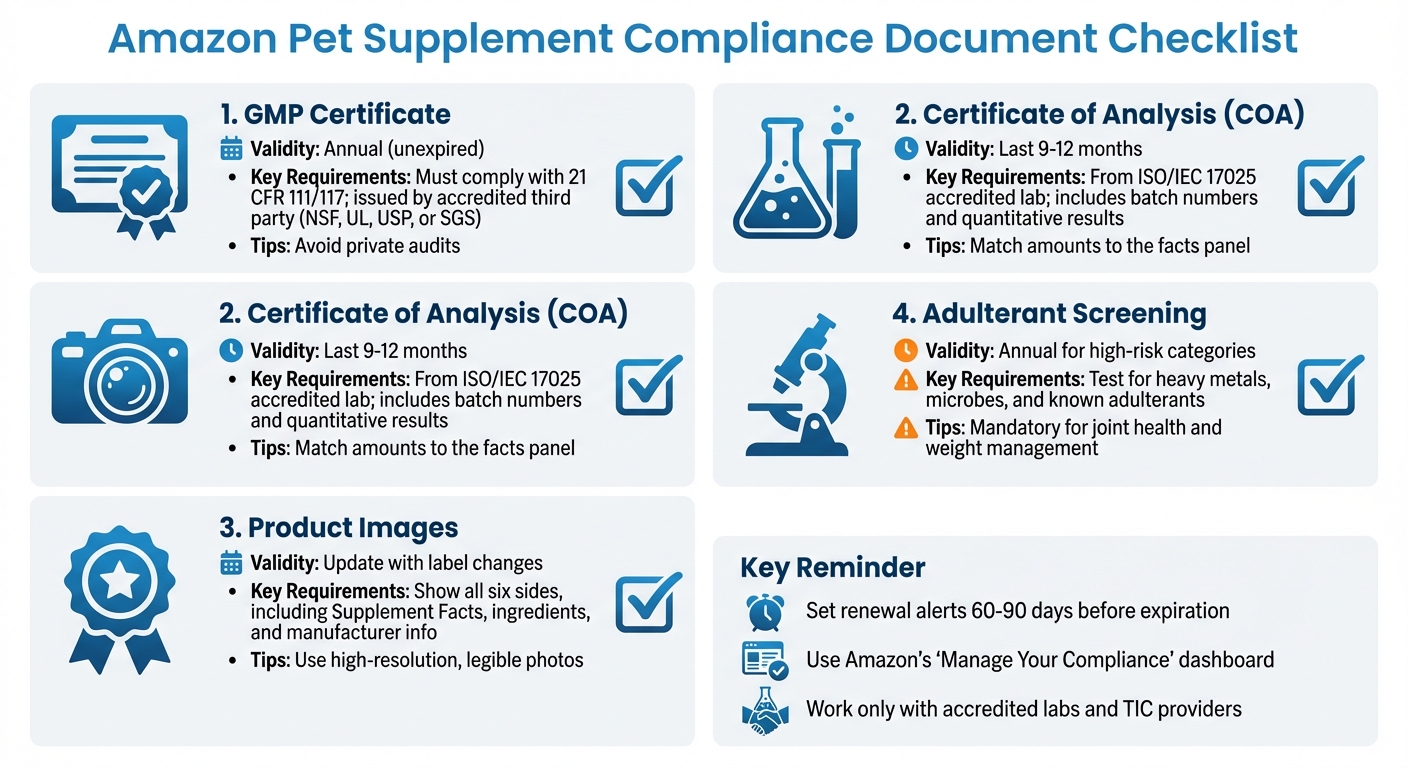
Amazon Pet Supplement Compliance Checklist: Required Documents and Validity Periods
Navigating Amazon’s compliance requirements can feel like a maze, but with the right documents, timely submissions, and a solid system, staying compliant becomes manageable. Here’s a practical guide for pet supplement brands to avoid listing suppressions and maintain compliance.
Compliance Document Checklist
Amazon has specific documentation requirements for pet supplements, each with its own rules and validity periods. Here’s what you need to know:
- GMP Certificate: This must be current, unexpired, and issued by an accredited third-party organization like NSF, UL, USP, or SGS. Amazon won’t accept private or consulting audits.
- Certificate of Analysis (COA): Issued within the last 9–12 months by an ISO/IEC 17025 accredited lab, this document must include batch or lot numbers, quantitative ingredient results that match your supplement facts panel, and the lab’s signature.
- Product Images: Submit real photos (not mock-ups) showing all six sides of the packaging. Ensure the "Supplement Facts" or "Guaranteed Analysis" panel, ingredient list, and manufacturer contact details are clearly visible. For products sold in Mexico, include the 8-digit SAGARPA authorization code.
- Adulterant Screening: Annual testing is required for high-risk categories like joint health or weight management. Tests should check for heavy metals, microbial contaminants, and known adulterants. Some brands may meet these requirements by enrolling in third-party quality programs like NSF Certified for Sport or USP Verification.
Here’s a quick reference table to keep things organized:
| Document Type | Validity | Key Requirements | Tips for Success |
|---|---|---|---|
| GMP Certificate | Annual (unexpired) | Must comply with 21 CFR 111/117; issued by an accredited third party | Avoid private audits |
| Certificate of Analysis (COA) | Last 9–12 months | From ISO/IEC 17025 accredited lab; includes batch numbers and quantitative results | Match amounts to the facts panel |
| Product Images | Update with label changes | Show all six sides, including Supplement Facts, ingredients, and manufacturer info | Use high-resolution, legible photos |
| Adulterant Screening | Annual for high-risk categories | Test for heavy metals, microbes, and known adulterants | Mandatory for joint health and weight management |
| 3rd-Party Quality Certification | Per program guidelines | Programs like NSF Certified for Sport or USP Verification | May replace some COA requirements |
Once your documents are in order, the next step is managing them effectively through Amazon’s tools.
How to Use Amazon’s Manage Your Compliance Dashboard
Amazon’s Manage Your Compliance dashboard in Seller Central is your go-to tool for handling compliance tasks. After logging in, head to the dashboard to find a list of ASINs with pending documentation, categorized by "Compliance requirements." The Status column will indicate whether documents are "Required", "Under Review", or "Approved."
A standout feature of this dashboard is the "At-risk sales" column, which shows the potential revenue impact of suppressed listings. This helps you prioritize which products need immediate attention. As Lola Okusami, Sr. Creative Writer at Amazon, puts it:
"Manage Your Compliance reduces the time you spend completing compliance requirements, including appeals… providing a faster, simplified workflow where you can file and organize all necessary information."
You can upload documents one at a time using the "Upload" button or handle up to 5,000 products at once with the bulk upload feature. Simply download the spreadsheet, update your compliance details, and re-upload it. The Compliance Reference Tool is another handy resource, allowing you to search by keyword or product type to verify requirements for different regions and product categories.
Amazon now requires sellers to work with third-party Testing, Inspection, and Certification (TIC) providers to validate testing documents. Lisa Thomas, Chief Commercialization Officer at Nuherbs, explains:
"Amazon will ‘suppress’ product listings that don’t have verification from a third-party Testing, Inspection, and Certification (TIC) organization by your company’s product due date on your dashboard."
This means sellers no longer submit testing documents directly to Amazon but instead rely on TIC providers for verification.
How to Maintain Long-Term Compliance
Staying compliant isn’t a one-and-done task – it’s an ongoing process. Here’s how to integrate compliance into your regular workflow:
- Organize Your Documents: Create SKU-specific folders for each product to store updated COAs, GMP certificates, and high-resolution label PDFs. This makes retrieval quick and easy during audits or appeals.
- Set Alerts for Renewals: Schedule reminders 60–90 days before GMP audits or COA expiration dates. This gives you enough time to arrange lab testing, third-party inspections, and document updates.
- Audit Your Catalog Regularly: Proactively review your listings to catch issues before Amazon flags them. Remove prohibited medical claims by replacing terms like "treats", "cures", or "prevents" with compliant alternatives like "supports" or "helps maintain." Ensure consistency across your COA, GMP certificate, and product labels.
- Partner with Accredited Labs: Always work with ISO/IEC 17025 accredited labs and recognized TIC providers like NSF, UL, USP, or Eurofins. Make sure the lab’s accreditation number or certificate is included with your COA.
- Research New Requirements: Use Amazon’s Compliance Reference Tool to check specific documentation needs when expanding into new markets or product categories.
Cecilia Diaz from Bellavix emphasizes the importance of making compliance part of your routine:
"Treat compliance as part of your workflow rather than a fix you happen to make once in a while. This way, restricted listings will become something you can manage instead of something that manages you."
For extra support, companies like Emplicit offer tailored solutions, including compliance audits, renewal tracking, and strategies to keep your account in good standing year-round.
Conclusion
Amazon’s compliance rules for pet supplements can make or break a business. Falling short of these requirements can result in severe consequences like listing removals, restrictions on adding new products, and even payment holds. The stakes have only risen since the FDA issued a formal warning letter to Amazon on March 3, 2025, regarding unapproved drug products distributed via FBA. This increased regulatory focus means businesses must prioritize compliance like never before.
Amazon’s shift to third-party TIC (Testing, Inspection, and Certification) verification, annual renewal mandates, and stricter labeling requirements has turned compliance into an ongoing responsibility. As Harris Beach Murtha points out:
"It is therefore especially critical that dietary supplement brands selling on Amazon are promptly taking steps to comply with the new policy and properly managing their quality obligations to ensure that their products are being manufactured in accordance with cGMPs."
To navigate these challenges effectively, here’s what you need to do:
- Keep your cGMP certificates up to date, ensuring they’re issued by accredited organizations like NSF, Eurofins, UL, or USP. Set up reminders 60–90 days before expiration to avoid lapses.
- Regularly check your "Manage Your Compliance" dashboard to identify and address potential issues before they escalate into listing suppressions.
For businesses with extensive product catalogs or plans to expand into new markets, working with compliance experts can be a game-changer. Specialists like Emplicit offer services such as compliance audits, document management, and account health strategies to ensure your listings remain active and your revenue steady.
The brands that integrate compliance into their daily operations are the ones that stay ahead. By treating compliance as a core part of your workflow, you’ll not only safeguard your market share but also maximize your revenue potential on Amazon. Now’s the time to act and secure your business’s future.
FAQs
What happens if a Certificate of Analysis (COA) isn’t renewed on Amazon?
Failing to keep an updated Certificate of Analysis (COA) for your product on Amazon can lead to significant setbacks. Amazon might suspend or even remove your product listing, which could drastically affect your sales and visibility. Beyond that, the platform has the authority to withhold payments connected to the product in question, potentially causing cash flow issues for your business.
In more severe situations, ignoring COA requirements could result in legal troubles. Keeping your COA current isn’t just a formality – it’s a critical step in staying compliant and safeguarding your revenue on Amazon.
How can pet supplement brands stay on top of compliance document expirations on Amazon?
Pet supplement brands selling on Amazon need to keep a close eye on document expiration dates, particularly for Certificates of Analysis (CoAs), which require updates every six months.
To avoid compliance headaches, it’s smart to set up a centralized system where all key documents – like CoAs, GMP certificates, product images, and labels – are stored and tracked. Make sure to log issue dates and use automated reminders to flag upcoming expirations at least 30 days in advance. Assigning a team member to manage this process can help ensure updates are handled promptly and timelines are regularly reviewed.
Staying organized like this can help brands sidestep issues like listing removals or payment delays, keeping their Amazon operations running smoothly.
What are the advantages of using Amazon’s Manage Your Compliance dashboard for pet supplement brands?
Amazon’s Manage Your Compliance dashboard brings all your product safety and regulatory tasks into one easy-to-use hub. Instead of juggling multiple systems, sellers can now handle documentation, testing results, and appeals in one place – saving time and allowing them to focus on growing their business. Plus, the option to submit documents and appeals in bulk makes managing multiple listings much more efficient.
This tool also connects sellers directly to Amazon’s compliance services, streamlining the certification process and helping minimize the risk of listing suspensions. For pet supplement brands, this means staying on top of compliance requirements, protecting their sales, and avoiding costly errors that could hurt their bottom line.
Related Blog Posts
- Why 73% of Pet Brands Fail on Amazon Before Year Two (And How to Be the Exception)
- What Happens to Pet Brands That Ignore Amazon’s New Ingredient Transparency Rules
- Pet Parents Will Pay 3x More for This One Thing (And Most Amazon Listings Don’t Mention It)
- The Pet Brands Winning on Amazon in 2025 Aren’t Playing the Same Game You Are