
Post-purchase engagement isn’t just a nice-to-have – it’s a game-changer for ecommerce brands in 2025. With rising customer acquisition costs and fierce competition on platforms like Amazon and TikTok Shops, keeping existing customers engaged is the smartest way to drive revenue. Here’s why it matters:
- Repeat customers drive 40% of revenue for most ecommerce stores.
- Shoppers with two prior purchases are 50% more likely to buy again.
- Brands focusing on post-purchase strategies see revenue increases of 15–25% compared to those prioritizing new customer acquisition.
To succeed, prioritize timely updates, personalized offers, and loyalty-driven incentives. Start with basics like order confirmations and shipping updates, then build on that with tailored discounts, how-to content, and social media communities. Track metrics like Customer Lifetime Value (CLV) and Repeat Purchase Rate (RPR) to measure success. Even small improvements in retention can lead to significant revenue growth.
Ready to turn one-time buyers into loyal customers? Dive into specific strategies like personalized email sequences, loyalty programs, and exclusive perks to build lasting relationships and drive sustainable growth.
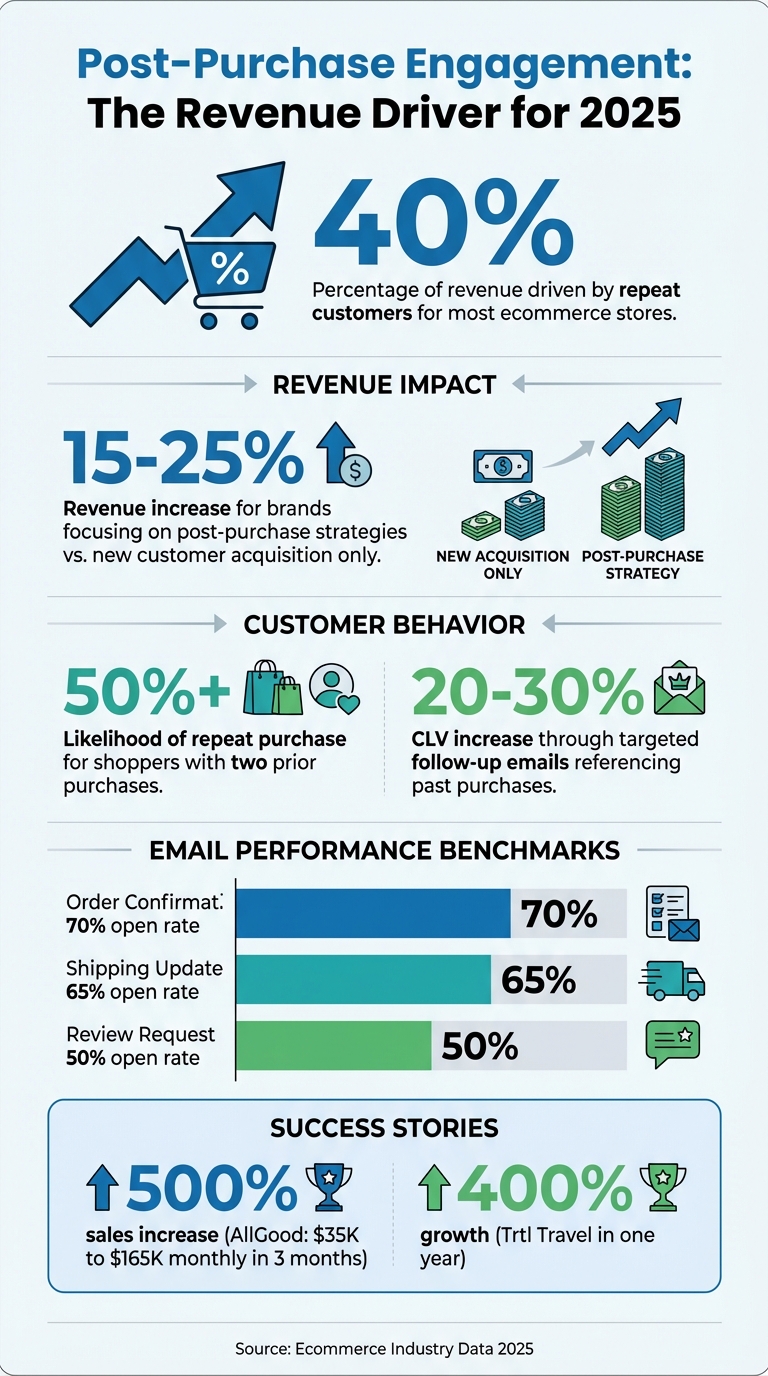
Post-Purchase Engagement Statistics and Revenue Impact 2025
Beyond Checkout: Designing a Post-Purchase Experience That Sticks
Why Post-Purchase Engagement Drives Revenue Growth
Did you know that repeat customers account for 40% of an ecommerce store’s revenue? This isn’t just a random statistic – it’s a testament to how vital customer retention is for long-term revenue stability. By focusing on keeping customers coming back, businesses can reduce their reliance on expensive acquisition strategies while creating a steady revenue stream. In fact, customers who have already made two purchases are far more likely to buy again, making post-purchase engagement a critical growth driver.
In 2025, retention strategies are more important than ever. With customer acquisition costs climbing and competition heating up on platforms like Amazon and TikTok Shops, brands that prioritize the post-purchase phase are seeing revenue increases of 15–25% compared to those focused solely on acquiring new customers. Over time, loyal customers not only buy more frequently but also refer others, creating a natural cycle of growth that reduces the need for heavy marketing spend. These numbers set the stage for actionable strategies that can make a real difference.
Converting First-Time Buyers into Repeat Customers
Turning first-time buyers into repeat customers is a game-changer, and the window to do so opens right after the initial purchase. Timing is everything. For example, Dollar Shave Club uses "Toss More In?" emails immediately after purchase, encouraging customers to add complementary products like shaving cream or aftershave with just a click. Similarly, H&M’s loyalty program invites shoppers to join a points system at checkout, leading to a conversion rate of over 50% for second-time buyers.
To make this happen, practical steps include sending personalized follow-up emails within 24–48 hours of delivery, offering pre-shipping bundle discounts to prompt a quick second purchase, and recommending complementary items based on purchase history. Etsy excels at this by suggesting related items – like a matching necklace for a pair of earrings – boosting both engagement and customer lifetime value (CLV).
The Connection Between Post-Purchase Engagement and CLV
While strategies to convert first-time buyers bring immediate benefits, they also set the stage for long-term gains in customer lifetime value (CLV). CLV, which measures the total revenue a customer generates over their relationship with your brand, is calculated as:
average purchase value × purchase frequency × customer lifespan.
Post-purchase engagement can enhance all three factors. For instance, targeted follow-up emails referencing past purchases can increase CLV by 20–30% through better retention. Combine this with loyalty programs, exclusive offers tailored to purchase data, and hassle-free returns, and the impact multiplies. AI-powered personalization is also becoming a key tool, using dynamic content in follow-up communications to deepen customer relationships and boost long-term value.
For ecommerce brands managing multiple sales channels, scaling post-purchase engagement requires strong infrastructure. Companies like Emplicit specialize in this by offering integrated marketplace management services. From PPC campaigns that bring customers back to inventory management, they help brands tie post-purchase tactics – like personalized email sequences and loyalty programs – directly to platform-specific strategies on Amazon, TikTok Shops, and beyond. This approach ensures businesses capture the full potential of every customer relationship.
Proven Strategies for Post-Purchase Engagement
In 2025, brands are focusing on three standout strategies to keep customers engaged after they’ve made a purchase: personalized email sequences, loyalty-driven incentives, and social communities that create a sense of connection. These approaches work together to ensure customers stay connected and invested in the brand long after checkout.
Email Sequences That Keep Customers Engaged
Post-purchase emails are a direct and effective way to communicate with customers, and getting the timing and content just right is key.
- Order confirmations: Sent immediately after purchase to establish trust and confirm the transaction.
- Shipping updates: Delivered when the order is shipped to reassure customers and provide peace of mind.
- Review requests: Sent about seven days after delivery to gather valuable feedback.
Here’s a quick breakdown of these email types and their typical open rates:
| Email Type | Timing | Goal | Benchmark Open Rate |
|---|---|---|---|
| Order Confirmation | Immediately after purchase | Build trust | 70% |
| Shipping Update | When order is shipped | Reassure customer | 65% |
| Review Request | 7 days post-delivery | Gather feedback | 50% |
Want to take these numbers even higher? Personalization is the secret sauce. Using customer names, including order details (like product images or tracking links), and crafting tailored messages make emails feel more relevant. For example, a review request that says, “Tell us how you’re enjoying your new [product name]!” paired with a clear call-to-action like “Leave a Review” can work wonders.
Once you’ve nailed your email strategy, the next step is to encourage customers to return with well-placed incentives.
Using Incentives to Bring Customers Back
Strategic incentives are a proven way to encourage repeat purchases and build loyalty. Whether it’s discounts, loyalty programs, or exclusive content, these perks give customers a reason to come back.
Here are some effective incentive ideas:
- Post-purchase discounts: Offering 10–20% off their next order is a classic way to drive repeat business.
- Loyalty programs: Rewarding customers with points for purchases, with a free sign-up bonus to sweeten the deal.
- Value-added content: Tutorials or videos that show how to get the most out of their recent purchase.
To make incentives work even harder, consider these tips:
- Set clear goals, like increasing repeat purchase rates.
- Segment your audience. For example, first-time buyers might get a 15% discount, while loyal VIP customers could enjoy early access to new products.
- Use automation to deliver offers via email or SMS, and include pre-shipment upsells when appropriate.
- Personalize offers based on purchase history – like sending tips for a product they just bought or a birthday reward.
- Track success using metrics such as repeat purchase rates.
Time-sensitive deals, such as “20% off if you order within 48 hours,” can also create urgency and help move excess inventory.
Creating Customer Communities on Social Media
Social media platforms offer a unique opportunity to turn customers into brand advocates by fostering genuine connections. Each platform provides different ways to engage:
| Platform | Engagement Type | Pros | Cons |
|---|---|---|---|
| Visual content | Wide reach | Algorithm dependency | |
| Discord | Community discussion | Deep engagement | Requires moderation |
| TikTok Shops | Short videos/UGC | Viral potential | Trend-sensitive |
| Facebook Groups | General discussion | Easy setup | Saturation |
Here’s how to build and nurture these communities:
- Invite buyers to join exclusive groups through post-purchase emails.
- Share user-generated content, like unboxing videos, to highlight real customer experiences.
- Host Q&A sessions or discussions on platforms like Discord, where customers can exchange tips and insights.
- Offer exclusive perks, such as discounts or early access to new products, for community members.
- Encourage the use of branded hashtags and mentions to amplify your reach.
sbb-itb-e2944f4
Measuring Post-Purchase Performance in 2025
Keeping track of key metrics like Customer Lifetime Value (CLV), Repeat Purchase Rate (RPR), and Referral Rate is crucial for understanding whether your post-purchase strategies are cultivating loyal customers or just driving one-off sales.
Key Metrics: CLV, Repeat Purchase Rate, and Referrals
Customer Lifetime Value (CLV) is a measure of the total revenue you can expect from a customer over the course of their relationship with your brand. It’s calculated by multiplying the average order value by the purchase frequency per year, then multiplying that by the average customer lifespan. For example, if your average order value is $75, customers buy twice a year, and they stick around for three years, your CLV would be $450.
Repeat Purchase Rate (RPR) shows the percentage of customers who return to make additional purchases. Repeat customers are a powerhouse for revenue – those with two prior purchases convert at rates above 50%. To calculate RPR, divide the number of customers who made two or more purchases during a specific timeframe by the total number of customers who purchased in that same period.
Referral Rate measures how much of your sales come from customer recommendations. You can calculate this by dividing the number of orders driven by referral codes or links by the total number of orders. Including unique referral codes in your post-purchase emails makes it easy to track which customers are bringing in new business.
Digging deeper into these metrics – by acquisition source, product type, or customer cohort – can uncover what’s working and where tweaks are needed. For example, you might discover that customers acquired through TikTok have a lower CLV but a higher referral rate, which could help refine your engagement strategies.
These insights lay the groundwork for using analytics to create more personalized customer experiences.
Using Analytics to Personalize Customer Experiences
Data analytics takes personalization to the next level, turning generic follow-ups into tailored, revenue-driving interactions. Start by consolidating data from your ecommerce platform, marketplace dashboards (like Amazon Seller Central, TikTok Shop, or Walmart), and marketing tools into one central hub. With this unified view, you can segment customers and craft messages based on their purchase behavior.
Brands like Etsy and Dollar Shave Club have been leveraging dynamic, personalized post-purchase messaging for years to keep customers engaged.
Automate touchpoints triggered by key events such as order placement, shipment, delivery, and post-delivery follow-ups. Use customer data to make these interactions more relevant. For instance:
- Share product education content tailored to the specific item purchased.
- Suggest complementary products often bought together.
- Send replenishment reminders based on typical reorder timelines.
- Offer targeted discounts or coupons to re-engage customers showing signs of reduced activity.
Test and refine these strategies by experimenting with subject lines, send times (optimized for the recipient’s time zone), discount types (percentage vs. dollar amount), and content balance (promotional vs. educational). These tweaks can significantly boost repeat purchases and overall revenue.
In 2025, leading brands are pushing personalization even further with predictive modeling, which identifies new customers likely to become high-value based on early behaviors like their first purchase, acquisition source, or email engagement. They’re also using propensity-to-churn scores to preemptively launch retention campaigns. For example, offering personalized discounts or surprise gifts to customers at risk of disengaging can help maintain loyalty and protect CLV.
How Emplicit Supports Post-Purchase Operations
Strong post-purchase metrics only matter if backed by streamlined operations. Efficient inventory management, PPC campaigns, and account oversight are the backbone of successful post-purchase strategies.
Inventory management ensures that products are always in stock and orders ship on time across platforms like Amazon, TikTok Shops, Walmart, Target, and your own website. This reduces the risk of cancellations, negative reviews, and customer churn caused by stockouts or delays.
PPC optimization goes beyond simply lowering acquisition costs. Instead, it aligns your ad spend with post-purchase data, focusing on campaigns and keywords that bring in customers with higher CLV and greater repeat purchase potential. This approach ensures your budget targets buyers who are more likely to stick around.
Conclusion: Growing Revenue Through Post-Purchase Engagement
Post-purchase engagement is key to building a thriving e-commerce business. Brands that take the time to nurture their customers after the initial purchase – through thoughtful email sequences, well-placed incentives, and meaningful community interactions – gain a lasting edge over those relying solely on paid ads. These strategies not only boost repeat purchase rates but also create a business model that’s better equipped to handle rising ad costs and fierce competition.
Start with the basics: transactional emails and simple follow-ups. From there, expand into personalized product recommendations, loyalty programs, and exclusive offers. Keep a close eye on metrics like customer lifetime value (CLV), repeat purchase rates, and referral data to measure success. Even small improvements can lead to big results. For instance, increasing your repeat purchase rate from 20% to 30% could mean hundreds of thousands of dollars in additional annual revenue for a mid-sized U.S. brand.
Within the next 30–60 days, outline your core post-purchase workflows, introduce a targeted incentive like $10 off a second purchase or free shipping, and monitor the results. Encourage your customers to connect with your brand on platforms like Instagram or TikTok to stay engaged and keep your products top of mind.
For brands managing multiple marketplaces – Amazon, TikTok Shops, Walmart, Target – and their own websites, coordinating post-purchase efforts can feel overwhelming. That’s where a specialist like Emplicit can help. Emplicit provides integrated solutions, aligning post-purchase strategies with PPC campaigns, inventory management, and account health. Their approach has delivered impressive results: brands like AllGood saw a 500% sales increase in just three months, jumping from $35,000 to $165,000 in monthly revenue. Similarly, Trtl Travel achieved 400% growth in a single year by following Emplicit’s tailored roadmap and full-service strategy.
The most successful brands of tomorrow will treat post-purchase engagement as a core part of their growth strategy – not just an occasional effort. Launch your program, track your metrics diligently, and refine your approach over time. Repeat customers are your most profitable audience, and investing in them pays off.
FAQs
What are the best ways to measure the success of my post-purchase engagement efforts?
To gauge how well your post-purchase engagement strategies are working, keep an eye on key performance indicators (KPIs) that show how happy and loyal your customers are. Some essential metrics to track include customer retention rate, repeat purchase rate, customer lifetime value (CLV), and Net Promoter Score (NPS).
Additionally, dive into engagement data like email open rates, click-through rates, and the number and tone of customer reviews. By combining this feedback with insights from your overall sales and revenue trends, you can get a clear picture of how your post-purchase efforts are helping to build lasting customer relationships.
How can I personalize post-purchase communications effectively?
When it comes to post-purchase communication, personalization is key. Use customer data to craft messages that feel tailored and relevant. For instance, you could suggest products that align with their previous purchases, send a heartfelt thank-you note with their name on it, or offer exclusive discounts based on their preferences.
Automation tools can make this process smoother by handling tasks like sending follow-up emails, requesting feedback, or providing updates on order status. These small but meaningful gestures can strengthen your relationship with customers and make them more likely to return.
Why is understanding customer lifetime value (CLV) essential for growing an ecommerce business?
Understanding customer lifetime value (CLV) is crucial for driving growth in ecommerce. Why? Because it shows how much revenue a customer is expected to bring in throughout their entire relationship with your brand. This knowledge helps you make smarter calls on how much to spend on attracting and keeping customers.
When you prioritize CLV, you can spot your most valuable customers, craft marketing strategies that strengthen loyalty, and ultimately boost profitability. It’s a powerful metric that helps you allocate resources wisely and build a thriving business over the long haul.