
AI is transforming how businesses manage PPC campaigns by automating complex tasks, analyzing data in real-time, and improving ad performance. This article explores three examples where companies achieved better results by switching to AI-powered PPC strategies:
- Scoutshop.org: Increased ROAS to 56 and cut acquisition costs by 49.5% using Google’s Performance Max.
- Karaca: Boosted ROAS by 44% and revenue by 31% through dynamic budget allocation with SMEC.
- Pilgrim’s: Grew market share by 19% and ROAS by 53% using CommerceIQ‘s real-time bid optimization.
These cases highlight how AI tools handle tasks like bid adjustments, budget reallocations, and keyword targeting faster and more effectively than manual methods. For businesses, adopting AI in PPC campaigns means better efficiency, higher returns, and the ability to compete even with limited budgets.
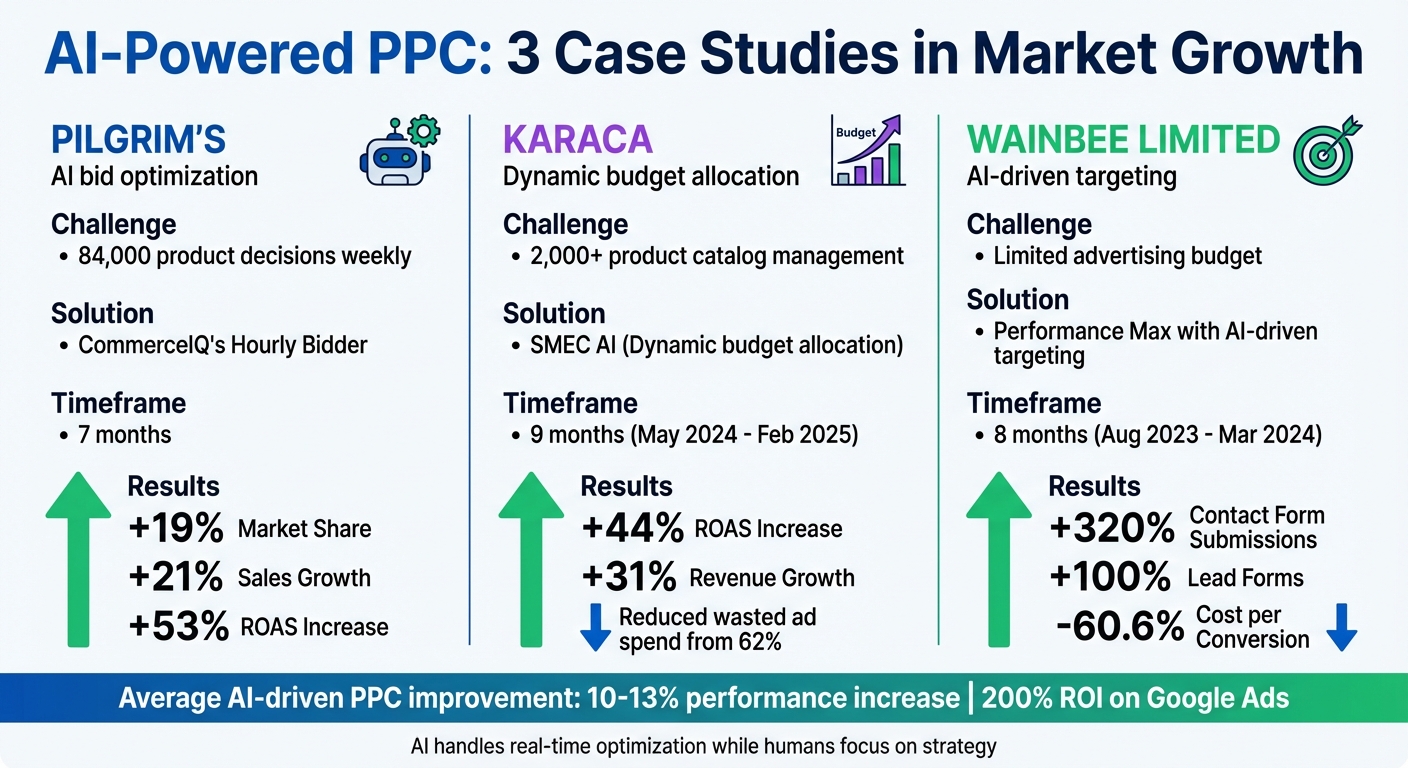
AI-Powered PPC Case Study Results: ROAS and Revenue Growth Comparison
Case Study 1: Growing Global Market Share with AI Bid Optimization
Challenge: Manual Campaign Management Limitations
In 2022, Pilgrim’s hit a major roadblock in managing their PPC campaigns on Amazon and Walmart. Their team faced a staggering workload – 84,000 product decisions every week, spread across hundreds of items and performance variables. Rizwan Aktar, Head of E-Commerce, explained the challenge: the team was constantly lagging behind, missing key sales opportunities when they mattered most.
To keep campaigns fully optimized, they would have needed to make two decisions every minute – a pace no human team could sustain. Manual analysis simply couldn’t keep up with high-traffic shopping periods. As a result, ad bids often stayed static during critical moments, leading to wasted spending during low-converting hours and missed chances to boost visibility when demand peaked.
Brandon Titmus, Director of Marketing, summed it up: "Ranking in the top 3 search results is critical, but our current process makes it impossible to keep up". With competitors moving faster, delayed responses directly impacted their market share.
This inefficiency made it clear that a new approach was needed.
Solution: AI-Driven Bid Optimization
Pilgrim’s turned to CommerceIQ’s "Hourly Bidder" to overhaul their bidding strategy. This AI-powered tool analyzed sales trends every hour, automatically adjusting bids based on real-time ROAS performance across both Amazon and Walmart. Instead of relying on weekly manual reviews, the AI handled continuous micro-adjustments, effortlessly managing those 84,000 weekly decisions.
The platform’s "Spotlights" feature flagged urgent opportunities and risks – like sudden drops in ROAS or unexpected traffic surges – so the team could focus on strategic planning instead of data crunching. By using day-parting analysis, the AI identified high-converting hours and allocated budget accordingly, eliminating the delays that had previously held them back.
This shift allowed Pilgrim’s to move from a reactive to a proactive approach in their campaign management.
Results: Higher Conversions and Market Reach
By addressing their manual inefficiencies with AI, Pilgrim’s achieved measurable success. Within just seven months, the numbers spoke for themselves: a 19% growth in market share, a 21% increase in sales, and a 53% boost in ROAS. The AI’s ability to respond in real time ensured that peak sales opportunities were no longer missed.
"CommerceIQ helped us achieve 19% growth in market share, 21% sales growth on Amazon, and a 53% increase in return on ad spend. Its platform gave us the insights and automation needed to optimize campaigns and drive profitable growth." – Rizwan Aktar, Head of E-Commerce, Pilgrim’s
With time freed up from manual tasks, the team could focus on refining product positioning and exploring new growth opportunities. This strategic shift not only improved efficiency but also set the stage for long-term success.
sbb-itb-e2944f4
Case Study 2: Managing Large Product Catalogs with AI Budget Allocation
Challenge: Complex Product Portfolio Management
From May 2024 to February 2025, Karaca, a Turkish kitchenware brand with over 2,000 products, faced challenges in managing campaigns for its extensive product catalog. The company’s digital marketing team, led by Basak Odemis, used category-based groupings for campaigns. While this approach seemed logical, it created inefficiencies: top-performing products couldn’t receive extra budget without also funding underperformers. On top of that, manual reviews of ROAS (Return on Ad Spend) couldn’t keep up with rapid market changes. The result? A staggering 62% of their ad spend went to conversions with above-average costs, leaving high-demand products underfunded during critical periods. These inefficiencies pushed Karaca to seek a smarter, automated solution.
Solution: Dynamic Budget Reallocation with AI
Karaca turned to SMEC, an AI-powered tool, to overhaul its campaign strategy. Instead of grouping products by category, the AI sorted them into three performance tiers – High, Mid, and Low – based on real-time ROAS and sales data. This allowed the system to dynamically promote top-performing products while pausing or downgrading underperformers. The AI also automated day-parting, ensuring ads ran during the most profitable hours. This data-driven approach brought precision to budget allocation and campaign management, addressing the inefficiencies of the previous system.
Results: Better ROAS and Revenue Growth
The shift to AI-driven campaigns paid off. Over nine months, Karaca saw a 44% boost in ROAS and a 31% increase in revenue. Products that had previously been overshadowed in broad category campaigns finally received the budget they deserved, driving more efficient performance.
"The ability to dynamically manage product prioritization and budget allocation in real-time was incredibly insightful and proved to be a game-changer for Karaca’s PMax campaigns."
– Basak Odemis, Digital Marketing Consultant, Make Digital Agency
Case Study 3: Improving Budget Efficiency with Precision Targeting
Challenge: Small Ad Budgets Requiring High Returns
From August 2023 to March 2024, Wainbee Limited, a Canadian engineering solutions provider, faced a tough challenge: achieving meaningful results on a shoestring advertising budget. Competing for broad, expensive keywords wasn’t an option, and their manual bidding process struggled to pinpoint clicks that led to conversions. This inefficiency drained their limited resources, making it critical to ensure every dollar spent delivered measurable returns.
Solution: AI-Driven Keyword Analysis and Audience Segmentation
To overcome these hurdles, Wainbee adopted scandiweb‘s AI-powered Performance Max campaigns. The automated bidding system, combined with enhanced tracking, identified high-intent keywords and leveraged broad match to expand their reach. This approach allowed them to efficiently target qualified prospects beyond the narrow scope of manually managed keyword lists.
Results: More Conversions and Better ROI on Limited Budgets
The results were striking. Wainbee saw a 60.6% reduction in cost per conversion, while contact form submissions skyrocketed by 320%, and lead forms doubled, increasing by 100%. This success showed how even businesses with limited budgets could compete effectively without requiring massive ad spend or a large internal team.
"Using Adthena’s insights, we were able to determine which search terms might be important to appear on for the customer to increase their visibility in that product category, and which broad match keywords would be profitable to activate to grow their business."
– Celia Rosado, Paid Search Senior, iProspect
This case highlights how precise, AI-driven strategies can help businesses squeeze maximum value from even the smallest budgets.
From $0 to $1M in 1 Year: A Complete Amazon PPC Case Study
How AI-Driven PPC Delivers Results
The case studies paint a clear picture: AI doesn’t just simplify tasks – it redefines campaign performance. By blending advanced capabilities, AI creates a seamless system that drives growth in PPC campaigns. Let’s break down the three key elements behind these results.
Real-Time Bid Optimization
AI tools continuously analyze performance data and make instant bid adjustments to ensure ads remain competitive while managing costs. Take ARCTIC, a PC cooling manufacturer, as an example. Between March 2022 and June 2023, Adspert’s AI managed nearly 2 million bids for their eBay Promoted Listings Advanced campaigns. The payoff? A 313% boost in conversions on ebay.com and a 135% increase on ebay.de, all while saving their team 2,736 hours of manual work.
"AI-driven PPC automation is at the forefront of real-time bidding (RTB) optimizations. By continuously analyzing performance data, AI can adjust bids in real-time to maximize ad placements and minimize costs."
– Georgios Kafentzis, Director – Paid Search, iProspect
This real-time adjustment ensures ads stay visible during peak conversion opportunities without overspending during slower periods. For instance, a travel company using AI-driven bidding reported a 20% drop in cost-per-click while maintaining top ad positions. The speed and scale of these adjustments are simply unattainable with manual management, setting the stage for equally responsive budget strategies.
Dynamic Budget Allocation
AI doesn’t just adjust bids – it reallocates budgets in real time to focus on the best-performing products and campaigns. This approach has consistently delivered impressive results.
Consider an unnamed pharmacy webshop managed by Mashup Digital. By using AI to dynamically shift budgets based on traffic patterns and promotional activity, they achieved a 60% revenue increase within the first five months of 2024. By August, their traffic had grown by over 300%. These automated budget adjustments deliver efficiency, but they also rely on detailed audience insights to further refine campaign personalization.
Better Precision and Personalization
AI’s ability to analyze behavioral data – like browsing habits, purchase history, and search queries – allows it to pinpoint high-intent audiences that manual targeting often overlooks. For example, Liforme ran a holdout test comparing Meta’s Advantage+ Shopping Campaigns with their manual campaigns in 2024/2025. The AI-driven approach outperformed manual campaigns by 67% in sales, with 99% of purchases coming from new customers.
AI also excels at creative personalization. Hatch, working with agency Monks, used an AI pipeline to produce 60 ad variants and three AI-generated personas for their Restore 2 sleep device. This effort led to a 31% drop in cost per purchase, an 80% jump in click-through rates, and a 97% reduction in production costs. On average, companies using AI for personalization see a 15-25% rise in conversion rates compared to generic campaigns.
Together, these three capabilities – real-time bidding, dynamic budget shifts, and precision targeting – work in harmony. Each reinforces the other, creating a feedback loop that enables campaigns to adapt quickly and perform at levels manual management simply can’t achieve.
How to Implement AI-Powered PPC Campaigns
Shifting from manual PPC management to AI-driven campaigns requires careful planning, the right tools, and a prepared team. Here’s how to make the transition both smooth and profitable.
Cost vs. ROI: Balancing Investment with Returns
You don’t need a massive budget to start using AI in your campaigns. Many platform-native tools, such as Google Smart Bidding, Performance Max, and Meta Advantage+, are completely free to use. These tools should be your go-to starting point before considering third-party software.
For those ready to explore beyond native tools, third-party platforms typically range from $100 to over $500 per month. For instance, entry-level tools like 30 Chars cost just $6/month for text optimization, while Opteo starts at $99/month per account. On the higher end, tools like Optmyzr average $500+ monthly, and advanced platforms like Triple Whale can exceed $1,000/month.
Patience is key when measuring ROI. While you may see initial improvements within 2–3 weeks, full optimization usually takes 6–8 weeks. On average, AI-powered campaigns improve performance by 10–13%, and businesses using Google Ads often achieve a 200% ROI – earning $2 for every $1 spent.
Case studies also highlight the potential for success. AI-driven tools have been shown to deliver higher ROAS, lower CPAs, and reduced CPCs. However, there’s one critical requirement: AI needs data to function effectively. For example, Smart Bidding generally requires at least 30 conversions per month, which often translates to an ad budget of $1,000–$3,000. Without sufficient data, AI algorithms struggle to optimize.
Once you’ve addressed ROI and budget considerations, the next step is integrating AI into your existing systems.
Integrating AI with Current Systems
Accurate tracking is the backbone of any AI-powered campaign. Many campaigns fail because of broken or incomplete conversion tracking, which leads to poor optimization decisions. Start by installing Google Analytics 4 (GA4) and ensuring conversion tracking captures all key actions, such as purchases, form submissions, and phone calls.
The integration process typically unfolds over several weeks.
- Weeks 1–2: Install GA4, set up conversion tracking, switch to Target CPA bidding, and upgrade to Responsive Search Ads.
- Weeks 3–4: Focus on optimizing campaigns. Allocate 20% of your budget to Performance Max, use broad match keywords, and upload high-quality creative assets.
- Month 2 and beyond: Experiment with third-party tools, AI-driven landing page testing, and predictive budget planning.
For example, kitchenware brand Karaca used SMEC’s AI tool to reorganize over 2,000 products into performance-tiered campaigns, moving away from category-based segmentation. This strategy led to a 44% increase in ROAS and 31% revenue growth. Similarly, iProspect leveraged Adthena’s AI-driven insights to restructure campaigns, resulting in a 324% increase in conversions, a 47% reduction in CPA, and a 14% decrease in CPC.
"Using Adthena’s insights, we were able to determine which search terms might be important to appear on for the customer to increase their visibility in that product category, and which broad match keywords would be profitable to activate to grow their business."
– Celia Rosado, Paid Search Senior, iProspect
Start with native tools first. Use Google Smart Bidding or Meta Advantage+ to establish a performance baseline before diving into premium third-party platforms. Broad match keywords, when paired with Smart Bidding, can help capture high-intent, long-tail searches that manual keyword lists might miss. Automating routine tasks like scheduling, budget allocation, and promotional adjustments can also reduce manual errors, especially during high-demand periods like Black Friday.
Once your systems are in place, it’s time to prepare your team to fully embrace AI.
Preparing Teams for AI Adoption
While AI can optimize campaigns and save time, it often raises concerns among marketers. In fact, 60% of marketers worry about the complexity of AI implementation, even though 71% believe it could enhance their efforts. Common fears include job displacement, reliance on vendors, and losing control over campaign decisions.
The solution lies in maintaining a "human-in-the-loop" approach. Let AI handle data processing and real-time optimizations, while humans focus on strategy, creative tasks, and interpreting results. This balance not only alleviates concerns but also frees up nearly 11 hours per week, which teams can redirect toward higher-value activities.
Empower your team with "superusers." Assign internal champions to lead the AI integration process. These individuals should receive advanced training and act as resources for colleagues navigating the transition.
Develop a customized implementation plan with regular progress check-ins and feedback sessions to address challenges early. Set clear, measurable goals – like reducing time-to-market or improving ROI by a specific percentage – to track success. Establish weekly learning loops to review AI performance, refine strategies, and document successful approaches.
Continuous training is essential. Beyond the initial setup, offer ongoing workshops and research sessions to help your team stay updated on AI’s evolving capabilities. Without this commitment, resistance to change and skill gaps could undermine your efforts.
For example, fashion retailer Ashley Stewart revamped its AI-led systems by optimizing Performance Max with behavioral signals and ensuring compliance for creative assets. The result? A 400% increase in ROAS, a $2.94 drop in cost per conversion, and a $1.16M boost in total purchase value. This success wasn’t just about the tools – it was about preparing the team to collaborate effectively with AI.
For businesses managing campaigns across platforms like Amazon, TikTok Shops, Walmart, and Target, the complexity can be overwhelming. That’s where services like Emplicit (https://emplicit.co) come in. They handle AI-powered optimization across multiple marketplaces, from bid adjustments to listing improvements, allowing your team to focus on strategic growth.
Conclusion: AI’s Role in the Future of PPC
Main Lessons from the Case Studies
The case studies above paint a clear picture of how AI is reshaping PPC from reactive management to proactive, data-driven growth. Brands highlighted in these examples reported remarkable results, with ROAS improvements ranging from 44% to 400% and notable drops in acquisition costs.
The key to these successes lies in a few shared strategies: combining AI with behavioral data to refine automated decisions, scaling product prioritization through automation, and keeping human oversight at the helm for strategic calls while leaving real-time optimizations to AI. These takeaways not only summarize the case studies but also emphasize AI’s growing importance in modern eCommerce.
Why AI Matters for Competitive eCommerce
As explored throughout this article, the shift from manual to AI-driven PPC management is no longer optional for businesses aiming to keep up with today’s fast-paced, complex digital landscape. Consider this: when a brand is faced with making 84,000 product-related decisions weekly, relying solely on human management is bound to leave gaps.
AI doesn’t just speed up processes – it uncovers patterns that manual methods might miss. For example, it can detect which creative elements trigger platform disapprovals or pinpoint the exact times of day when conversions are at their highest.
Beyond efficiency, AI delivers capabilities that manual management simply cannot match. These include hourly bid adjustments across multiple marketplaces, real-time product scoring to allocate budgets to top performers, and advanced behavioral targeting to connect with high-value customers across platforms like Search, Shopping, and YouTube.
The numbers speak for themselves: advertisers using Performance Max report 18% more conversions at comparable CPA, while AI-driven campaign restructuring has delivered outcomes like 324% increases in conversions and $1M+ in additional revenue. These aren’t minor tweaks – they’re transformative leaps in performance that set market leaders apart from competitors still relying on manual approaches.
For brands juggling campaigns across platforms like Amazon, TikTok Shops, Walmart, and Target, the complexity only grows. Companies like Emplicit simplify this challenge by using AI-powered bid management and listing enhancements across major marketplaces, allowing your team to focus on driving strategic growth.
FAQs
How can small businesses use AI-powered PPC campaigns to maximize results on a limited budget?
AI-powered pay-per-click (PPC) campaigns are transforming how small businesses manage their advertising budgets. By automating tasks like bid adjustments, keyword targeting, and ad copy tweaks, these systems ensure every dollar works harder. They analyze real-time performance data to shift funds toward top-performing ads, cut spending on low-return placements, and pinpoint audiences most likely to convert. The result? Less wasted ad spend and more time for business owners to focus on growing their ventures.
Real-world examples underscore the potential of AI-driven strategies, even with limited budgets. Take one small retailer, for instance – it doubled its revenue and achieved an incredible 56-to-1 return on ad spend. Another business saw a fourfold increase in qualified leads without spending a penny more on its monthly budget. These stories showcase how AI can deliver efficiency and profitability, even for businesses keeping a close eye on their expenses.
For small businesses in the U.S., partnering with Emplicit provides access to cutting-edge AI tools and customized strategies. From managing PPC campaigns to optimizing listings and planning for growth, Emplicit helps brands achieve measurable results without breaking the bank.
What are the benefits of using AI for real-time bid optimization in PPC campaigns?
AI-driven real-time bid optimization streamlines the process of identifying trends and tweaking bids, cutting down the hours spent on manual analysis to just a few minutes. This not only saves time but also conserves critical resources.
By leveraging AI, businesses can boost their Return on Ad Spend (ROAS) while simultaneously reducing Cost Per Acquisition (CPA) and Cost Per Click (CPC). The result? More efficient campaigns that stretch marketing budgets further and deliver stronger overall performance.
How does AI enhance precision targeting and personalization in PPC advertising?
AI takes targeting and personalization to the next level by sifting through massive amounts of real-time data to analyze user behavior, preferences, and intentions. It can automatically break audiences into highly detailed segments and customize ads to align perfectly with individual interests. The result? Ads that feel relevant and resonate with users on a personal level.
On top of that, AI adjusts ad content and timing dynamically, ensuring businesses can reach the right people at the perfect moment. This approach doesn’t just improve click-through rates – it drives stronger conversions. By fine-tuning every aspect of a campaign, AI helps businesses get more out of their marketing efforts, delivering better results and a higher return on investment (ROI).