
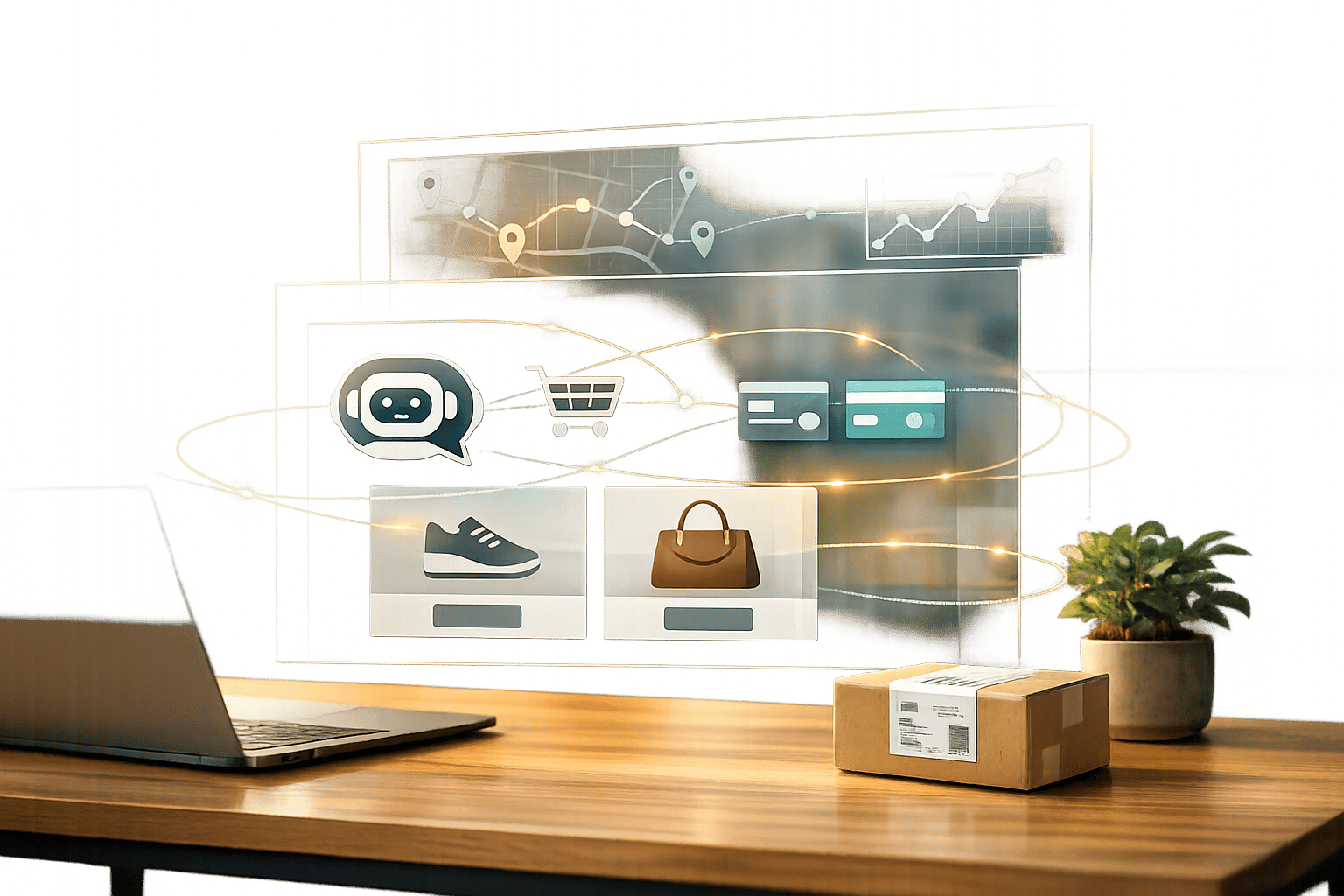
As the e-commerce landscape continues to evolve, businesses face a seismic shift in how customers discover and purchase products. The rise of agentic commerce powered by artificial intelligence (AI) and large language models (LLMs) – such as ChatGPT, Gemini, and Perplexity – has disrupted traditional growth strategies. Bryce Roberts, VP of Marketing at Logic Broker, and Steve Norris, Chief Customer Officer at Logic Broker, recently explored this transformation in a discussion that sheds light on how e-commerce brands can navigate the challenges and opportunities of this new frontier.
This article breaks down the key insights from their conversation, providing actionable strategies to help e-commerce professionals thrive in a world where discovery and conversion are increasingly driven by AI agents.
What Is Agentic Commerce?
Agentic commerce shifts the e-commerce paradigm by leveraging AI agents to collapse the traditional shopping funnel. Instead of customers manually navigating various platforms to research, compare, and purchase products, AI agents handle this process based on detailed customer prompts.
For example, instead of searching for running shoes across multiple sites, a customer might simply ask an AI agent: "Find me a size 13 running shoe under $150 with great arch support that can be delivered by next week." The agent then processes this query, identifies relevant products, and provides a curated list of options for the customer to choose from. This fundamental shift compresses the path to purchase, with significant implications for how brands market and sell in this environment.
sbb-itb-e2944f4
The Three Pillars of Growth in the Agentic Era
E-commerce growth strategies must adapt to this new reality. As highlighted in the discussion, growth opportunities can be categorized into three main areas:
1. Durable Growth Channels: Master the Basics
Durable growth lies in the foundational aspects of e-commerce that customers value most – what Norris described as the "boring stuff." These include:
- First-party data collection to strengthen customer insights.
- Offering compelling loyalty programs and subscription services.
- Ensuring inventory accuracy and optimized product content.
- Delivering exceptional customer service and fulfillment performance.
While these areas may not seem glamorous, they are critical to long-term success. Brands that invest in these core elements build equity and resilience, even as market conditions change.
2. Heavily Taxed Growth Channels: Rethink ROI
Traditional channels like paid search, retail media, and SEO are becoming increasingly expensive and less effective. Norris described these channels as "paying rent", with rising costs for customer acquisition and diminishing returns due to market saturation.
For example:
- Paid Search and Social Media: These platforms are flooded with competition, driving up costs while delivering lower returns.
- SEO: With AI-powered search engines dominating the top of Google’s results page, traditional blue links are losing visibility. In fact, reports indicate that 60% of Google searches in 2025 resulted in no clicks.
3. Emerging and Messy Growth Channels: The Agentic Opportunity
The emergence of AI agents and LLMs represents a promising but uncharted territory for e-commerce brands. According to Gartner, LLM-native search could surpass Google search by 2030, creating new opportunities for brands to engage with customers. However, this space is still evolving, with no definitive playbook for success.
Early data suggests that traffic from AI agents converts at rates up to four times higher than traditional search, making it a critical area for experimentation and investment. Brands must adapt quickly to meet the demands of this new channel.
How to Prepare Your Brand for Agentic Commerce
Navigating the agentic commerce shift requires strategic preparation. Here are the key steps to position your brand for success:
1. Optimize Product Data for AI Agents
AI agents rely on structured, accurate product data to deliver relevant recommendations to customers. Unlike traditional e-commerce strategies focused on keywords and product display pages (PDPs), agentic commerce requires brands to anticipate and answer specific customer questions.
- Provide detailed product attributes: Ensure your product listings include all relevant details, such as size, material, features, and benefits. For example, mention unique selling points like "eco-friendly materials" or "lifetime warranty."
- Focus on machine readability: Ensure your data is structured and up-to-date so agents can easily parse and use it.
2. Invest in Technology for Seamless Integration
Agentic commerce depends on low-latency integrations to ensure real-time communication between brands and AI agents. This includes:
- Orchestration platforms: Use systems that enable seamless integration across multiple agentic channels.
- Real-time data updates: Maintain up-to-date inventory availability, pricing, and shipping options to avoid errors and delays.
3. Pilot Agentic Readiness with a High-Value Category
Norris recommends testing agentic commerce strategies with a single, high-value product category. This allows you to refine your processes and measure results before scaling. Focus on products that are consistently in stock, have strong customer demand, and align with agent-ready data standards.
4. Monitor Key Metrics
To evaluate your readiness and performance in agentic commerce, track metrics such as:
- Share of voice in AI agent recommendations: Assess whether your products appear in results for relevant customer prompts.
- Referral traffic from AI sources: Determine what percentage of your site traffic originates from LLMs and identify growth opportunities.
- Blended customer acquisition cost (CAC): Compare CAC across channels to identify inefficiencies and potential areas for reinvestment.
The Risks of Waiting
Some e-commerce leaders may be tempted to adopt a "wait and see" approach regarding agentic commerce. However, this comes with significant risks. If competitors are already optimizing for AI agents and capturing market share, brands that delay may struggle to catch up. Additionally, low visibility in AI-driven search results could erode your brand’s relevance and customer base over time.
The Future of Brand Power in the Agentic Era
One of the most pressing questions for brands is whether agentic commerce will reinforce brand power or commoditize it. Norris argues that brands with clear, compelling value propositions will thrive in this environment. Customers who prioritize factors such as sustainability, durability, or loyalty programs will rely on AI agents to identify brands that meet their criteria.
On the other hand, brands that offer generic products with no differentiation risk being left behind. As Norris puts it, "Selling the same stuff as everyone else puts you in a commoditized position, whether it’s traditional e-commerce or agentic commerce."
Key Takeaways
- Durable growth comes from the basics: Focus on first-party data, loyalty programs, inventory accuracy, and fulfillment performance.
- Traditional channels are under pressure: Rising costs in paid search, retail media, and SEO are challenging their ROI.
- AI agents are the future: These emerging channels offer high-conversion opportunities but require structured product data and real-time integration.
- Optimize for agentic commerce: Provide detailed, machine-readable product information and ensure seamless integration with AI platforms.
- Pilot with a high-value category: Test your readiness with a standout product line to refine your approach.
- Monitor AI traffic: Track referral traffic from AI sources to gauge your visibility and identify areas for improvement.
- Brand differentiation is crucial: Highlight unique value propositions to avoid commoditization and stand out in agent-driven searches.
Conclusion
The rise of agentic commerce offers both challenges and opportunities for e-commerce brands. By focusing on foundational strengths, optimizing for AI-driven discovery, and investing in the right technologies, businesses can position themselves for success in this rapidly changing landscape. The key is to act now – those who delay risk losing ground to competitors who are already adapting to this new paradigm. It’s time to embrace the agentic future and take control of your brand’s destiny in the e-commerce ecosystem.
Source: "Where eCommerce Growth Still Works: Navigating Discovery with Agentic Commerce" – Logicbroker, YouTube, Mar 10, 2026 – https://www.youtube.com/watch?v=GmvBbdgvJAs