

Marketplace tax audits are on the rise, and being unprepared can cost your business thousands of dollars. If you sell on platforms like Amazon or Walmart, you’re still responsible for tracking nexus, filing returns, and maintaining exemption certificates – even if the platform collects and remits taxes for you. States are aggressively auditing sellers, and common triggers include mismatched reports, missing records, and nexus compliance gaps.
Here’s what you need to know to prepare:
- Audit Triggers: Reporting discrepancies, nexus issues, and improper exemption certificates are major red flags.
- Key Documents: Maintain sales records, exemption certificates, tax returns, and shipping data for at least 3–7 years.
- Nexus Compliance: Verify physical and economic nexus obligations based on inventory locations and sales thresholds.
- Reconciliation: Regularly match marketplace reports, tax filings, and bank deposits to avoid discrepancies.
- Exemption Certificates: Ensure all certificates are valid, signed, and up to date to avoid penalties.
Pro Tip: Conduct internal self-audits quarterly to address gaps before they attract state scrutiny. The average sales tax audit costs over $14,000, but proactive preparation can save you stress and money.
Stay organized, review your filings, and consider professional support to navigate compliance challenges.
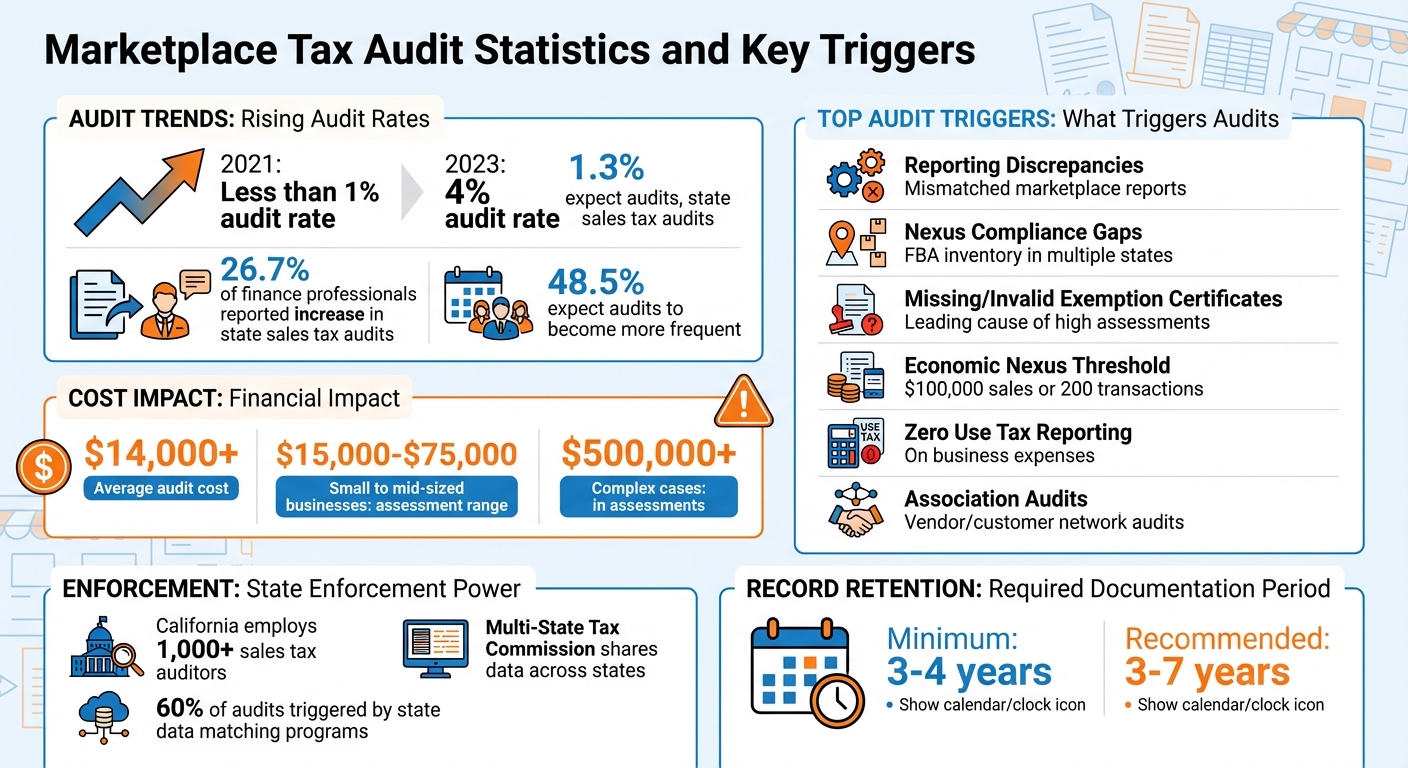
Marketplace Tax Audit Statistics and Key Triggers for Online Sellers
Lunch and Learn: What to expect during a Sales and Use Tax Audit
sbb-itb-e2944f4
What Triggers Tax Audits for Amazon and Walmart Sellers
States have stepped up their game when it comes to tracking sales tax compliance. They rely on automated data matching systems to compare sales tax returns with reports from marketplace facilitators, credit card processors, and shipping records. This increased scrutiny has led to a jump in audit rates, climbing from less than 1% in 2021 to 4% by 2023. California alone employs more than 1,000 auditors focused on sales tax enforcement.
One of the most common reasons sellers get flagged is reporting discrepancies. For example, if you report total sales, including marketplace transactions, while Amazon or Walmart separately reports the same transactions to the state, it can look like you’re underreporting, which raises red flags. Another red flag is filing a high initial tax report right after registering late. This often signals to auditors that you may have crossed nexus thresholds earlier and owe back taxes.
"States are aggressively auditing ecommerce businesses, often targeting those that have failed to register, have high initial tax filings, or use resale certificates improperly." – LedgerGurus
Nexus compliance gaps are another major issue. If you use services like FBA (Fulfillment by Amazon) or Walmart Fulfillment Services, you establish a physical nexus in every state where your inventory is stored, regardless of your sales volume. Amazon even shares this inventory data with state authorities, making it easier for them to identify unregistered sellers. Additionally, failing to meet the economic nexus threshold – $100,000 in sales or 200 transactions in a state – can also draw attention. These nexus-related problems often lead to deeper audits.
Common Audit Triggers
In addition to mismatched data and nexus issues, there are several other patterns that frequently attract auditors. For instance, association audits can be a significant risk. If one of your vendors or customers is audited, states may conduct "whipsaw audits" on their entire network, which could include your business – even if your records are clean. Ignoring pre-audit questionnaires or business activity surveys sent to unregistered sellers also almost guarantees a formal audit.
States have also joined forces through the Multi-State Tax Commission, sharing information to track down non-compliant remote sellers across state lines. For example, Illinois has been known to request sales data from multiple other states to cross-check against its own records. This collaboration means that an issue in one state could quickly lead to audits in others.
Another common trigger is reporting zero use tax on business expenses like equipment, software, or supplies. Auditors often see this as an easy opportunity to uncover tax liabilities.
Platform-Specific Compliance Requirements
Selling on platforms like Amazon and Walmart comes with its own set of challenges. On Walmart’s marketplace, sellers are required to complete a "tax interview" during onboarding and assign tax codes to every product. Walmart’s policy explicitly states that sellers are liable for any taxes, penalties, or interest caused by incorrect tax code assignments.
"Walmart.com reserves the right to make any adjustments or corrections to tax designations and Retailer may be liable to Walmart.com for incorrect Tax Designations." – Walmart Marketplace Policy
For Amazon sellers, the biggest risk stems from the FBA warehouse network. Inventory stored in multiple states creates a physical nexus, which means you need to register in those states – even if you’re making only a few sales there. While both Amazon and Walmart collect and remit taxes as marketplace facilitators in most states, sellers are still required to hold permits and file "zero-tax" or informational returns in states like Texas. Failing to file these returns, even when no tax is owed, can lead to an investigation.
Another potential pitfall is software misconfiguration. If your automated tax settings on either platform don’t correctly account for local tax rates or specific product rules – like groceries versus apparel – this can lead to discrepancies that trigger audits. To avoid these issues, it’s crucial to reconcile marketplace-provided monthly sales summaries with your tax filings regularly.
Gather Required Documents for Marketplace Compliance
Once you’ve identified the key audit triggers, the next step is collecting the necessary documentation. Missing or incomplete records can make audits expensive – on average, a sales tax audit costs over $14,000.
State auditors will need proof to verify that every tax-exempt sale, collected tax, and filed return is accurate. This means you must maintain detailed transaction records, including dates, gross amounts, item descriptions, tax collected per transaction, and shipping destinations. If you’re an Amazon seller using FBA, inventory placement reports showing where your products are stored are essential for establishing physical nexus.
"Proper documentation is the cornerstone of a successful sales tax audit. Whether you’re a small business owner or managing a large corporation, maintaining comprehensive records isn’t just a legal requirement – it’s essential for protecting your business."
– Jenner Bryson, VP, The Sales Tax People
Exemption Certificates: A Critical Focus
Exemption certificates require extra care. Missing or invalid certificates often lead to higher audit assessments. If an auditor can’t locate a valid certificate for a tax-exempt sale, they may assume the sale was taxable. Each certificate must clearly include the customer’s name, sales tax ID, date, and signature, and it must be valid for the state where the sale was delivered.
Key Documentation Categories
Most states require you to keep sales tax records for at least three to four years, but experts suggest retaining them for three to seven years to account for varying state statutes. Be proactive and download your marketplace reports monthly, as platforms may limit access to older reports.
| Category | Required Documents | Retention Period | Platform-Specific Notes |
|---|---|---|---|
| Sales Records | Invoices, receipts, POS reports, merchant account statements | 3–7 years | Includes settlement statements and order details from Amazon/Walmart |
| Tax Returns | Filed sales/use tax returns, payment confirmations | 3–7 years | Should reconcile marketplace and direct sales |
| Exemption Certificates | Resale certificates, exempt entity forms | Relationship duration + 3–4 years | Must align with the state of sale delivery |
| Shipping & Fulfillment | Shipping invoices, bills of lading, fulfillment reports | 3–7 years | Amazon FBA reports are crucial for proving nexus |
| Platform Reports | Marketplace facilitator reports, tax collection summaries | 3–7 years | Includes Walmart tax interview records, Amazon product tax codes |
| Accounting Records | General ledger, bank statements, federal tax returns | 7 years | Auditors use these to verify total gross revenue |
Tips for Organizing Records
- Digital Storage: Keep exemption certificates organized by state and customer. Track expiration dates, as certificates often need renewal every three to four years.
- Automated Alerts: Set calendar reminders or automated emails to notify customers 60–90 days before their certificates expire.
- Marketplace-Specific Reports: For Amazon and Walmart sellers, maintain Marketplace Facilitator Reports to confirm which taxes were collected and remitted. This helps prevent double-taxation issues. Don’t confuse these reports with FBA inventory reports, which are used to establish nexus.
With your documents in order, you’re ready to streamline your record-keeping system and review your sales tax filings for accuracy.
Organize Records and Review Sales Tax Filings
Once your documentation is complete, the next step is to ensure your financial filings align with your actual transactions. Take the time to organize your records and confirm that your sales tax filings match the transactions recorded in your marketplace. Discrepancies between sales tax returns and other financial records – such as income tax returns or bank deposits – are common triggers for audits. In fact, 26.7% of top finance professionals noted an increase in state sales tax audits over a recent two-year period.
Start by setting up a filing system that categorizes your records into clear groups: financial statements, sales records, tax filings, exemption certificates, and verification documents. Label each file by date, transaction type, or customer name to make retrieval quick and easy. While digital storage is often the most efficient option, the same level of organization should apply if you rely on paper records.
An organized system doesn’t just save time – it also helps ensure accuracy. Reconcile your sales tax returns with supporting documents like invoices, receipts, and bank deposits. Double-check that your sales tax filings are consistent with your IRS and state income tax filings. Also, verify that the correct tax rates were applied for each jurisdiction. These steps not only streamline your compliance efforts but also prepare you for any potential audit.
"The second you receive an audit notice, start getting ready. You’ll want to give yourself as much time as possible to find or reconstruct missing records."
– Sarah Craig, TaxJar
Conduct quarterly internal self-audits to identify missing documents, incorrect tax rates, or gaps in your transaction history. Review exemption certificates to ensure all exempt sales are supported by valid, signed, and up-to-date certificates. If a "zero return" is required, file it promptly, as missing filings often lead to audits. Address any discrepancies you uncover by preparing explanations or corrections. Being transparent with auditors about errors is far better than attempting to conceal them.
Verify Nexus, Rates, and Exemption Certificates
Once your records are organized, the next step in preparing for an audit is to ensure your nexus, tax rates, and exemption certificates are all in compliance. This step is essential to confirm that your records align with current requirements, helping you avoid costly errors during an audit.
Start by verifying your nexus and tax rate configurations. Nexus determines where you’re obligated to collect sales tax. Physical nexus occurs when your business has a tangible presence in a state, such as storing inventory in a third-party logistics center. Economic nexus, on the other hand, applies when your sales exceed a state’s specific thresholds, even if you lack a physical presence. Many states set the threshold at $100,000 in sales or 200 separate transactions, though some states go beyond this standard. Use your inventory reports to identify states where you have a physical presence.
Tax rate accuracy is just as critical. Platforms like Amazon and Walmart calculate tax rates automatically based on the product tax codes you assign. To ensure accuracy, assign each SKU to the correct tax category – whether it’s clothing, electronics, or groceries. Keep in mind that taxability varies by state, especially for items like food or prescription medicine. Don’t forget to confirm whether shipping and handling charges are taxable based on local regulations.
If you sell to tax-exempt buyers, such as wholesalers or nonprofits, validating exemption certificates is crucial. Each certificate must be signed, dated, include a valid tax ID, and match the items sold. Errors with exemption certificates – whether they’re missing, invalid, or expired – are a common cause of high audit assessments. On average, audits can cost over $14,000. To avoid these issues, review and update all exemption certificates before an audit. Tools like the MTC Uniform Sales and Use Tax Resale Certificate (accepted in 36 states) or the Streamlined Sales Tax Certificate of Exemption (valid in 24 states) can simplify compliance.
"If you don’t collect sales tax on a taxable sale, you need to validate the exemption by collecting an exemption certificate or resale certificate from your customer. Otherwise, you could end up liable for the uncollected tax, plus associated penalties and interest."
– Gail Cole, Senior Marketing Writer, Avalara
Reconcile Marketplace Transactions and Prepare for Auditor Review
Steps to Reconcile Transactions
Start by cross-checking your marketplace transactions with your tax filings – this is often where discrepancies pop up, and those can lead to penalties. Pull your sales journals, invoices, and settlement reports from platforms like Amazon or Walmart. Then, match each entry to your filed sales tax returns to confirm that every taxable sale is properly accounted for and taxed.
Make sure your reported revenue aligns with bank deposits, profit and loss statements, and ledger entries. This process can help you spot issues like unreported sales or duplicate entries. Also, review your purchase records to ensure you’ve paid any self-assessed use taxes. Don’t overlook exemption certificates – keeping them up to date is crucial, as missing ones can drive up audit costs. In fact, audit expenses often exceed $14,000. Accurate reconciliation not only helps you avoid costly mistakes but also makes responding to audits much easier.
Auditors typically review a sample of transactions using methods like stratified or block sampling to estimate error rates across the audit period. Because even a small mistake in the sample can snowball into a bigger issue, ensuring the accuracy of your records is critical. A thorough reconciliation process strengthens your defense if an audit occurs.
Preparing for an Audit Review
Once your transactions are reconciled, the next step is getting ready for the audit itself. Put together an audit file that tracks each transaction from start to finish, showing how taxes were calculated and paid. Designate a single point of contact – whether it’s someone on your team or a tax professional – to handle all communication with the auditor.
When the auditor requests information, ask for their requests in writing to keep a clear record. Provide only what they ask for – offering extra details could lead to additional scrutiny. If the audit is conducted on-site, set up a dedicated area for the process. Timely and clear responses go a long way in building trust with the auditor and can even help shorten the audit timeline.
"Remember that the auditor is neither an adversary nor a friend; they are just doing their job. Treating them as a professional and showing respect and courtesy will usually get you equal courtesy back."
– Sarah Craig, TaxJar
Reconciling your transactions thoroughly not only ensures compliance but also sets you up for a smoother audit experience.
Maintain Compliance with Emplicit Services

Staying compliant isn’t just about avoiding penalties – it’s about protecting your business from the ever-present risk of audits. Consider this: 26.7% of top finance professionals have reported a rise in state sales tax audits, and 48.5% expect these audits to become even more frequent. For small to mid-sized businesses, the average sales tax audit assessment ranges from $15,000 to $75,000, but in more complex cases, it can soar past $500,000. These numbers highlight why consistent monitoring is essential.
Emplicit’s account health management services are designed to help you stay ahead of potential compliance issues. By keeping a close eye on physical and economic nexus thresholds, they ensure your business is registered and collecting taxes before any problems arise. The service also verifies that product tax codes and categories on platforms like Amazon and Walmart are accurate, reducing the chances of classification errors that could attract state scrutiny. Additionally, routine reconciliation of settlement statements, tax reports, and filed returns helps identify discrepancies that might be flagged by state matching programs – programs responsible for about 60% of all sales tax audits. These steps build on earlier measures like audit preparation and transaction reconciliation.
"It’s best not to stand back and hope you don’t get audited, but instead expect to be impacted by an audit in the future."
– Brian Greer, TaxConnex
Emplicit’s expert support simplifies the audit process and strengthens your compliance strategy. Acting as your dedicated audit liaison, their team handles communications and routine compliance tasks, freeing you to focus on running your business. This includes managing exemption certificates – a critical area since missing or invalid certificates are a leading cause of negative audit outcomes. With nearly one in five finance professionals citing tax audits as a major concern, having expert support can significantly reduce both stress and financial risk.
Conclusion
Getting ready for a marketplace tax audit means acting early and staying organized. Start by gathering all necessary documentation – like exemption certificates, settlement reports, and transaction records. Early preparation gives you time to fill in any gaps and avoid penalties from delayed responses, which could lead to accumulating interest. With 26.7% of finance professionals reporting a rise in audits, staying consistently compliant is more important than ever.
Keeping accurate records, determining nexus clearly, and reconciling transactions on time are your strongest safeguards. Knowing your nexus obligations, maintaining precise product tax codes, and routinely reviewing marketplace transactions put you in a stronger position when auditors come knocking. Remember, the responsibility to prove exempt sales lies entirely with you, so keeping signed and updated exemption certificates in order is non-negotiable. Performing internal self-audits can also help you catch compliance issues before state auditors do.
"Your best bet is to ensure you have sales tax compliance under control so when you are audited you know where your pitfalls exist, and you can be more proactive in your defense."
– Brian Greer, TaxConnex
Beyond internal efforts, professional support can make the audit process even smoother. Assigning a single point of contact with expertise in tax regulations ensures consistent communication and prevents unintentional disclosures of sensitive information. Services like Emplicit’s account health management provide ongoing monitoring of nexus thresholds, accurate product classifications, and regular reconciliation. These tools help simplify compliance and keep your business prepared for any audit.
Taking action now reduces financial risks and ensures a less stressful audit experience.
FAQs
Do I still need to file sales tax returns if Amazon or Walmart remits tax for me?
Yes, even if platforms like Amazon or Walmart handle tax collection and remittance on your behalf, you’re still required to file sales tax returns. It’s your responsibility to report and pay any sales tax that wasn’t collected by these marketplaces. Make sure to carefully review your tax responsibilities to remain compliant with state and local regulations.
Which marketplace reports should I download now in case I’m audited later?
When selling on various platforms like Amazon, it’s essential to download your sales tax reports regularly. These reports play a key role in verifying your sales figures and tax payments, especially during an audit. By organizing this information ahead of time, you’ll be well-prepared to address any questions about your compliance.
How do I know which states I have nexus in from FBA or Walmart fulfillment?
To figure out your nexus states, you need to look at both physical presence and economic activity. For sellers using FBA (Fulfillment by Amazon), nexus is typically created if your inventory is stored in Amazon warehouses within a state. Similarly, for Walmart sellers, nexus applies if your inventory is kept in Walmart warehouses.
Economic nexus, on the other hand, arises when your sales or transaction volumes surpass the thresholds set by individual states. These thresholds vary, so it’s important to stay on top of them. Regularly checking your sales data and inventory locations can help ensure you remain compliant with state requirements.