

Pricing can make or break your ecommerce business. This case study reveals how a brand revamped its pricing strategy to better align with customer value, resulting in a 3% revenue boost and a 30-60% improvement in product performance. Here’s how they did it:
- Problem: Outdated geographic pricing and rigid flat-fee models were driving away customers and stalling growth.
- Solution: By analyzing customer journeys, the brand identified key pricing friction points. They used data-driven insights to introduce usage-based pricing, adjust regional pricing, and tailor offers across different customer segments.
- Results: Improved retention, higher customer lifetime value, and faster conversion rates, with pilot programs delivering results in just three months.
The key takeaway? Pricing isn’t static. By aligning it with how customers perceive value at different stages, ecommerce brands can drive growth without alienating their audience.
The Challenge: Pricing Problems Hurting Revenue
Finding Where Pricing Was Broken
The team began by digging deep into the data to uncover hidden pricing issues that had been buried in years of transactional records and customer behavior. To make sense of it all, they built a data warehouse consolidating 2–3 years of transactions, product details, and customer interactions. This centralized system allowed them to see the real impact of their pricing decisions, including how discounts and geographic segmentation were performing across various markets.
Using clustering algorithms, they went beyond basic demographics to identify patterns in customer behavior and product usage. This analysis revealed natural customer segments with distinct price sensitivities. Two major problems stood out: outdated geographic segments that no longer reflected regional value differences and an ineffective flat-fee upgrade model that was losing its appeal. In some regions, customers were paying prices that didn’t match the value they received, while the rigid upgrade structure discouraged potential buyers who felt it didn’t meet their needs.
These discoveries highlighted how misaligned pricing was directly affecting both revenue and customer retention.
How Bad Pricing Affected Revenue and Retention
The consequences of poor pricing were clear – and costly. Misaligned pricing was driving away valuable customers while missing opportunities with those willing to pay more. According to McKinsey & Company, inflated prices can alienate "good customers", while ineffective pricing strategies leave money on the table. The flat-fee upgrade model, in particular, created friction, leading many prospects to abandon their purchase altogether.
The financial toll was significant. Research indicates that companies failing to align pricing with customer journeys lose 15–20% of potential revenue growth, missing out on conversions and upselling opportunities. For this brand, outdated geographic segmentation alone accounted for a missed 3% revenue growth opportunity. Meanwhile, the upgrade products, which should have driven additional revenue, fell short because customers saw the flat-fee structure as poor value compared to their actual usage needs.
These findings made it clear: a complete overhaul of the pricing strategy was essential to better align value with customer expectations at every stage of their journey.
Using Customer Journey Mapping to Fix Pricing
Data Collection Methods
To address pricing misalignments, the team leaned on a solid, data-driven approach. They pulled together data from CRM systems, invoices, website analytics, and POS systems to uncover where pricing friction was causing issues. This quantitative analysis offered clear insights into conversion rates and cart abandonment patterns.
On the qualitative side, they gathered feedback through NPS, CSAT, and CES surveys. Customer interviews and session replay tools provided an extra layer of understanding by revealing how users interacted with the website. For example, Sainsbury’s digital team, using Glassbox Journey Analytics in 2024, discovered that nearly 50% of visitors abandoning their purchase had chosen the same delivery option. This pricing issue alone was costing them about $202,700 every quarter.
"The reality is, when you think of a customer journey, it’s understanding that customer in the context of their current point in time." – Amanda Elam, Chief Marketing Officer, Bloomreach
AI tools also played a role in analyzing the behavior of the 96% of customers who didn’t provide direct feedback. By tracking technical events and user actions, these tools identified hidden friction points. This combination of insights enabled the team to create targeted customer segments based on price sensitivity.
Grouping Customers by Price Sensitivity
Using an 80/20 analysis, the team segmented customers based on pricing power, identifying areas where excessive discounts were being offered. This segmentation revealed clear distinctions: some customers were highly price-sensitive and needed competitive pricing, while others prioritized premium features and were willing to pay more.
The segmentation process considered factors like customer size, region, product category, purchase history, and the competitive landscape of each deal. For physical stores, they introduced "store tiering", which evaluated the 4Cs: Customer, Competition, Cost to serve, and local market Conditions. In March 2024, Sheets & Giggles, a bedding brand, ran a large-scale price test across their core products involving over 58,000 shoppers. The results showed that 59% of the winning price points were lower than the original prices, and a 15% price cut boosted conversion rates by 40%.
Journey Stages Where Pricing Matters Most
With customer segments clearly defined, the team mapped out the key stages in the customer journey where pricing adjustments could make the biggest difference. They identified three critical points:
- Decision/Purchase Stage: Pricing had the most immediate impact here. This is the moment when customers either complete their purchase or abandon their cart. Offering targeted incentives at this stage helped close deals effectively.
- Retention and Loyalty Stage: Retaining customers proved far more cost-effective than acquiring new ones, with the latter being five times more expensive. Pricing strategies here focused on upsells, cross-sells, and personalized offers to boost Customer Lifetime Value. Studies show that optimizing customer journeys can increase revenue by 15% and cut service costs by 20%.
- Awareness and Consideration Stages: Early in the journey, pricing needed to align with the perceived value instead of pushing for immediate conversions. Positioning the brand as value-driven and conducting competitive benchmarking helped build trust and kept potential customers engaged until the purchase stage.
Ultimate Guide to Ecommerce Price Optimization
New Pricing Strategies at Each Customer Touchpoint
Using insights from the customer journey, the brand reworked its pricing strategy to align with customer expectations at every stage.
Value-Based Pricing for Early-Stage Customers
In the awareness and consideration phases, the brand moved away from aggressive discounting and focused on demonstrating value transparently. They introduced targeted offers, such as discounts tied to lead capture and loyalty points, to turn casual browsers into engaged prospects. Automated price-drop alerts for wishlisted items and dynamic product recommendations helped maintain interest without cutting into profit margins unnecessarily.
By aligning prices with perceived value, the brand built early trust, presenting itself as premium yet accessible to budget-conscious shoppers. Testing different promotional thresholds allowed them to identify which offers genuinely drove conversions versus those that simply reduced profitability. This groundwork created a strong foundation for more tailored pricing during the purchase phase.
Tiered and Usage-Based Pricing for New Customers
For customers ready to make a purchase, the brand adopted more flexible pricing models. Instead of sticking to rigid pricing structures, they introduced tiered and usage-based options. For example, in July 2024, an international ecommerce platform applied this approach by transitioning a major upgrade product to a "per-item" pricing model, showcasing the adaptability and appeal of usage-based pricing.
The tiered model offered multiple entry points to match varying customer budgets and needs. Price-sensitive shoppers could choose lower-tier options instead of abandoning their carts, while premium buyers could opt for higher-value offerings. This strategy allowed the brand to capture revenue across a broader spectrum of customer preferences rather than forcing everyone into a one-size-fits-all price.
Pricing Adjustments for Retention and Upsells
Once customer trust was established, the brand fine-tuned its pricing to encourage retention and upselling. They introduced mid-tier products, bundled offers, and subscription discounts to maximize Customer Lifetime Value. Recognizing that loyal customers, while making up 21% of their audience, generated 44% of revenue, they focused on strategies that catered to this crucial segment.
Shipping fees and bundling were also adjusted to improve margins and retention. Blanket free shipping was replaced with optimized cart minimum thresholds, which proved more profitable while maintaining customer satisfaction. These changes balanced profitability with clear communication of value, ensuring customers remained engaged and satisfied over the long term.
sbb-itb-e2944f4
Results from the Pricing Changes
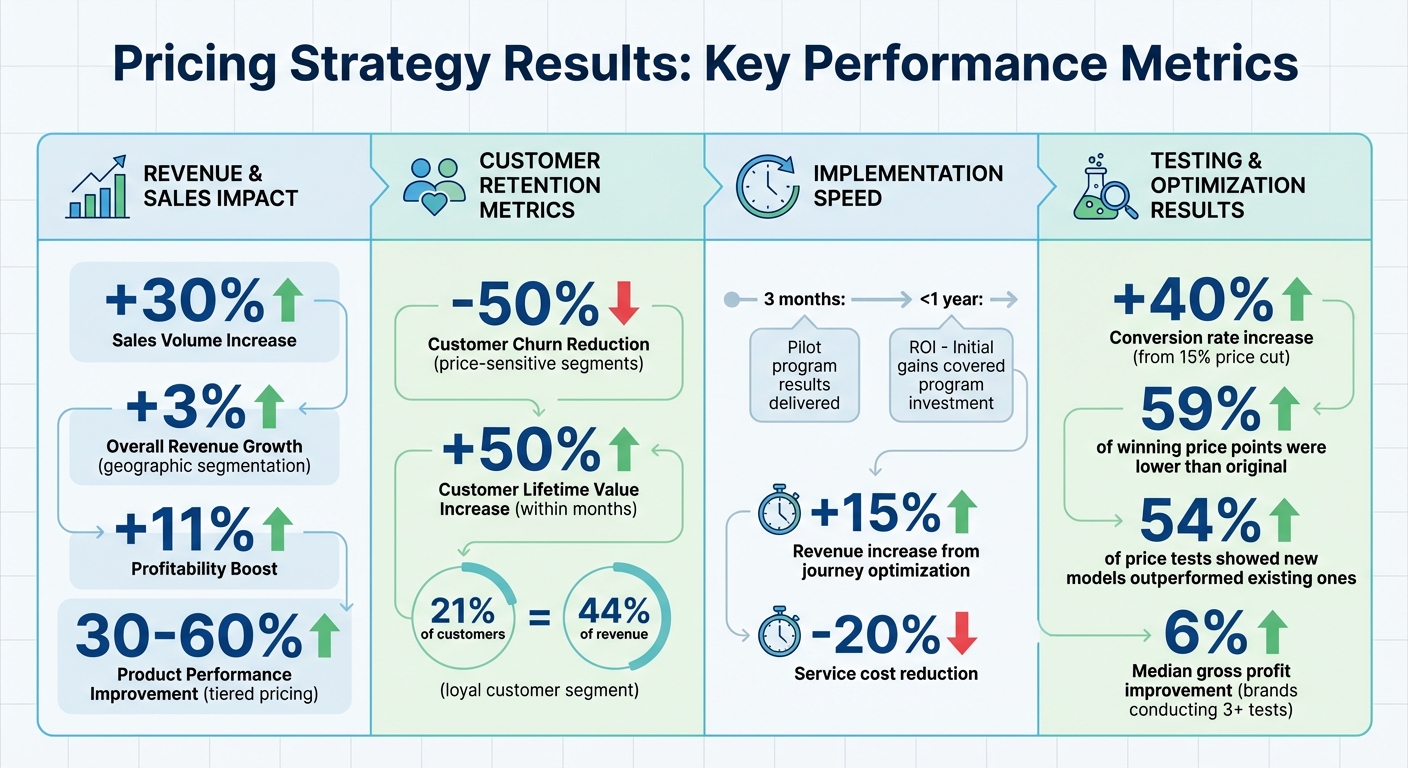
Pricing Strategy Results: Revenue Growth and Performance Metrics
Revenue Growth and Conversion Improvements
The pricing adjustments significantly impacted key financial metrics. Sales volume surged by 30%, while overall revenue climbed by 3%, thanks to more effective geographic segmentation. Additionally, tiered pricing strategies enhanced product performance by 30–60%, leading to an 11% boost in profitability.
These financial improvements also set the stage for better customer retention and increased value, as outlined below.
Better Retention and Customer Lifetime Value
Refined pricing strategies had a noticeable effect on customer loyalty. For highly price-sensitive segments, customer churn dropped by an impressive 50%. At the same time, customer lifetime value increased by 50% within just a few months. Premium customers remained engaged with higher-tier offerings, maintaining a well-balanced customer portfolio.
How Fast Results Appeared
Speed played a crucial role in the success of these pricing changes. Pilot programs launched in select regions delivered strong results within three months. This phased approach allowed the team to test assumptions, gather actionable data, and fine-tune strategies before implementing changes on a larger scale.
"Within three months, the team had compelling results."
To further streamline the process, sales teams used brief risk surveys to refine algorithmic price recommendations. By combining data-driven insights with on-the-ground expertise, the team avoided delays and ensured pricing adjustments aligned with market realities. Impressively, the initial gains from these changes covered the program’s investment in less than a year.
Lessons and Practical Advice
Getting Teams to Work Together on Pricing
Pricing strategies often fail when teams operate in silos. To avoid this, organizations can create a "touchpoint pricing governance team", which brings together marketing, sales, product, delivery, and finance. This ensures pricing aligns with the value delivered at every customer interaction.
Take the example of a multinational chemicals company in April 2015. They implemented a pricing program across seven countries using an analytics engine that segmented customers and recommended target prices. Front-line managers played a critical role by using a quick 15-second risk survey to adjust the automated recommendations based on real customer insights. The results? A 3% to 7% improvement in return on sales. The takeaway is clear: while data-driven algorithms are powerful, the input of customer-facing teams is indispensable for success.
Continuous Pricing Adjustments
Pricing isn’t a "set it and forget it" task – it’s an evolving process. Leading companies often adopt a "model, measure, maximize" approach. This involves building consumer decision models, measuring price elasticity through controlled tests, and optimizing pricing to meet specific goals. To stay competitive, pricing algorithms should be updated at least every six months to reflect changes in customer preferences, competitor actions, or product updates.
For instance, a recent experiment showed that cutting prices by 15% led to a staggering 40% increase in conversion rates. This highlights the importance of regular testing to fine-tune pricing strategies and adapt to market dynamics.
How Ecommerce Brands Can Apply These Strategies
These principles are especially relevant for ecommerce platforms like Amazon, Walmart, or TikTok Shops. A practical starting point is to focus on the 20% of SKUs that drive 80% of revenue. These high-impact products benefit from advanced, data-driven pricing models, while simpler strategies can be used for less critical items. For example, during November and December 2023, a large Chinese online retailer applied AI-driven pricing to its top 30 baby product SKUs. This resulted in an 11% revenue boost while maintaining a 10% gross margin.
Shipping strategies are another area ripe for optimization. Testing has revealed that 60% of successful shipping rate experiments involved higher rates than the original control. Additionally, 70% of merchants found that setting a higher free-shipping threshold was more profitable than offering free shipping across the board. For instance, running an A/B test with free shipping on orders over $100 can help find the sweet spot between conversion rates and profitability.
To implement these strategies effectively, ecommerce brands can start with small pilot programs in specific regions. Demonstrating results within three to six months can build the case for scaling these efforts. Companies that follow this disciplined approach can see annual revenue increases of 2% to 8%.
For ecommerce businesses aiming to refine their pricing strategy across various touchpoints, working with experts can make a big difference. Emplicit (https://emplicit.co) specializes in tailored ecommerce solutions, helping brands integrate dynamic pricing into their broader digital commerce strategies.
Conclusion
This case study highlights how pricing alignment is not a one-and-done task – it’s a continuous process that thrives on testing, collaboration, and understanding customer needs. Companies that embrace optimized touchpoint pricing strategies often see revenue growth outpacing market averages by 15–30%. Additionally, focusing on the entire customer journey can deliver a 15% increase in revenue and cut operational costs by 20%.
Shifting from traditional cost-plus pricing to data-driven methods yields measurable results. For instance, 54% of price tests show that new pricing models outperform existing ones. Brands conducting at least three tests report a median gross profit improvement of 6%. Models like transparent value-based tiers and consumption-based pricing further drive higher conversion rates and improved net revenue retention. The takeaway? Consistent testing, tracking, and refining are essential.
"Strategic pricing across customer journey touchpoints represents perhaps the most underutilized revenue lever available to SaaS executives today." – Monetizely
For ecommerce brands leveraging platforms like Amazon, Walmart, or TikTok Shops, the roadmap is clear: start small with a representative sample, run systematic A/B tests, and establish solid pricing governance. Within three to six months, brands can experience tangible results, including margin improvements of 2 to 7 percentage points. These outcomes underscore the importance of aligning pricing strategies with customer expectations.
This case study demonstrates that when brands treat pricing as a dynamic tool tied to customer value – rather than a fixed figure – they unlock the potential for sustained revenue growth. Aligning pricing with the key moments in a customer’s journey isn’t just a tactic; it’s a strategy that builds long-term success.
FAQs
How can ecommerce brands determine the best pricing strategy for their customers?
Ecommerce brands can fine-tune their pricing strategies by digging into customer behavior and figuring out how shoppers perceive value at different stages of their buying journey. By carefully mapping out this journey, brands can identify key moments where pricing becomes a deciding factor and adjust their approach to align with what customers expect and value.
Experimenting with various pricing elements – like product images, titles, and descriptions – can reveal what truly connects with shoppers. Running data-driven tests and refining these elements over time helps develop pricing models that not only enhance customer satisfaction but also improve profitability. The real key lies in aligning prices with customer preferences to ensure steady and meaningful revenue growth.
How does customer journey mapping help optimize pricing strategies?
Customer journey mapping gives businesses a detailed look at how customers interact with a brand during key stages like awareness, consideration, purchase, and post-purchase. By digging into customer needs, motivations, and behaviors at these touchpoints, companies can fine-tune their pricing strategies to better match expectations – leading to increased revenue and happier customers.
It also helps identify obstacles that might affect a customer’s willingness to pay, such as friction during checkout or inconsistent messaging. Fixing these issues with thoughtful pricing adjustments not only boosts conversion rates but strengthens customer loyalty. Armed with these insights, businesses can craft pricing strategies based on solid data, paving the way for sustainable growth and a stronger position in the market.
How long does it take to see results from pricing strategy adjustments?
Brands typically begin observing results from pricing changes within three to six months. This period gives customers time to adjust to the new pricing and allows businesses to track measurable shifts in revenue and profit. That said, the timeline can differ based on factors such as the complexity of the changes and the competitive environment.