

Pricing isn’t just numbers; it’s a tool that connects with your customers at every step. From the moment they discover your brand to becoming loyal advocates, adjusting pricing to match their journey can boost profits and trust.
- A 1% price improvement can lead to 11% higher operating profits.
- Transparent pricing increases conversions by 24%.
- Tiered options capture 30% more market share.
- Loyalty-focused pricing reduces churn by 30%.
Here’s the key: Different stages of the customer journey need different pricing approaches. Freemium models work for awareness, clear pricing builds trust during consideration, and tiered pricing seals the deal at the decision stage. Post-purchase, discounts and loyalty rewards keep customers coming back, while advocacy pricing turns them into brand ambassadors.
Pricing isn’t static – it’s a dynamic way to connect with your audience and grow revenue.
The 5 Stages of the Customer Journey
What Each Stage Means
The path buyers take is rarely straightforward. Instead, the customer journey tends to loop back on itself as buyers uncover new information or bring additional decision-makers into the process. This is especially noticeable in B2B sales, where cycles often stretch 3 to 6 months and involve 6 to 10 stakeholders.
Here’s a breakdown of the five stages:
- Awareness: At this stage, customers recognize a problem but aren’t actively searching for specific solutions. Instead, they’re gathering general information and exploring trends.
- Consideration: Buyers begin comparing options, diving into product details, reviewing case studies, and using tools like ROI calculators to weigh their choices.
- Decision: This is the moment they’re ready to make a purchase. Buyers are narrowing down competitors and addressing any lingering concerns.
- Retention: After the purchase, this stage focuses on keeping customers engaged. Proactive onboarding, ongoing support, and ensuring product adoption are key here.
- Advocacy: Satisfied customers evolve into repeat buyers and brand champions. They’ll leave reviews, refer others, and amplify your brand’s reputation.
One eye-opening fact: only 17% of a B2B customer’s journey involves direct interaction with vendors. The other 83%? That’s spent on independent research and internal discussions. What’s more, 88% of customers say a company’s overall experience is just as critical as the products they offer. This highlights the need for a pricing strategy that resonates even when you’re not part of the conversation.
Since customer intent shifts at each stage, pricing strategies should adapt accordingly. Early on, pricing is a way to qualify leads and communicate value. As the journey progresses, it evolves into aligning costs with perceived value and rewarding loyalty. By understanding these stages, businesses can craft pricing strategies that meet customers’ needs every step of the way.
sbb-itb-e2944f4
Pricing Strategy: Leveraging customer psychology to maximize average customer value
Pricing Strategies for Each Journey Stage
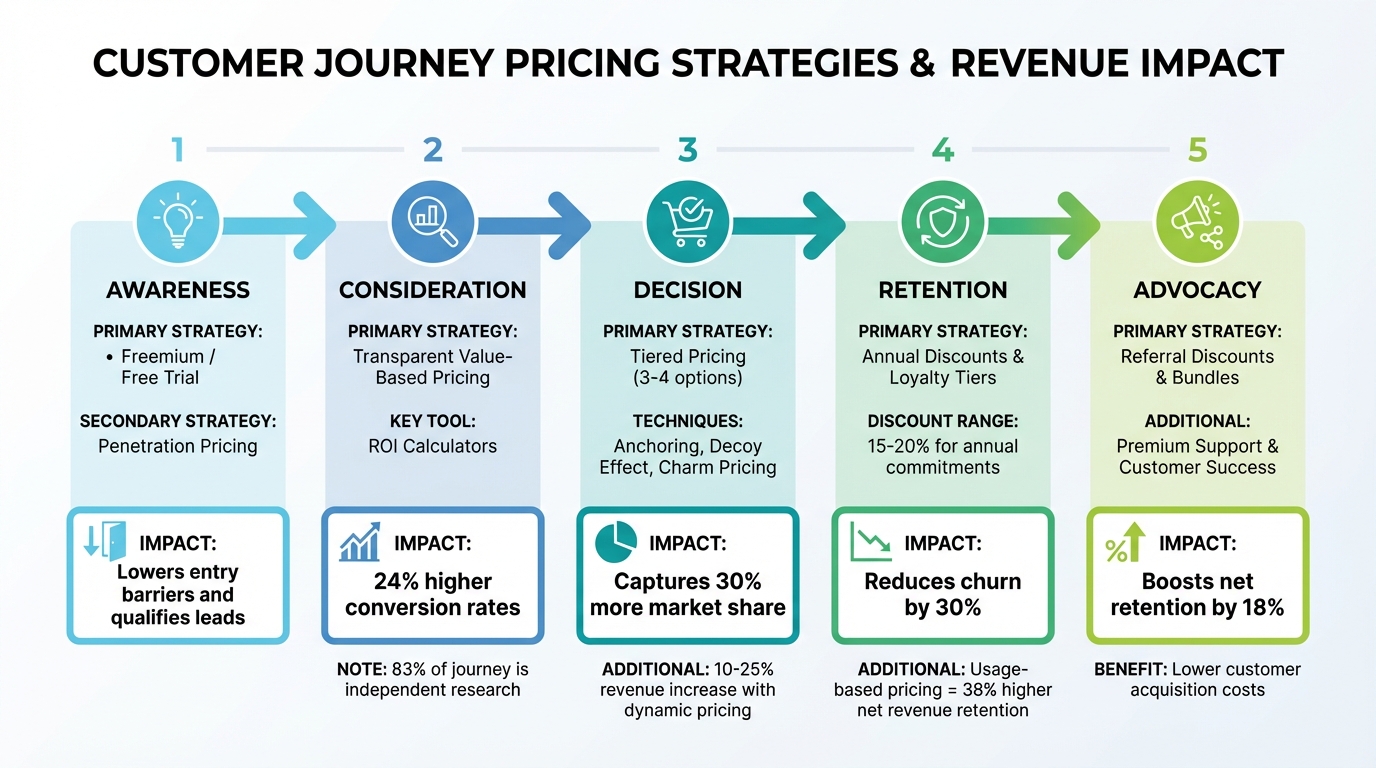
Pricing Strategies Across the 5 Customer Journey Stages
Aligning pricing strategies with the customer journey can unlock more revenue at every step.
Awareness Stage: Showcasing Value Without Barriers
In the awareness stage, it’s all about making it easy for potential customers to engage with your product. Freemium models and free trials are great tools here – they let people experience the value of your offering without an upfront commitment. Another effective approach is penetration pricing, where you start with lower rates to quickly gain market share and build brand recognition.
The key isn’t just about low prices – it’s about showing value. A freemium tier should highlight enough functionality to demonstrate your product’s worth while leaving room for users to see why upgrading is a smart move. This ensures you’re attracting the right audience and weeding out those unlikely to convert.
As prospects begin evaluating options, clarity in pricing becomes essential.
Consideration Stage: Building Trust Through Transparency
During the consideration phase, buyers are comparing their options carefully. Transparent pricing can make all the difference – companies that clearly display their prices on their websites see conversion rates 24% higher than those that hide them behind "Contact Sales" forms. Simplifying your pricing page can also reduce friction by 30% to 40%.
ROI calculators are another powerful tool at this stage, helping prospects understand the value they’ll get. Messaging that focuses on outcomes, like "Save 10 hours per week", can address potential objections before they surface. Since buyers spend 83% of their journey doing independent research, your pricing page needs to deliver even when you’re not there to explain it.
Once buyers recognize your value, the next step is guiding them toward the right purchase.
Decision Stage: Sealing the Deal with Tiered and Dynamic Pricing
When customers are ready to commit, tiered pricing helps guide them to the best choice. Offering three to four pricing tiers can capture 30% more market share than fewer options. A common structure includes an entry-level "Bait", a mid-tier "Target" (usually your main revenue driver), and a high-end "Premium" option for enterprise clients.
Psychology also plays a big role here. Starting with the highest-priced tier can anchor the perceived value, making mid-tier options seem more affordable. The decoy effect – offering a less valuable option at a similar price – can nudge customers toward the tier you want them to choose. On top of that, dynamic pricing powered by AI can increase revenue by 10% to 25%, while charm pricing (e.g., $9.99 instead of $10) boosts conversions by an average of 24%.
Even after the sale, pricing strategies can keep customers engaged.
Retention Stage: Rewarding Loyalty to Reduce Churn
Post-purchase, pricing can help retain customers. Offering discounts for annual commitments (typically 15% to 20%) not only improves cash flow but also reduces churn – customers who pay annually are 30% less likely to leave. Loyalty tiers that reward long-term customers with better pricing or exclusive features can further strengthen relationships.
Usage-based pricing is another effective approach, aligning costs with the value customers receive. This model has been shown to deliver 38% higher net revenue retention compared to fixed subscriptions. Additionally, strategic renewal pricing and preferential bundle deals for existing customers can increase expansion revenue by 20% to 25%.
And satisfied customers can do more than just stick around – they can help grow your business.
Advocacy Stage: Turning Customers into Brand Ambassadors
Happy customers are your best advocates. Referral discounts encourage them to bring in new leads while lowering your customer acquisition costs. The beauty of this approach is that it benefits both parties – the referrer feels appreciated, and the new customer gets a deal.
Providing value-added tools, like professional resources, can also keep your brand top-of-mind. Companies that monetize premium support and customer success services report 18% higher net retention rates. Advocacy-stage pricing isn’t just about discounts – it’s about delivering ongoing value that customers are excited to share.
Here’s a quick summary of these strategies and their impact:
| Journey Stage | Primary Pricing Strategy | Revenue Impact |
|---|---|---|
| Awareness | Freemium / Free Trial | Lowers entry barriers and qualifies leads |
| Consideration | Transparent Value-Based Pricing | 24% higher conversion rates |
| Decision | Tiered Pricing (3–4 options) | Captures 30% more market share |
| Retention | Annual Discounts & Loyalty Tiers | Reduces churn by 30% |
| Advocacy | Referral Discounts & Bundles | Boosts net retention by 18% |
Creating a Unified Pricing Strategy
Crafting a pricing strategy that feels consistent yet adaptable is all about finding the sweet spot between structure and flexibility. At its core, this strategy should consider three key factors: your cost floor, the price ceiling your customers are willing to pay, and the competitive landscape you’re operating in.
Start by conducting a journey pricing audit. This means mapping out every step of your customer’s journey – from the moment they first hear about your brand to when they become loyal advocates. The goal? Pinpoint where you’re delivering value but not capturing it. For example, a potential customer in the awareness stage will likely have a much lower price sensitivity compared to a long-term, loyal user. By segmenting customers based on their willingness to pay at different stages, you can uncover pricing gaps and opportunities. This audit lays the groundwork for an agile pricing framework that adapts to your findings.
Next, establish cross-functional governance. Bring together team members from marketing, sales, and product to oversee pricing decisions across the entire customer lifecycle. This ensures that short-term tweaks to pricing don’t undermine your long-term brand image or the trust you’ve worked hard to build. In fact, companies with well-optimized pricing strategies across touchpoints often see revenue growth that’s 15% to 30% higher than the industry average.
Another critical step is to refine your value metric. Your charges should align with the outcomes your customers care about most. Regularly reassess whether your pricing reflects the value you’re providing. For instance, if you’re charging per user but your customers prioritize results like time saved or revenue generated, you might be missing out on potential revenue. Companies that tie their pricing to real customer outcomes tend to grow 30% faster than those that don’t.
Finally, use robust analytics to measure the impact of pricing changes. Start with small, structured experiments at two or three key touchpoints before expanding changes across your entire organization. This data-driven approach lets you stay agile, making adjustments based on market shifts while maintaining the consistency that fosters customer trust over time.
How Emplicit Optimizes Pricing Strategies
Emplicit uses a data-driven, purchase funnel approach to craft pricing strategies tailored to the unique challenges of platforms like Amazon, TikTok Shops, Walmart, and Target.
The process kicks off with a Discovery and Analysis phase, where Emplicit digs into your customer data, past campaign results, and competitor insights using tools like Helium10. This step helps uncover not just what customers are buying, but also why they make their decisions at different points in their journey. To get even deeper insights, Emplicit conducts customer interviews, online surveys, and targeted keyword research to understand consumer needs and where your audience is searching.
"Emplicit’s experience in creating data-driven, purchase funnel-based marketing strategies enables us to develop a successful marketing strategy before you spend a dime on media."
- Emplicit
What makes their approach stand out is their Continual Ecommerce Maximization model. Instead of treating pricing as a one-time adjustment, they view it as an ongoing process. Monthly monitoring, quarterly reviews, and annual strategy updates ensure your pricing stays competitive as the market shifts.
This model combines internal and external SWOT analyses with multichannel planning to identify impactful pricing tweaks. By setting SMART goals – specific, measurable, attainable, relevant, and time-based – and tracking metrics like ROAS (Return on Ad Spend) and ROI (Return on Investment), Emplicit ensures every pricing decision drives clear business results. This method not only helps seize market opportunities quickly but also builds customer trust across every interaction. The result? A pricing strategy that adapts seamlessly to the evolving customer journey.
Conclusion
Shaping your pricing strategy to align with the customer journey is a powerful growth tool that directly influences your profitability. For eCommerce businesses competing on platforms like Amazon, Walmart, and TikTok Shops, every pricing decision – at every stage of the customer experience – carries weight.
The numbers back this up. Studies show that value-based pricing can generate 15-35% more revenue compared to traditional cost-plus methods. Similarly, B2B SaaS companies adopting consumption-based pricing models report 38% higher net revenue retention. These aren’t just one-time gains; they build momentum over time, highlighting the game-changing potential of a thoughtful pricing approach.
"The most successful SaaS organizations no longer view pricing as a static, one-time decision but rather as a dynamic opportunity to capture appropriate value at each meaningful customer interaction."
But it’s not just about the revenue. When pricing aligns with the customer journey, it fosters trust and satisfaction. Transparent pricing during the research phase, tailored tiered options at decision points, and loyalty rewards for existing customers create an experience where buyers feel understood, not exploited. This trust leads to higher conversion rates, reduced churn, and increased customer advocacy – a positive cycle that drives growth from multiple angles.
FAQs
How do I know which pricing model fits each journey stage?
To pick the right pricing model for each phase of the customer journey, think about how customers see value at different points. In the early stages, like awareness, clear and value-focused pricing helps establish trust. As customers move to later stages, such as making a purchase or renewing a service, dynamic or tiered pricing works well. This approach adapts to their behavior, usage patterns, and needs, aiming to boost both satisfaction and revenue.
What metrics should I track to prove a pricing change worked?
To gauge the impact of a pricing change, focus on tracking a few key metrics. Customer retention can reveal how well your pricing aligns with customer expectations. Lifetime value (LTV) helps you understand the long-term financial contribution of your customers under the new pricing. Conversion rates indicate how the change affects buying decisions, while product performance highlights shifts in demand or sales trends. Together, these metrics offer a clear picture of how the pricing adjustment influences both customer satisfaction and revenue growth.
How can I test new prices without hurting trust or retention?
To experiment with new pricing strategies without risking customer trust or retention, concentrate on the design and presentation of your pricing page instead of immediately altering the prices themselves. For instance, you can A/B test different ways of bundling features or tweak how the value is communicated. Present price changes as opportunities for added value, making sure to clearly outline the benefits to your customers. Keep a close eye on both conversion rates and trust metrics to gauge how well these changes are received, and fine-tune your approach accordingly.