

The type of deal you run can matter more than the size of the discount. A product priced at $300 with $30 off and 10% off gives the same savings, but shoppers may react in different ways.
If I had to boil the article down, it’s this:
- Percent-off often works best for lower- to mid-priced items, such as $10 to $75
- Dollar-off often works better for higher-priced products, around $50+
- Bundles and spend-threshold deals can grow average order value without cutting every order
- Coupons can help with trial and new customer offers
- Limited-time promos push urgency, but timing matters: 48 hours can drive a spike, while 7 days may soften urgency
- The goal should guide the format: conversion, basket size, launch, or clearance
- Before scaling, I’d test discount depth, wording, thresholds, audience, and promo length
- To protect profit, I’d track ROAS, ACoS, TACoS, CAC, sell-through, and SKU-level conversion rate
Bottom line: I wouldn’t ask, “What’s the biggest discount I can offer?” I’d ask, “Which format gets the result I want with the least margin loss?”
Why Some Discounts Work (and Others Kill Your Brand)
Quick Comparison
| Promotion type | Best use | Why it works | Main risk |
|---|---|---|---|
| Percent-off | Broad conversion | Easy to scan on many lower-priced items | Can train shoppers to wait for deals |
| Dollar-off | Higher-ticket items | Savings feel easier to judge in dollars | May feel small on very expensive items |
| Coupon | Launches, trial, new buyers | Lets me target who sees the offer | Can cut profit if shown too broadly |
| Bundle / threshold | Basket growth | Pushes shoppers to add more items | Needs the right spend level |
| Limited-time offer | Urgency, short sales push | Gives shoppers a reason to act now | Demand spikes can cause stock issues |
The core idea is simple: promotion format shapes how shoppers read value, urgency, and savings. That’s why the right offer can lift sales without using the deepest cut.
How Each Promotion Type Affects Purchase Intent
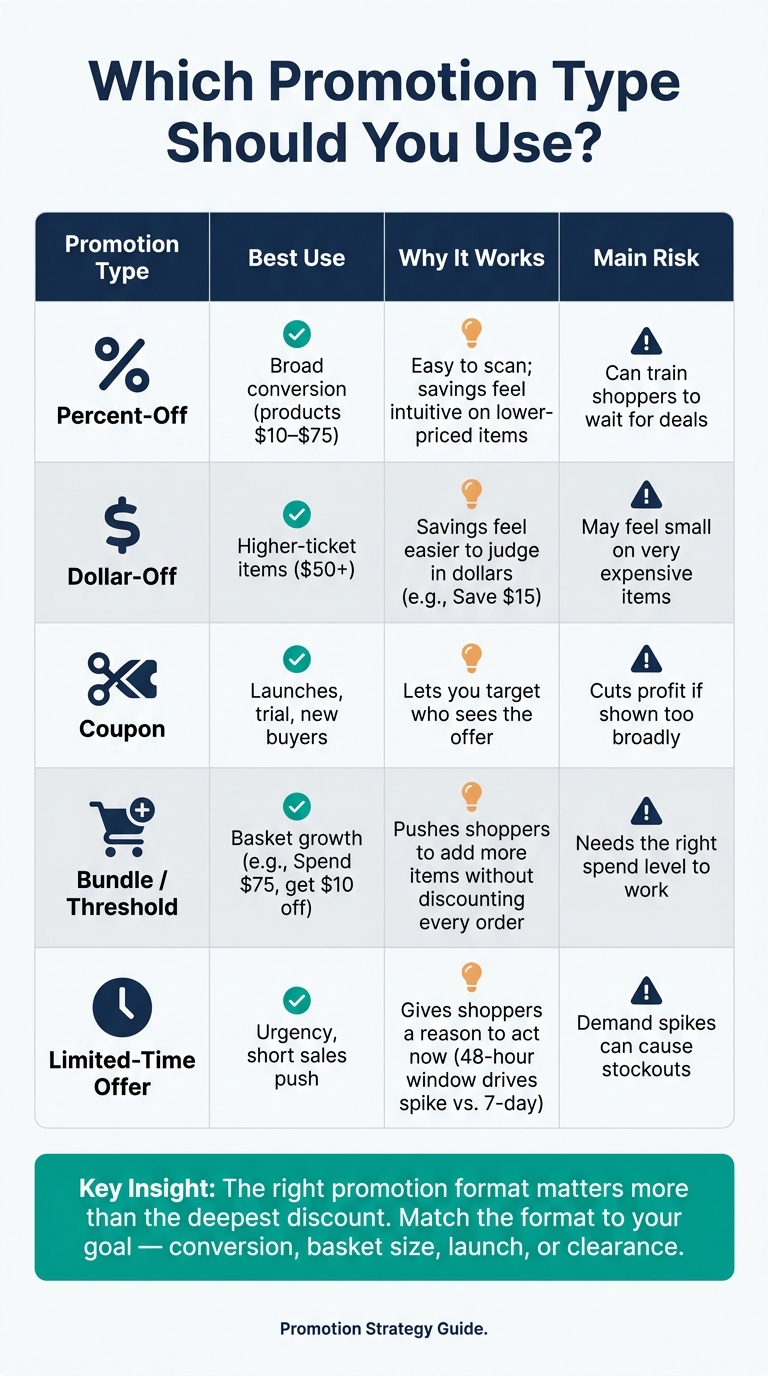
Promotion Type Comparison: Best Use, Why It Works & Main Risk
Percent-Off vs. Dollar-Off: How Savings Framing Changes Perceived Value
Shoppers don’t read the same deal the same way. A discount can look very different depending on whether it’s framed as a percentage or as a dollar amount.
Small discounts usually don’t do much. Midrange discounts can help convert people who are already close to buying, without teaching them to hold off for a bigger deal. Deep discounts can drive a spike in signups, but they also tend to pull in price-sensitive shoppers who buy once and disappear. That can eat into margin and lifetime value.
The offer should fit the goal. For subscription-based products, a 20% to 25% subscribe-and-save coupon often hits a good middle ground between purchase intent, long-term retention, and per-order profitability. That’s where framing starts to matter most: when you want more conversions without cutting the price too far.
sbb-itb-e2944f4
How To Match Promotion Type to Product Goals
Best Promotion Types for Conversion, Basket Size, Launch, and Clearance
Once the framing is set, the next step is matching the offer to the goal. Different promo types push different buying triggers: savings, urgency, or larger carts. So the point isn’t picking the “best” promotion in the abstract. It’s picking the one that fits the job. Price, margin, inventory, and the outcome you want should drive the format.
For broad conversion lifts, like seasonal events or sitewide sales, a simple percent-off deal often works best. That tends to work especially well for products priced between $10 and $75, where shoppers can size up the savings at a glance. For higher-priced items, roughly $50 and up, a dollar-off message like Save $15 often feels easier to judge than a percentage.
When the goal is basket growth, bundles and threshold offers start to do the heavy lifting. A Spend $75, get $10 off deal gives shoppers a reason to toss one more item into the cart without forcing you to discount every single order. If you’re trying to drive trial, targeted coupons or intro percent-off offers can help bring people in without training them to wait for full-price items to go on sale. And for clearance, the job changes: move inventory fast. That means the focus is on selling units, freeing up cash, and opening shelf or warehouse space, not squeezing every last dollar of margin out of the stock.
Use percent-off for broad conversion, dollar-off for higher-ticket items, coupons for launches, bundles for basket growth, and limited-time promos for urgency.
Format choice also depends on margin and inventory. High-margin products can handle deeper discounts. Low-margin SKUs usually need thresholds to protect profit. If inventory is tight, smaller and more targeted offers make more sense. If you’re sitting on too much stock, bundles and multi-buy deals are often the better play.
What To Test Before Rolling Out a Promotion on Amazon, Walmart, Target, or TikTok Shop
Before you scale anything, test it on a small group of SKUs. That gives you a cleaner read on what’s working before you roll the promo out across the board. Most marketplace promo tools let you do limited runs, which makes this pretty doable.
Start with discount depth. Test two or three levels, such as 10%, 20%, and 30%, or $5 vs. $10 off. The goal is simple: find the lowest discount that still gives conversion a meaningful bump, instead of giving away margin you didn’t need to lose. After that, test the wording. Save $10 now and 20% off today can lead to different click-through, add-to-cart, and conversion rates, even when the shopper saves the exact same amount.
Threshold offers need testing too. Try different spend levels like $50, $75, and $100, then watch how many shoppers hit each one and how much extra revenue each threshold brings in compared with the cost of the discount. Targeting matters just as much. A coupon shown only to new customers or email subscribers will often produce better ROI than one shown to shoppers who were likely to buy at full price anyway.
The expiration window matters too. A 48-hour promo window can create a sharper spike in demand. A 7-day window tends to spread demand out more, but it can also weaken urgency. Neither option is always right. It depends on how ready your team is to handle a surge and how much inventory you can actually fulfill if orders jump.
How To Run Promotions Without Wasting Margin
Once you pick a promotion type, the next step is simple: make sure it still protects margin.
Each promotion should serve one goal only. That goal might be conversion, basket size, launch velocity, or clearance. Before anything goes live, model the offer against contribution margin so you know what the promo needs to do to pay off.
Common Promotion Mistakes That Cut ROI
One of the biggest mistakes is discounting products that already sell well at full price. That move gives away margin for no good reason. Inventory planning matters too. A promo can drive a sharp sales spike, and stock can disappear fast if you’re not ready.
Blanket discounts create another problem. Using the same percent-off deal across the board often hurts efficiency. Tiered discounts or bundles usually do a better job of protecting margin while also pushing basket size.
And a flash sale won’t save a weak listing. It just puts more attention on a weak message.
Set the goal first. Then track ACoS, ROAS, and sell-through. Those numbers tell you whether to run the promo again, adjust it, or stop it for that SKU.
That’s why promotion strategy has to connect with listings, ads, and inventory, not just the discount itself.
How Emplicit Can Help Align Promotion Strategy With Marketplace Execution
Promotion ROI depends on listing readiness, ad timing, and inventory placement.
Emplicit aligns PPC, listing optimization, inventory, and account health so promotions turn traffic into sales without stockouts or wasted spend.
Conclusion: Choose the Promotion Format That Fits the Buying Decision
Every promo works because of a few simple levers: framing, urgency, perceived value, and targeting. Shoppers don’t react to discounts in a vacuum. They react to how the deal is presented, who sees it, what comes with it, and how long it stays live.
Match the promotion type to the job at hand: conversion, basket size, launch, or clearance. That’s why the right format matters more than the deepest discount.
Before you scale anything, prove the offer on one product first. Test steeper discounts on a small set of key SKUs for a fixed window. Then measure conversion and subscriber LTV. Track TACoS, CAC, and conversion rate at the SKU level. The right format, on the right product, drives purchase intent with less waste. Weak data from broad rollouts won’t tell you much.
Promotion strategy is margin strategy. When you test the right format on the right SKU and track it against the right metrics, a promo becomes a growth lever instead of a drain.
FAQs
Which promo type fits my product best?
The best promotion depends on your product goals, audience, and profit margins.
- Percent-off deals work well when you want to launch a product or drive sales fast.
- Coupons can help lift conversions in crowded niches where shoppers are comparing options side by side.
- BOGO offers and bundles are a smart fit when you want to move extra inventory or increase average order value.
- Limited-time promos add urgency and can push people to act now instead of later.
- Subscribe and Save tends to work best for consumables and household staples that people buy again and again.
Should I use percent-off or dollar-off?
It comes down to your product goals and the way your audience likes to buy. Percent-off deals tend to catch the eye and can drive fast sales because the value feels easy to spot. Dollar-off offers can work better for shoppers who want a plain, concrete number.
Test both with A/B experiments, then use the results to see which format lines up best with your conversion goals.
How do I test promos without hurting margin?
Start with a clear pricing floor based on your unit costs. Then run a break-even analysis to check whether a lower margin can be made up through more sales.
Instead of discounting the whole store, test specific SKUs. That gives you a cleaner read on what’s working and helps limit risk if the offer falls flat.
Use A/B testing with control groups, and track:
- conversion rate
- Average Order Value
- Advertising Cost of Sale
For bundles, show each item’s regular price next to the bundle price. It makes the deal easier to see at a glance and helps reinforce the value.