

Scaling a marketplace can drive growth, but it also introduces serious challenges that can hurt profitability. From inventory mismanagement to rising customer acquisition costs, these issues escalate as operations expand. Here’s a quick breakdown of the five biggest risks you face when scaling:
- Inventory Issues: Inaccurate tracking across platforms like Amazon and Walmart leads to overselling, stockouts, and wasted capital.
- Complex Operations: Adding warehouses or sales channels increases workload, hidden costs, and inefficiencies.
- High Customer Acquisition Costs: Rising ad costs and declining conversions strain budgets, making growth harder to sustain.
- Regulatory Compliance: Evolving laws and automated enforcement can result in costly penalties or account suspensions.
- Inefficient PPC Management: Poorly structured ad campaigns waste money and erode profits.
Without proper systems and expert support, these problems can snowball, turning growth into a liability. The key is identifying these risks early and implementing scalable solutions to protect your margins.
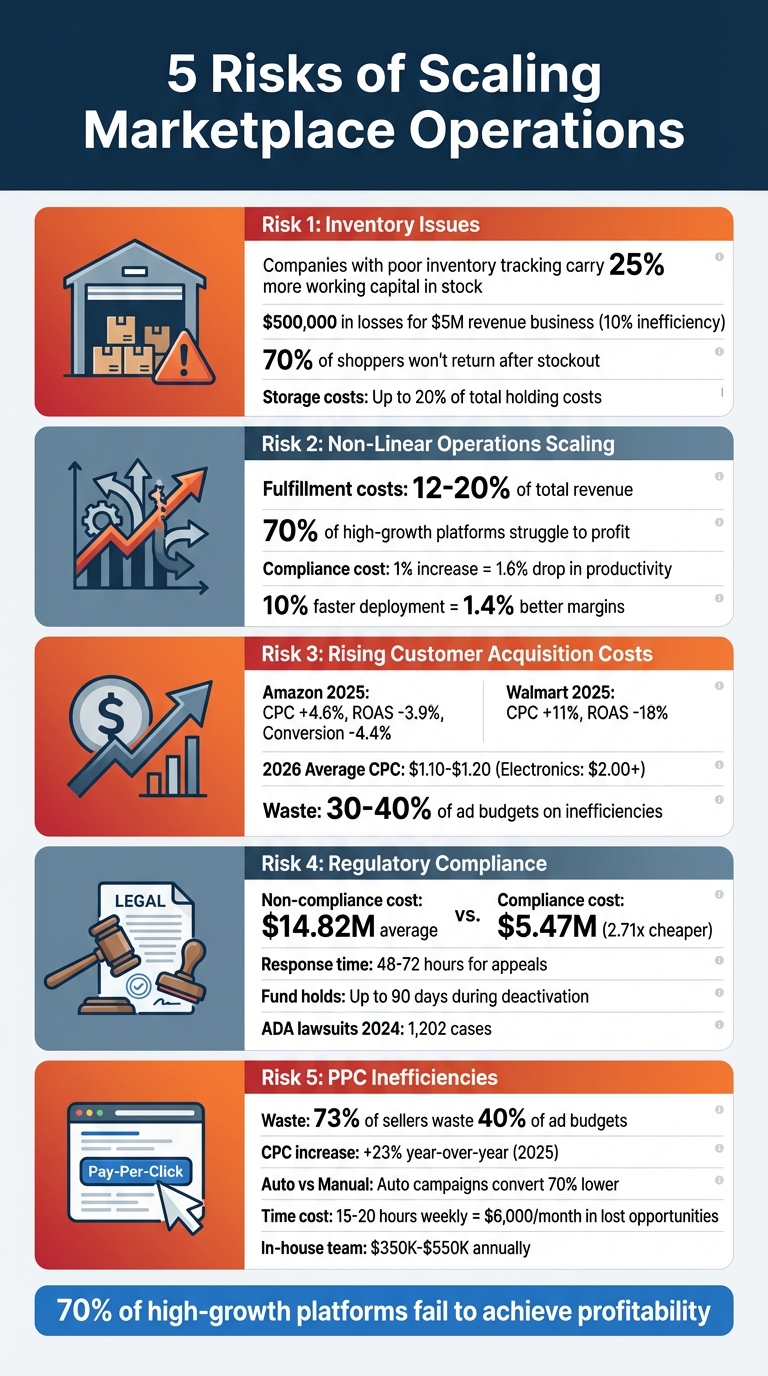
5 Critical Risks When Scaling Marketplace Operations: Key Statistics and Impact
1. Inventory Becomes a Growth Tax
Scaling across multiple marketplaces often turns inventory into a growth bottleneck. Every dollar tied up in unsold inventory is a dollar that could have been invested in marketing or developing new products. Companies with inaccurate inventory records typically carry 25% more working capital in stock compared to top-performing competitors. For a merchant earning $5 million in revenue, even a 10% inefficiency means $500,000 in losses.
Impact on Profitability
Poor inventory management hurts profitability in two major ways. Overstocking leads to clearance markdowns, while understocking forces businesses to rely on expensive air freight instead of cost-effective ocean shipping to avoid sales losses. On top of that, long-term warehouse storage fees can eat up as much as 20% of total holding costs. And the stakes are even higher for customer retention – 70% of shoppers are unlikely to return after encountering a stockout.
On Amazon, the consequences of stockouts are especially harsh. Repeated stockouts can drop your in-stock rate below 90%, which directly impacts your Buy Box share and overall marketplace eligibility.
"Dead stock isn’t just a merchandising embarrassment, it’s cash that can’t fund marketing, product development, or the boring bills." – Luke Hodgson, Commerce Thinking
Operational Complexity
As your operations grow, so does the risk of inventory errors. Discrepancies between system records and actual stock become more frequent, especially when manual processes are stretched by increasing order volumes. These errors can lead to costly mistakes in picking, packing, and returns. Expanding from one warehouse to multiple locations only adds to the complexity. Inventory becomes fragmented – stock reserved for outgoing shipments might not be available for sale, and system delays can create further confusion. To avoid running out of stock, teams often add safety buffers at each location, which ties up even more capital.
Take GadgetWorks, for example. In Q4, the electronics retailer faced 12% daily stock discrepancies across four marketplaces due to disconnected systems. During the critical Christmas week, these issues resulted in $75,000 in lost sales from stockouts and cancellations. These problems grow worse as SKU counts increase, making cross-platform synchronization a priority.
Scalability Challenges
The challenges of scaling inventory management aren’t just operational – they’re systemic. Platforms like Shopify, Amazon, Walmart, and TikTok Shop all require real-time inventory updates to avoid selling items that are no longer in stock. Batch updates can create delays, leading to overselling and customer dissatisfaction.
As your SKU count grows from a handful of products to hundreds, forecasting errors become more costly. For example, when stockouts exceed 5%, about 40% of potential sales are lost to competitors. Overstocking, on the other hand, can increase carrying costs by 20–30%, locking up funds that could have fueled growth. If shipping expenses surpass 15% of the cost of goods sold, it’s often a sign that a centralized inventory model is no longer sustainable.
sbb-itb-e2944f4
2. Operations Scale Non-Linearly
As businesses grow, scaling operations can quickly turn small, manageable issues into significant risks. For instance, adding a second sales channel or warehouse doesn’t just double the complexity – it multiplies it. The real challenge lies in these sudden leaps, where systems that once worked smoothly can quickly become overwhelmed.
Operational Complexity
Operational processes face immense strain as businesses expand. For example, managing inventory across platforms like Shopify, Amazon, and Walmart requires precise synchronization. Without it, overselling becomes a real risk. Imagine a scenario where an item sells on one platform but hasn’t been updated on another – this kind of mismatch is all too common. On top of that, warehouse inventory might be tied up in quality checks or reserved for other purposes, further complicating matters.
Manual systems that worked fine for a handful of orders can break down under the pressure of hundreds, especially when those orders span multiple channels. To avoid stockouts, teams often resort to adding safety stock at different locations. While this might reduce immediate risks, it ties up capital and increases the likelihood of accumulating unsold inventory.
"Scaling rarely fails in one dramatic moment. It fails in stages, as systems and processes fall out of sync with the business they’re meant to support." – SalesWarp
Impact on Profitability
As operations scale, hidden costs can grow faster than revenue. Fulfillment and logistics alone can eat up 12–20% of total revenue. For a mid-sized platform processing $100 million annually, fraud prevention measures can cost between $4 million and $6 million, or 1.2% to 3.6% of GMV. Add cross-border compliance, and transaction costs can climb by another 9–12%.
Even a small rise in compliance costs – just 1% – can lead to a 1.6% drop in productivity and revenue. For example, EU-based marketplaces dealing with regulations like the Digital Markets Act and AI Act have increased compliance staffing by 40% since 2022. This is why nearly 70% of high-growth digital platforms struggle to turn a profit – they fail to shift from aggressive growth strategies to more sustainable operations.
Scalability Challenges
The systems that supported a business in its early stages often fall short when growth accelerates. Disconnected data systems lead to inconsistent inventory levels and force teams to implement temporary fixes, which ultimately slow down decision-making.
Interestingly, reducing deployment latency by just 10% can lead to a 1.4% improvement in profit margins. Similarly, adopting API-driven architectures can cut the incremental cost of adding new features by 58–67% as complexity rises. To keep up with growth, centralizing inventory management becomes essential before manual processes become unmanageable.
These challenges highlight the importance of streamlining operations early. Left unchecked, inefficiencies in operations can snowball, making it harder to tackle other pressing issues, like customer acquisition.
3. Rising Customer Acquisition Costs
Scaling marketplace operations comes with a major hurdle: the sharp increase in customer acquisition costs, which often magnifies other inefficiencies.
Impact on Profitability
For many marketplace sellers, customer acquisition costs are outpacing revenue growth. In 2025, Amazon saw its cost-per-click (CPC) increase by 4.6%, while return on ad spend (ROAS) dropped by 3.9%, and conversion rates fell by 4.4%. Walmart faced even steeper challenges, with CPCs rising by about 11%, leading to an 18% drop in ROAS. Essentially, sellers are spending more on clicks but converting fewer shoppers.
Traditional Advertising Cost of Sales (ACOS) metrics can also be misleading. Hidden fees – like low-inventory surcharges of up to $0.89 per unit and inbound placement fees ranging from $0.20 to $0.60 per unit – can turn what looks like a healthy 30% ACOS into a less sustainable 32.9% break-even point.
"If your dashboard still shows ‘healthy’ ACOS numbers but your bank balance keeps shrinking, the problem is not traffic or conversion: it is math that no longer reflects reality." – Rick Wong, Sellermetrics
This squeeze on margins doesn’t just complicate profit calculations; it also makes managing campaigns far more challenging.
Operational Complexity
Higher acquisition costs create a vicious cycle. Aggressive pay-per-click (PPC) campaigns can deplete inventory below 28 days of supply, triggering surcharges that further erode margins.
Privacy changes have also driven up targeting costs. For example, Apple’s iOS 14.5 update and the decline of third-party cookies disrupted tracking, forcing brands to spend more to reach high-intent audiences. On top of that, inefficient ad campaigns can waste 30% to 40% of total ad budgets. In 2026, average CPCs hover between $1.10 and $1.20, with highly competitive categories like electronics exceeding $2.00 per click.
Scalability Challenges
Throwing more money into ad campaigns no longer guarantees profitability. Nearly 70% of high-growth digital platforms struggle to turn a profit because they rely on "rented growth" – sales that disappear as soon as ad spending is cut. This reliance keeps Total Advertising Cost of Sales (TACoS) high, making it difficult to build the organic traction needed for sustainable growth.
To combat this, savvy operators are adopting "Contribution Margin ACOS" (cmACOS), which factors in all variable costs – like inbound placement fees, returns, and low-inventory charges – before setting performance goals. Inventory-aware bidding systems are also gaining traction. These systems automatically lower bids when stock levels get close to triggering additional fees. The focus has shifted from simply selling faster to selling at a pace that maximizes profits.
"In 2026, selling more slowly is sometimes more profitable than selling faster." – Rick Wong, Sellermetrics
The rising costs of customer acquisition highlight the delicate balance needed to scale profitably in today’s marketplace landscape.
4. Regulatory Compliance Challenges
Expanding across marketplaces comes with the constant hurdle of keeping up with evolving regulations. By 2026, platforms are employing AI-driven bots to monitor transactions in real-time, leading to instant deactivations for even minor infractions. Sellers now face the daunting task of responding within 48–72 hours to appeal these actions, leaving little time to gather evidence and draft effective Plans of Action. These tight timelines can disrupt critical revenue streams and create chaos for businesses.
Impact on Profitability
Regulatory compliance is not just a legal necessity – it directly affects profits. The cost of non-compliance averages $14.82 million, while proactive compliance measures cost around $5.47 million, making compliance 2.71 times less expensive. On top of fines and penalties, platforms may withhold funds for up to 90 days during deactivation cases, straining cash flow. This can limit a seller’s ability to replenish inventory or invest in advertising campaigns.
"Non-compliance costs 2.71 times more than maintaining compliance when factoring in fines, settlements, and business disruption." – ServeRetail
There’s also the less obvious but equally damaging issue of "shadow suppression." Listings flagged by algorithms can be buried, effectively making them invisible to shoppers for months. Sellers often remain unaware of these suppressions until significant damage has been done to their sales.
Operational Complexity
Compliance has become a full-time job. Sellers must meet strict performance standards, such as keeping a negative feedback rate below 2% over a rolling 60-day period and maintaining a 95% or higher response rate to customer inquiries within 24–48 hours. Even small oversights, like missing a weekend inquiry, can lead to automated penalties that hurt account health.
Global expansion adds another layer of difficulty. Data sovereignty laws like GDPR in the EU, PIPL in China, and similar regulations in India require localized storage of customer data, adding logistical and financial burdens. In the U.S., new product safety rules mandate that by July 8, 2026, the Consumer Product Safety Commission (CPSC) must receive electronic filings for safety certificates on regulated products before they enter the country. Missing this deadline can result in products being deactivated at the border.
Even compliant listings are not safe from "policy drift." Automated filters now flag previously acceptable claims. For instance, a wellness product once allowed to claim it "boosts energy and mental clarity" must now say "supports energy metabolism when paired with diet." Similarly, skincare items can no longer promise to "eliminate wrinkles" without proper evidence. These shifting rules create additional obstacles for sellers trying to scale their businesses.
Compliance and Legal Risks
The challenges don’t stop at operational hurdles; legal risks are also escalating. ADA-related lawsuits surged in 2024, with 1,202 cases targeting online retailers over issues like poor color contrast or inaccessible text for screen readers. Each lawsuit brings legal fees, potential settlements, and reputational harm, which can snowball as sellers expand across multiple channels.
Sustainability requirements are also tightening. New mandates demand "digital passports" to verify recycled content and carbon emissions. Listings that fail to meet these environmental, social, and governance (ESG) standards risk suppression, even if the products themselves are legally sellable. Tax compliance is yet another growing challenge. Following the Wayfair ruling, brands must track economic nexus thresholds across all 50 states and begin collecting sales tax once specific revenue or transaction limits are reached.
"Marketplace compliance risk management has evolved from a legal checkbox into a core business strategy." – ServeRetail
Platforms have shifted from issuing warnings to enforcing strict, automated penalties. Sellers no longer have the luxury of learning compliance through trial and error. A single documentation mistake or delayed response can result in an entire marketplace channel being shut down without warning.
5. PPC and Profitability Inefficiencies
Inefficient PPC spending is a silent profit killer that can seriously hinder marketplace growth. While PPC advertising is essential for driving sales, it can quietly consume 30%–40% of total ad budgets, eating into net profits without obvious warning signs. The real risk lies in how rising revenue can disguise this gradual profit erosion.
Impact on Profitability
The economics of PPC can turn unfavorable fast. By 2026, average CPC (Cost-Per-Click) rates are hovering between $1.10 and $1.20, with competitive niches like electronics exceeding $2.00 per click. If conversion rates don’t keep pace with these costs, sellers can find themselves losing money on every sale, essentially paying the platform to move their products.
Here’s a staggering figure: 73% of Amazon sellers waste at least 40% of their ad budgets on avoidable mistakes. Overspending on branded keywords is one common pitfall – these are sales that likely would’ve happened without paid ads. Compounding the issue, CPC rates rose 23% year-over-year in 2025, tightening profit margins even further.
Scalability Challenges
Managing PPC campaigns becomes exponentially harder as operations grow. Handling five products, for instance, can demand eight to ten times the effort of managing just one, thanks to the increased complexity of campaign interactions and data management. Grouping unrelated products into a single campaign only adds to the problem, making it harder for algorithms to match the right keywords to the right products, which can quickly drain budgets.
Larger operations also face overlapping bids, which split performance data and confuse algorithms. This makes it difficult to identify which campaigns are driving profit and which are cannibalizing organic sales. Then there’s the issue of "budget cap" blind spots – campaigns that run out of funds by mid-afternoon miss peak shopping hours, handing sales opportunities to competitors and harming organic rankings.
Manual bid management for hundreds of keywords is another hurdle. It’s often reactive, leading to missed opportunities and wasted spend. Auto campaigns, while tempting, convert at rates 70% lower than well-optimized manual campaigns. All these inefficiencies make scaling PPC management a significant challenge.
Operational Complexity
Inefficient PPC management doesn’t just hurt ad performance – it amplifies broader profitability challenges. Tracking the right metrics is critical but tricky. While ACoS (Advertising Cost of Sales) shows direct campaign efficiency, it doesn’t tell the full story. A low ACoS might still mask deeper issues. That’s why many sellers now monitor TACoS (Total Advertising Cost of Sales), which measures ad spend against total revenue. A rising TACoS alongside a low ACoS often indicates over-reliance on paid ads and declining organic performance.
The operational burden is no small matter. Sellers managing PPC themselves spend 15–20 hours weekly, translating to over $6,000 in lost growth opportunities every month. Hiring an in-house team – roles like PPC Manager, Listing Specialist, and Brand Manager – can cost between $350,000 and $550,000 annually. Even DIY approaches often require $200 to $600 monthly for tools like automation and analytics software.
Inefficient PPC spending also creates ripple effects across operations. Ads that fail to drive inventory turnover leave products languishing in fulfillment centers, racking up long-term storage fees and straining cash flow. A modest 2% increase in marketplace fees can slash take-home profit by 7.5% if ad spend remains unchanged. At scale, professional PPC management – whether through services like Emplicit or by building internal expertise – shifts from being optional to essential for survival.
"Doubling bids rarely doubles sales but always doubles costs, creating diminishing returns." – Sequence Commerce
How to Reduce Scaling Risks
Scaling your business comes with challenges, but there are practical ways to manage these risks effectively. Whether you’re dealing with inventory issues, inefficient PPC campaigns, or compliance hurdles, the right strategies can make all the difference.
The first step is focusing on disciplined operations. Managing inventory accurately isn’t something you can fix with a patchwork of spreadsheets or manual adjustments. As CommerceBlitz explains:
"Inventory accuracy is not a feature, it is a discipline"
To achieve this, you need a centralized system that consolidates inventory control across all your sales channels – whether it’s Shopify, Amazon, Walmart, or your own warehouses. Real-time synchronization is crucial to avoid delays that lead to overselling or compliance problems.
For PPC inefficiencies, expert management is key. Emplicit, for example, fine-tunes PPC campaigns by tracking both TACoS and ACoS, ensuring ad spend isn’t wasted on poorly structured campaigns or unnecessary branded keywords. Their Growth plan includes inventory and account health management across up to three marketplaces. Meanwhile, the Enterprise plan takes it further with omnichannel marketing and a full-service team, including USA-based account managers – ideal for handling complex campaigns.
When it comes to compliance risks, automated verification systems and quick-response protocols are essential. By 2026, AI tools are monitoring transactions in real time, with appeal windows as short as 48 hours. Keeping organized records is critical for audit readiness. Emplicit’s account health services help businesses stay ahead of policy changes and respond swiftly, avoiding the staggering $14.82 million average cost of non-compliance – an expense that’s 2.71 times higher than proactive management.
Here’s a breakdown of Emplicit’s plans to support scalable operations:
| Emplicit Plan | Best For | Key Features | Marketplace Limit |
|---|---|---|---|
| Basic | Small businesses starting out | Marketplace management, basic PPC optimization, listing optimization | One marketplace |
| Growth | Scaling businesses | All Basic features + inventory management, account health management, custom strategies | Three marketplaces |
| Enterprise | Large operations | All Growth features + omnichannel marketing, full-service team, USA-based account managers | Unlimited |
Ignoring these risks can be costly. For instance, between January and May 2025, Walmart added 44,000 new sellers to its marketplace, ramping up competition and making operational precision more crucial than ever. Businesses relying on manual processes often struggle to keep up. Professional support isn’t just helpful – it becomes essential when rising CPCs, compliance penalties, and inventory mismanagement threaten your profits.
Conclusion
Scaling marketplace operations comes with a host of challenges: managing inventory, navigating operational complexity, rising acquisition costs, evolving compliance demands, and inefficiencies in PPC campaigns.
It’s no surprise that nearly 70% of high-growth digital platforms struggle to achieve profitability. With logistics, fraud, and compliance costs eating into revenue, unprofitable growth can erode value quickly.
Planning ahead is the key to avoiding costly mistakes down the line. As Peter Curac-Dahl from Amify explains:
"Trying to DIY your marketplace strategy may work for startups with a handful of SKUs, but it becomes a major risk as your assortment, ad spend, fulfillment complexity, and customer expectations expand".
The brands that thrive are those that shift from reacting to problems to anticipating them before they snowball.
This proactive approach often means bringing in outside expertise. For instance, partnering with specialists like Emplicit allows you to focus on what you do best – building your brand and creating products – while experienced professionals handle the operational complexities. Whether you’re selling on a single platform or scaling across Amazon, Walmart, and TikTok Shops, having experts manage inventory, PPC, and compliance helps protect your margins and ensures steady growth.
The competition is only getting fiercer. Walmart, for example, added 44,000 new sellers in just five months during 2025. Precision in operations is no longer a luxury – it’s the cost of staying in the game. So, ask yourself: Are your systems and support ready to scale alongside these challenges? Growth isn’t just about expanding – it’s about doing so with discipline and strategy.
FAQs
When should I move to real-time inventory sync?
Managing inventory across multiple marketplaces can get tricky, especially as your sales grow or you expand to platforms like Amazon and Walmart. Without real-time inventory sync, you risk overselling, stock discrepancies, and other inventory-related errors. These issues can lead to unhappy customers, account suspensions, or even disruptions in your operations.
Switching to real-time sync helps keep your stock levels accurate across all channels, ensuring smoother operations and better customer satisfaction. It’s a must-have for businesses juggling multiple platforms.
Which scaling costs are easiest to miss?
Scaling a marketplace can bring unexpected expenses that are easy to miss. Some of the most commonly overlooked costs include logistics, fraud mitigation, and compliance expenses. If these aren’t managed carefully, they can balloon and even outpace your revenue.
To stay ahead, it’s crucial to have strategies in place for each of these areas as your marketplace expands. For logistics, consider streamlining operations to handle increased demand efficiently. Fraud prevention requires robust systems to protect both your platform and users. And compliance? Staying on top of regulations is non-negotiable – falling behind can lead to hefty fines or operational disruptions.
Planning for these costs now can save you from unpleasant surprises down the road.
What PPC metric best shows true profit?
The PPC metric that gives the clearest picture of true profit is TACoS (Total Advertising Cost of Sales). This metric factors in both ad spend and organic revenue, providing a broader, more long-term perspective on profitability. By evaluating TACoS, businesses can gain insight into how their advertising strategies contribute to overall revenue growth.