

Scaling TikTok ads effectively boils down to smart budget management. To get the best results, you need to clear TikTok‘s Learning Phase – requiring at least 50 conversions in a week. Without this, your campaigns risk underperforming. Here’s the key takeaway:
- Budget Basics: Start with a daily budget of 10x your target CPA or at least $30/day for North America.
- Types of Budgets: Choose between daily budgets (steady spend) or lifetime budgets (flexible spend for time-specific campaigns).
- Campaign Budget Optimization (CBO): Let TikTok automatically shift budgets to top-performing ad groups when you have 3-5 active groups.
- Scaling Tips: Increase budgets gradually by 15-20% every 2-3 days to avoid resetting the algorithm.
- Creative Updates: Update ad visuals every 7-10 days to combat ad fatigue and maintain engagement.
To maximize performance, test strategies using TikTok’s Split Test tool, segment your audience, and use the right bidding strategy (e.g., Lowest Cost or Cost Cap). Automation tools like Smart+ and VBO bidding also help optimize and scale campaigns efficiently. By following these steps, you can achieve consistent results and improve your return on ad spend (ROAS).
The BEST Way To Scale TikTok Ads in 2025
How TikTok Campaign Budgets Work
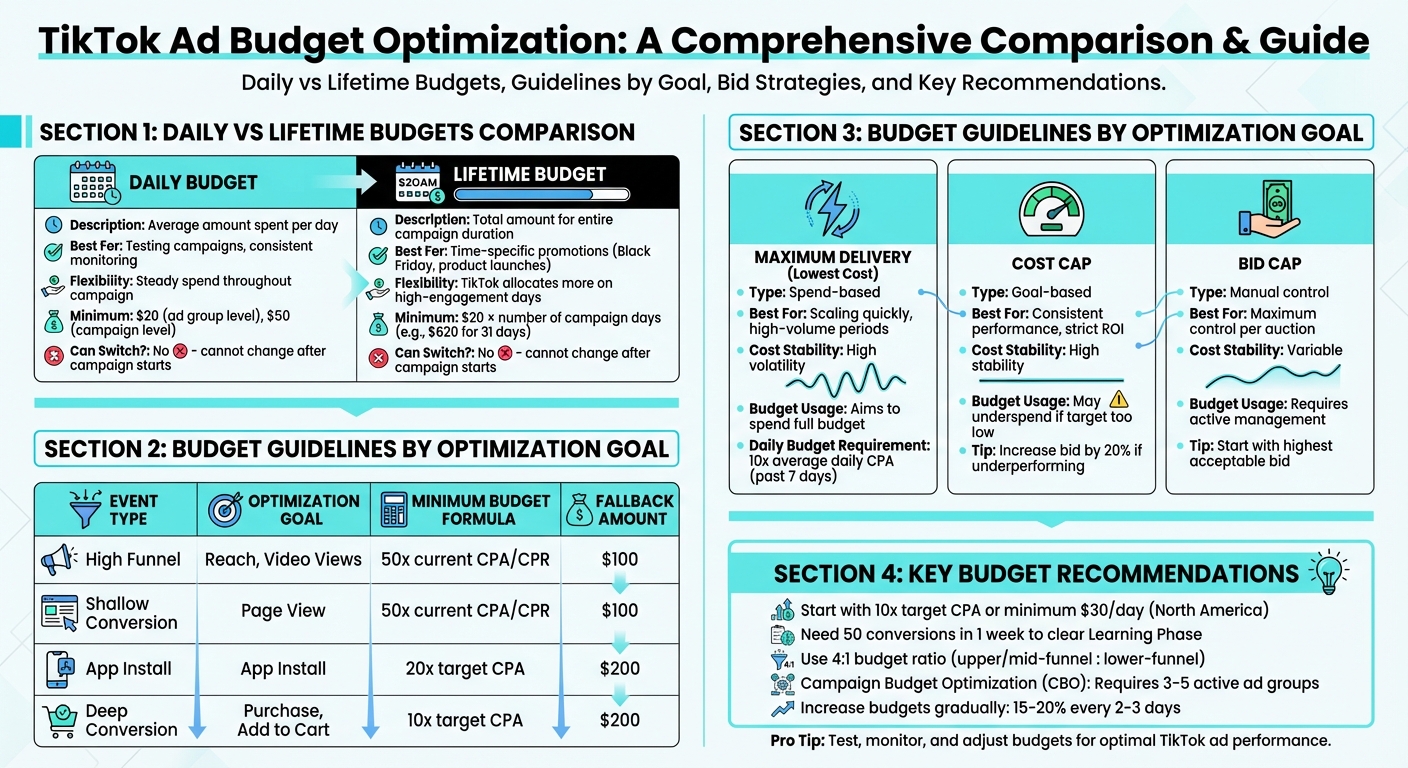
TikTok Ad Budget Types and Optimization Strategies Comparison Guide
TikTok allows advertisers to manage their spending through daily and lifetime budgets. A daily budget sets the average amount you’re willing to spend each day on a campaign or ad group, making it a great option for campaigns where you want to monitor performance consistently over time. On the other hand, a lifetime budget defines the total amount you’ll spend for the entire duration of your campaign – ideal for promotions with specific deadlines, like Black Friday sales or product launches.
The main distinction between these two lies in how TikTok distributes your budget. Daily budgets ensure steady spending throughout the campaign, while lifetime budgets give TikTok the flexibility to allocate more funds on days with higher engagement opportunities, optimizing performance within your set budget. However, once your campaign starts, you cannot switch between these budget types, so it’s important to choose wisely at the outset.
Campaign Budget Optimization (CBO) takes budgeting a step further by allowing you to set a single daily or lifetime budget for the entire campaign. TikTok’s system then redistributes the budget to the best-performing ad groups, maximizing overall conversions. To make CBO effective, you’ll need at least 3 to 5 active ad groups within the campaign, all sharing the same optimization goal.
Daily Budgets vs. Lifetime Budgets
Daily budgets are perfect for testing new campaigns or when flexibility is key. They provide more control during the learning phase, making it easier to manage daily performance fluctuations. TikTok even recommends daily budgets for ad groups to better handle this early stage.
Lifetime budgets, however, are better suited for campaigns with a strict deadline. For example, if you’re running a 7-day flash sale with a $2,000 budget, TikTok can allocate more funds on days with higher engagement and less on slower days. It’s worth noting that daily budgets must be at least $20 at the ad group level and $50 at the campaign level. For lifetime budgets, the minimum is calculated as $20 multiplied by the number of campaign days – so a 31-day campaign would require at least $620.
Matching Campaign Objectives to Budget Allocation
Your budget should align with your campaign’s goals and where your audience is in the marketing funnel. For upper-funnel objectives like Reach or Video Views, you’ll typically need a smaller budget per result since these campaigns aim to reach a broader audience. In contrast, lower-funnel objectives such as Conversions or Sales demand more budget because they target a smaller, highly engaged audience.
TikTok provides budget guidelines based on your optimization goals. Here’s a breakdown:
| Event Type | Optimization Goal | Minimum Budget | Fallback Amount |
|---|---|---|---|
| High Funnel | Reach, Video Views | 50x current CPA/CPR | $100 |
| Shallow Conversion | Page View | 50x current CPA/CPR | $100 |
| App Install | App Install | 20x target CPA | $200 |
| Deep Conversion | Purchase, Add to Cart | 10x target CPA | $200 |
For high-funnel campaigns, set your daily budget at 50 times your current cost per result (or $100 minimum if you lack historical data). For app installs, use 20 times your target CPA or $200 minimum, and for deep conversions like purchases, aim for 10 times your target CPA or $200 minimum. These multipliers help ensure ad groups exit the learning phase and deliver consistent results.
To balance your strategy, TikTok suggests a 4:1 budget ratio between upper/mid-funnel campaigns and lower-funnel campaigns. This approach builds brand awareness while still capturing high-intent customers, laying the groundwork for long-term growth. Next, we’ll dive into advanced techniques to optimize these budgets further.
Advanced Budget Optimization Techniques
After setting up your budget structure, it’s time to fine-tune how you allocate funds. This can be done through A/B testing, audience segmentation, and bid strategy selection – three methods that help distinguish successful campaigns from those that waste money without delivering results.
Using A/B Testing to Improve Budget Efficiency
A/B testing, or Split Testing, allows you to figure out which elements of your campaign are driving the best performance. By identifying what works, you can allocate your budget more effectively. TikTok’s Split Test tool in Ads Manager is perfect for this – it lets you experiment with variables like creative formats, audience targeting, and optimization goals to discover the combinations that yield the best results. The goal? Find those "multipliers", such as a specific video style or targeting method, that significantly boost conversions.
For reliable insights, run your tests for 7–14 days. Your test budget should be at least 20 times your target CPA to ensure you gather enough data. Aim for a "power value" of 80% or higher, which indicates a strong likelihood of identifying meaningful differences between variations.
"Opt to use a spend-based approach, like Lowest Cost Bidding. This will make it easier to specify a budget and let the system maximize usage to drive the most results possible." – TikTok Business
Before starting, clearly define your hypothesis. For example, instead of vaguely testing "different audiences", try something like, "Lookalike audiences based on purchasers will generate 20% more conversions than interest-based targeting." Make sure the differences between test groups are distinct enough for the system to provide measurable results. Once you identify a winning strategy, gradually shift your budget toward it – but avoid making changes mid-test, as this can disrupt the learning phase and skew your data.
Keep in mind that CBO campaigns require manual A/B testing through separate campaigns. Once your ad group generates at least 50 conversions in a single week, you’re ready to scale up the winning variation. From here, you can refine your budget allocation further using audience segmentation.
Audience Segmentation and Budget Prioritization
Audience segmentation helps you focus your budget where it delivers the best returns. Start with broad targeting, which allows TikTok’s machine learning to explore and identify high-performing segments. Once you’ve gathered enough data, shift more budget to Custom Audiences for retargeting and Lookalike Audiences to find new customers who resemble your best-performing ones.
The data supports this approach: ads that target a "fairly broad" audience (reaching over 80% of potential users in a country) tend to achieve a 15% lower CPA and a 20% higher conversion rate compared to narrowly targeted campaigns. In fact, over 50% of ad spend from TikTok’s top advertisers is allocated to campaigns using custom audience segments. If you narrow your targeting based on interests or behaviors, use the "Smart Audience" toggle. This feature expands targeting when performance drops, helping maintain stability.
When scaling a high-performing segment, increase the budget by no more than 50% at a time to avoid resetting the learning phase. Wait at least three days or 50 conversions before making further adjustments.
To improve efficiency, use audience exclusions to remove groups unlikely to convert, such as recent purchasers (unless you’re running a retention-focused campaign). Allocate your budget strategically based on the funnel stage: prioritize higher spending on "bottom-of-funnel" segments like retargeting lists, while keeping some budget for "top-of-funnel" efforts to drive discovery. For web conversion campaigns, maintain a minimum daily ad group budget of $30 for brands in North America and EMEA, or $20 for those in APAC.
Choosing the Right Bid Strategy: Lowest Cost, Cost Cap, and Bid Cap
Once you’ve optimized your budget through testing and segmentation, choosing the right bid strategy ensures your spending is as effective as possible. Your bid strategy directly impacts how TikTok allocates your budget during ad auctions.
- Maximum Delivery (Lowest Cost): This spend-based strategy focuses on maximizing conversions within your budget, without targeting a specific CPA. It’s ideal for high-volume periods like promotions or product launches but comes with high volatility, meaning your CPA may fluctuate based on competition.
- Cost Cap: A goal-based strategy that keeps your average CPA close to your target. It provides high stability, making it suitable for campaigns with strict ROI requirements. However, if your target CPA is set too low, the campaign may not spend its full budget. To improve performance, consider increasing your bid by at least 20%.
- Bid Cap: This strategy allows you to control the maximum bid per auction. While it offers the most control, it requires active management. For campaigns focused on Reach or Video Views, start with the highest acceptable bid to ensure competitiveness.
| Strategy | Type | Best For | Cost Stability | Budget Usage |
|---|---|---|---|---|
| Maximum Delivery | Spend-based | Scaling quickly, high-volume periods | High volatility | Aims to spend full budget |
| Cost Cap | Goal-based | Consistent performance, strict ROI | High stability | May underspend if target is too low |
A useful approach is hybrid bidding: start with Maximum Delivery to collect data, then switch to Cost Cap as you scale up to maintain a stable CPA and control costs. For Maximum Delivery, set a daily budget that’s at least 10 times your average daily CPA from the past 7 days to pass the learning phase successfully. Once the learning phase is complete, increase ad group budgets by at least 20% at a time.
"If you are concerned that the cost per result may get too high, we recommend you use hybrid bidding to switch Maximum Delivery to Cost Cap and set a bid that you can accept while increasing budget." – TikTok Ads Manager Help Center
sbb-itb-e2944f4
How to Scale Your TikTok Ad Budget
Once you’ve fine-tuned your campaigns through testing and segmentation, the next step is scaling your budget. But scaling isn’t just about throwing more money at your campaigns – it’s about finding the right balance between growth and stability. Push your budget too fast, and you risk resetting TikTok’s algorithm learning phase. Move too slowly, and you could miss valuable opportunities. The key is respecting TikTok’s optimization process while staying proactive with creative updates and leveraging automation tools.
Gradual Budget Increases vs. Fast Scaling
One reliable way to scale is by increasing your budget gradually. A good rule of thumb is to wait 7–14 days between changes, giving TikTok’s algorithm enough time to adjust.
"Each change throws the algorithm into a Learning Phase, which is a period of adjustment and lower performance." – Tommy Albrecht, Head of Performance Marketing, Funnel
Before making any big moves, ensure your campaign has collected enough data to confirm its performance is solid. If your metrics look strong and you’re ready to scale faster, consider consolidating campaigns by merging ad sets. This approach provides TikTok’s algorithm with a larger data pool, allowing it to stabilize more quickly during the scaling process.
For campaigns focused on maximizing ROAS, Value-Based Optimization (VBO) bidding can be a game changer. This strategy targets users likely to generate higher transaction values. For instance, Dippin’ Daisy’s boosted its ROAS from 3.5× to 8× by adopting VBO bidding. Another effective tactic is using organic content to test creative performance. High-performing videos from your organic feed can be scaled further with Spark Ads, ensuring your content has already proven its appeal.
While rapid scaling – dramatically increasing your budget in a short span – can work during high-traffic events like product launches or flash sales, it’s a high-risk move. If you notice critical metrics like click-through rates or cost-per-conversion deteriorating, it’s a signal to pause and refresh your creatives instead.
Once your budget increases have stabilized, focus on creative updates to sustain performance.
Refreshing Creatives to Support Scaling
As your ads reach a broader audience, the risk of creative fatigue grows. On TikTok, high-spend accounts often see creative fatigue within 3–5 days. For aggressive scaling, aim to refresh your ads at least twice a week.
Refreshing doesn’t mean starting from scratch every time. Use a modular approach by tweaking specific elements of your ads: the hook (the first 3 seconds), the format (visual style), or the message (call-to-action). These small adjustments can keep your audience engaged.
"Often when I talk about creative fatigue or creative swaps, people think they need to rethink the whole creative concept. You don’t need a new concept unless the performance is really tanking. Try the low-hanging fruit first." – Corey Waldron, Account Manager, LumenAd
Focus on Hook Rate during creative tests to determine scalability. TikTok users respond best to content that feels authentic to the platform, such as ads with DIY aesthetics, real people, trending sounds, and native tools like text overlays. In fact, 74% of viewers say TikTok-first ads grab their attention, and brands using this style drive 3.3× more actions compared to other platforms.
Take inspiration from success stories. In 2025, the mobile game Eatventure by Lessmore tackled creative fatigue by layering over 500 user-generated clips from the TikTok Creative Challenge onto existing gameplay footage. This strategy revived click-through rates and slashed cost-per-install. Similarly, Sulake refreshed creatives for its game Hotel Hideaway by using high-resolution vertical footage of in-game events, leading to a 44% drop in cost-per-install and a 3.3× boost in Day 1 ROAS.
When introducing new creatives, add them to existing ad groups rather than creating new ones. This extends the lifetime of your ad groups and preserves the optimization data you’ve already gathered.
Setting Up Automation Rules for Scaling
Automation can simplify the scaling process by managing budget adjustments in real time. TikTok Ads Manager offers automation tools like Smart+, an AI-driven solution that optimizes delivery across both paid and organic content.
In internal tests, over 60% of brands saw at least a 10% ROI lift using Smart+ for Paid and Organic campaign optimization. Smart+ combines your paid ads and organic content into a single campaign, dynamically shifting budgets based on performance. As of June 2025, Smart+ also supports Organic Anchors – clickable links within organic videos that drive engagement into Spark Ads.
For ROAS-focused campaigns, VBO bidding automates targeting high-value customers as your budget grows. If you’re using Campaign Budget Optimization (CBO), TikTok’s system will automatically allocate more budget to the best-performing ad groups, reducing the need for manual adjustments.
To make the most of automation, set clear guardrails. Use negative audiences to filter out users unlikely to convert, apply frequency caps to avoid overexposure, and establish cost-per-acquisition (CPA) or ROAS limits that align with your goals. Just make sure your campaigns have completed TikTok’s learning phase – typically 7–14 days – before making major budget changes.
| Method | Best Use Case | Pros | Cons |
|---|---|---|---|
| Smart+ | Full-funnel scaling | Combines paid/organic; 10%+ ROI lift | Requires 18+ age targeting for anchors |
| VBO Bidding | ROAS-focused scaling | Targets high-value users | Needs sufficient conversion data |
| Consolidation | Data-driven learning | Speeds up algorithm optimization | Limits granular audience control |
TikTok Ads Cost Benchmarks and Metrics for 2026
Analyzing your campaign performance against benchmarks can highlight opportunities to reduce costs and improve results. In 2026, TikTok’s ad costs rose by 12.28% year-over-year, driven by increased advertiser competition. Despite this, TikTok remains cost-effective compared to other platforms. Understanding key metrics can help you spot underperforming campaigns before overspending.
Breaking Down CPM, CPC, and ROAS
Cost Per Thousand Impressions (CPM) is the amount you pay for every 1,000 ad impressions. TikTok CPMs typically range from $2.62 to $9.16. Awareness campaigns often fall between $4.00 and $10.00, while conversion-focused campaigns may cost more. Seasonal trends also play a role – CPMs can jump 20–40% during Q4 and drop 15–30% between January and March.
Cost Per Click (CPC) shows how much you pay each time someone clicks on your ad. Most TikTok campaigns see CPCs between $0.30 and $1.50. Traffic campaigns generally range from $0.40 to $1.20, while conversion campaigns can go as high as $1.00 to $2.50. If your CPC exceeds $2.00 consistently, it might indicate issues with your ad creative or overly narrow targeting.
Return on Ad Spend (ROAS) measures how much revenue you earn for every dollar spent. A strong ROAS is usually 3:1 or higher. Industry averages vary widely: home goods brands often achieve a ROAS of 4.2, fashion brands hover around 2.06, fitness averages 1.29, and beauty products sit at 0.91. Falling below these benchmarks could mean it’s time to refine your creatives or narrow your audience.
"Think about how to make someone stop the scroll in the first two seconds… I always tell brands they should focus 90% of their attention on optimizing the hook." – Savannah Sanchez, Founder, The Social Savannah
Ad creative plays a huge role in campaign success – about 60%. Ads that grab attention in the first two seconds can reduce cost-per-conversion by 40–60%. Plus, native-style, user-generated content often costs 20–40% less than similar campaigns on Instagram for comparable reach.
These metrics are essential for evaluating whether your campaigns are hitting the mark.
Measuring Your Performance Against Benchmarks
Once you understand the core metrics, comparing your results to industry benchmarks can pinpoint areas for improvement. Accurate benchmarks are key to scaling your TikTok ad budget effectively.
TikTok’s average Click-Through Rate (CTR) is about 0.84%, while conversion rates range from 0.5% to 5%, with a platform-wide average of 0.46%. If your CTR falls below 0.5%, it could mean your ad creative isn’t engaging enough. Similarly, a conversion rate under 0.5% might signal issues with your landing page or offer.
The "50 conversion" rule can help guide scaling. Once an ad group hits 50 conversions in a week, it likely has completed TikTok’s learning phase and is ready for budget increases. Avoid making significant changes before this point, as it could reset the algorithm.
| Industry | Avg. CPC | Avg. CPM | Expected ROAS |
|---|---|---|---|
| E-Commerce & Retail | $0.50 – $1.50 | $6.00 – $12.00 | 2.0 – 4.0+ |
| Beauty & Skincare | $0.50 – $1.50 | $6.00 – $12.00 | 0.91 |
| Mobile Apps & Gaming | $0.50 – $1.80 (CPI) | $5.00 – $10.00 | Varies |
| B2B / SaaS | $1.50 – $3.00 | $5.00 – $12.00 | High LTV focus |
| Home Goods | $0.40 – $1.20 | $5.00 – $10.00 | 4.2 |
If your costs are significantly higher than these benchmarks, your campaign might need a refresh. Ad fatigue is a common issue on TikTok – engagement can drop by 43% when users see the same ad more than three times. To maintain performance, rotate your hooks and visuals every 7–10 days, especially after spending surpasses $1,000. Additionally, using custom audiences and retargeting strategies can lower acquisition costs by 40% and improve conversion rates by 3–5× compared to cold audiences.
Conclusion
To achieve success when scaling TikTok campaigns, it’s crucial to follow a structured approach. Start by respecting TikTok’s learning phase – waiting for at least 50 conversions before making any changes. Once you’re ready to scale, increase budgets gradually by 15–20% every 2–3 days to keep the algorithm stable and performing effectively.
Another key to success is keeping your creatives fresh. TikTok users thrive on novelty, so refreshing your creatives every 7–10 days can help you avoid a significant 43% drop in engagement. As TikTok Business emphasizes:
"Sustainable ad performance and continued growth comes from regularly testing what works and applying those learnings in subsequent campaigns".
Tracking is just as important. Using tools like TikTok Pixel and the Events API ensures accurate conversion data, which is critical for the algorithm to optimize your campaigns. Without reliable data, it becomes nearly impossible to identify which campaigns deserve more budget. Pairing this with Campaign Budget Optimization (CBO) can further boost conversion rates by 15–20% compared to manual budget allocation.
For effective scaling, consider applying the 60/30/10 rule: allocate 60% of your budget to top-performing campaigns, 30% to testing new ideas, and 10% to experimental strategies. Keep an eye on ad frequency – if it exceeds 3.5, it’s time to refresh your creatives or adjust your budget. This balanced approach helps you maximize returns from proven strategies while continuing to explore new opportunities.
Long-term success on TikTok requires constant testing, learning, and refining. By combining these strategies – like optimizing budgets, refreshing creatives, and leveraging automation tools – you can create a cycle of continuous improvement. With these techniques in place, your TikTok campaigns are well-positioned to scale profitably well into the future.
FAQs
How do I switch from a daily budget to a lifetime budget for my TikTok ads?
To switch from a daily budget to a lifetime budget on TikTok, you’ll need to pause your existing campaign and set up a new one. TikTok doesn’t allow this type of change for active campaigns. Here’s a quick guide:
- Pause your current campaign and calculate your lifetime budget. Multiply your daily budget (minimum $20 per ad group) by the number of days you want the campaign to run. For instance, a 30-day campaign would require at least $600 ($20 × 30).
- Set up a new campaign in TikTok Ads Manager. Choose your advertising objective and, if desired, enable Campaign Budget Optimization (CBO) to let TikTok distribute the budget across ad groups.
- Select “Lifetime Budget” during the campaign setup and enter the calculated total. TikTok will handle the budget allocation for the entire campaign duration.
Once your campaign is live, keep an eye on its performance. Adjust the budget or campaign timeline as needed. If you’re looking for expert assistance with managing budget transitions or optimizing your ad spend, Emplicit can guide you through the process to ensure everything runs smoothly.
How can I scale TikTok ad budgets without disrupting the algorithm?
To effectively scale your TikTok ad budgets while keeping the algorithm running smoothly, concentrate on campaigns that have moved past the learning phase and are consistently delivering at least 50 conversions. When increasing the daily budget, do it gradually – stick to a 20-30% increase at most – and give the algorithm at least 24 hours to adjust before making any further changes.
If maintaining a steady cost-per-acquisition (CPA) is a priority, try using Cost-Cap or hybrid bidding strategies. To keep performance steady, continue running your original ad groups and creatives. Test new variations in separate campaigns to ensure your main campaign’s momentum isn’t disrupted.
What’s the best bidding strategy for my TikTok ad campaign?
The bidding strategy you choose for your TikTok ad campaign should align with your specific objectives. If your main aim is to maximize conversions within your budget, the Maximum Delivery strategy is worth considering. This option prioritizes achieving the highest number of results possible, without being overly constrained by cost.
On the other hand, if keeping costs in check is a top priority, the Cost Cap strategy might be a better fit. This approach helps you maintain your cost per action (CPA) near a set target. That target should reflect the value of a new customer and how much you’re comfortable spending to acquire them. Take the time to evaluate your campaign goals and budget carefully to determine which strategy works best for your needs.