

Seasonal insights are the key to improving PPC campaigns by aligning your strategies with predictable changes in consumer behavior. These shifts, driven by holidays, weather, and shopping events, directly impact metrics like search volume, conversion rates, and cost per acquisition (CPA). Here’s what you need to know:
- Spot Trends: Use tools like Google Analytics and Google Trends to identify when demand for products or services spikes.
- Adjust Budgets: Allocate more ad spend during peak periods, such as Q4 or holiday seasons, and scale back during slower times.
- Refine Keywords: Update your keyword strategy to include terms relevant to seasonal trends.
- Tailor Ad Copy: Create ads that match the seasonal mood, such as holiday promotions or back-to-school themes.
- Optimize Landing Pages: Ensure your landing pages reflect your ads and make the conversion process seamless.
For example, a PPC campaign for a nutrition company in January 2026 saw a 6.5x increase in conversion rates by leveraging New Year’s resolution trends. Seasonal planning isn’t just about reacting to changes – it’s about anticipating them to maximize your campaign’s performance.
Let’s break down how to use seasonal insights effectively to improve your PPC strategies.
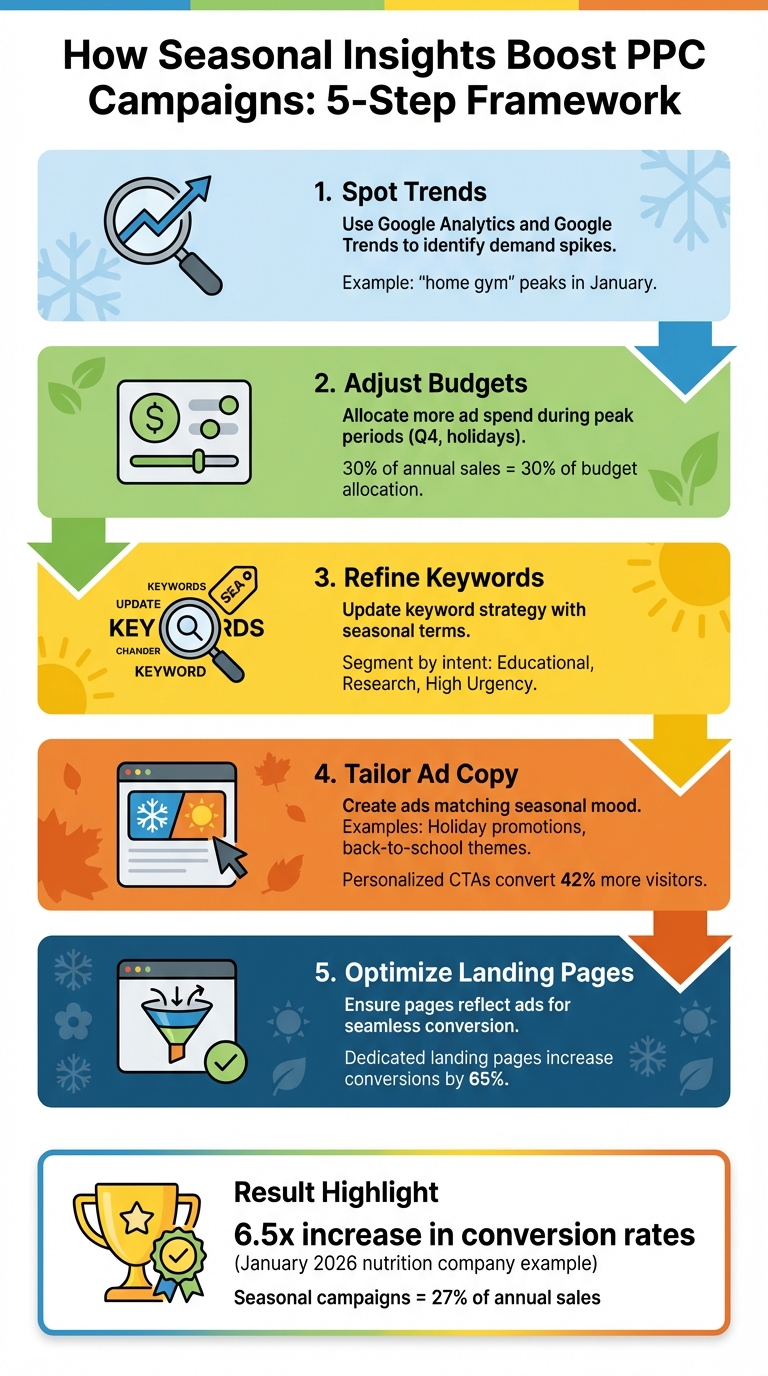
5-Step Framework for Optimizing PPC Campaigns with Seasonal Insights
How to Analyze Keyword Seasonality for Better SEO & PPC Strategy & Client Communication
sbb-itb-e2944f4
What Seasonality Means for PPC Campaigns
Seasonality in PPC refers to predictable changes in consumer behavior, search volume, and ad performance influenced by holidays, events, academic schedules, or even weather patterns.
During these high-demand periods, key metrics like click-through rates (CTR), conversion rates, and cost per acquisition (CPA) often shift significantly. For instance, conversion rates can jump by as much as 30%, while seasonal campaigns account for 27% of annual sales and drive 90% of shoppers to hunt for seasonal deals.
Recognizing these trends is crucial for optimizing your ad spend. Allocate more budget during peak times and scale back during slower periods. Ignoring seasonality can result in wasted ad dollars on campaigns that don’t align with current consumer needs. Growth expert Benjamin Wenner highlights this risk:
"If you’re not factoring seasonality into your PPC strategy, you’re essentially flying blind".
Since competitors face the same seasonal hurdles, Samuel Edwards, CMO at PPC.co, points out:
"Whatever seasonal issues you face are probably also affecting your top competitors… it also means you have a critical opportunity to surpass their performance".
This creates a chance to fine-tune your bidding and targeting strategies to outperform rivals who stick to static, year-round tactics.
Grasping these seasonal dynamics is the first step to uncovering actionable insights from your data.
How to Find Seasonal Trends in Your Industry
Once you understand how seasonality influences PPC, the next move is to identify specific trends in your industry.
Start by diving into your historical data. Tools like Google Analytics and Google Ads offer year-over-year (YoY) comparisons that reveal when sales and traffic consistently rise or fall. Metrics such as return on ad spend (ROAS), cost per click (CPC), and CPA can highlight weeks or months when clicks and conversions spike.
Google Trends is another powerful resource. It shows seasonal keyword patterns, like how searches for "home gym" peak in January or "beach body workout" trend in summer. Comparing terms like "air conditioner" and "heater" can also signal upcoming shifts in consumer interest.
For more granular insights, use tools like the Shopping Products report in Google Ads. By sorting data by month, you can spot product-level trends over time. Amazon sellers, on the other hand, can use Amazon‘s Keyword Tool to link external search trends with internal sales data. Combining insights across platforms gives you a well-rounded view of demand fluctuations.
Typical Seasonal Trends Across Ecommerce Platforms
Certain holidays – like Christmas, Valentine’s Day, Mother’s Day, and Halloween – consistently drive spikes in traffic and conversions. Similarly, shopping events such as Black Friday, Cyber Monday, and Prime Day remain crucial for marketplaces like Amazon, Walmart, and TikTok Shops.
Academic and financial cycles also influence demand. The back-to-school rush in late August boosts sales for items like clothing, electronics, and school supplies. Tax season, meanwhile, sees increased interest in financial software and services. These recurring patterns make it easier to plan and allocate budgets each year.
Lifestyle and weather-related trends vary by category. January sees a rise in fitness gear demand due to New Year’s resolutions, while travel and swimwear interest often kicks off in April. Weather shifts also play a role – air conditioners peak in summer searches, while winter brings higher demand for sweaters and boots. Additionally, platform-specific strategies, like Amazon’s Sponsored Display retargeting, help sellers capture holiday shoppers who browse but don’t immediately purchase.
Using Seasonal Insights to Improve PPC Strategies
Once you’ve spotted seasonal trends, it’s time to use that knowledge to fine-tune your campaigns. This means adjusting your keywords, ad creatives, and budgets to align with seasonal demand. By tailoring these elements to match consumer behavior, you can make smarter spending decisions and maximize your returns.
Updating Keywords and Targeting for Seasonal Demand
Seasonal trends should guide your keyword strategy as consumer intent evolves. For instance, during peak seasons, expand your keyword list to include terms that are time-sensitive and highly relevant to what shoppers are searching for. Location-based targeting can also sharpen your approach. If you’re selling outdoor gear, you might increase bids in warmer regions during spring while scaling back in colder areas.
Another strategy is to segment your keywords based on user intent. Organize them into categories like "Educational", "Research", and "High Urgency" to align with different stages of the buyer’s journey. This ensures your campaigns are hitting the right audience at the right time, improving both engagement and conversions.
Creating Seasonal Ad Copy and Visuals
Your ad messaging should reflect the seasonal mood and consumer mindset. For example, winter campaigns can focus on gift-giving and holiday promotions, while spring ads might highlight themes like "spring cleaning" or fresh beginnings. Summer is perfect for showcasing outdoor activities and travel, and fall aligns well with back-to-school or cozy, home-centered themes.
The impact of seasonal ad alignment can be huge. For instance, festive campaigns in the UK generated around $106 billion in seasonal sales last year. Adjusting your messaging to seasonal peaks can lead to noticeable improvements – conversion rates can skyrocket, and cost per acquisition can drop significantly. Use ad extensions to emphasize limited-time offers or seasonal deals, and ensure your visuals are mobile-friendly to capture the attention of on-the-go shoppers. During slower periods, shift your focus to micro-conversions, like encouraging users to download a guide or sign up for a newsletter. These actions help build trust and keep your brand top of mind as peak seasons approach.
How to Allocate Budget During Seasonal Peaks
Your budget strategy should align with your sales patterns to maximize results. If December accounts for 30% of your annual sales, it makes sense to allocate about 30% of your PPC budget to that month.
Divide your seasonal spending into three phases. First, there’s the pre-phase, where you gradually increase your budget to build anticipation. Then comes the peak phase, where you maximize spending to capture heightened consumer activity. Finally, during the cool-off phase, you scale back strategically while still capturing lingering interest.
For peak periods, allocate 40–60% of your budget to bottom-of-funnel tactics like targeting high-intent keywords and remarketing to cart abandoners. Dedicate 10–20% to testing new ad copy, platforms, or keywords, and reserve 10–15% for branded campaigns to maintain your market share during high-traffic times. Start increasing your budget a month before peak seasons to capture early interest. For short-term promotions, use tools like Google Ads’ seasonality adjustments to fine-tune bidding for expected conversion spikes. If a campaign is performing well, scale your budget incrementally – around 15–20% – to avoid inefficiencies caused by sudden increases.
Preparing Conversion Paths for Seasonal Campaigns
Driving traffic to your seasonal campaigns is just the first step. The real challenge begins once shoppers click your ads – they need to land on pages that match the promise of your ad and make converting as easy as possible. This step ties directly to your seasonal PPC efforts by ensuring the entire conversion process is as smooth and effective as your ad targeting. To pull this off, your landing pages, inventory, and fulfillment processes must align with the seasonal demand you’re generating.
Updating Landing Pages for Seasonal Campaigns
Your landing pages should immediately reflect the promise made in your ads. For example, if your ad promotes "50% Off Holiday Gifts", this message should be front and center on the landing page. This practice, known as message matching, keeps visitors from feeling misled and helps lower bounce rates. In fact, dedicated landing pages can increase conversions by up to 65%.
Seasonal visuals play a big role in engaging visitors. Use graphics that match the campaign’s theme – think holiday-inspired designs for winter, sunny outdoor vibes for summer, or school-related imagery for back-to-school campaigns. Since users spend an average of just 6 seconds looking at content above the fold, make sure your seasonal offer is prominently displayed right at the top. Also, use action-oriented, value-driven CTAs. Swap generic phrases like "Sign Up" for something more enticing, such as "Claim Your Holiday Discount." Personalized CTAs can convert 42% more visitors into leads compared to generic ones.
Don’t forget to simplify the checkout process. Include quick-payment options and "Buy Now" buttons to reduce friction. For lead generation, keep forms short – stick to essentials like First Name, Last Name, and Email. To build trust, highlight customer reviews and testimonials; nearly 97% of B2B buyers rely on these when making decisions.
Managing Inventory and Fulfillment for Seasonal Demand
Running out of stock is a surefire way to derail a campaign. To avoid this, connect your inventory management system directly to your ad platforms. This ensures you’re only spending on products you can actually deliver. Set up automated rules to lower bids or pause campaigns when stock levels drop below a specific threshold. As Nectar Blog puts it:
"If you are running full-budget campaigns on SKUs that are three weeks from a stockout, you are paying to acquire customers you cannot serve".
Conduct quarterly audits of your marketing tech, especially before peak seasons, to ensure it can handle sudden spikes in demand. During Q4, platforms like Amazon and Walmart often see cost-per-click rates jump by as much as 50%, so you’ll need systems that can keep up. For Amazon campaigns, start prepping your stock and increasing budgets 2 to 3 weeks ahead of major events like Prime Day. To avoid inventory mishaps, standardize product identifiers (SKUs) across platforms like Amazon, Walmart, and Shopify, and update inventory feeds daily. This level of preparation helps ensure your campaigns run smoothly without frustrating stock shortages.
Tracking and Adjusting Campaigns in Real-Time
Once you’ve fine-tuned your landing pages and prepared your inventory for seasonal demand, the next step is keeping a close eye on your campaigns and making timely adjustments. Seasonal periods can be unpredictable – what drives results today might fall flat tomorrow. By tracking performance in real time, you can catch problems before they drain your budget and seize opportunities while they’re still relevant. This approach builds on earlier strategies like optimizing seasonal keywords and ad copy. The trick is knowing which metrics to prioritize and how to act when performance changes.
Key Metrics to Monitor During Seasonal Campaigns
During seasonal peaks, Return on Ad Spend (ROAS) should be your guiding metric. It tells you how much revenue you’re generating for every dollar spent. If your ROAS is outperforming your targets, that’s a signal to increase spending. Meanwhile, Conversion Rate (CR) helps you gauge whether your seasonal messaging and landing pages are successfully driving purchases or sign-ups. Seasonal campaigns often see a noticeable boost in conversions when targeting aligns with consumer intent.
Click-Through Rate (CTR) acts as a quick check on ad relevance, showing whether your seasonal creative is connecting with what shoppers are searching for. Keep an eye on Cost Per Acquisition (CPA) as well – competitive periods can drive costs up, so ensure you’re still operating profitably. Another vital metric is Impression Share, which reflects your visibility. A drop here during peak hours could mean competitors are capturing your audience.
Budget pacing is equally crucial. For instance, during Q4, it’s easy to overspend earlier in the day and run out of budget before the evening rush, which often peaks between 6:00 PM and 9:00 PM ET. Daily monitoring helps ensure your ads stay live when shoppers are most likely to convert.
By focusing on these metrics, you can stay agile and make smarter decisions as conditions evolve.
Making Data-Driven Changes During Active Campaigns
When performance takes a turn, let the data guide your next steps. As Rel.ai explains:
"Seasonal variation is signal, not noise. The seller who builds a calendar of expected fluctuations can distinguish between ‘normal seasonal dip’ and ‘actual campaign problem’ in minutes rather than days".
Instead of comparing today’s performance to yesterday’s, compare it to the same day last week – like this Tuesday versus last Tuesday – to account for weekly shopping patterns.
Set up automated alerts for major shifts, such as a 20–30% drop in conversion rates or unexpected spikes in CPC, so you can act quickly. Use real-time search term reports to identify and exclude irrelevant traffic by adding negative keywords (e.g., "free" or "tutorial"). Adjust bids based on performance: if certain keywords or ad groups are spending heavily but delivering no conversions over 30–60 days, pause them. During high-traffic hours (8:00 AM to 10:00 PM ET), consider raising bids to secure valuable impressions.
It’s also important to recognize natural dips in activity. For example, as Rel.ai points out:
"Never interpret a holiday-day dip as a campaign problem… The dip is demand-side, not campaign-side. Your campaigns did not break on Thanksgiving. People were eating turkey instead of shopping".
Focus your adjustments on solving real performance issues, not reacting to predictable pauses in shopping behavior. By staying responsive and strategic, you can turn seasonal insights into lasting results for your campaigns.
Conclusion
Seasonal insights can turn PPC advertising into a more calculated and effective strategy. This guide has covered how to spot seasonal trends, tweak keywords and ad copy, fine-tune landing pages, and monitor performance in real time. By understanding that seasonal fluctuations are patterns, not random setbacks, you can avoid mistaking normal dips for failures and focus on actions that genuinely improve performance.
Creating a seasonal calendar is a practice that becomes more rewarding over time. Use slower periods, like Q1, to broaden your keyword reach and experiment with new campaign setups when CPCs are lower. Take advantage of high-performing windows, such as the Sunday-to-Tuesday peak or the post-Prime Day buying surge when customers return for full-price purchases. During the lead-up to Q4, allocate more budget and set daily limits strategically to ensure you don’t run out of funds before the evening rush (6:00 PM to 9:00 PM ET).
Incorporating these seasonal strategies into your overall marketing plan helps establish a framework for consistent growth. Businesses that integrate seasonal planning into their long-term approach don’t just survive seasonal changes – they use them to gain an edge. By normalizing data, forecasting with confidence, and avoiding unnecessary adjustments during predictable holiday dips, you create a system that supports steady, year-round success. These methods highlight how precise seasonal planning can elevate PPC campaigns from routine tasks to a powerful competitive tool.
For brands running PPC campaigns on platforms like Amazon, TikTok Shops, Walmart, and Target, Emplicit provides comprehensive ecommerce services. From PPC management to listing optimization and tailored strategies, they help you scale efficiently through every seasonal shift.
FAQs
How far ahead should I plan seasonal PPC campaigns?
Experts suggest preparing seasonal PPC campaigns 3 to 6 months ahead of time. This timeline gives you the breathing room needed for detailed research, crafting compelling ad creatives, and running tests well before the busy season hits. By syncing your campaign schedule with major seasonal events, you can fine-tune your strategies and make the most of high-demand periods.
What’s the fastest way to find seasonal keyword trends?
To quickly identify seasonal keyword trends, tools like Google Trends are incredibly helpful. They show when interest in specific keywords spikes, broken down by time and region. Another option is using Amazon’s autocomplete feature or third-party tools like Helium 10. These can uncover high-intent, long-tail keywords linked to upcoming seasons or events. Armed with this information, you can fine-tune your PPC campaigns to perform their best during peak periods.
Which PPC settings should I change first during a seasonal spike?
During a seasonal surge, it’s smart to tweak your bids and budgets to tap into the growing consumer interest. Increase bids on top-performing keywords to stay competitive and consider expanding your campaign budget to gain more visibility. Leverage ad scheduling to target peak shopping times and use ad extensions to highlight special seasonal deals. By fine-tuning these elements early, you can make the most of the increased demand and improve your ROI.