

When selling on Amazon, your choice of keywords directly impacts your product’s visibility and sales. There are two main types to focus on: seasonal keywords, which spike during specific times (e.g., "Christmas decorations"), and evergreen keywords, which maintain steady demand year-round (e.g., "kitchen utensils").
Here’s the key takeaway:
- Evergreen keywords ensure consistent traffic and long-term growth.
- Seasonal keywords target short-term demand surges for events or holidays.
The best strategy combines both, using a 1:4 ratio – one seasonal keyword focus for every four evergreen ones. This balance helps capture seasonal sales while maintaining steady visibility year-round.
Quick Overview:
- Evergreen Keywords: Stable search volume, minimal updates, consistent sales.
- Seasonal Keywords: Fluctuating demand, high-intent traffic during peak times, requires early preparation.
Understanding these differences and planning ahead can help you optimize your Amazon SEO and PPC campaigns for better results.
The Keyword Method I Use to Help Brands Rank #1 on Amazon
What Are Evergreen Keywords?
Evergreen keywords are search terms that enjoy consistent demand throughout the year, staying relevant over time. Unlike seasonal or trend-based keywords tied to holidays or fleeting fads, these focus on essential topics and products that people regularly search for, regardless of the time of year. They’re a reliable way to drive steady traffic and don’t require constant updates or significant reinvestment.
Here’s how Sean Si, Editor-in-Chief of SEO Hacker, puts it:
"Evergreen keywords are the backbone of any SEO-friendly website, keeping traffic steady over time." – Sean Si
By targeting evergreen keywords, businesses can achieve sustainable growth. These keywords continually attract visitors, helping to generate consistent traffic and sales over the long haul. This makes them a more budget-friendly option compared to seasonal campaigns that often need frequent adjustments.
Characteristics of Evergreen Keywords
Evergreen keywords stand out because of their stable search volume. Tools for keyword research often show a steady, predictable trend for these terms, which can be incredibly helpful for planning inventory. This predictability minimizes risks like overstocking or running out of stock.
Another advantage is their low-maintenance nature. While they’re not entirely "set it and forget it", they require much less attention compared to seasonal content. Occasional audits to ensure they align with current SEO practices are usually enough. These keywords focus on addressing ongoing needs or solving universal problems – topics that rarely lose relevance. This stability is why they’re so effective at meeting consistent consumer demand.
Examples of Evergreen Keywords
Think about products like "coffee mugs", "yoga mats", "office chairs", "phone chargers", or "kitchen utensils." These are classic examples of evergreen keywords on Amazon, spanning categories like home goods, fitness, and personal care. They represent items people need year-round, unaffected by holidays or weather changes. For instance, a seller offering USB cables can expect steady demand whether it’s the middle of summer or the start of the new year. These kinds of keywords are essential for maintaining long-term visibility and success on platforms like Amazon.
What Are Seasonal Keywords?
Seasonal keywords are search terms that see predictable spikes in search volume during specific times of the year. These increases are often tied to holidays, events, seasonal changes, or even weather patterns. Unlike evergreen keywords, which maintain steady interest throughout the year, seasonal keywords experience short-lived surges and then drop off once the relevant period ends.
Take "April 15 tax help", for example. This term sees a massive jump in searches leading up to the U.S. tax deadline but virtually vanishes afterward. These keywords are perfectly timed to align with consumer needs, helping businesses reach buyers when their intent to purchase is at its highest.
The main goal of seasonal keywords is to capture this high-intent traffic during peak periods, driving quick conversions and boosting brand visibility. Interestingly, search activity for holiday-related terms often starts well before the actual event. For instance, people begin researching gifts and recipes weeks or even months in advance. Let’s dive into the unique behaviors and traits of these keywords.
Characteristics of Seasonal Keywords
Seasonal keywords are defined by their fluctuating search demand, which is influenced by holidays, trends, or specific events. For example, searches for "Christmas sweaters" in the U.S. drop off during the summer but skyrocket in December. These keywords generally fall into three main categories:
- Holiday-focused: Terms like "Christmas dinner recipes" or "Valentine’s Day gifts."
- Weather-dependent: Keywords such as "snow removal" or "air conditioning."
- Event-driven: Phrases like "back-to-school supplies" or "tax season tips."
Each category follows a predictable pattern, though the timing can vary depending on geography and consumer habits. A growing trend known as "Holiday SEO" sees businesses optimizing for terms like "Christmas sweaters" as early as October to capture traffic before December’s peak.
Examples of Seasonal Keywords
Some of the most popular seasonal keywords include "Halloween costumes", "Black Friday deals", and "Valentine’s Day gifts", all tied to specific dates on the calendar. During Mother’s Day, for instance, roughly 24% of all holiday sales occur, making it a critical period for businesses. As Brian Burt aptly calls it, this time is the "Super Bowl of florists". Interestingly, nearly half of Mother’s Day shoppers look for "unique or different" gifts, while only 17% prioritize price.
Other examples highlight different trends: "NFL jerseys" peak during football season, "wrapping paper" surges in December, and "fitness equipment" sees a predictable rise every January as part of the "New Year, New You" movement. Weather-related terms like "snow removal" peak in October in northern regions but don’t see the same demand in southern areas.
These examples underscore the importance of planning ahead when targeting time-sensitive keywords. Proper timing and strategy can turn these fleeting moments of interest into significant revenue opportunities.
Key Differences Between Seasonal and Evergreen Keywords
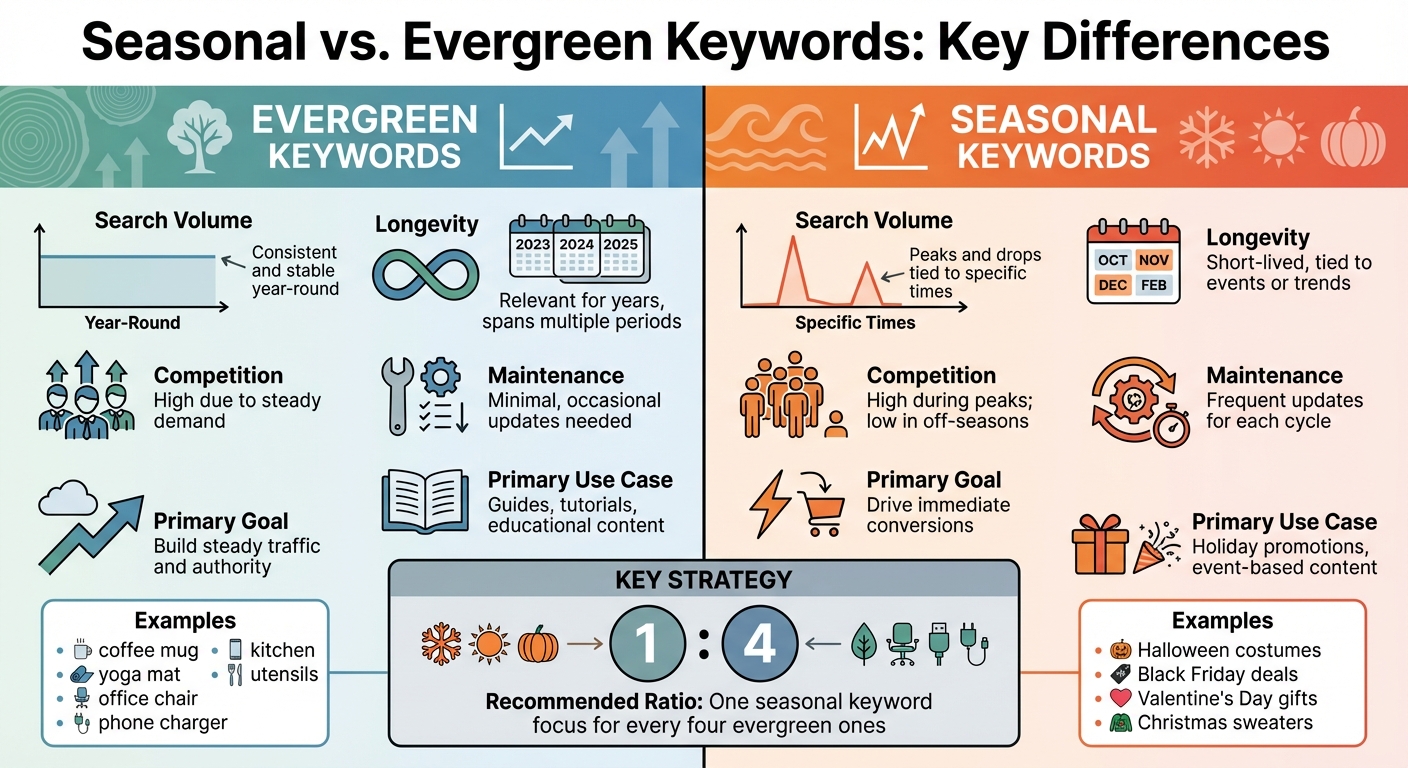
Seasonal vs Evergreen Keywords Comparison for Amazon Sellers
Search Volume and Demand Patterns
The main distinction between seasonal and evergreen keywords lies in how people search for them. Evergreen keywords generate steady, reliable traffic throughout the year, making them a cornerstone of any content strategy.
Seasonal keywords, however, are tied to specific times, events, or trends. They experience sharp spikes in search interest followed by rapid drops. For instance, a term like "Christmas sweaters" might barely register in the summer months in the U.S., only to skyrocket in December before plummeting again. This creates a cycle of highs and lows in both traffic and potential revenue.
"Timely, trending topics create short-term spikes in engagement."
– Sean Si, Editor-in-Chief, SEO Hacker
To strike the right balance, a mix of content – such as one seasonal post for every four evergreen ones – can help maximize traffic.
Seasonal keywords also demand early preparation. Search interest often starts to pick up weeks or even months before the peak season. For Amazon sellers, evergreen products tend to carry less risk since demand is steady, while seasonal products can deliver high profits within a short window. However, missing that window increases the risk of leftover inventory.
Comparison Table: Seasonal vs. Evergreen Keywords
Here’s a quick breakdown of the key differences:
| Attribute | Evergreen Keywords | Seasonal Keywords |
|---|---|---|
| Search Volume | Consistent and stable year-round | Peaks and drops tied to specific times |
| Longevity | Relevant for years | Short-lived, tied to events or trends |
| Competition | High due to steady demand | High during peaks; low in off-seasons |
| Maintenance | Minimal, occasional updates needed | Frequent updates for each cycle |
| Primary Goal | Build steady traffic and authority | Drive immediate conversions |
| Primary Use Case | Guides, tutorials, educational content | Holiday promotions, event-based content |
For Amazon sellers, understanding the behavior of these keywords can guide smarter decisions about inventory and marketing strategies. These insights play a crucial role in shaping effective SEO and PPC campaigns, which will be explored further in the next section.
sbb-itb-e2944f4
Optimizing SEO and PPC Strategies for Keywords
SEO Strategies for Evergreen Keywords
Evergreen keywords are the backbone of long-term visibility. These are the "Golden Keywords" – highly relevant, low-competition long-tail terms that consistently drive conversions. For example, instead of targeting a broad term like "water bottle", focus on something more specific like "stainless steel water bottle for hiking" to capture buyer intent more effectively.
To maintain strong rankings, keep your listing quality consistent. This includes optimizing backend keywords with synonyms, common misspellings, and regional variations. Regularly update your content to prevent ranking decay. Amazon indexes the first 250 characters across five backend fields, so make every character count.
"To sell a product on Amazon, you need people to see or find that product on Amazon."
– Jungle Scout
Building brand authority with evergreen content is another key strategy. Amazon’s A10 algorithm now factors in external traffic from platforms like social media and Google. By driving consistent visits to your listings, you can strengthen your organic rankings over time.
While evergreen SEO focuses on steady, long-term traffic, seasonal PPC campaigns are essential for capturing short-term demand spikes.
PPC Campaigns for Seasonal Keywords
Seasonal PPC campaigns require precise timing to make the most of short-lived demand surges. Start your campaigns 1–2 months before peak periods to establish ad history and organic ranking before competition – and costs – intensify. As Michael Waters from Intentwise explains: "Starting early means you can strike before those CPCs skyrocket".
Segmentation is key. Separate seasonal keywords into their own campaigns, allowing you to adjust bids and budgets without disrupting your evergreen campaigns. Early in the season, use broad match to discover trending keywords, then shift to exact match for top performers to control costs. Keep a close eye on conversion rates – if they drop below average during pre-season bidding, lower your bids to avoid negatively impacting Amazon’s algorithm.
A great example of this approach is the Japanese men’s cosmetics brand NULL. They began with automatic targeting to identify seasonal trends, then transitioned to exact match. By leveraging Sponsored Products, Sponsored Brands, and Brand Stores, they achieved a 1.7× increase in year-over-year sales. Similarly, electronics products with deals promoted through Sponsored Products saw an average 69% boost in sales and a 79% increase in units sold compared to non-promoted periods.
To fully capitalize on seasonal demand, plan your inventory at least three months in advance to avoid stockouts. Don’t stop your campaigns after the main event – extending your budget into late December and January can help you capture last-minute shoppers and New Year buyers.
When to Prioritize Seasonal vs. Evergreen Keywords
Evaluating Business Goals and Product Type
Your choice between seasonal and evergreen keywords should align with your product type and overall business goals. Evergreen keywords are ideal for products that meet ongoing needs, like kitchen utensils or pet supplies. These products often provide consistent cash flow, make inventory planning easier, and help establish long-term brand recognition.
On the other hand, seasonal keywords are most effective during peak demand periods such as holidays, back-to-school shopping, or weather-related events. Products like heaters, holiday decorations, and Halloween costumes thrive with aggressive seasonal keyword targeting. Even products that are typically evergreen, like toys, can benefit from a seasonal twist. For example, targeting "holiday toy gifts" in November and December can significantly boost sales.
If you’re new to selling, evergreen products are a safer bet because they simplify inventory management. Seasonal items, while potentially lucrative, require more advanced planning. You’ll need to forecast demand and order inventory well in advance – often three months before the peak season – to avoid running out of stock or over-ordering.
"If you’re not checking key phrase difficulty, you’re not doing key phrase research. You simply don’t have a chance of ranking for phrases that are way outside your website’s authority."
– Andy Crestodina, Cofounder, Orbit Media
Using a Hybrid Approach
A hybrid strategy that combines both evergreen and seasonal keywords can offer the best of both worlds. This approach ensures steady traffic from evergreen keywords while capitalizing on the revenue spikes that come with seasonal campaigns. It also helps maintain strong seller authority and organic rankings throughout the year, which can improve the success of seasonal product launches.
For balance, consider focusing on one seasonal campaign for every four evergreen efforts. This ratio allows you to capture seasonal traffic without compromising your year-round visibility. You can also enhance SEO by linking seasonal pages, like a Christmas gift guide, to evergreen content, such as general gift-buying tips. This internal linking boosts the search value of both types of content.
As noted in the PPC section, it’s smart to create separate campaigns for seasonal keywords. This segmentation allows for more flexible bidding and budget adjustments. Beyond SEO, seasonal campaigns can also support better inventory decisions for Amazon sellers. Additionally, the increased traffic from seasonal products creates opportunities to cross-sell evergreen items, broadening brand awareness and driving more sales.
Updating Keywords for Optimal Amazon Performance
Keeping your keywords up to date is a must if you want to maintain strong performance on Amazon.
Leveraging Amazon Brand Analytics

Amazon Brand Analytics is a treasure trove of real-time shopper behavior data. It helps you figure out which search terms are driving impressions, clicks, add-to-cart actions, and purchases. This means you can spot trends before they peak and tweak your keyword strategy to stay ahead.
Take the Top Search Terms report, for example. It shows the most popular queries across Amazon and highlights the top three products customers click on for each term. This report is a goldmine for identifying seasonal keywords that are starting to gain traction – perfect for getting ahead of peak periods. On the other hand, the Product Opportunity Explorer pinpoints search volume trends and unmet demand in specific niches, helping you time your keyword updates effectively.
If you’re juggling both seasonal and evergreen products, the Search Catalog Performance tool can track your sales funnel – from search impressions to conversions. High visibility but low conversions? That’s a sign your keywords might not be matching customer intent. This feedback is invaluable for testing new seasonal keywords while keeping your evergreen ones intact.
Pair these insights with regular audits to keep your keyword strategy sharp and relevant.
Regular Keyword Performance Audits
Analytics are just the start – regular audits ensure your listings stay optimized over time.
Aim for bi-monthly keyword audits to catch emerging trends while holding onto your stable rankings. During these audits, dive into your Advertising Search Term Reports in Seller Central. These reports reveal which PPC queries are driving sales. If certain seasonal terms are performing well in your ad campaigns, consider moving them into your organic backend search terms.
Amazon’s Manage Your Experiments tool is another great resource. Use it to A/B test keyword variations in your titles and descriptions. For example, when transitioning between seasons, you can test whether updating a year in your title (like switching from "2024" to "2025") boosts performance before applying the change across all listings.
Don’t forget to update backend keywords in the "Generic Keyword" field. Use lowercase letters and single spaces, and avoid duplicating terms already in your frontend copy. This lets you layer in seasonal keywords without disrupting your evergreen strategy.
Conclusion
Grasping the distinction between seasonal and evergreen keywords is key to crafting a solid Amazon SEO strategy. Evergreen keywords form the backbone – they deliver steady search volume throughout the year, helping to establish long-term brand credibility and ensuring a more predictable revenue stream. On the other hand, seasonal keywords drive short-term bursts of traffic and conversions during specific times, like holidays or back-to-school shopping seasons.
Rather than choosing one over the other, a balanced approach works best. Experts suggest aiming for a 1:4 ratio, combining the reliability of evergreen keywords with the high-demand opportunities seasonal terms bring. This blend allows you to capture immediate sales during peak times while maintaining steady performance year-round.
"The smartest SEO strategy isn’t choosing one over the other – it’s using both. Evergreen keywords are the backbone… But timely, trending topics create short-term spikes in engagement."
- Sean Si, Editor-in-Chief, SEO Hacker
To get the most out of your keyword strategy, planning is critical. For seasonal keywords, start incorporating them into your listings at least two months before peak periods so Amazon’s algorithm has time to index your content. For private label sellers, it’s wise to order inventory about three months ahead of these high-demand periods to avoid running out of stock. Meanwhile, evergreen listings should be regularly audited and fine-tuned to maintain strong rankings. As highlighted, consistent updates and early preparation for seasonal trends are vital.
If you’re looking for expert help to create a tailored Amazon SEO strategy that leverages both evergreen and seasonal keywords, consider reaching out to Emplicit.
FAQs
What’s the best way to balance evergreen and seasonal keywords for Amazon success?
To get the most out of your Amazon strategy, it’s important to strike the right balance between evergreen and seasonal keywords. Seasonal keywords target specific times of the year – think holidays like Christmas or events like back-to-school shopping. These can create short-term sales boosts. In contrast, evergreen keywords are relevant all year long, providing steady visibility and sales over time.
The key is to blend the two effectively. Use seasonal keywords during high-demand periods to capitalize on immediate opportunities, but don’t neglect evergreen keywords – they’re essential for keeping traffic and sales consistent throughout the year. Keep an eye on keyword performance and adjust as trends shift. This way, you can seize seasonal spikes while maintaining a solid, year-round growth strategy.
How can I prepare seasonal keywords effectively before peak shopping periods?
Getting seasonal keywords right starts with planning ahead. Begin by researching important shopping dates and trends tied to holidays, weather shifts, or events that spark consumer interest. Dig into historical sales data and search trends to pinpoint when specific keywords tend to gain traction.
Once you’ve identified the right keywords, update your product listings, titles, and backend search terms before the season hits its peak. This way, your listings are primed to match what shoppers are actively searching for during high-demand periods.
Keep a close eye on seasonal patterns and what your competitors are doing. Regularly fine-tuning your strategy ensures you can adapt quickly to shifts in demand. The combination of early preparation and ongoing adjustments will help keep your products visible and boost sales when it matters most.
What role do evergreen keywords play in achieving long-term SEO success on Amazon?
Evergreen keywords are a cornerstone of long-term SEO success on Amazon. These keywords focus on products or topics that enjoy consistent demand throughout the year. Unlike seasonal keywords, which see spikes in popularity during specific periods, evergreen keywords deliver steady relevance and traffic all year round.
When you optimize your Amazon listings with evergreen keywords, you create a foundation for stable search rankings over time. This ensures your products remain visible and competitive, making evergreen keywords an essential part of any effective Amazon SEO strategy.