
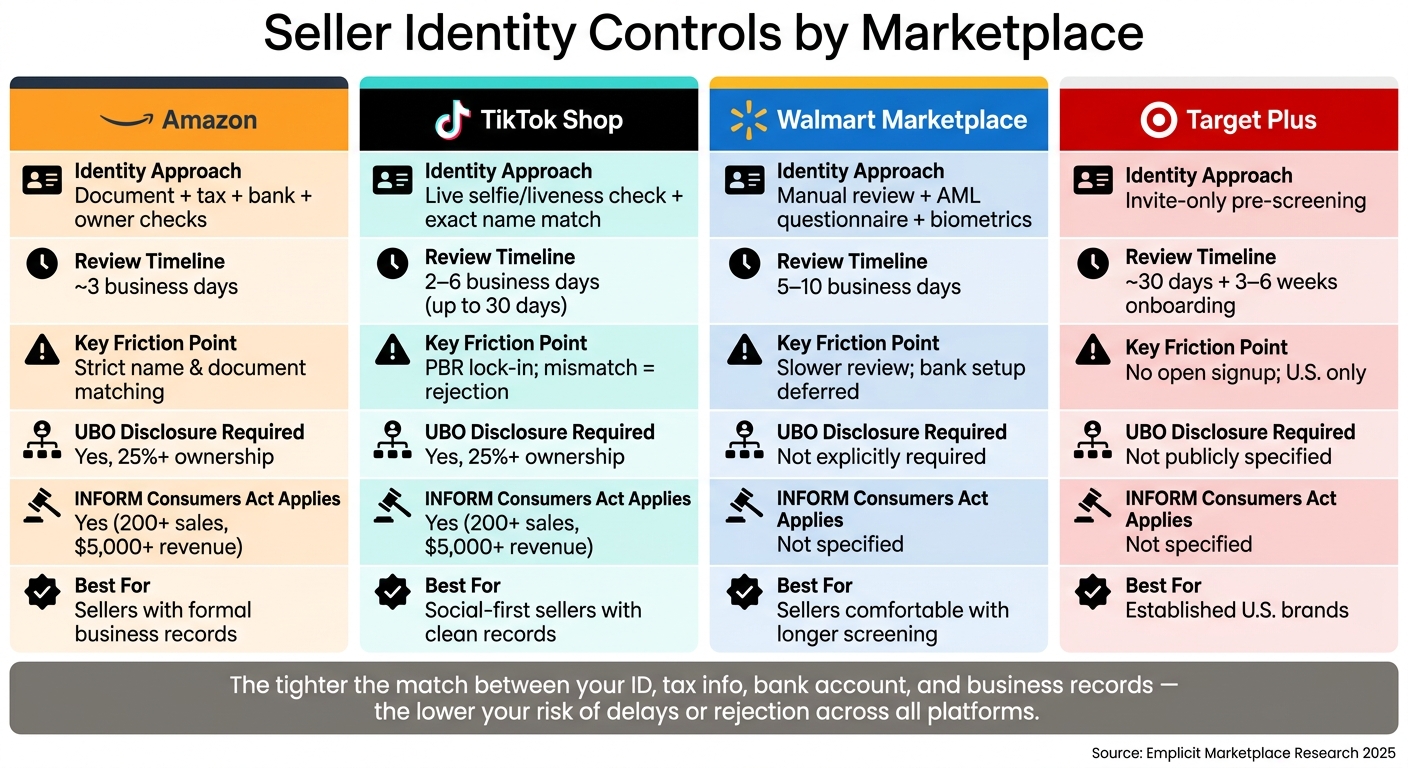
If you want the short answer: Amazon asks for the most up front, TikTok Shop is strict on live ID checks and exact matches, Walmart leans more on manual review, and Target Plus keeps entry tight with an invite-only model.
If I were comparing these four for a U.S. seller, I’d look at three things first:
- How much proof the marketplace asks for
- How long approval usually takes
- How hard it is to change account details later
The big patterns are simple:
- Amazon ties identity, tax, bank, and owner records together from the start
- TikTok Shop leans hard on live selfie checks, bank-name matching, and a fixed account rep
- Walmart Marketplace adds manual screening, AML review, and some biometric checks
- Target Plus limits risk by letting in sellers by invitation only
A few numbers stand out:
- Amazon review: about 3 business days
- TikTok Shop review: 2 to 6 business days, sometimes up to 30 days
- Walmart review: 5 to 10 business days
- Target Plus initial review: about 30 days, plus 3 to 6 weeks for onboarding
U.S. law also matters. Under the INFORM Consumers Act, sellers that hit 200+ sales and $5,000+ in gross revenue in a rolling 12-month period face added verification on marketplaces like Amazon and TikTok Shop.
Marketplace Seller Identity Controls Compared: Amazon vs TikTok Shop vs Walmart vs Target Plus
Complete your identity verification as an Amazon seller
Quick Comparison
| Marketplace | Main identity approach | Usual review time | Main friction point | Best for |
|---|---|---|---|---|
| Amazon | Heavy document, tax, bank, and owner checks | ~3 business days | Strict document and name matching | Sellers with formal business records |
| TikTok Shop | Live selfie/liveness checks plus exact account matching | 2 to 6 business days | PBR lock-in and mismatch risk | Social-first sellers with clean records |
| Walmart Marketplace | Manual review, AML questions, and screening | 5 to 10 business days | Slower review and later bank setup | Sellers fine with more screening |
| Target Plus | Invite-only screening before full onboarding | ~30 days + 3 to 6 weeks onboarding | No open signup | Established U.S. brands |
What this comes down to is simple: the tighter the match between your ID, tax info, bank account, and business records, the lower your risk of delays or rejection. That’s the thread running through all four platforms.
1. Amazon
Amazon runs layered KYC and KYB checks across identity, business, bank, and tax records. In this group of marketplaces, it sets the toughest starting point.
Required data fields
Business accounts need a legal business name, business type, registration number, registered address, and an active business phone number. The primary contact has to provide a full legal name, including middle name, date and country of birth, citizenship, residential address, and phone number.
Sellers also submit credit card and bank account details, plus a Tax Identification Number, which means an EIN or SSN for U.S. sellers. If a person owns more than 25% of the business, Amazon requires that person to be listed as a beneficial owner.
Verification depth
Amazon asks for more than a basic document upload. Sellers may need to send clear color scans of a government-issued photo ID, a business license, or a bank statement. In some cases, Amazon also asks for a selfie with the ID or a live video call with an associate.
If address checks don’t pass on their own, Amazon can mail a physical postcard with a verification code to the registered business address. For U.S. sellers, tax IDs are checked directly with the IRS.
Review usually takes about 3 business days. During that time, accounts stay inactive, which means listings remain hidden.
Regional rules
In the U.S., the INFORM Consumers Act applies to sellers that hit 200 or more sales and $5,000 or more in gross revenue during any continuous 12-month period. Those sellers must verify their tax ID, phone number, and business address, then recertify each year.
That adds another verification step, and it can affect both approval timing and payout access. Outside the U.S., European stores need VAT registration and must comply with Amazon Payments UK’s KYC rules. Sellers in the Middle East and Asia-Pacific may also need regional trade licenses.
Fraud prevention controls
Amazon checks IP addresses and device data to spot location mismatches. Bank account holder names must match the registered seller identity exactly. And if you change bank account details or your business address, Amazon triggers full re-verification.
Sellers get 60 days to finish that process before selling privileges and disbursements are restricted. Common rejection triggers include:
- Names that don’t match across documents
- Proof-of-address documents older than 180 days
- Blurry scans or images with cropped edges
- Screenshots sent instead of official files
The next marketplace shows how identity checks shift when speed and platform rules matter more.
2. TikTok Shop

TikTok Shop blends document review, tax checks, bank account matching, and live selfie verification. Amazon leans more on address and document re-checks. TikTok Shop puts more weight on live identity confirmation and exact account matching. So while approvals can happen fast, that speed depends on a precise match between the seller, the documents, and the bank details.
Required data fields
What TikTok Shop asks for depends on the seller type.
Individual sellers need to provide:
- Full legal name
- Date of birth
- U.S. residential address
- Last four digits of their SSN or ITIN
Business sellers such as LLCs, corporations, and partnerships need to submit their legal business name, registered U.S. business address, and EIN. Registered businesses also have to name a Primary Business Representative (PBR). That person submits a government ID, address, and the last four digits of their SSN or ITIN.
For corporations and partnerships, any person who owns 25% or more of the company must be listed as an Ultimate Beneficial Owner (UBO). TikTok requires that person’s name, date of birth, and ID. Bank account rules are strict too: individual sellers must use personal accounts, while companies must use business accounts.
Verification depth
TikTok goes past basic document upload. It also requires a liveness check through a live selfie or short video to confirm that the applicant is a real person and matches the submitted ID.
Small mismatches can cause trouble. TikTok expects exact name matching, so nicknames, skipped middle initials, or other variations may lead to rejection. The ID image must also be clean and complete. All four corners need to show, and screenshots are not accepted.
Approval usually takes 2 to 6 business days, though manual review can stretch the process to 30 days.
Regional rules
In the U.S., TikTok Shop is subject to the INFORM Consumers Act. That applies to sellers who reach 200 or more transactions and $5,000 or more in gross revenue during any rolling 12-month period. Once a seller hits that mark, TikTok requires annual re-verification of identity and address.
Tax checks have a firm trigger too. After a seller reaches $2,000 in sales, TikTok requires a completed W-9. If that form is not submitted on time, TikTok pauses selling access and applies the IRS-required 24% withholding rate to payouts.
Fraud prevention controls
TikTok treats the PBR role almost like a fixed anchor for the account. In most cases, changing that person means shutting down the shop and opening a new one, which makes unauthorized transfers much harder. A single PBR can be tied to up to five TikTok Shops.
TikTok also bans VPN or proxy use during registration, and that can lead to a permanent ban. Some restricted product categories need extra paperwork as well.
Walmart Marketplace handles this differently, leaning more on document review and putting less friction on identity checks during onboarding.
3. Walmart Marketplace
Walmart verifies sellers through document review, background screening, and biometric checks. Compared with Amazon and TikTok Shop, Walmart puts more weight on manual review and deeper identity checks.
Required data fields
Walmart asks for the legal business name, address, phone number, email, TIN/EIN, country of incorporation, tax-status documents, a government ID, and a bank statement dated within the past two months. Before any listings go live, sellers also complete a four-question AML questionnaire. That step is usually reviewed within 24 hours.
Verification depth
The first review of company details and submitted documents usually takes 5 to 10 business days. Walmart may also run background and sanctions checks against OFAC and other restricted-entity databases.
Biometric checks add another gate. Through outside partners, Walmart may use facial, voice, or iris scans. Walmart receives only the result, not the raw biometric data. Biometric data is deleted within 30 days, while general verification records may be kept for up to three years.
Bank account details are set up only after the initial company review is approved. Sellers can choose direct deposit or Payoneer.
That extra friction can be a pain, but it helps cut down on account takeover and identity fraud before a seller is approved.
Regional rules
Before approval, sellers are screened against OFAC-sanctioned countries, regions, and individuals. A March 2025 CNBC investigation found stolen-business-identity abuse on Walmart Marketplace. Walmart removed those accounts and joined the IACC Marketplace Advisory Council in mid-2025 to tighten vetting.
Fraud prevention controls
Walmart goes past document checks. It monitors keystroke patterns during registration to spot bot activity and tracks device identifiers such as MAC addresses and IP addresses, along with geolocation data. AI scans listings for IP violations, and a dedicated seller vetting team manually reviews applications that don’t pass automated checks.
Target Plus is even more selective.
sbb-itb-e2944f4
4. Target Plus
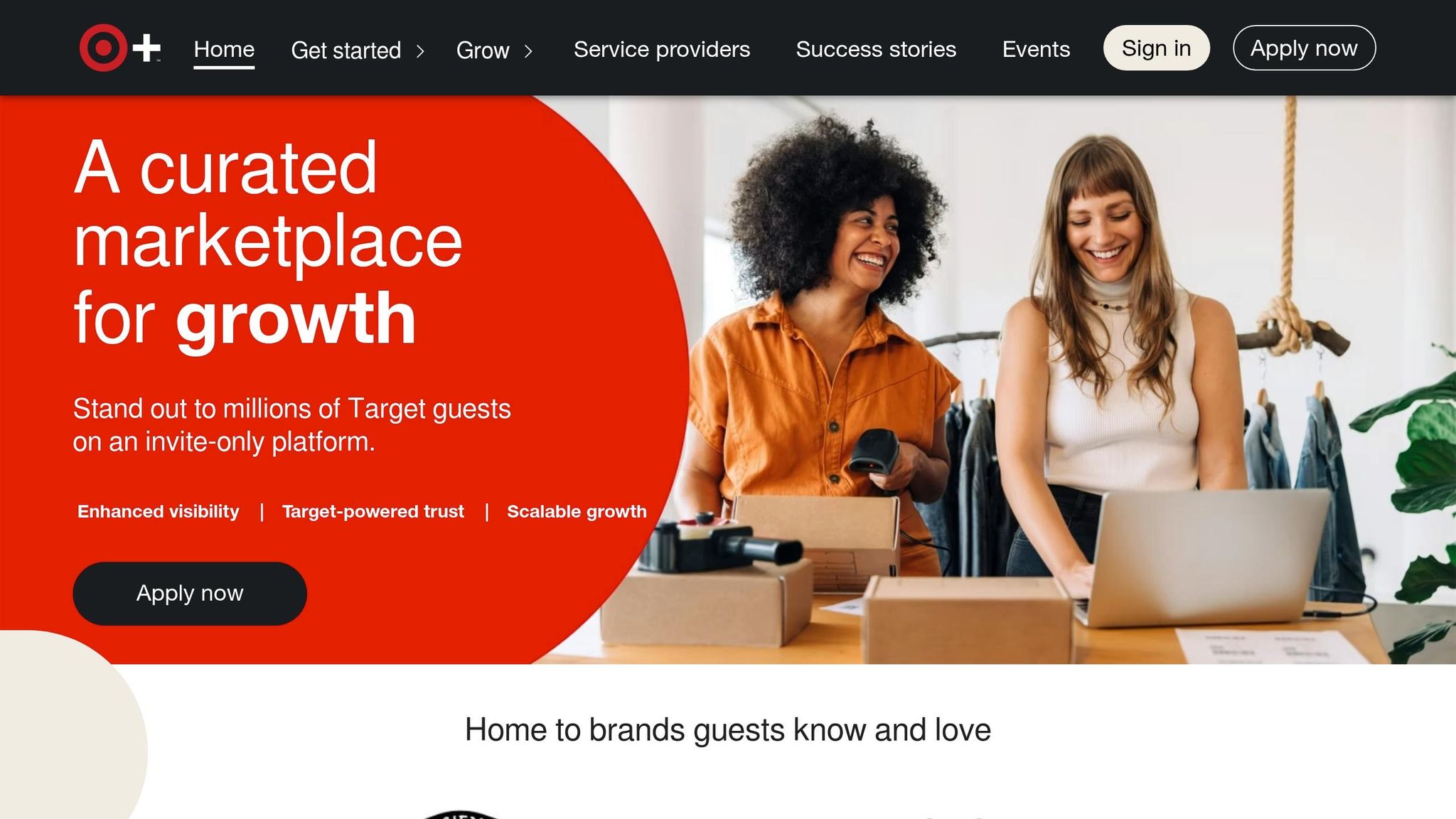
Target Plus is the strictest option in this group. You can’t just sign up and wait for approval. Sellers join by invitation only, and Target screens them before any formal application moves ahead.
Required data fields
If you’re invited, you need to submit a U.S. business address, a U.S. bank account, a W-9, an EIN, and a DUNS number. Target also asks where you already sell, along with your product category and SKU data.
One detail matters a lot here: the business name on your EIN letter, bank statement, and application must match exactly. Even small mismatches can slow things down.
Verification depth
Target’s first review usually takes about 30 days. If you’re approved, onboarding then takes another 3 to 6 weeks.
This isn’t just a paperwork check. Target also manually reviews your brand reputation, web presence, and marketplace track record before it makes a call. That early screening helps keep bad actors out before they ever reach the platform.
Regional rules
Target Plus is limited to U.S.-based entities.
Fraud prevention controls
The invite-only setup is the first fraud check. On top of that, Target uses a one-retailer-per-SKU policy, which helps cut down on listing hijacking and unauthorized resale.
Side-by-Side Comparison of Identity Controls and Risk Safeguards
Each marketplace handles seller identity checks a little differently. That choice shapes how fast a seller can get approved, how many documents they need to gather, and how much fraud risk the platform is trying to shut down upfront.
The tables below focus on the controls that matter most: identity data, review depth, and fraud safeguards.
Table 1: Mandatory Data Fields
| Field | Amazon | TikTok Shop | Walmart Marketplace | Target Plus |
|---|---|---|---|---|
| Personal ID | Government-issued photo ID | Government-issued photo ID | Official ID of the legal representative | Not required at application; invite-only screening |
| Business Info | Articles of Incorporation or Operating Agreement | Legal business name, EIN, and PBR/UBO information | Legal business name, country of incorporation, and tax-status documents | EIN and DUNS number |
| Address | Proof of address within the last 180 days | Proof of address | Business address and phone | U.S. business address |
| Tax ID | SSN or EIN, with IRS auto-verification | SSN or ITIN for individuals; EIN for businesses; W-9 required at $2,000 in sales | TIN/EIN and proof of tax status | W-9 and EIN |
| Banking | Bank account details | U.S. bank account matching the registration name | Direct deposit or Payoneer | U.S. bank account |
A quick look at this table shows a simple truth: the more tightly a marketplace links a seller’s identity to tax and banking records, the less room there is for fake or borrowed details. Amazon and TikTok Shop are strict here. Walmart asks for much of the same core data, while Target Plus keeps the front door narrow by making the program invite-only.
Table 2: Verification Depth and Review Methods
| Marketplace | Verification Depth | Review Timeline | Primary Method |
|---|---|---|---|
| Amazon | High – cross-references IRS records and beneficial owner identities | About 3 business days | Manual document review and IRS data matching |
| TikTok Shop | High – verifies a permanently assigned Primary Business Representative (PBR), UBOs over 25% equity, and bank/ID name matches | 2 to 6 business days; up to 30 days if manually reviewed | Live data matching and a liveness check |
| Walmart Marketplace | Moderate – requires an AML questionnaire and a recent bank statement no older than two months | 5 to 10 business days | Manual review plus an Anti-Money Laundering questionnaire |
| Target Plus | High – manual review of brand reputation, web presence, and marketplace track record | About 30 days initial review; 3 to 6 weeks onboarding | Invite-only pre-screening before any formal application |
This is where the differences start to matter. Amazon leans on document review plus IRS matching, which helps keep review times to about 3 business days. TikTok Shop goes hard on live matching, liveness checks, and fixed identity roles like the PBR, but that can stretch from 2 to 6 business days to as long as 30 days when manual review kicks in.
Walmart Marketplace takes a slower, more hands-on route with manual review and an AML questionnaire. Target Plus is almost the opposite of open enrollment marketplaces. It screens sellers before a formal application even begins, then reviews brand reputation, web presence, and marketplace history.
Table 3: Fraud Prevention Controls Tied to Identity
| Control Measure | Amazon | TikTok Shop | Walmart Marketplace | Target Plus |
|---|---|---|---|---|
| Name Matching | Discrepancies trigger additional review | Name mismatches can trigger immediate rejection or a longer review | Must match across tax and bank documents | Must match exactly across EIN letter, bank statement, and application |
| Tax Compliance | Required at onboarding; IRS auto-verification | Payouts pause at $2,000 in sales until a W-9 is submitted, and missing tax information can trigger 24% withholding | Proof of tax status required before listing | W-9 required before approval |
| UBO Disclosure | Mandatory for owners with more than 25% equity | Mandatory for owners with 25% or more equity | Not explicitly required | Not publicly specified |
| Geographic Restrictions | Not publicly specified | Addresses validated against USPS records; VPN/proxy use can lead to permanent bans | OFAC screening before approval | U.S.-based entities only |
| Account Limits | Not publicly specified | Up to 5 shops per verified business entity | Not publicly specified | One retailer per SKU |
The fraud controls tell the same story from another angle. Exact matching is doing a lot of the work. If the name on the ID, tax file, bank account, and application doesn’t line up, the process slows down or stops. TikTok Shop is especially strict: mismatches can mean an instant rejection, and address checks go as far as USPS validation, with VPN or proxy use risking permanent bans.
Tax checks are another pressure point. Amazon requires tax verification during onboarding and matches data with IRS records. TikTok Shop pauses payouts once a seller hits $2,000 in sales if a W-9 is missing, and absent tax information can trigger 24% withholding. Walmart requires proof of tax status before listing, while Target Plus requires a W-9 before approval.
One more pattern stands out. Amazon and TikTok both require UBO disclosure at the 25% ownership mark, which gives them a clearer view of who owns the business behind the storefront. Walmart does not state that rule in the same way, and Target Plus does not publicly spell it out.
The tradeoff is pretty direct: tighter identity matching can cut fraud risk, but it also adds friction. Amazon and TikTok lean into exact matching, while Walmart adds slower manual review and AML screening.
Pros and Cons by Marketplace
Every marketplace makes its own tradeoff between access and risk.
Some move fast and keep signup friction low. Others put more checks up front, which can help block fraud but can also slow good sellers down. The platforms below show that balance pretty clearly.
The table below compares identity friction with fraud risk. Best fit reflects how much verification friction each platform is willing to accept.
| Marketplace | Pros | Cons | Best Fit |
|---|---|---|---|
| Amazon | Clear KYC requirements; structured onboarding | Strict name matching slows approval; accounts inactive until approved | Established brands with formal corporate structures |
| TikTok Shop | Fast verification for clean matches; fixed PBR anchor strengthens account integrity | PBR cannot be changed without closing the account; small name mismatches can trigger manual review and delay approval | Social-first brands with a dedicated U.S.-based representative |
| Walmart Marketplace | AML screening and biometric checks reduce fraud before approval; multiple payout options | Slower review at 5 to 10 business days; bank account setup deferred until after initial approval | Established businesses that can handle a longer onboarding timeline |
| Target Plus | Invite-only model filters out bad actors early; one-retailer-per-SKU policy limits listing abuse | Longest path to approval; limited to U.S.-based entities; no self-serve application | Established U.S. brands with a strong marketplace track record |
TikTok’s permanent PBR model makes account transfer hard. That’s the tradeoff in plain English: tighter identity controls can cut fraud, but they also make approval slower.
Conclusion
Across these four marketplaces, identity checks come down to a three-way tradeoff: speed, proof, and fraud defense. Each platform leans in its own direction. Amazon leans on document-heavy verification, TikTok Shop uses live identity checks, Walmart adds manual screening, and Target Plus relies on invite-only vetting.
For U.S. sellers, the big differences are how fast approval happens, how strict the review is, and how difficult it is to change account ownership later. That matters when you’re weighing fast setup against tighter account control.
Amazon usually verifies sellers in about 3 business days. TikTok Shop approvals often take 2 to 6 business days, and they can take longer if the account gets pushed to manual review. Both platforms also support individual sellers.
The main point is straightforward: clean, consistent documentation lowers risk on every marketplace, but TikTok Shop locks in the PBR after approval. Emplicit helps brands manage marketplace onboarding, account health, and compliance.
FAQs
Which marketplace is easiest to get approved on?
No marketplace is the easiest for everyone. The big platforms all ask for strict identity and business checks, and approval usually comes down to one thing: how accurate your application is.
In plain English, a simple-looking form doesn’t mean an easy approval.
TikTok Shop can feel a bit more direct for individual creators. But even then, small mismatches in your business or bank details can get your application rejected. Amazon and Walmart are no different. They also expect precise documentation.
What documents should I prepare before applying?
To help the application process go smoothly, have these core documents ready:
- A valid, government-issued photo ID
- Business registration documents, if applicable
- Tax documentation, including an EIN for businesses
- A recent bank statement dated within 90 to 180 days
Your bank statement should match your registered legal name and business address.
What happens if my business or bank details change later?
If your business or bank details change, update your seller profile right away. That helps you stay compliant and lowers the chance of account interruptions.
On Amazon, you need to submit the new information for verification. Amazon also places a 3-day security hold on fund transfers after you update bank details, so try not to make changes within 3 days of a scheduled disbursement.
If you want a second set of eyes, Emplicit can help audit your account information and manage the paperwork to cut down on downtime.