
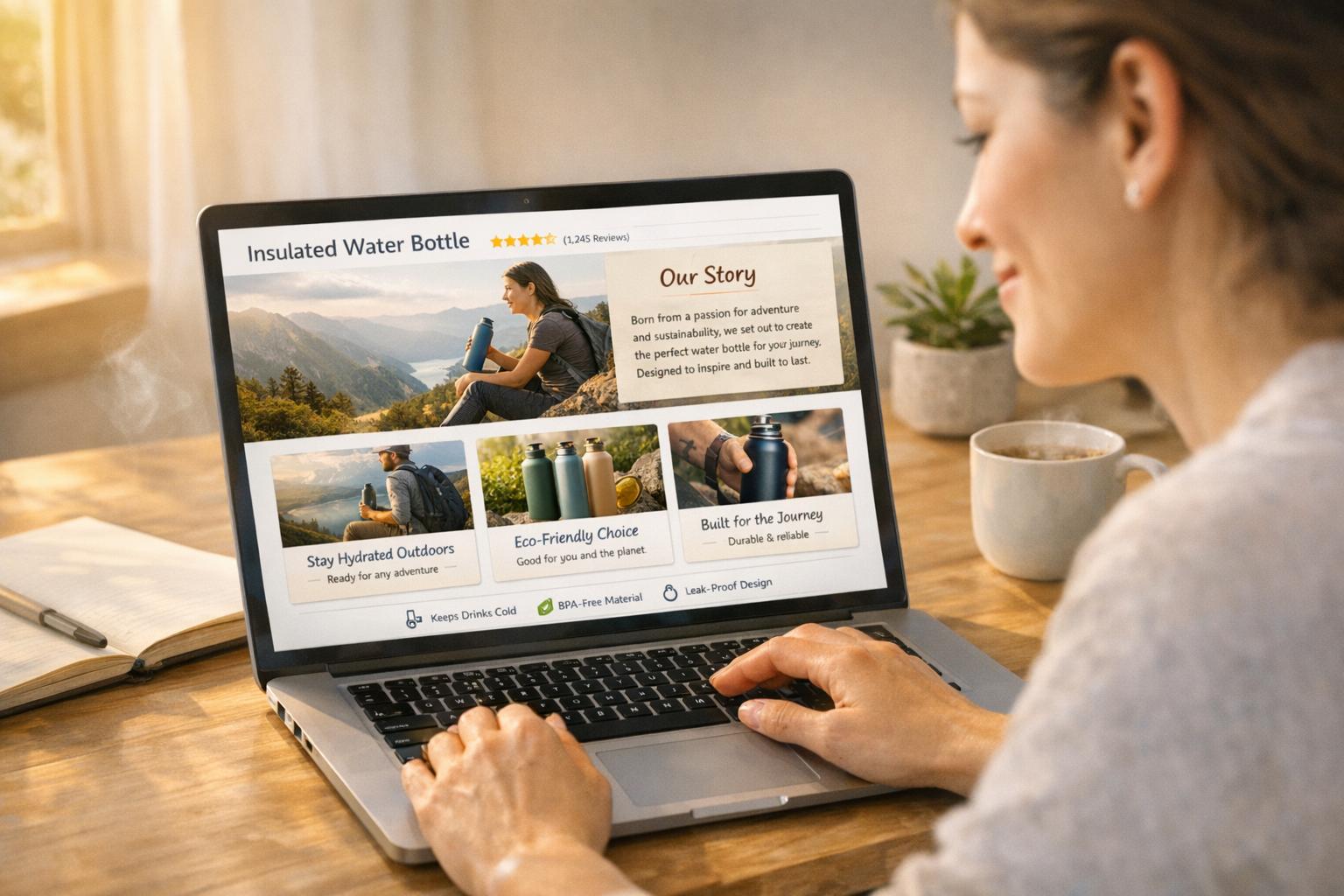
Storytelling can transform your Amazon listings into sales powerhouses. Here’s why: shoppers are more likely to trust and buy from brands that share their mission, values, and purpose. By adding a clear narrative – focused on solving problems and building emotional connections – you can increase conversion rates by up to 30% and improve customer loyalty.
Key takeaways:
- Emotional Connection: 76% of shoppers prefer brands they feel connected to.
- Higher Sales: Story-driven content can boost revenue by 10–30%.
- Improved Visibility: Listings with engaging content rank better in Amazon search results.
- Reduced Returns: Clear narratives set accurate expectations, cutting return rates by 10–20%.
Use Amazon’s free Brand Story and A+ Content tools to showcase your mission, solve customer pain points, and highlight your product’s value. Focus on clarity, mobile optimization, and high-quality visuals to stand out in a crowded marketplace.
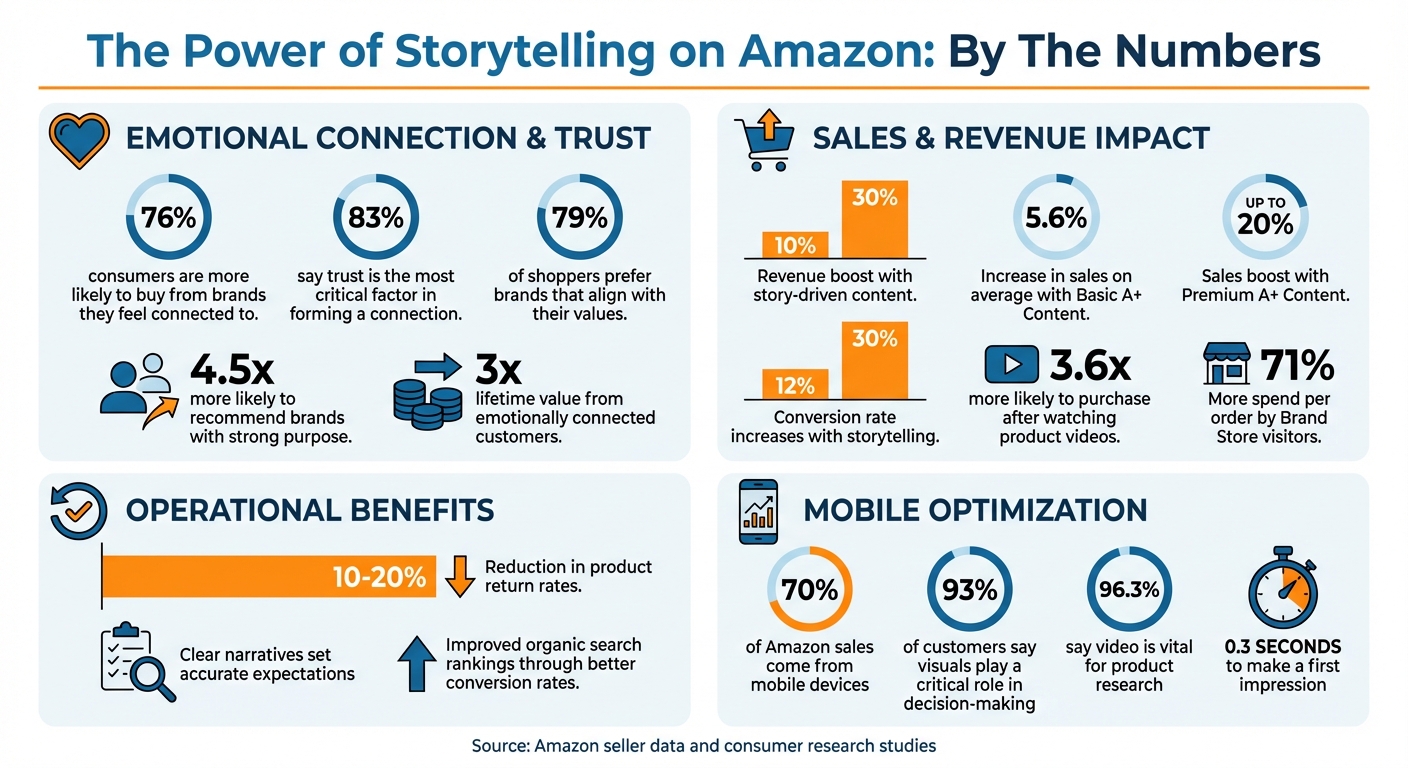
How Storytelling Impacts Amazon Listing Performance: Key Statistics
Amazon Brand Story Explained (and How It Boosts Your Sales Fast!)
sbb-itb-e2944f4
Why Storytelling Improves Amazon Listings
Storytelling changes the way customers view your brand, turning casual shoppers into loyal buyers. By creating an emotional connection, your brand becomes more relatable, boosts visibility, and reduces hesitation during the buying process. Let’s break down how emotional appeal, engaging content, and a clear narrative work together to achieve this.
Building Emotional Connections with Customers
Shopping on Amazon often starts with emotion and ends with logic. The Brand Story module, prominently displayed, helps establish trust by humanizing your brand. Instead of being just another seller, you become a relatable company with shared values and a clear mission. And the stats don’t lie: 76% of consumers are more likely to buy from brands they feel connected to. Even better, when customers perceive your brand as having a strong purpose, they’re 4.5 times more likely to recommend it.
This emotional bond can also justify higher prices. Shoppers are often willing to pay more for products that align with their identity or values. By connecting on a deeper level, you give customers a reason to choose your brand over others.
Improving Visibility Through Engaging Content
Amazon’s algorithm now prioritizes listings that feel authentic rather than those crammed with keywords. Storytelling not only builds brand recall but also shifts customer behavior. Instead of searching for generic terms like "yoga mat", customers begin searching for your brand directly, signaling to Amazon that your products are in demand.
While the Brand Story and A+ Content modules don’t directly impact keyword indexing, they do improve conversion rates, which in turn boosts organic search rankings. Brands using Premium A+ Content have reported sales increases of up to 20%, and a well-crafted Brand Story can drive 10–30% more revenue by building trust and encouraging upsells. These benefits reinforce why engaging content is essential for visibility and growth.
Increasing Conversions with a Clear Narrative
A clear and compelling narrative helps customers see how your product solves their problems. The Problem → Promise → Proof framework is a proven approach: highlight the customer’s pain point, offer a solution, and back it up with evidence.
"In high-intent environments such as Amazon, clarity will always trump creativity because consumers come to the site with a problem to solve, not a story to tell." – Adorbix
Take Clean Kitchen Co. as an example. In 2025, they revamped their A+ Content to share the founder’s journey of tackling plastic-heavy kitchen products. Over 45 days, this storytelling approach boosted their conversion rate by 23% and increased engagement on Amazon Posts by 40%. Beyond conversions, it also reduced product return rates by 10–20% by setting clear expectations.
The lesson here? While product features can be copied, your story is uniquely yours. In a marketplace where 79% of shoppers prefer brands that align with their values, your narrative becomes your competitive edge. It builds trust and drives the conversions that set your brand apart.
Where to Add Storytelling in Amazon Listings
Amazon provides sellers enrolled in Brand Registry with tools to share their brand’s story and highlight product features. The Brand Story module, located above the product description, and A+ Content, found below, work together to boost conversions and reduce returns. Let’s explore how to make the most of these features.
Using the Brand Story Module
The Brand Story module is perfect for showcasing your brand’s mission, values, and history through visual storytelling. This scrollable carousel of brand cards allows you to connect with customers on a deeper level. Options include:
- Hero Banner: Sets the tone with lifestyle imagery and a tagline.
- Founder’s Story: Shares your origin story.
- Brand Q&A: Answers common questions like "How did we get our start?"
- Product Family Carousel: Links to other items in your catalog, encouraging cross-selling.
To keep your message clear, stick to 2–5 modules. Use consistent brand colors, fonts, and lifestyle photography to maintain a cohesive look. When choosing background images, position the main subject on the left side to avoid interference from content boxes on the right. Don’t forget to fill out the "Image Keywords" (alt text) for every image – this improves accessibility and helps search engines discover your content.
Adding Storytelling to A+ Content
While the Brand Story module sets the emotional tone, A+ Content gives you space to delve into product benefits and provide proof of value. Basic A+ Content allows up to 5 modules and can increase sales by up to 8%. Premium A+ Content (A++) expands this to 7 modules, adding interactive features like videos, clickable carousels, and hover hotspots, which can boost sales by up to 20%. Listings with videos are particularly effective, as customers who watch them are 3.6 times more likely to make a purchase.
Follow the "Problem → Promise → Proof" structure to craft your narrative. Use full-width lifestyle images featuring real people in relatable settings. Highlight how your product solves a specific problem, and back it up with comparison charts, testimonials, or before-and-after visuals.
"HexClad is a premium product, so A+ Content is where we convey the story of how our product adds value, showcase content that demonstrates how to use our product and point out unique features." – Jason Panzer, President of HexClad
Always preview your content on mobile to ensure it’s easy to read and visually appealing. Avoid embedding small text in images, keep written content concise, and prioritize lifestyle photography over generic stock photos for a more authentic feel.
How to Write an Effective Brand Story
Storytelling has a powerful impact on how customers perceive your brand. Crafting an effective brand story helps you connect on a deeper level with your audience. To get started, focus on clarity – know your identity and values inside out. Ask yourself four key questions: Who is your ideal customer? How does your brand communicate? What design elements define your look? And what principles guide your decisions? These answers will shape every aspect of your Brand Story carousel.
Define Your Brand Identity and Values
Your origin story is your chance to make your brand relatable and show why it exists. Take Clean Kitchen Co., for example. In 2025, they revamped their A+ Content to highlight their founder’s journey of tackling plastic-heavy kitchenware for their kids. By adding an "About Us" section to their Storefront and using warm lifestyle images, they saw a noticeable boost in conversions and customer loyalty.
Instead of just listing product features, focus on your mission – whether that’s sustainability, craftsmanship, or family values. This approach resonates with shoppers: 79% prefer buying from brands that align with their values, and 83% say trust is the most critical factor in forming a connection.
Include Customer-Focused Narratives
Make your customer the hero of your story, with your product as the guide helping them solve a problem. Highlight the benefits of your product – for instance, stress-free pet walks for middle-aged parents who worry about their pets’ safety. Use the Problem-Promise-Proof structure: identify the issue your customer faces, explain how your product solves it, and back it up with testimonials or certifications.
Keep your tone conversational and true to your brand’s personality, whether that’s playful, bold, or sophisticated. As Simon Sinek famously said:
"People don’t buy what you do, they buy why you do it".
Finally, make sure your story captivates on every device.
Optimize for Mobile and Desktop Views
Your story should look great on any screen to keep shoppers engaged. With 70% of Amazon sales coming from mobile devices, it’s crucial to optimize for smaller screens. Place key visuals – like your logo or main product – on the left side of your background image, as scrolling modules can obscure the right side. Avoid embedding text in images; shrinking graphics often make text unreadable on mobile. Instead, use Amazon’s text fields for headlines and body copy. Always preview your content on both desktop and mobile screens, and don’t forget to fill in "Image Keywords" to improve accessibility and search visibility.
Best Practices for Storytelling on Amazon
Building a compelling brand story for your Amazon listing can make a world of difference. By following a few essential practices, you can create a narrative that not only engages but also converts. The key is balancing Amazon’s guidelines with an authentic and engaging approach.
Keep Content Clear, Concise, and Genuine
Your story should feel authentic – less like a sales pitch and more like a conversation. Share the why behind your brand: the family history, the personal struggle, or the problem that inspired your product. As Marketplace Valet puts it:
"Storytelling isn’t fluff – it’s strategy".
Structure your content using the Problem → Promise → Proof method. This helps you address customer pain points, show how your product solves them, and back it up with evidence.
Stay within Amazon’s content rules. Avoid subjective claims like "best-selling" or "top-rated", and skip including QR codes, hyperlinks, pricing, or contact details. Stick to facts and genuine storytelling to build trust and ensure compliance.
Use High-Quality Visuals and Media
Visuals are your first chance to grab attention – 93% of customers say visuals play a critical role in their decision-making. And with just 0.3 seconds to make an impression, high-quality lifestyle images featuring real people in relatable settings are essential.
Videos are even more powerful. Shoppers who watch product videos are 3.6 times more likely to buy, and nearly all (96.3%) say video is vital for product research. Use Amazon’s seven A+ Content modules wisely – combine lifestyle images, product benefits, and technical details for a well-rounded presentation.
For your Brand Story graphic, ensure a minimum resolution of 3,620 x 1,200 pixels to maintain a sharp and professional look. When paired with concise copy, these visuals can clearly communicate your product’s value without overwhelming the viewer.
Highlight What Makes Your Product Different
Your story isn’t just about engaging content – it’s about showing why your product stands out. Position your product as the solution to your customers’ challenges. Focus on how your features address specific needs, avoiding technical jargon that can confuse shoppers.
Interactive tools like comparison charts and hover hotspots make it easy for customers to see your product’s unique benefits. These features not only simplify decision-making but can also boost order value through cross-selling opportunities.
Stick to 3 to 5 well-organized modules. Overloading your listing with too much information can dilute your message and overwhelm shoppers. Use icons and short captions to keep your content scannable and impactful. As Marketplace Valet notes:
"Your story is your competitive edge. Buyers don’t remember specs. They remember how you made them feel".
The impact is clear: Basic A+ Content can boost sales by 5.6% on average, while Premium A+ Content can drive sales up by as much as 20%. Plus, brands that excel in storytelling often see 10% to 20% fewer returns because customers know exactly what to expect.
Measuring the Impact of Storytelling on Listings
Track Key Performance Metrics
To gauge how well your storytelling resonates, focus on key performance indicators. Conversion rate is a crucial metric – it reveals the percentage of visitors who make a purchase after engaging with your story. Another important metric is sessions, which tracks unique visits and reflects whether your storytelling and SEO strategies are attracting more shoppers to your page.
Pay attention to your average order value (AOV) as well. If your Brand Story modules are effective, they can encourage customers to explore more of your offerings. For example, shoppers who visit an Amazon Brand Store tend to spend 71% more per order compared to those who don’t. To refine your approach, take advantage of Amazon’s "Manage Your Experiments" tool, which allows you to A/B test different versions of your Brand Story or A+ Content. This can lead to sales increases of up to 25%. Ben Huge, Brand Manager at Onkata Hardware Sales, Inc., highlights its value:
"With Manage Your Experiments, we can explain what’s going on in a customer’s marketplace… we can give our customers positive results".
Additionally, keep an eye on your organic keyword ranking and page dwell time. These metrics provide valuable insights into how well your storytelling engages your audience. Turning these insights into results often requires expert guidance.
Work with Emplicit for Listing Optimization
Once you’ve gathered data, the next step is to act on it with strategies designed to improve performance. While tracking metrics is essential, leveraging them effectively can be challenging. That’s where Emplicit comes in. They specialize in listing optimization and marketplace management for Amazon sellers, offering a full range of services like testing optimization, refining keywords, overseeing inventory, and monitoring account health.
Conclusion
Storytelling has the power to turn ordinary product listings into engaging brand experiences that drive sales. By creating emotional connections, you go beyond competing solely on features, building a distinct identity that supports premium pricing and safeguards your brand from imitators. As Marketplace Valet aptly states:
"The best-selling brands on Amazon don’t just compete on features. They compete on emotional connection".
The data backs this up. Brands using storytelling through Amazon’s A+ Content and Brand Story modules have reported conversion rate boosts of 12% to 30%. Additionally, emotionally connected customers are shown to deliver three times more lifetime value. These figures highlight the importance of crafting a clear and strategic narrative for every product listing.
Consistency is key – ensure your visuals align across all touchpoints, and prioritize mobile optimization since most Amazon traffic comes from mobile users. Use the Brand Story module to personalize your brand, include comparison charts to ease buyer hesitation, and experiment with Amazon’s testing tools to refine your approach.
For many brands, expert assistance can make a significant difference. Emplicit offers a comprehensive range of ecommerce services, including marketplace management, content creation, marketing, and custom strategies to help businesses grow on platforms like Amazon, Walmart, TikTok Shops, and Target. Their expertise spans PPC management, listing optimization, inventory control, account health, and more, providing tailored solutions to scale your business effectively.
In today’s competitive landscape, your story isn’t just another piece of content – it’s your key to standing out. With 73% of consumers willing to stick with new brands that share their values, brands that foster genuine connections are the ones that win.
FAQs
Do I need Brand Registry to add a Brand Story?
No, you don’t need to be enrolled in Amazon Brand Registry to add a Brand Story. However, since the Brand Story is part of A+ Content, you’ll need to be brand-registered to use it. This feature is exclusively available to sellers who have completed the Brand Registry process.
What story elements actually improve conversions on Amazon?
Story elements that drive conversions on Amazon focus on forming an emotional connection, establishing trust, and presenting a strong brand identity. Share your story – who you are, why your product matters – and back it up with compelling visuals. These touches not only make your listing more engaging but also help it connect with shoppers on a deeper level, setting it apart from the competition.
How do I measure if A+ Content storytelling is working?
To measure how well your A+ Content storytelling performs, take advantage of Amazon’s tools like Manage Your Experiments to run A/B tests on your product detail pages. Pay close attention to the conversion rate (CVR) – this is the most important metric for identifying which content variations resonate best with your audience. When storytelling elements and visuals are fine-tuned, they can lead to a noticeable lift in engagement and sales. In fact, Amazon suggests that well-tested, high-quality A+ Content can drive sales increases of 8-20%.
Related Blog Posts
- Common Amazon Listing Optimization Mistakes to Avoid
- The Amazon Listing That Sold $1.2M in Dog Supplements Last Year Had One Thing Yours Doesn’t
- Your Amazon A+ Content Looks Beautiful. It’s Also Why Nobody’s Adding to Cart.
- Your Amazon A+ Content Looks Beautiful. It’s Also Why Nobody’s Adding to Cart.