

Your pet brand on Amazon is doing well, hitting $2 million in annual revenue. But now, growth has stalled. Why? It’s not just competition – it’s a mix of rising ad costs, cash flow issues, operational inefficiencies, and challenges in scaling. Here’s what’s holding you back and how to fix it:
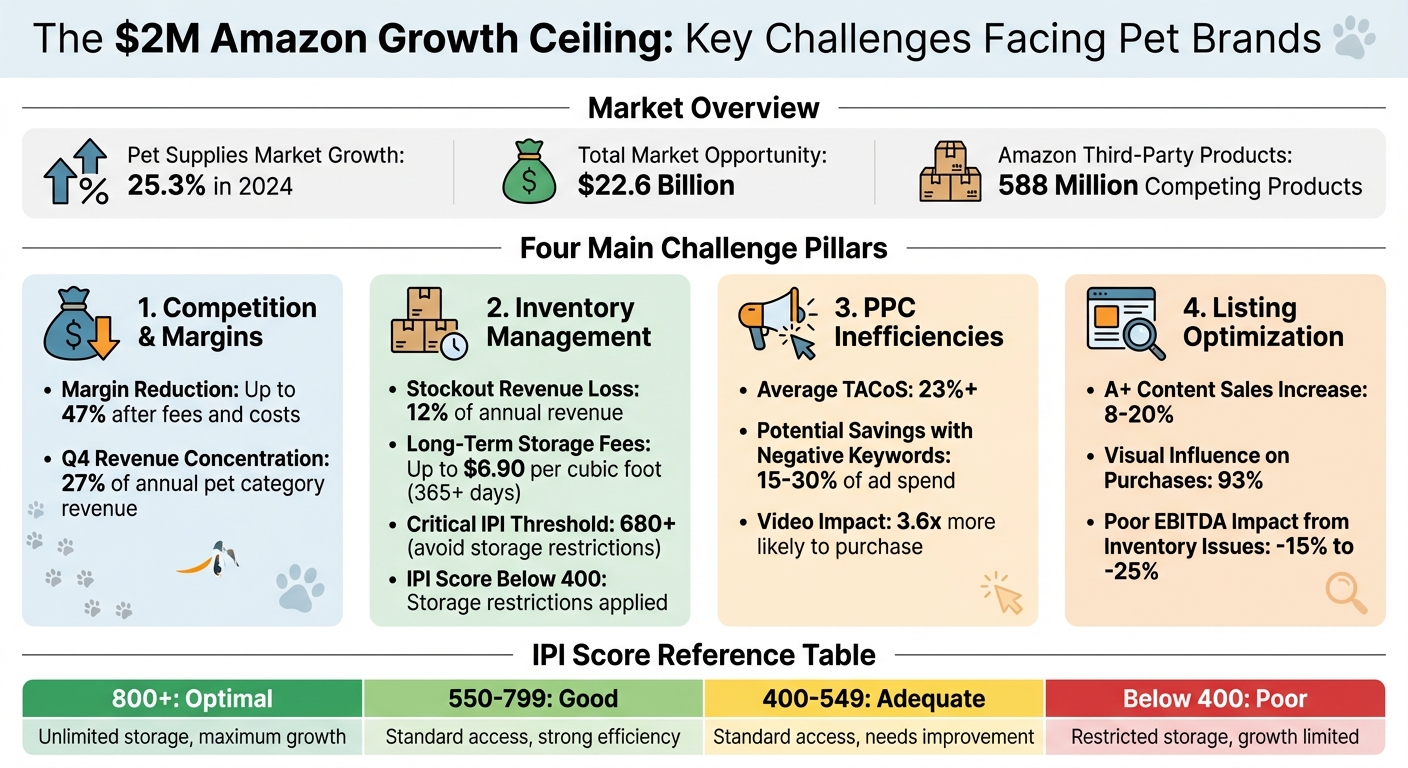
- Fierce Competition: The pet supplies market grew 25.3% in 2024, creating a $22.6 billion opportunity. But big players like Purina dominate, and pricing battles cut margins by up to 47%.
- Inventory Challenges: Stockouts hurt rankings, overstocking racks up fees, and Amazon’s biweekly payouts strain cash flow.
- Ad Spend Inefficiencies: PPC campaigns often waste money on broad keywords, poor targeting, and manual bidding.
- Subpar Listings: Weak product pages and poor keyword strategies reduce conversions and visibility.
To grow beyond $2M, you need smarter systems for inventory, PPC, and listings. Focus on data-driven forecasting, automation, and keyword optimization. Advanced tactics like isolating high-performing keywords, improving A+ Content, and maintaining a strong Inventory Performance Index (IPI) can make the difference. Brands that refine these areas can scale sustainably in a competitive market.
The $2M Amazon Growth Ceiling: Key Challenges Facing Pet Brands
From Struggles to Success: The Story Behind Cologio Pet Products on Amazon
Why Pet Brands Get Stuck at $2M on Amazon
Hitting the $2 million revenue mark on Amazon can feel like success, but for many pet brands, it’s where growth stalls. Why? Three major challenges collide at this stage: tougher competition, operational hurdles, and inefficiencies in ad spending. Together, these obstacles make scaling beyond this point incredibly difficult.
Intense Competition in the Pet Category
Amazon is packed with competition – there are around 588 million third-party products vying for attention on the platform. The pet category alone grows by 25.3% every year, drawing in new players and ramping up pressure from established brands. This kind of crowded market often leads to pricing battles that cut into profits, with margins shrinking by as much as 47% after fees and costs.
Take, for example, a pet treats brand working with Incrementum Digital in April 2025. The brand was pulling in $190,000 a month (roughly $2.28 million annually) but was up against giants like Purina and Royal Canin. To stay competitive, they had to increase ad spending, which only fueled bidding wars and made scaling harder.
"Having a superior product that is high-quality, loved by customers, difficult to replicate and differentiated from the competition is the key to long-term success. Without differentiating your brand, it’s guaranteed that another player will come in and ‘eat your lunch.’"
- Vera Nieuwland, Director of Brand Strategy, unybrands
If your brand doesn’t stand out – whether through ingredient transparency, innovative packaging, or a unique formulation – you risk getting caught in a race to the bottom. And this intense competition only magnifies the operational challenges that come with growth.
Operational Problems That Limit Scale
At $2 million in revenue, the cracks in your operations can start to show. Stockouts, for instance, can cost brands an average of 12% in annual revenue, while overstocking leads to hefty long-term storage fees – up to $6.90 per cubic foot after 365 days. Add to that Amazon’s biweekly payout structure, which often forces brands to reorder inventory earlier than they’d like, putting a strain on cash flow.
Keeping a strong Inventory Performance Index (IPI) is critical. If your IPI dips below 680, Amazon may restrict your storage space – often during crucial periods like Q4, which can account for 27% of annual pet category revenue. Even a single stranded SKU can cause your IPI to drop by over 50 points, pulling resources away from growth. On top of that, relying on one supplier or a single region for production can leave your brand exposed to supply chain disruptions, labor shortages, or rising material costs.
These operational headaches are compounded by another big issue: poorly managed ad campaigns.
PPC Problems That Hurt ROI
Pay-per-click (PPC) inefficiencies become glaringly obvious at this stage. A common mistake is overspending on broad keywords that bring clicks but no sales. For example, if you’re spending more than 50% of a product’s sale price on a single keyword without seeing conversions, it’s a clear warning sign.
Overcrowded ad groups are another issue. When you cram more than five keywords into a single group, budgets often get skewed, with just a few terms hogging most of the spend.
"Setting a single ACoS target (like 30%) for every campaign is a mistake. It forces you to overspend on branded terms that should be cheap, and it starves your ranking campaigns that need more room to grow."
- Steven Pope, Founder, My Amazon Guy
Manual bidding adds to the challenge. Adjusting bids across hundreds of keywords is time-consuming and makes it harder to respond quickly to demand spikes. As a result, Total Advertising Cost of Sales (TACoS) can climb above 23%. Meanwhile, competitors leveraging automation and placement-specific bidding strategies secure prime ad spots, like Top of Search, with much better ROAS (Return on Ad Spend).
In one case study, Incrementum Digital helped the same pet treats brand overcome these hurdles. By isolating high-performing keywords into targeted exact-match campaigns and retargeting shoppers who had seen their ads multiple times over a two-week period, they managed to triple revenue while keeping TACoS under control. Without these advanced strategies, many brands end up bleeding profits through inefficient PPC management.
How to Optimize Product Listings for Pet Products
Your product listing serves as your online storefront, and it plays a huge role in converting casual browsers into paying customers – or losing them to competitors. If you’re aiming to surpass $2M in revenue, refining your listings is a must. At this level, optimizing A+ Content can increase sales by 8–20%. The secret? Focus on two areas: creating visually engaging content and strategically placing keywords where Amazon’s algorithm can easily find them.
Create Better A+ Content
Forget the boring, generic product images. Instead, showcase real pets using your products in action. For instance, if you’re selling chew toys, post an image of a dog happily gnawing on the toy rather than just showing the product by itself.
Why does this matter? Because visuals influence 93% of purchase decisions. But don’t hide essential information in your images – Amazon’s algorithm can’t read text embedded in pictures. Use Amazon’s text modules to ensure your content is indexed properly.
"Images capture attention, while text provides context that can mean the difference between a sale or no sale."
- Daisy Quaker, Sr. Marketing Manager, Amazon
Address customer concerns directly in your A+ modules. For example, if you’re selling dog treats, dedicate a section to answering common questions like, “Is this safe for my dog?” You can also use comparison charts to highlight other products in your catalog, such as different sizes, flavors, or complementary items like grooming tools. If you have access to Premium A+ Content, take it a step further by adding videos. Shoppers who watch product videos are 3.6 times more likely to make a purchase.
Experiment with A/B testing to find what works best. For example, test images featuring different dog breeds to see which ones resonate most with your audience and lead to higher conversions.
Once your visuals are dialed in, it’s time to perfect your keyword strategy.
Use Better Keyword Strategies
Strategic keyword placement can make or break your listing. Start with your product title. Keep it under 60 characters to ensure it displays fully on mobile, and place your main keyword at the very beginning. For example: "Organic Dog Treats for Large Breeds – Grain-Free, USA Made, 12 oz."
Next, focus on your bullet points. Each bullet should begin with an ALL-CAPS benefit, followed by supporting details. For example: "INDESTRUCTIBLE DESIGN – Made from military-grade rubber that withstands aggressive chewers".
Don’t ignore backend search terms. Use the 250-byte limit wisely by including synonyms, abbreviations, and Spanish translations. For example, if you’re selling dog beds, you could add "cama para perros" without repeating keywords already used in your title or bullets. This tactic ensures your listing reaches a broader audience.
"ALT text plays a crucial role in Amazon SEO, helping your images rank for more search queries. Many Amazon pet supplies sellers underutilize this feature."
- Noah Wickham, VP of Sales and Marketing, My Amazon Guy
Leverage the 100-character limit for image ALT text by packing it with high-volume keywords, common misspellings, and translations. For instance: "durabledogtoy chewtoy largedogs indestructible heavyduty mascotajuguete." While it may look messy, Amazon indexes this text, helping your product appear in more search results.
Finally, keep your keywords fresh. The pet product market is highly seasonal – terms like "cooling mats" surge in summer, while "heated beds" dominate in winter. By updating your keyword list weekly, you can stay ahead of trends, outpace competitors, and boost both visibility and sales.
How to Scale PPC Campaigns While Maintaining Profit
Let’s dive into strategies for scaling your PPC campaigns while keeping profits intact, especially in a growing market like Amazon’s pet category, which is expanding at a rate of 25.3% year-over-year. Breaking through the $2 million revenue mark requires precise control over ad spend and smart adjustments to leverage seasonal demand spikes.
Automate Bids and Adjust for Seasonal Trends
Manually adjusting bids is a time sink. Instead, embrace automation to make real-time bid changes based on performance. For instance, you can set rules to adjust bids depending on your ACoS (Advertising Cost of Sales). If your ACoS drops below 15%, increase bids to capture more traffic; if it climbs above 40%, scale bids back to protect profitability.
Seasonality plays a huge role in campaign success. October, for example, sees the highest year-over-year growth at 33.6%. Plan to ramp up ad spend during high-demand periods like flea and tick season, National Pet Adoption Month, and the holidays. Conversely, pull back during slower times.
To prepare for major events like Amazon Pet Day (scheduled for May 13–14, 2025, with early deals starting April 29), launch automated, low-bid campaigns weeks in advance. This approach allows you to gather valuable data on high-performing search terms and competitor ASINs without overspending. When the event kicks off, you’ll be ready to scale aggressively.
Dayparting is another tactic to maximize efficiency. For example, increase bids during peak shopping hours, typically 6–9 PM when pet owners are browsing after work, and reduce bids during slower periods to conserve budget. During high-traffic events, consider promoting larger pack sizes or product bundles, as shoppers are often looking to stock up when deals are available.
While automation is key to scaling, keeping wasted spend in check is equally important.
Cut Wasted Spend with Negative Keywords
One of the quickest ways to bleed money in PPC campaigns is through wasted clicks. A solid negative keyword strategy can save you 15–30% in ad spend. Follow the "50% Rule": if a search term eats up more than half your product’s sale price without generating a sale, it’s time to add it as a negative keyword. For example, if you’re selling a $30 dog bed and a keyword has already cost $15 in ad spend with no conversions, cut it immediately.
"Negative keywords have emerged as one of the most powerful yet underutilized tools for optimizing your Amazon advertising campaigns."
- Hai Mag, Guide Author, Eva
In addition to the 50% Rule, exclude universally irrelevant terms like "free", "DIY", "cheap", "jobs", or "recipes". For pet brands, eliminate search terms tied to species or conditions your product doesn’t cater to – for example, negate "cat" if you’re selling dog supplements.
Apply broad exclusions, such as irrelevant categories or competitors, at the campaign level. Meanwhile, use ad group negatives to avoid internal competition between product variations. To stay on top of your negative keyword strategy, download a Search Term Query Report every 30 days. This report helps you identify "bleeders" – terms that drain your budget without delivering results – and irrelevant queries.
Lastly, transfer high-performing search terms from discovery campaigns into individual Exact Match campaigns. Once you do this, negate those terms in the original discovery campaigns to streamline your traffic and better control your costs.
sbb-itb-e2944f4
Better Inventory Management to Avoid Stockouts
Running out of stock can be a major setback. A single stockout can hurt your Best Seller Rank, push customers to competitors, and disrupt sales momentum. On the flip side, overstocking ties up cash and racks up costly long-term storage fees. Poor inventory practices can cut EBITDA by 15–25% because of these fees and missed sales opportunities. For pet brands aiming to surpass $2M in revenue, staying on top of inventory management is non-negotiable. Using data-driven forecasting helps you stay ahead of demand shifts.
Forecast Demand for Pet Products
Getting demand forecasting right means relying on data. Start with at least 90 days of sales history and use ABC inventory segmentation to zero in on your top-performing SKUs. Focus on maintaining a 99%+ in-stock rate for your top 20% of products.
Here’s a helpful formula: (Daily Unit Sales × Lead Time Days) + Safety Stock. For fast-growing pet brands, it’s smart to add a 20–30% safety stock buffer to account for unpredictable lead times. If your sales spike during specific seasons – like holidays or pet adoption periods – plan ahead by adjusting reorder points 3–4 months in advance, especially if demand could triple.
Instead of placing massive bulk orders, consider smaller, more frequent shipments. This strategy improves your sell-through rate, which contributes about 30–35% to your Inventory Performance Index (IPI) score. It also works well with a hybrid fulfillment approach: use FBA for fast-selling "hero" products to keep Prime eligibility, and FBM for slower-moving or seasonal items to avoid excess storage fees.
Maintain a Strong Amazon Inventory Performance Index (IPI)
Accurate forecasting is the backbone of a solid IPI, a key metric for growth. Your IPI score, which ranges from 0 to 1,000, reflects how well you manage FBA inventory. As of 2025, a score of at least 400 is required to avoid storage restrictions. To scale efficiently, aim for 550+ for unlimited storage, and if you’re chasing eight-figure revenue, target a score between 680 and 750 to handle peak periods seamlessly.
The IPI score updates weekly as a 12-week rolling average and is influenced by four main factors:
- Excess inventory: 40–45% of the score
- Sell-through rate: 30–35%
- Stranded inventory: 15–20%
- In-stock rate: 10–15%
Keeping supply aligned with a 90-day forecast helps avoid penalties.
| IPI Score Range | Status | Storage Access | Impact |
|---|---|---|---|
| 800+ | Optimal | Unlimited | Maximum growth potential |
| 550–799 | Good | Standard | Strong operational efficiency |
| 400–549 | Adequate | Standard | Room for improvement |
| Below 400 | Poor | Restricted | Growth severely limited |
Fix stranded inventory as soon as possible. Stranded inventory – products listed in FBA but unavailable due to errors – makes up 15–20% of your IPI score. Resolving these issues within 24–48 hours is crucial.
If a product has 60–75 days of supply, consider launching coupons or increasing PPC spend to boost movement. For inventory exceeding 90 days, aggressive discounts (30% or more) or removal orders can help you avoid excess inventory penalties. Items with no sales for over 90 days should be removed immediately if your IPI score falls below 700.
Another option is Amazon Warehousing & Distribution (AWD), which costs around $0.24 per cubic foot – far cheaper than the $0.87–$2.40 for standard FBA storage. Inventory in AWD doesn’t affect your IPI, letting you store bulk stock without penalties while automatically replenishing FBA inventory as needed.
"Your Amazon inventory management strategy can determine whether your business scales to $20M or plateaus at $5M."
Switching from FBA to FBM to save on storage fees might seem appealing, but it typically results in a 20–40% drop in conversion rates due to the loss of the Prime badge. For pet brands, keeping Prime eligibility on key products is critical. Reserve FBM for oversized or slow-moving items where the storage savings outweigh the conversion rate hit.
How Emplicit Helps Pet Brands Break Through $2M
Reaching and surpassing $2M in revenue requires precision, especially in areas like PPC, listing optimization, and inventory management. Emplicit’s Growth and Enterprise plans are designed to help pet brands overcome the operational hurdles that often stall progress at this level. Here’s a closer look at how Emplicit addresses these challenges.
When it comes to PPC, Emplicit swaps out manual trial-and-error approaches for automated, rule-based bidding. For example, bids are automatically increased by 10% when ACoS drops below 15% and decreased when it climbs above 40%. Instead of managing each SKU individually, Emplicit employs a multi-product "stack" strategy with Sponsored Brand campaigns. This involves bundling related pet products – like pairing dog food with treats or supplements – to increase basket size and strengthen brand visibility. Additionally, they use ASIN targeting to protect top-performing products by preventing competitors from appearing on their pages, while also strategically targeting weaker competitor listings.
Building on listing optimization, Emplicit focuses on improving key above-the-fold elements, such as titles, bullet points, and images, to turn clicks into conversions. High-quality A+ content and carefully arranged images ensure that advertising dollars translate into actual sales. Core keywords are seamlessly woven into titles, bullet points, backend search terms, and image alt text, boosting organic discoverability.
For inventory management, Emplicit relies on predictive analytics to stay ahead of demand. Their models take into account rolling 12-month baselines, seasonal trends, influencer mentions, and competitor launches. This approach helps brands maintain an IPI score of 680 or higher, unlocking unlimited storage capacity – an essential factor for scaling beyond $2M. By avoiding stockouts that harm organic rankings and overstocking that ties up capital, Emplicit ensures smoother growth.
The Enterprise plan is specifically crafted for brands ready to break through the $2M revenue mark. It offers advanced automation, omnichannel integration, and USA-based account managers who understand the nuances of the pet industry. With the pet supplies market growing at 25.3% annually and valued at $22.6 billion, having the right systems in place can transform your brand from plateauing to scaling toward eight figures.
Conclusion
Reaching beyond the $2M mark isn’t about working harder – it’s about creating systems that can grow with you. Brands that hit a plateau often stay stuck in a reactive mode, patching problems instead of building the solid infrastructure needed for long-term growth.
The way forward rests on four key pillars: cutting down costly inefficiencies in operations, fine-tuning PPC campaigns to push past ad spend limits, enhancing product listings to turn traffic into sales, and adopting predictive inventory management to prevent stockouts that harm organic rankings. These aren’t standalone fixes – they form a cohesive strategy where every improvement strengthens the next, creating a flywheel effect that powers sustainable growth.
What separates businesses that stall at $2M from those that scale to eight figures is the shift from reactive problem-solving to data-driven, precise operations.
Emplicit’s Enterprise plan is designed to tackle these exact challenges. From automated PPC management and conversion-focused listing upgrades to predictive inventory systems, Emplicit provides the tools and expertise needed to grow. With USA-based account managers who understand the nuances of the pet industry – like Subscribe & Save programs and seasonal demand trends – your brand gains the operational foundation it needs to scale effectively. Now’s the time to build systems that last.
FAQs
How can pet brands effectively manage their Amazon inventory to scale beyond $2M in revenue?
Effective inventory management is a game-changer for pet brands aiming to grow sustainably on Amazon. Start by leveraging data-driven demand forecasting to anticipate sales trends and set automated reorder points. This approach helps you steer clear of costly stockouts or overstocking. Consider factors like sales velocity, lead times, seasonal demand (like holiday pet gift spikes), and keep a safety stock buffer to handle unexpected surges.
Organizing your SKUs can also make a big difference. Ensure your best-selling items are always in stock, plan ahead for seasonal products, and reduce storage costs by limiting slower-moving inventory. Keeping an eye on Amazon’s Inventory Performance Index (IPI) and Restock Limits is equally important. A strong IPI score not only helps you maintain Buy Box eligibility but also keeps excess storage fees in check. Using strategies like just-in-time deliveries can further optimize inventory levels while freeing up capital.
To streamline operations, consider integrating inventory management tools that sync stock data across Amazon, your website, and other sales channels. Regularly track key metrics like sell-through rates and days of inventory on hand to make timely adjustments. By combining accurate forecasting, SKU prioritization, and consistent monitoring, pet brands can effectively scale their Amazon business beyond the $2M milestone.
What are the best strategies for pet brands to improve ROI on Amazon PPC campaigns?
To boost ROI on Amazon PPC campaigns, pet brands should adopt a data-driven strategy. Start by organizing keywords based on their intent – such as high-volume search terms, long-tail phrases aimed at purchase-ready shoppers, and brand-specific queries. Use negative keywords to weed out irrelevant traffic that drains your budget without leading to conversions. Combine this with engaging ad copy and visuals that connect with pet owners, highlighting themes like pet health, happiness, and the special bond they share with their furry companions.
Keep a close eye on key metrics like click-through rate (CTR), conversion rate, ACOS (Advertising Cost of Sale), and ROAS (Return on Ad Spend). Make weekly adjustments to refine performance – pause keywords that aren’t delivering results and increase bids on those driving profitable conversions. Structuring campaigns around specific goals, such as product launches or seasonal promotions, and using clear naming conventions can streamline your analysis and improve overall efficiency.
Another effective tactic is targeting Amazon’s Top of Search placement, which captures shoppers with strong purchase intent. You can also leverage rule-based automation to fine-tune bids – raising them for keywords that perform well and lowering them for those that exceed your target ACOS. By implementing these strategies, your PPC campaigns can evolve into a growth engine, helping your pet brand scale to exceed $2,000,000 in annual revenue.
What makes a product listing for pet products successful on Amazon?
A winning Amazon listing for pet products zeroes in on elements that boost visibility, attract clicks, and drive sales. Start with a sharp, keyword-rich product title that balances readability with Amazon’s character limits. This title should include popular search terms while staying easy to understand. Next, craft short, benefit-focused bullet points that tackle common pet-owner priorities like safety, nutrition, and durability. Sprinkle in secondary keywords naturally to improve search performance.
Your product description is where you can expand on these benefits. Make it engaging and informative, covering essential details like compliance or certifications if applicable.
Visuals play a massive role, too. The main image should feature a real pet interacting with the product – this not only grabs attention but also meets Amazon’s image standards. Supplement this with additional images that showcase key features and benefits. Use descriptive ALT text for these images to enhance searchability.
Lastly, leverage A+ Content to elevate your listing. This space allows you to tell your brand’s story and offer extra product details in an eye-catching and SEO-friendly format. By combining these strategies, your pet product listing can stand out in a competitive market and convert browsers into buyers.
Related Blog Posts
- Why 73% of Pet Brands Fail on Amazon Before Year Two (And How to Be the Exception)
- The Humanization of Pet Care Is Changing Amazon. Is Your Brand Keeping Up?
- The Real Reason Your Amazon Pet Product Has 4.8 Stars and Still Isn’t Selling
- The Pet Brands Winning on Amazon in 2025 Aren’t Playing the Same Game You Are