
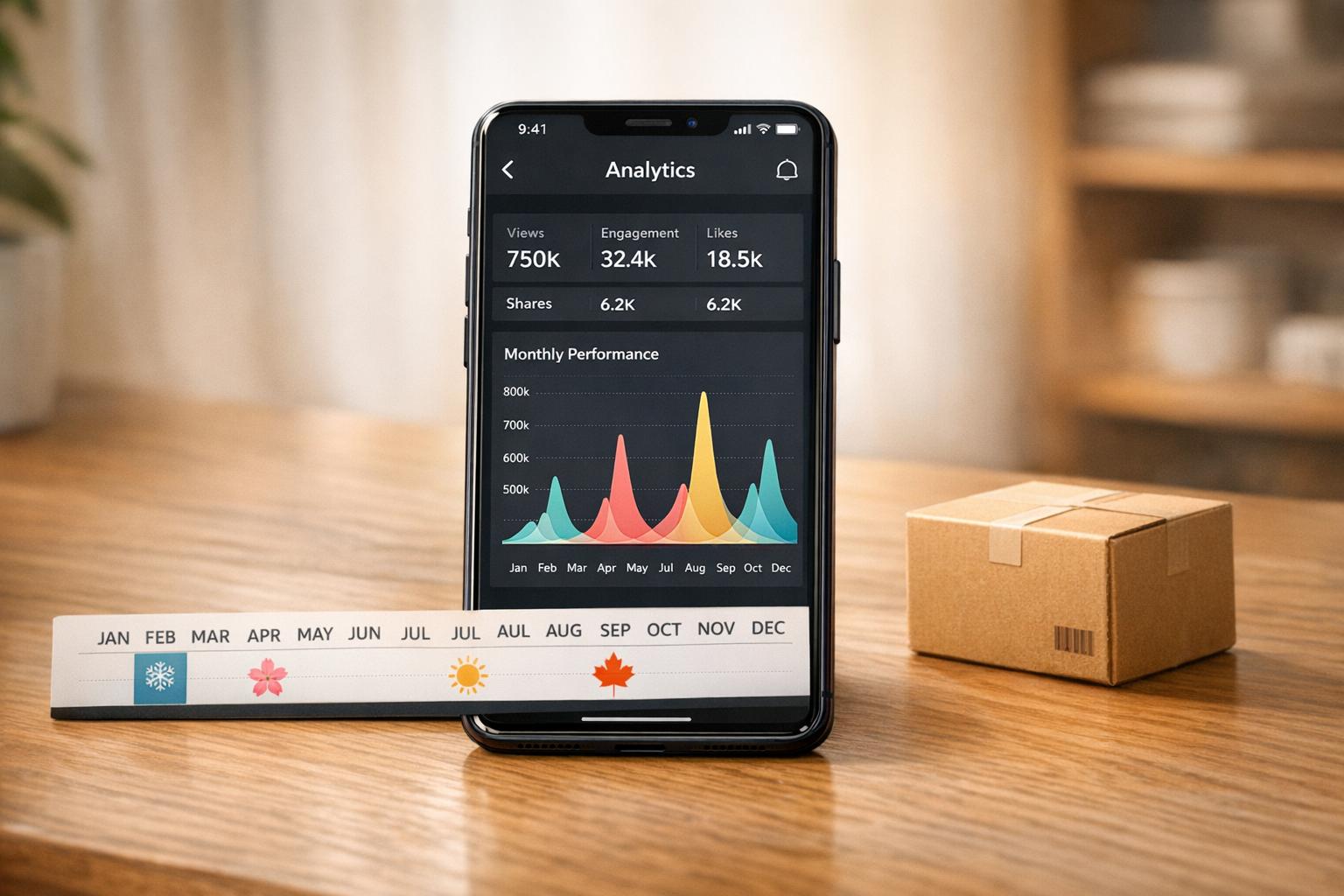
TikTok seasonality creates predictable shifts in shopping behavior tied to holidays and events, like Black Friday or mid-year sales. These patterns can drive massive sales spikes but also bring challenges like inventory issues and fluctuating demand. For example, TikTok Shop hit $100M in sales on Black Friday 2024, with 165% more shoppers compared to the previous year. Sellers who plan early, analyze trends, and diversify content can navigate these shifts effectively.
Key takeaways:
- Peak seasons (Q4 and holidays): High engagement and impulse buying, but intense competition.
- Off-peak months: Lower sales requiring engaging content like tutorials or live events.
- Challenges: Viral trends can strain inventory and fulfillment, while ad content needs constant updates.
- Solutions: Use TikTok analytics, start campaigns early, and maintain consistent posting to stay relevant year-round.
Brands that embrace TikTok’s seasonal trends and prepare ahead can turn these fluctuations into opportunities for growth.
How to Boost Sales This Holiday Season on TikTok Shop (2025 Strategy You Need NOW)
sbb-itb-e2944f4
The Problem: Sales Fluctuations Due to TikTok Seasonality
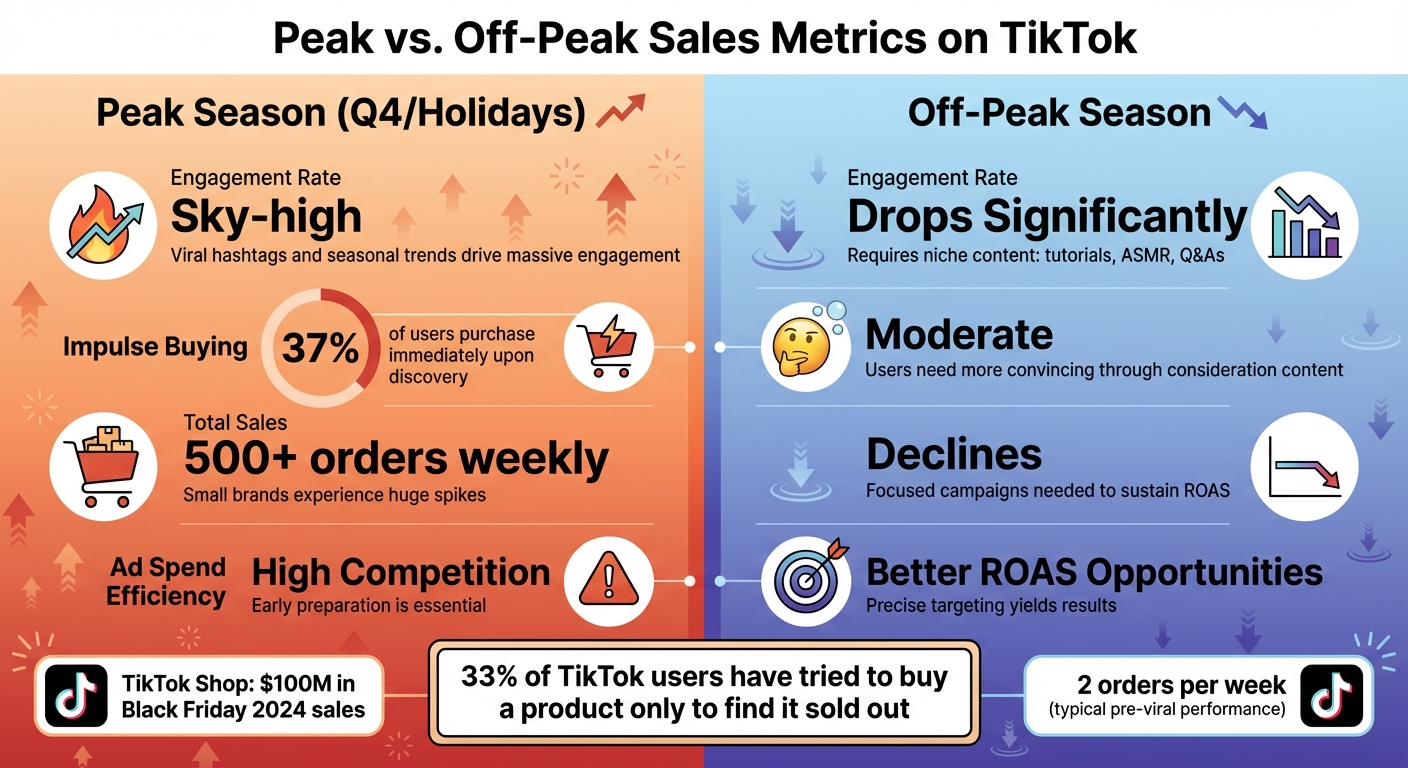
TikTok Peak vs Off-Peak Season Sales Metrics Comparison
TikTok’s unpredictable traffic patterns can wreak havoc on order volumes. Imagine going from just 2 orders a week to 500 after a viral video takes off. While this sounds like a dream, it often turns into a logistical nightmare. A staggering 33% of TikTok users have tried to buy a product only to find it sold out. That’s not just lost revenue – it’s also disappointed customers who may not return.
Adding to the complexity, product categories can shift in the blink of an eye. Take July 2025, for example: swimwear was trending at its peak with a scale index of 100, but then demand plummeted as audiences quickly turned their attention to fall apparel. If your inventory planning doesn’t account for these sudden changes, you’re left with surplus stock in declining categories and empty shelves for trending ones. For high-ticket items, maintaining sales during slower months often requires hosting live events or bundling products to entice buyers.
Peak vs. Off-Peak Sales Metrics
The difference between TikTok’s busy and quiet periods is dramatic. During high-demand times like Black Friday, 37% of users discover a product and want to buy it immediately. But during slower months, that urgency fades, forcing brands to pivot toward creating content like Q&As or tutorials to keep their audience engaged.
| Metric | Peak Season (Q4/Holidays) | Off-Peak Season |
|---|---|---|
| Engagement Rate | Sky-high due to viral hashtags and seasonal trends | Drops significantly; requires niche content like tutorials or ASMR to hold attention |
| Impulse Buying | Strong; 37% of users purchase immediately upon discovery | Moderate; users need more convincing through "consideration" content |
| Total Sales | Huge spikes, with small brands hitting 500+ orders weekly | Declines; requires focused campaigns to sustain ROAS |
| Ad Spend Efficiency | Intense competition; early prep is key | Better ROAS opportunities with precise targeting |
These metrics highlight the operational challenges of navigating TikTok’s erratic sales cycles.
Challenges for eCommerce Businesses
The "TikTok Feta Effect" is a perfect example of how unpredictable TikTok’s impact can be. Dasha Derkach, the founder of Enchanted Scrunch, saw her business explode from 2 orders per week to nearly 500 after incorporating daily TikTok Lives. While this surge was a huge win, it also brought significant challenges – fulfillment, customer service, and cash flow all came under intense pressure.
"Before TikTok, we got around two orders a week, then once we started… now we also do TikTok Lives nearly every day and get almost 500 orders a week!" – Dasha Derkach, Founder, Enchanted Scrunch
Advertising on TikTok adds another layer of complexity. To keep campaigns performing, brands need to refresh their creative assets every 7–10 days. This constant need for fresh content drives up production costs, even during slower sales periods. Plus, TikTok’s "infinite loop" model doesn’t follow a traditional sales funnel. You could invest heavily in August to build momentum for December, only to find that trends have shifted or your content didn’t land as expected.
These challenges reinforce the need for flexible, data-driven strategies to survive TikTok’s unpredictable landscape.
Strategies to Adapt to TikTok Seasonality
Using TikTok Analytics to Plan Seasonal Campaigns
Switching to a Business Account unlocks key analytics tools, allowing you to track video views, growth rates, and average watch times. This data helps you identify which content works best during specific seasonal periods. To keep engagement steady, TikTok suggests posting 1–4 times daily. The Trends page in the TikTok Creative Center is another goldmine, showcasing trending hashtags, sounds, and regional insights.
Once you’ve pinpointed what resonates, take advantage of the Pulse Suite’s "Seasonal Lineups" to position ads alongside trending holiday content as it gains traction. After running campaigns, dig into metrics like "Conversion Lift" and "Attribution Analytics", and use post-purchase surveys to gather direct feedback. These insights help fine-tune your approach to align with seasonal shifts.
Launching Early Campaigns for Holiday Peaks
Getting a head start on holiday campaigns can make all the difference. Consider the example of Canvas Beauty: during a Black Friday 2024 livestream, founder Stormi Steele generated an incredible $2 million in sales by combining exclusive holiday bundles with real-time engagement.
October events like Halloween are perfect for testing ad formats, gauging engagement, and refining discount strategies ahead of the November rush. To maximize sales, create "price ladders" with bundles priced under $25, $50, and $100, capturing a range of budgets while boosting Average Order Value. Pair TopView ads for wide reach with Focused View to engage high-intent shoppers. And since 90% of ad recall happens within the first six seconds, make those opening moments count. This early, strategic planning lays the groundwork for sustained success through the peak season.
Diversifying Content for Year-Round Engagement
Holiday campaigns may bring in big numbers, but consistent content keeps your brand relevant during quieter months. Going silent after the holiday rush isn’t an option. Take Maybelline Indonesia, for instance. During their "Pay Day" campaign in November 2024, they hosted a 6-hour LIVE shopping session, attracting over 42,000 viewers, driving 1,200+ purchases, and achieving a 1.64× ROAS. Their structured "Run-of-Show" included hooks, product demos, social proof, and urgency to keep viewers engaged.
In slower periods, experiment with different content styles: behind-the-scenes footage of product creation, action shots of your products, or lighthearted videos using trending soundbites. Since creative fatigue can hit within 48–72 hours, remix successful User-Generated Content by adding new angles, fresh text overlays, or shorter edits. Collaborating with creators through the Creator Marketplace is another smart move. With TikTok influencers averaging a 15.86% engagement rate, more than triple other platforms, these partnerships can keep your brand visible and engaging when organic reach matters most.
Emplicit‘s Role in Optimizing TikTok eCommerce Strategies
Custom Strategies for Seasonal Inventory and PPC Optimization
TikTok’s seasonal sales patterns can be tricky, but Emplicit has a plan to tackle them head-on. By focusing on early inventory preparation and automated PPC management, they help brands stay ready for demand spikes while ensuring smooth marketplace execution. For example, preparation for Q4’s busy period starts months in advance, so stock levels and advertising campaigns are ready to handle the rush.
Emplicit uses GMV Max campaigns, an AI-driven approach that optimizes targeting and creative delivery to boost gross merchandise value (GMV). These campaigns guide shoppers from discovery to purchase with tools like TopView, Focused View, and Smart+ Catalog Ads. A great example is James Allen, an online diamond retailer, which leveraged Smart+ Catalog Ads during Black Friday/Cyber Monday in November 2024. The result? A 127% jump in conversions and a 91% increase in return on ad spend (ROAS). Similarly, Mavwicks Fragrance saw impressive results with GMV Max campaigns and premium ad placements, achieving a 6× average ROI and 53% GMV growth.
To avoid stockouts during peak times like Black Friday/Cyber Monday (BFCM), Emplicit employs dashboards that calculate buffer stock. This proactive inventory management, combined with automated PPC strategies, ensures brands can meet seasonal demand without missing a beat.
But Emplicit’s expertise doesn’t stop there – they also excel at scaling TikTok Shops for greater marketplace success.
Scaling TikTok Shops with Marketplace Management
Emplicit takes TikTok Shops to the next level by focusing on scalable product listings. These listings are tailored for TikTok’s discovery-driven commerce, featuring video-first content, engaging product pages with at least five high-quality images or videos, and descriptions that highlight giftability during busy seasons.
To maintain momentum during peak periods, Emplicit schedules Shoppable Videos, ensuring a steady stream of content with up to five videos posted daily. They also manage affiliate and creator networks, tapping into TikTok’s community-driven culture for authentic promotions. Since 3 in 4 TikTok users are likely to purchase from brands they see on TikTok Shop, these partnerships can make a big difference.
Take MaryRuth Organics as an example. During the 2024 holiday season, their TikTok Shop strategy – guided by Emplicit – generated over 18 million impressions, a 304% increase in shop traffic, and a 246% rise in GMV. Emplicit also handles operational tasks like responding to comment surges and managing the Seller Center, so brands can scale confidently without sacrificing customer service during their busiest times.
Conclusion
Navigating TikTok seasonality requires consistent analysis and early preparation. As the TikTok Business Blog aptly states, "August is the new December", emphasizing that successful brands kick off their Q4 planning well in advance.
Take Black Friday 2024 as an example: TikTok Shop generated over $100 million in single-day sales and saw a 165% year-over-year growth in shoppers during the BFCM period. These numbers highlight TikTok’s growing role as a powerful commerce platform, rewarding brands that plan with precision.
Achieving success on TikTok means adopting a full-funnel approach. From building awareness and driving peak sales to engaging customers post-holiday, brands need to focus on consistent content (up to five shoppable videos daily), agile inventory management, and PPC strategies that adapt to shifting trends in late December. These tactics create the foundation for experts like Emplicit to deliver scalable results.
Emplicit’s approach addresses the challenges of fluctuating demand and inventory management through AI-driven GMV Max campaigns, proactive inventory strategies, and streamlined marketplace management. Their automated PPC optimization ensures brands can handle demand surges without running out of stock or overspending on ads.
Results speak for themselves: campaigns have achieved a 127% lift in conversions and a 6× ROI. By mastering TikTok seasonality and leveraging expert strategies, brands can turn seasonal challenges into opportunities for steady growth, ensuring their TikTok commerce efforts remain resilient and effective.
FAQs
How can brands manage inventory effectively during TikTok’s busiest seasons?
Handling inventory during TikTok’s peak sales times, like Black Friday and Cyber Monday, requires careful planning. Start by pinpointing products that have the potential to go viral and make sure they’re fully stocked ahead of these high-demand periods. TikTok’s inventory tools can be a game-changer here, allowing you to track stock levels in real time and make quick adjustments to avoid running out of your most popular items.
It’s also smart to plan and schedule your content, like shoppable videos, well in advance. This approach helps maintain a consistent sales flow without straining your inventory. And don’t forget the importance of smooth logistics and fulfillment processes – timely delivery plays a huge role in keeping customers happy during these busy times.
By preparing early, keeping a close eye on stock levels, and planning strategically, you can tackle TikTok’s seasonal sales rush with confidence.
How can I keep sales steady during TikTok’s slower seasons?
To keep sales steady during TikTok’s slower seasons, it’s important to mix up your content and advertising strategies. TikTok’s ad platform can help you run targeted campaigns that keep your brand visible and drive traffic, even during quieter times. Focus on creating engaging content that uses trending audio and tells a compelling story – this helps grab attention and keeps your audience interested.
You can also tap into seasonal events like Back to School, holidays, or big shopping days like Black Friday and Cyber Monday to create timely campaigns that boost sales. Building long-term partnerships with creators is another great way to keep your brand in the spotlight. Authentic, consistent content from creators can strengthen your presence and keep your audience connected throughout the year. With these strategies and some careful planning, you can handle seasonal dips and keep your sales on track.
How do viral TikTok trends influence eCommerce sales and customer satisfaction?
TikTok trends can send eCommerce sales into overdrive, often in the blink of an eye. When a product or brand catches fire through viral videos, challenges, or influencer partnerships, the ripple effect on sales can be massive. Picture this: a single trending moment could result in tens of thousands of units flying off the shelves almost instantly. While exciting, this kind of surge can put immense pressure on fulfillment operations.
The challenge lies in managing the sudden demand. Inventory can deplete quickly, warehouses may struggle to keep up, and shipping delays can become inevitable. Without the right systems in place, businesses risk stockouts or frustrated customers. To navigate these high-pressure moments, brands need to adopt real-time inventory tracking, ensure flexible logistics, and prioritize clear communication. Keeping customers informed about delays or stock levels can go a long way in preserving trust.
Staying on top of TikTok trends and reacting quickly is also crucial. Engaging with trending content and adjusting strategies on the fly can help brands meet expectations while riding the wave of viral success. While these trends offer incredible sales opportunities, they demand swift and smart planning to keep customers happy.