
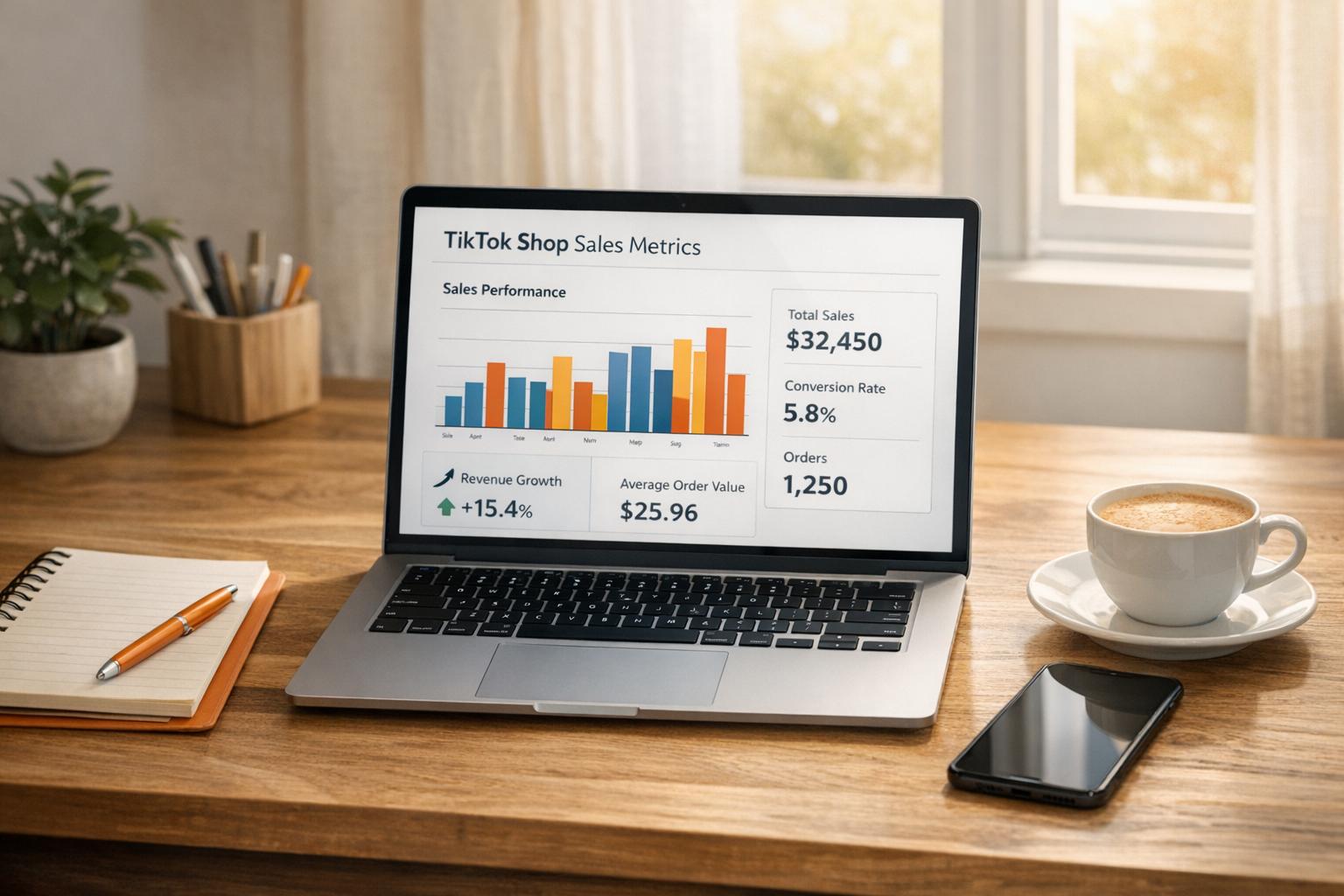
TikTok Shop has quickly become a major player in e-commerce, with projections showing it could hit $66 billion in marketplace size by the end of 2025. If you’re selling on TikTok, tracking your sales volume is critical. Here’s what you need to know:
- Gross Merchandise Value (GMV): Total sales before deductions. It shows consumer spending trends and is influenced by traffic, conversion rates, and average order value (AOV). Monitor weekly to spot trends.
- Net Sales: Revenue after returns and discounts. This reflects your actual earnings and highlights profit-impacting issues like high return rates.
- Orders and Units Sold: Tracks the number of purchases and items sold. This helps identify sales trends and manage inventory effectively.
Customer behavior metrics like AOV, conversion rates by traffic source, and repeat purchase rates also play a key role in understanding what drives sales. For example, TikTok LIVE shopping boasts an 8-12% conversion rate, far higher than other formats.
To improve sales, optimize product listings, leverage ads and influencers, and manage inventory carefully. TikTok’s fast-paced environment rewards sellers who analyze data regularly and adjust strategies based on performance.
Bottom line: Tracking the right metrics – like GMV, Net Sales, and AOV – helps you make smarter decisions, target the right audience, and grow your TikTok Shop effectively.
TikTok Shop Analytics Explained: Track Best-Selling Products
Core Sales Volume Metrics to Track
Keep an eye on three essential metrics to evaluate how well your TikTok Shop is performing.
Gross Merchandise Value (GMV)
GMV represents the total dollar amount of everything sold through your TikTok Shop before any deductions like returns or discounts. It reflects the total checkout value at the time of purchase.
Formula: GMV = Selling Price of Product × Number of Units Sold. For example, if you sell 500 beauty items at $25 each, your GMV would be $12,500.
Why is GMV important? It highlights actual consumer spending, not just engagement metrics like views. A million views mean little if they don’t convert into sales. In 2024, TikTok Shop achieved approximately $33 billion in global GMV, with $9 billion coming from the United States alone.
Ian Sells from JoinBrands emphasizes this point:
"Understanding TikTok GMV is the first step toward a crucial mindset shift. It’s about seeing the platform not just as a place for brand awareness, but as a powerful, direct-to-consumer sales engine."
GMV is influenced by three main factors: Shop Traffic, Conversion Rate, and Average Order Value (AOV). When your GMV increases, it’s a sign something worked – maybe a viral video, a successful creator partnership, or a live shopping event. Monitor GMV weekly to spot trends early and monthly for long-term planning. For newer brands, aim for a 10-20% month-over-month increase instead of fixating on a specific revenue number.
Once GMV is assessed, the next step is to analyze Net Sales for a clearer view of your profit.
Net Sales
Net Sales is the revenue you keep after deducting returns, refunds, and discounts. It’s essentially your GMV minus any deductions. For example, if your GMV is $12,500 but $1,200 worth of products were returned, your Net Sales would be $11,300.
This is your actual revenue. While GMV might look impressive, Net Sales reveals whether your business is genuinely profitable. High return rates can quietly drain your earnings, and GMV alone won’t flag this issue.
| Feature | Gross Merchandise Value (GMV) | Net Sales |
|---|---|---|
| Definition | Total value of goods sold at the point of sale | Total value after deductions for returns and refunds |
| Timing | Recorded at the time of transaction | Calculated after processing returns or refunds |
| Purpose | Reflects market demand and consumer interest | Shows actual revenue and profitability |
Tracking both metrics together is crucial. If your GMV is rising but Net Sales remains flat, you may have issues with product quality or customer satisfaction that need immediate attention.
Next, focus on orders and units sold to uncover sales trends and manage inventory effectively.
Orders and Units Sold
This metric tracks the total number of orders and units sold. For instance, if 200 customers each purchase 3 products, you’ll have 200 orders and 600 units sold.
These figures highlight your sales trends over time. A sudden surge in orders could indicate when a video went viral or an influencer’s post gained traction, enabling you to act quickly and adjust your content strategy if campaigns aren’t delivering results within the first few days.
Orders and units sold also play a vital role in inventory planning. Knowing which products are selling and at what speed allows for smarter restocking decisions. For newer brands, prioritize the growth rate of orders over absolute numbers – a steady 10-20% monthly increase signals positive momentum.
Customer Metrics That Affect Sales Volume

TikTok Shop Traffic Source Conversion Rates Comparison
Tracking sales figures is essential, but understanding why those numbers shift requires a closer look at customer behavior. By analyzing how your customers interact with your products, you can uncover the factors driving sales trends. Here are three key metrics that shed light on what influences buyer decisions on TikTok Shop.
Average Order Value (AOV)
AOV represents the average amount a customer spends per transaction. In 2024, the typical purchase on TikTok Shop in the U.S. was $59. This metric is important because increasing AOV directly boosts revenue without needing to attract more customers or increase order volume.
If your AOV is lower than you’d like – say, under $50 – consider strategies like bundling products or offering "buy more, save more" deals. These tactics can drive AOV up by 30-40%. For example, pairing complementary items or introducing discounts for larger purchases encourages customers to spend more in a single transaction, maximizing revenue per sale.
Conversion Rate by Traffic Source
Not all traffic sources are created equal when it comes to conversions. For TikTok Shop, the performance varies widely depending on the content type:
| Traffic Source | Benchmark Conversion Rate |
|---|---|
| LIVE Shopping | 8-12% |
| Short-form Videos | 2-4% |
| Shop Tab | 1.5-3% |
LIVE shopping leads the pack with conversion rates of 8-12%, while short-form videos and the Shop Tab deliver lower rates at 2-4% and 1.5-3%, respectively. These insights help you identify which channels are worth prioritizing. For instance, if LIVE shopping consistently outperforms other formats, it makes sense to allocate more resources to that channel.
To evaluate content effectiveness, aim for a click-through rate (CTR) of at least 2% and a view-through rate (VTR) of 30% or higher. Tools like TikTok Seller Center‘s Data Compass can further refine your strategy by analyzing revenue across Ads, Affiliate, and Non-Ads sources.
Repeat Purchase Rate
The repeat purchase rate measures how often customers return to buy again – a vital indicator of loyalty and long-term growth. In February 2024, TikTok Shop’s repeat customer rate soared to 81.3%, a significant jump from 64% in November 2023.
Repeat customers are gold for any business. They cost less to retain compared to acquiring new ones and typically contribute more to lifetime value. For consumable products, aim for a repeat purchase rate of 25-35%, while durable goods should target 15-25%. A high repeat rate signals that customers trust your brand and are satisfied with your products, creating a dependable revenue stream without relying on constant new customer acquisition.
sbb-itb-e2944f4
How to Improve TikTok Shop Sales Volume
Boosting your TikTok Shop sales starts with using your metrics wisely and implementing targeted strategies. Let’s dive into some practical ways to grow your sales.
Improving Product Listings
Start by refining your product listings based on sales data. Pricing matters – single items priced between $15–$49 and bundles in the $69–$99 range tend to increase your average order value (AOV). Choose compact products that creators can easily showcase in videos. Since TikTok limits product descriptions to 250 characters, every word needs to pack a punch. Use high-quality images and write concise, persuasive descriptions that highlight the key benefits of your products.
To make your listings more discoverable, focus on TikTok SEO. Add relevant hashtags, captions, and optimized video descriptions. Incorporating short-tail keywords in your hashtags helps align your products with trending topics. Social proof is another game-changer – actively encourage customer reviews and testimonials to build trust. With more people using TikTok for product searches, this step is essential.
Using TikTok Ads and Influencer Partnerships
Once your product listings are optimized, combine organic content with paid ads for maximum impact. Take inspiration from Love and Pebble’s Spark Ads campaign, which achieved a 3.2x return on ad spend (ROAS) and boosted sales by 1194% in July 2024. Their campaign generated over 240 conversions and 250,000 impressions, while cutting acquisition costs by 409%.
Affiliate marketing is another powerful tool. Offer creators a commission to promote your products, starting with an "Open Plan" at 10%, then adjusting to 1%–5% based on your profit margins. For paid ads, allocate a daily budget of at least $100 to give TikTok’s algorithm enough data to optimize your campaigns. During the first 14 days, use "Broad" or "Balanced" targeting to help the algorithm learn effectively.
Micro-influencers with 10,000–100,000 followers are especially effective, achieving an 18% engagement rate, which is 14% higher than similar influencers on Instagram. Test your content organically first, then amplify high-performing videos with Spark Ads. To maintain visibility, post at least two short videos daily and host live shopping sessions lasting 60–90 minutes, three to five times a week.
Managing Inventory Levels
Running out of stock during a viral moment can be a major setback. Use the TikTok Shop Inventory Dashboard to track stock levels and sales trends in real time. Set stock alerts for each SKU to ensure timely restocking. The "Suggested replenishment quantity" column in the Seller Center can help you determine how much inventory to order – check this daily in the "Manage Stock" section.
If a product sells out, redirect your ads to an alternative option immediately. For example, if a specific color is unavailable, update your product images to promote a different variation. For sellers managing inventory across multiple platforms, syncing tools can streamline data and shipping processes. Quickly deactivate listings for discontinued items to avoid customer dissatisfaction and protect your shop’s performance metrics.
Fast shipping is critical. TikTok buyers typically expect delivery within 2–5 business days, and failing to meet this expectation can harm your shop’s ratings.
Conclusion
Tracking sales volume metrics isn’t just about crunching numbers – it’s about building a reliable growth engine. By focusing on metrics like GMV, net sales, AOV, and conversion rates, you move beyond guesswork and start making precise, data-driven decisions that actually impact your bottom line.
These metrics go beyond surface-level insights. For instance, if you notice a drop in conversion rates at specific stages of the funnel, you can zero in on where shoppers are losing interest and take action to fix it. Similarly, keeping an eye on repeat purchase rates ensures you’re fostering long-term loyalty instead of just chasing one-off buyers. This kind of targeted strategy lays the groundwork for sustainable growth.
As Zorilla Marketing wisely put it:
"What gets measured gets improved."
This mindset doesn’t just help with immediate sales – it also shapes your future plans. By analyzing these metrics, you can forecast performance, allocate ad budgets more effectively, and determine when you’re consistently hitting a 3x+ ROAS, signaling that you’re ready to scale. Monitoring compliance metrics, like violation rates, is equally important to avoid setbacks like shop suspensions while keeping sales on track.
Leading TikTok Shop brands know the value of constant optimization. They analyze their data regularly, aim for view-through rates above 30%, and fine-tune campaigns in real time. With 43.8% of U.S. TikTok users expected to make at least one purchase in 2024, the potential is massive – but only for those who focus on the right metrics.
FAQs
How can I boost the Average Order Value (AOV) for my TikTok Shop?
Increasing your TikTok Shop’s Average Order Value (AOV) is a smart way to boost your revenue. When customers spend more per transaction, your profits grow without needing to attract additional shoppers. To make this happen, you can use strategies like bundling products, running targeted promotions, and encouraging higher spending with incentives.
One approach is to cross-sell and upsell by promoting complementary or premium products in your ads or livestreams. For example, you could create bundles like a skincare set or offer upgrades once someone adds an item to their cart. Dive into your sales data to find high-performing product combinations. Pair popular items with products that get lots of clicks but fewer sales to create “frequently bought together” bundles or offer tiered discounts like, "Buy 2 for $49.99."
Another way to increase AOV is by setting minimum-spend thresholds for perks like free shipping or exclusive rewards. For instance, offering free shipping on orders over $50 can encourage customers to add more to their carts. You can also offer limited-time gifts or loyalty rewards for higher-value purchases, giving shoppers that extra nudge to spend more.
If you’re looking for expert help, Emplicit’s ecommerce services can simplify the process. From crafting irresistible bundles and ads to tracking AOV trends and managing inventory, they can help ensure your TikTok Shop reaches its full potential.
How can I use TikTok influencers to increase sales on my TikTok Shop?
To effectively boost sales using TikTok influencers, it’s crucial to collaborate with creators who resonate with your target audience and reflect your brand’s values. Look for influencers who have genuine engagement and a strong connection with their niche. Micro-influencers, in particular, can deliver higher conversion rates thanks to the trust they’ve built with their followers.
Start by setting specific sales goals – whether it’s driving more clicks to your product pages or increasing checkout rates. Track key performance metrics like click-through rates (CTR), conversion rates, and return on ad spend (ROAS) to measure success. When working with influencers, provide clear guidelines, such as product links, suggested opening hooks, and essential brand messaging. At the same time, give them the creative freedom to craft content that feels organic to TikTok’s style.
Once your campaigns are live, use TikTok Shop analytics to track which influencers deliver the best results. Repurpose top-performing content across other platforms like social media, ads, or even email campaigns to maximize its impact. Building long-term partnerships with successful creators can help maintain growth and strengthen brand loyalty over time.
For a smoother workflow, consider tools like Emplicit. They specialize in creator discovery, campaign management, and real-time sales tracking, offering expert support to help you unlock the full potential of your TikTok Shop.
How can I manage inventory effectively during busy sales periods on TikTok Shop?
Managing inventory during high-demand periods on TikTok Shop takes a mix of strategy and flexibility to keep up with customer demand while avoiding excess stock. A great starting point is TikTok Shop’s Inventory Dashboard, which lets you track stock levels, sales patterns, and daily demand forecasts. To stay ahead, set up automated low-stock alerts for each SKU. These alerts notify you as soon as inventory dips below your set threshold, giving you enough time to reorder before running out.
TikTok’s demand forecasting tools can help you gear up for busy seasons like Black Friday. By pre-stocking with a safety margin of 10-20% above your expected demand, you can better handle surges in orders. For quick adjustments, TikTok’s bulk inventory tools allow you to efficiently update stock levels across multiple products. After big sales events, take time to review your inventory and, if necessary, reallocate stock between products to maintain balance.
For a more hands-off approach, you might want to explore working with Emplicit. They specialize in ecommerce services and can help you fine-tune your inventory management, ensuring you stay on top during hectic shopping seasons.