
TikTok Shop is transforming into a major e-commerce platform, driven by demographic changes and shifting user behaviors. Key highlights:
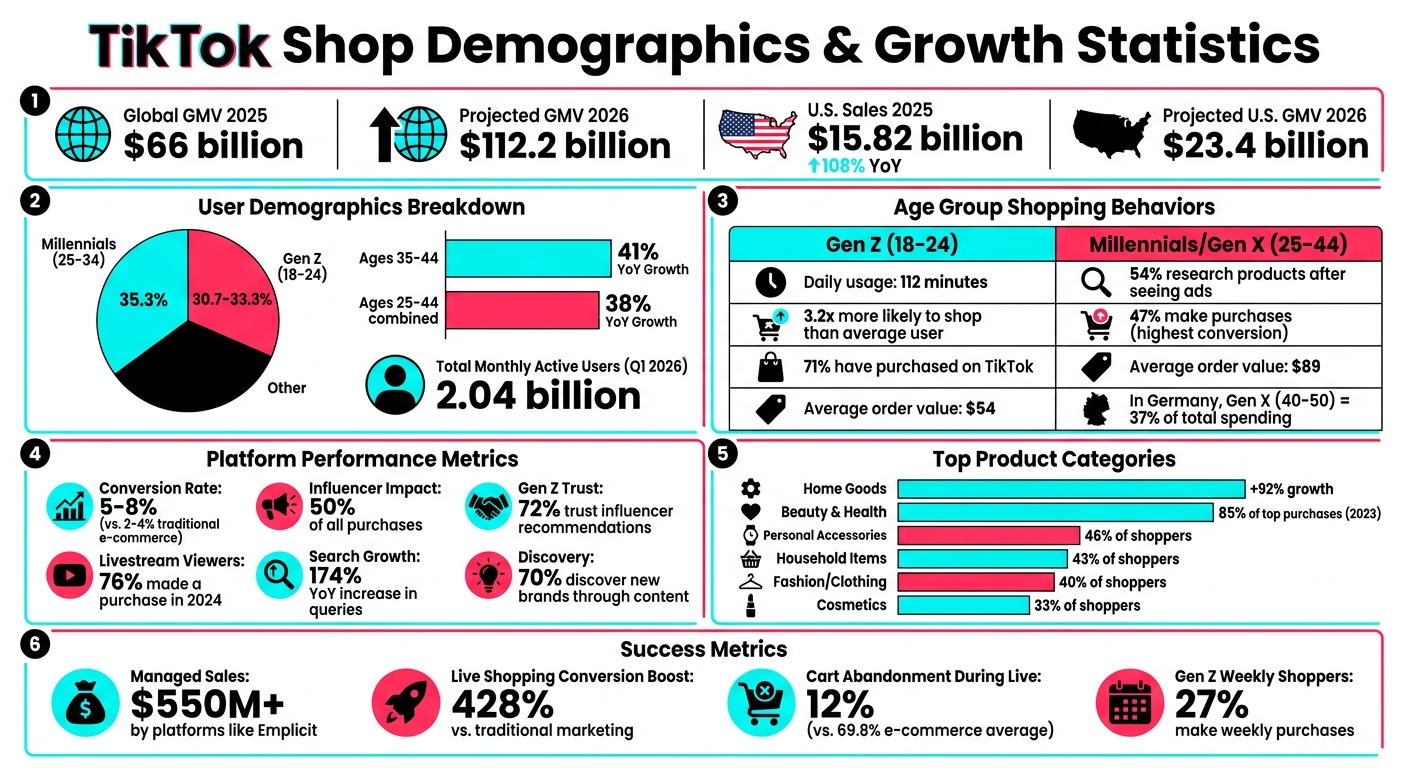
- Massive Growth: Global GMV hit $66 billion in 2025, projected to reach $112.2 billion by 2026. U.S. sales surged 108% YoY to $15.82 billion in 2025.
- Older Users Leading Growth: Users aged 25–44 grew 38% YoY, now the largest spending group. Gen X (40–50) accounts for 37% of TikTok Shop spending in Germany.
- Higher Conversion Rates: TikTok Shop boasts a 5–8% conversion rate, outperforming traditional e-commerce (2–4%).
- Top Categories: Home goods (+85%) and electronics (+92%) are the fastest-growing categories, reflecting older users’ preferences.
- Influencer Impact: Influencers drive 50% of purchases, with Gen Z and Millennials trusting creator recommendations more than traditional ads.
Brands are tailoring strategies to target diverse age groups, leveraging live shopping, creator partnerships, and discovery-driven content to maximize TikTok Shop opportunities. The platform’s evolution offers businesses new ways to connect with a broader audience and boost sales.
TikTok Shop Demographics and Growth Statistics 2025-2026
How TikTok Shop Became The Fastest Growing Social Media Shopping Platform
sbb-itb-e2944f4
How TikTok’s User Demographics Are Changing
TikTok has evolved into a platform that combines social search, e-commerce, and AI-driven discovery. With 2.04 billion monthly active users as of Q1 2026, its audience has shifted significantly from its early days, leading to noticeable changes in user behavior and shopping habits.
Millennials (ages 25–34) now make up 35.3% of TikTok’s audience, surpassing Gen Z as the platform’s largest demographic group. The 35–44 age group has seen a 41% year-over-year growth, and older users are increasingly turning to TikTok for product reviews, health tips, and shopping inspiration. Interestingly, 67% of Gen Z users now rely on TikTok as a search engine for reviews and recommendations before even considering Google, and this trend is beginning to influence older users as well. These shifts are reshaping how brands approach TikTok Shop strategies.
More Users Aged 25 and Older Are Joining TikTok
A closer look at TikTok’s older audience highlights their stronger purchasing power. Users aged 25 and older are twice as likely to have more than $2,500 in monthly disposable income compared to non-users, and 60% of them report making impulsive purchases, compared to 41% of non-users in the same age group.
Within TikTok Shop, the 25–44 age bracket emerges as the most lucrative segment. In this group, 54% of users research products after seeing ads, and 47% proceed to make a purchase. This makes them the age group with the highest conversion rate. As EMARKETER Editors observed:
"TikTok users ages 25-44 lead all age groups in taking action after seeing ads, with 54% gathering more info about products and 47% making purchases".
In Germany, Gen X shoppers (ages 40–50) contribute 37% of total spending on TikTok Shop, showing that older users are driving higher-value transactions beyond the platform’s typical viral, low-cost items.
How Gen Z Shopping Behaviors Are Evolving
Gen Z (ages 18–24) still plays a central role on TikTok, accounting for 30.7–33.3% of its users. They spend the most time on the app, averaging 112 minutes daily, and are 3.2 times more likely to shop on TikTok than the average user. Additionally, 27% of high-frequency social media shoppers who make weekly purchases belong to this group. However, their average order values remain lower due to limited disposable income.
This generation prioritizes authenticity, favoring creator-led content over traditional ads. A striking 78% of TikTok shoppers discover products through influencers, and 50% make purchases after watching livestreams. TikTok’s role as a search engine is also expanding, with search queries growing by 174% year-over-year.
These shifting behaviors across different age groups are redefining TikTok Shop’s long-term strategy, offering brands fresh opportunities to tailor their targeting and content strategies to a diverse and evolving audience.
Shopping Trends by Age Group on TikTok Shops
Product Categories That Drive the Most Sales
TikTok Shop has changed how people shop online. Instead of searching for specific products, users often stumble upon items they didn’t even know they wanted. This discovery-driven shopping behavior leads to unique preferences across different age groups.
In 2023, beauty and health products dominated, accounting for 85% of top purchases in the U.S.. By October 2024, standout items included perfumes (82,000 units sold) and T-shirts (60,000 units sold). Female Gen Z shoppers were especially active in the beauty category, purchasing at nearly three times the rate of their male counterparts. On the other hand, male Gen Z consumers leaned toward books, games, and electronics.
When looking at broader categories, personal accessories attracted 46% of all shoppers, household items appealed to 43%, fashion and clothing drew 40%, and cosmetics captured 33%. Millennials, in particular, showed interest in health, wellness, household goods, and accessories. Their buying habits often mix impulsive decisions with careful price research. Interestingly, luxury brands like Hermès, Chanel, Rolex, and Cartier have also found a place on TikTok Shop, primarily through pre-owned listings. These listings appeal to older users who value authenticity and certification.
Some products have become massive success stories. For example, Rotating Curling Irons amassed 1.3 million followers and brought in nearly $20 million in 2024. Similarly, beauty brands like Paradox and MadeByMitchel achieved sales of over $300 million and $30 million, respectively.
These trends highlight the importance of tailoring marketing strategies to specific age groups, especially as influencers continue to shape buying habits.
How Influencers Affect Different Age Groups
Influencers are a major force behind purchasing decisions on TikTok Shop, accounting for 50% of all purchases. However, their impact varies significantly across age groups.
For Gen Z, influencers hold incredible sway. A whopping 72% of Gen Z users trust product recommendations from influencers, and nearly one-third of their purchases come directly from influencer content. This trust translates into action: 71% of Gen Z users have purchased items they discovered on TikTok, with 47% completing their purchases directly through TikTok Shop.
Millennials also engage heavily with influencer-driven content. About 18% of millennials make between two and five purchases on TikTok Shop, and they’re willing to spend an average of $95 on a single product if it’s recommended by a trusted influencer. Claire Tassin, a Retail and E-commerce Analyst at Morning Consult, explained:
"Gen Z and millennials are high-volume shoppers and big spenders, especially in the kind of categories that tend to be promoted on social media, like apparel".
Gen X, however, remains more hesitant. While 63% of Americans under 60 take product advice from influencers, 85% of Gen Xers haven’t made a single purchase on TikTok Shop. Even when they discover products on the platform, 1 in 5 Gen X users opts to buy elsewhere due to concerns about checkout security.
Across all demographics, authenticity plays a key role. In 2024, 76% of livestream viewers made a purchase, and 60% of users said they trusted a product more when introduced by a creator rather than through a brand ad. However, not all experiences are positive – 23% of shoppers reported regretting purchases due to poor quality or misleading influencer promotions. This highlights the importance of building genuine partnerships between creators and brands to maintain trust and satisfaction.
How Brands Can Adapt to TikTok Shops’ Demographic Changes
Creating Age-Specific Campaigns and Product Listings
TikTok’s audience isn’t just about Gen Z anymore. Between 2023 and 2026, the platform saw a massive rise in users aged 30 and older, with the 40–49 group growing by 120% and the 50+ group by 240%. This demographic shift means brands must adapt their strategies to cater to how different age groups interact with content.
- Gen Z loves fast-paced, trend-driven content that entertains before selling. Think memes, trending audio, and quick product reveals. Tools like In-Feed Ads and Branded Hashtag Challenges work well for this audience.
- Millennials respond to value-driven content with clear benefits and social proof. Tutorials and problem-solving formats are effective, making In-Feed Ads and Collection Ads ideal.
- Gen X prefers slower, more educational content that prioritizes credibility. Straightforward messaging paired with In-Feed Ads and Carousel Ads resonates best with this group.
For instance, a home decor brand shifted 40% of its Meta budget to TikTok, focusing on authentic, behind-the-scenes content shot on an iPhone. The result? Their customer acquisition cost dropped from $55 to $32, and their return on ad spend (ROAS) jumped from 2.4x to 3.9x in just 90 days. Native, relatable content consistently outperforms polished ads. Reviews, routines, and styling hacks often feel more genuine and drive better engagement.
Interestingly, users aged 30–44 have the highest average order value at $89, compared to $54 for the 18–24 group. This means brands should consider creating exclusive TikTok bundles for higher-priced items to justify their value and offset shipping costs. Since most TikTok Shop purchases fall between $25 and $60, offering deals in this range can also boost sales.
Once your campaigns are tailored to these age groups, you can amplify engagement with livestream shopping.
Using Livestream Shopping and Genuine Content
Livestream shopping isn’t just a passing fad – it’s a powerhouse for driving conversions. Brands using live shopping have reported a 428% increase in sales conversion rates compared to traditional social marketing. Even cart abandonment rates drop significantly during live events, falling to just 12% versus the e-commerce average of 69.8%.
Timing is key. Schedule your livestreams during peak hours – typically 7–10 PM local time – and aim for Thursdays, which tend to see 67% more engagement than other weekdays. Sessions should last 45–90 minutes for solid engagement or 2–4 hours for maximum reach within the algorithm. Use a "Run-of-Show" format to keep the energy high: start with an attention-grabbing hook in the first five minutes, incorporate polls or Q&A every 10 minutes, and drop limited-time flash deals to create urgency.
Take Coastal Threads as an example. This fashion retailer embraced live commerce and saw a 670% increase in monthly revenue in April 2026. Weekly sessions generated $47,000 in sales per hour with a 34% conversion rate. Sarah Chen, the brand’s founder, explained:
"Customers can ask questions about fit, see products in different lighting, and get immediate responses. It’s like having a personal shopping experience at scale."
To ensure authenticity, provide creators with "product pillars" (key benefits and hooks) rather than rigid scripts. A beauty subscription box, for instance, switched from scripted ads to user-generated unboxing videos featuring real customer reactions. This change boosted their month-two retention rate from 42% to 58% and reduced refund rates from 18% to 9%.
Aligning Inventory and PPC with Demographic Patterns
After fine-tuning your creative strategies, aligning inventory and PPC campaigns ensures a smooth customer experience. TikTok Shop thrives on discovery rather than search. Unlike platforms like Amazon, where shoppers often know what they want, about 70% of TikTok users discover new brands through engaging content. This means your PPC strategy should focus on creating intent, not just capturing it.
Structure campaigns like a funnel:
- Use educational content for top-of-funnel awareness.
- Showcase product demos to engage mid-funnel audiences (e.g., viewers who watch 25% or more of your video).
- Add urgency messaging to recapture users who abandoned their carts at the bottom of the funnel.
Behavioral targeting works better than basic demographics. Focus on categories like "Shopping behaviors", "In-market audiences", and "Engaged shoppers". Also, build Lookalike Audiences from your TikTok Shop customers, using 1% similarity for scaling and 3% for higher-quality targeting.
Fresh content is essential. TikTok’s algorithm favors new material, so refresh winning ads every 14–21 days and test new creative weekly. Spark Ads, which amplify organic creator content, often lead to a 34% lower cost per acquisition compared to traditional in-feed ads. When launching new campaigns, start with a "Lowest Cost" bidding strategy to gather data for 7–14 days (aiming for 50+ conversions) before transitioning to "Target Cost" for more stable results.
Inventory management is just as critical. Use direct integrations with platforms like Shopify, BigCommerce, or Salesforce to sync inventory automatically and avoid overselling during viral spikes. Leveraging "Fulfilled by TikTok" (FBT) can boost rankings in search results and secure next-day delivery badges, both of which are crucial for converting high-intent shoppers. Lastly, plan your inventory around TikTok’s promotional calendar – events like "Deals for You Days" and "Back to School" drive significant traffic, so preparation is key.
For example, a pet food brand used educational "Day 1 to Day 30" transformation videos tied to TikTok Shop. Over six months, they achieved a $24 customer acquisition cost (compared to the $41 industry average) and a 4.2x ROAS, with 83% of sales happening directly through TikTok Shop. Combining tailored campaigns, strategic livestreaming, and precise inventory management allows brands to fully embrace TikTok Shops’ evolving demographics.
How Emplicit Helps Brands Succeed on TikTok Shops

Thriving on TikTok Shops requires brands to stay ahead of shifting demographics and evolving shopping habits. Emplicit supports this effort with its 4D Plan Framework:
- Diagnose: Pinpoint growth challenges.
- Design: Develop a custom roadmap with 67 strategies.
- Deploy: Implement targeted marketing campaigns.
- Dominate: Expand into new products and marketplaces.
This structured method has helped drive over $550 million in managed sales and supported more than 40,000 unique products across various marketplaces.
To connect with TikTok’s discovery-driven audience, Emplicit focuses on storytelling campaigns and tiered affiliate programs that reward top creators. This "creator-first" strategy is key to engaging the growing 25–44 age group, which has expanded by 38% year-over-year and leads all demographics in taking action. By building long-term partnerships with creators who resonate with specific audiences, Emplicit helps brands foster authentic connections with their target demographics.
Emplicit also tackles the technical side of scaling on TikTok Shops with full-service store management. Their services include:
- Integrated inventory and account health management to avoid suspensions.
- Optimized PPC campaigns tailored for discovery, live engagement, and retargeting.
- AI-driven budget allocation for maximum efficiency.
With over $100 million in managed ad spend, Emplicit uses data-driven insights to fine-tune campaigns, ensuring brands reach the right customers and achieve strong ROI.
"Unlock rapid marketplace growth: Identify unique opportunities, optimize your product selection, pricing, logistics, customer support, and tracking processes for maximum success." – Emplicit
Emplicit’s expertise extends beyond TikTok Shops, helping brands scale across multiple marketplaces. By offering seamless transitions from platforms like Amazon to TikTok Shops, Walmart, and Target, they enable brands to diversify and adapt to changing market trends. This approach is particularly valuable as categories like electronics and home goods continue to grow by 92% and 85% year-over-year, respectively.
With USA-based account managers and top-tier talent specializing in TikTok Shop strategies, Emplicit equips brands to capitalize on market shifts without needing to build an in-house team. Their comprehensive, data-focused solutions empower brands to thrive in a competitive, ever-changing landscape.
Conclusion
TikTok Shop is projected to reach $23.4 billion in US GMV by 2026, fueled by shifting demographics that are transforming the social commerce landscape. Once dominated by Gen Z, the platform has grown into a retail hub attracting Millennials and Gen X, who are becoming significant contributors to spending. With the 25–44 age group growing by 38% year-over-year and nearly half (47%) of this segment making purchases after seeing ads, TikTok Shop is now a marketplace catering to a variety of age groups, each with its own shopping habits.
To thrive in this environment, brands need to focus on content-driven discovery and genuine collaborations with creators. As Vitalii Khyzhniak, Head of Social Shopping at Teikametrics, explains:
"Success requires creating intent through content, not capturing existing demand through search".
This strategy involves aligning inventory with consumer trends and using live shopping events to engage audiences where they spend the most time.
Top-performing brands are already tailoring their efforts by matching creator audiences with specific product demographics, syncing campaigns with promotional schedules, and using data to fine-tune their approaches. With 70% of TikTok users discovering new brands through the platform’s content and 58% shopping directly on it, the potential for growth is undeniable.
Brands that adapt to these shifting behaviors – whether it’s Gen Z’s preference for raw, unfiltered content or Gen X’s interest in premium products – stand to gain a competitive edge. The real question isn’t whether to invest in TikTok Shop, but how quickly brands can align with these powerful demographic trends. Staying ahead will require constant evolution to meet the ever-changing needs of the marketplace.
FAQs
Why are older shoppers driving TikTok Shop growth now?
TikTok Shop isn’t just for the younger crowd anymore. Adults aged 25 and older are becoming a major force behind the platform’s growth. Recent studies reveal that this age group now makes up a large chunk of TikTok’s user base. Even more interesting? Gen X and Baby Boomers are diving into social commerce on the app.
Brands have taken notice. They’re tapping into the spending power of these older demographics, who are playing an active role in TikTok Shop’s rising popularity. This shift shows how TikTok is evolving to cater to a broader audience.
What should brands change to sell to Gen Z vs. Millennials vs. Gen X?
Brands need to align their strategies with the shopping preferences of each generation on TikTok.
Gen Z gravitates toward content that feels genuine and keeps up with trends. They’re also drawn to live streams and prioritize fast shipping when making purchases.
Millennials appreciate content that feels relatable and builds trust. They value a smooth and hassle-free shopping experience, making convenience a key factor.
Gen X is more likely to engage with campaigns that highlight product dependability and make the buying process straightforward.
To connect effectively, tailor your content: use short, snappy videos for Gen Z, share informative and relatable posts for Millennials, and adopt a multi-channel approach to reach Gen X. These adjustments can lead to better engagement and increased sales.
How can brands prevent stockouts when a product goes viral on TikTok Shop?
To handle stockouts during sudden demand spikes, brands should rely on a specialized inventory system and include buffers when allocating inventory. Even if a product goes out of stock, it’s important to keep listings active to retain engagement data and maintain ranking. Using a hybrid fulfillment model – combining Fulfilled by Amazon (FBT) and Fulfilled by Merchant (FBM) – can help mitigate delays in FBT processing. Additionally, real-time demand tracking and dynamic inventory adjustments are key strategies for staying prepared for unexpected surges.