
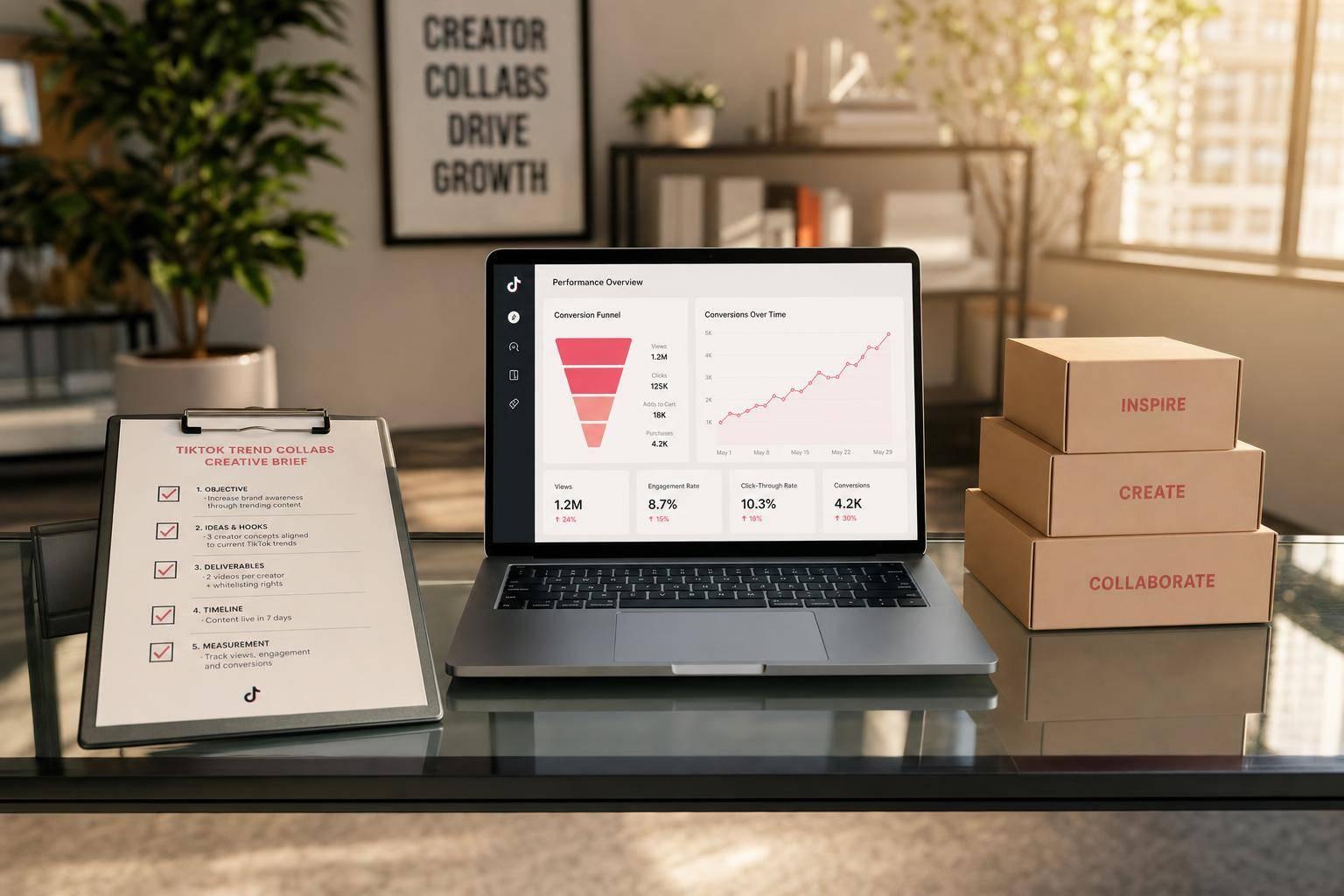
TikTok trend collabs can drive sales fast, but only if I move fast, pick the right creators, and set up tracking before the first post goes live. TikTok drove product discovery for 63% of surveyed consumers, and 80.4 million U.S. users use TikTok Shop. That means the upside is there, but trend windows are short.
If I had to boil the article down, it comes to this:
- Pick trends by fit, not hype
- Work with creators who post well and post often
- Use a short brief with fixed rules and room for the creator’s own style
- Set FTC disclosures, product tags, affiliate links, and UTMs before launch
- Scale only posts that show watch time, clicks, orders, and ROAS
- Run trend tests in 2- to 4-week sprints and log what won
A few details matter more than most:
- The first 6 seconds do a lot of the work for recall
- Paid support often starts around $50 to $200 per post for 3 to 5 days
- Average TikTok Shop commission across categories is about 13.02%
- Beauty may land at 15% to 30%, while electronics may sit closer to 5% to 10%
Here’s the simple takeaway: I shouldn’t treat trend collabs like slow brand campaigns. I should treat them like short sales sprints with clear rules, clean tracking, and daily review.
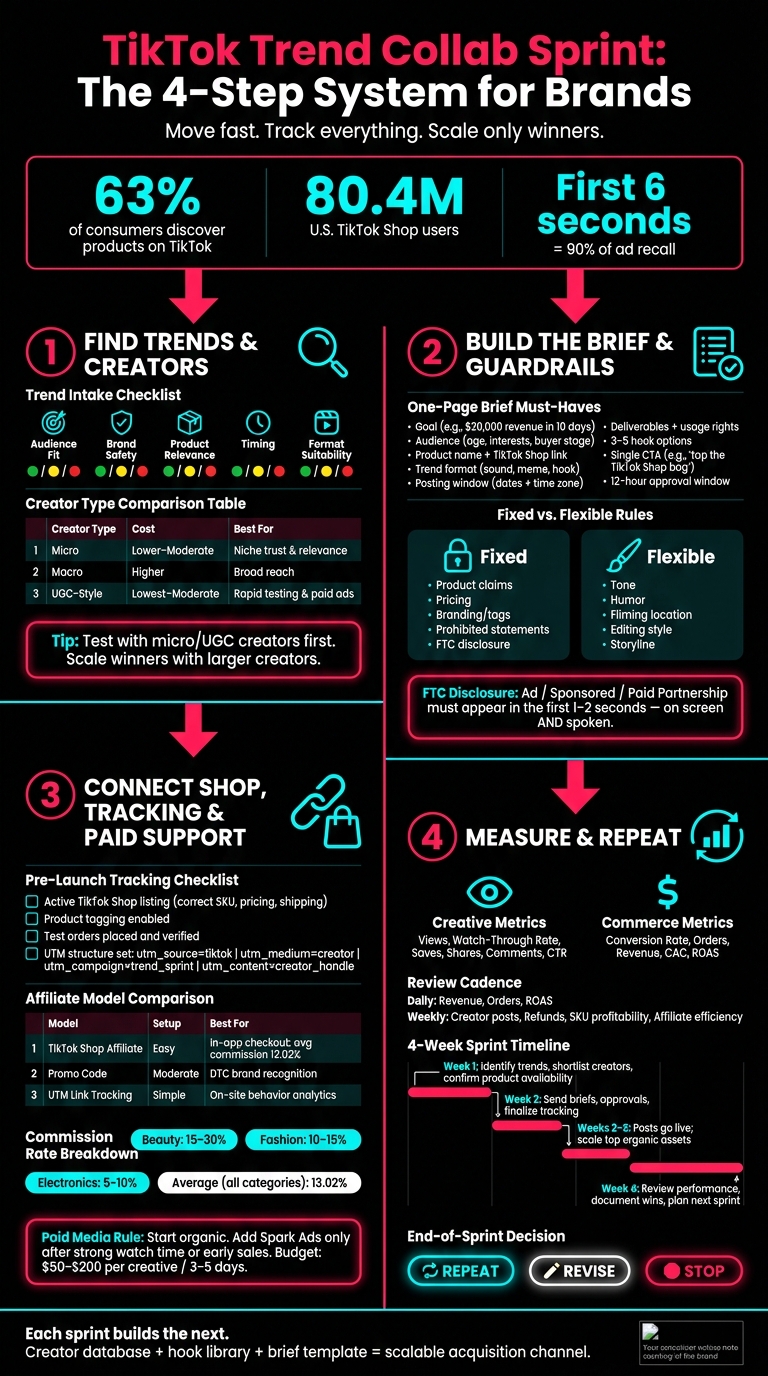
TikTok Trend Collab Workflow: 4-Week Sprint System for Brands
1. Find Trends and Creators That Fit the Brand
Spotting a trend early is only half the work. The brands that do well on TikTok make a same-day call on whether a trend is worth chasing. That starts with a simple intake process.
Review Trends With a Simple Intake Process
Watch the For You feed, search, TikTok Creative Center, sound pages, niche hashtags, and category communities. Have one team member gather trend ideas, then review them the same day with a short checklist.
A simple checklist should cover five filters:
- Audience fit – Do the people watching this trend line up with your target shopper?
- Brand safety – Could the humor, language, or social context put your reputation at risk?
- Product relevance – Can the product show up in a natural way, or does it feel jammed in?
- Timing – Are you early enough to act, and will the trend stick around long enough to make the content?
- Format suitability – Does the trend fit short-form video, demo-led content, voiceover, transitions, or creator narration?
Score each one as green, yellow, or red so weekly decisions stay fast. If a trend needs a long approval process, it’s usually smarter to pass unless it’s already showing staying power across several creators.
Source and Vet Creators for Speed, Fit, and Performance
Use four sourcing channels: TikTok Creator Marketplace, affiliate creator pools, UGC-style creators, and direct outreach to creators already posting in the trend. If speed matters most, direct outreach and affiliate pools are usually the fastest options because those creators already know how to make TikTok-native content. Creator Marketplace works better when you want more structured vetting and audience data.
The data that matters most isn’t follower count. It’s average views per post, steady engagement over time, comment quality, and posting cadence. Look at a creator’s last 20 to 30 posts and check whether results are consistent or propped up by one outlier. In most cases, a creator with steady output and strong niche fit will beat someone who had one big viral hit.
Before you reach out, check disclosure habits too. Creators who already label sponsored content clearly – paid partnerships, affiliate links, gifted products – are easier to scale in a compliant way and less likely to create FTC issues later.
Choose the Right Creator Type for the Goal
The right creator depends on the goal: speed, reach, or conversion.
| Creator Type | Cost | Turnaround Speed | Best for |
|---|---|---|---|
| Micro creators | Lower to moderate | Fast | Niche relevance and trust |
| Macro creators | Higher | Slower to moderate | Reach; less efficient for testing |
| UGC-style creators | Often lowest to moderate | Fastest | Rapid content testing and paid amplification |
A smart way to handle this is to test a trend idea with smaller creators and UGC-style creators first. If the format works, then put more budget behind the top version with a larger creator. That keeps testing costs in check and helps you avoid spending big on a format that hasn’t proved itself yet.
Keep a running shortlist of creators by category, content style, and average turnaround time. That way, your team isn’t starting from scratch every week. Once that list is in place, the next step is the brief, content rules, and compliance guardrails.
2. Build the Brief, Content Rules, and Compliance Guardrails
Once your creator shortlist is set, send a one-page brief so people can start that same day.
Write a Trend Collab Brief Creators Can Act On Quickly
The brief shapes the work. Keep it short enough to cut down on back-and-forth, not cause more of it.
Each brief should include:
- Goal – for example, drive $20,000 in TikTok Shop revenue in 10 days
- Audience – age range, interests, and buyer stage
- Product – name and direct TikTok Shop link
- Trend format – sound, meme, hook, or structure
- Posting window – dates and time zone, for example, July 15–24, ideally 5–9 p.m. PT
- Deliverables – number of videos, formats, and any repurposing rights
- Usage rights – what the brand can do with the content after posting
- Hooks – 3–5 opening lines tied to the trend
- CTA – end with one CTA, such as "tap the TikTok Shop bag"
- Approval window – such as 12 hours
TikTok research found that around 90% of ad recall comes from the first six seconds of a creator ad. That’s the part to sweat. If the opening lands, the collab has a shot. If it doesn’t, the rest of the video may not matter much.
For approvals, greenlight the first post, then let the creator keep posting within the same rules. The sweet spot is simple: keep the brief tight, split out the non-negotiables, and leave room for the creator’s own delivery so the content still feels native.
Set Content Rules Without Hurting Performance
The big mistake here is over-scripting. When a brand controls every line, creators stop sounding like themselves. The video starts to feel like a TV ad, and watch time can fall.
Use rules to protect the brand. Let the creator handle the delivery. In plain English: decide what must stay fixed and what they can shape on their own.
| Rule Type | Mandatory (Fixed) | Flexible (Creator-Controlled) |
|---|---|---|
| Product claims | Must stay within approved claims – for example, supports healthy-looking skin, not cures eczema overnight. | Creators can describe their own experience as long as it doesn’t conflict with approved claims – for example, My skin felt more hydrated in a week. |
| Pricing and offers (USD) | Use accurate U.S. prices, discounts, and end dates – for example, $29.99, 20% off through July 31, 2026. | Creators can decide whether to mention price at all; some trend formats perform better focusing on transformation or emotional payoff. |
| Branding and tags | Use the correct brand name, required hashtags, and any required brand or TikTok Shop tags. | Tone, slang, and humor style are fully creator-led within brand safety rules. |
| Prohibited statements | No health claims, income claims, guarantees, or competitor attacks. | Creators can improvise storylines, characters, and transitions as long as they avoid the prohibited categories. |
| Visual identity | Product must stay clearly visible; avoid misleading before-and-after edits or heavy retouching. | Filming location, outfit, props, and editing style are up to the creator. |
| Disclosure | FTC-compliant disclosure and TikTok’s branded content/commercial content toggles are required on every sponsored or affiliate post. | Exact phrasing can be in the creator’s own voice as long as it’s clear and conspicuous. |
Once those rules are set, formalize disclosure so approvals can move fast.
Handle FTC Disclosure and Platform Compliance in the U.S.
Every sponsored or affiliate post in the U.S. must disclose any material connection – payment, free product, commissions, or gifts. That disclosure should show up in the video itself, close to the beginning, using clear labels such as Ad, Sponsored, or Paid partnership. It should not be buried in a caption or tucked into a bio.
For TikTok Shop affiliate content, creators should also make it clear that they earn a commission when someone buys through the featured product or link.
Turn on TikTok’s commercial-content disclosure on every sponsored or affiliate post. Then pair that platform toggle with on-screen text in the first 1–2 seconds and one spoken line – for example, This video is sponsored by [Brand] or I earn a commission through TikTok Shop.
Pre-approved disclosures help avoid last-minute rewrites and keep trend windows from slipping away. For health, beauty, finance, and transformation claims, add a Red Lines section to every brief. Spell out banned phrases – such as cures, reverses aging, or guaranteed results – and pair them with approved swaps, such as supports healthier-looking skin or helps you feel more organized.
If the product touches medical outcomes, require an on-screen disclaimer: Results may vary. Not intended to diagnose, treat, cure, or prevent any disease. One simple rule helps here: If you’re unsure whether a claim is allowed, ask us before filming.
Once the brief is approved, lock in tracking before the first post goes live. With the brief and guardrails in place, connect each post to Shop, affiliate tracking, and paid support before launch.
sbb-itb-e2944f4
3. Connect TikTok Shop, Affiliate Tracking, and Paid Support
Set Up TikTok Shop, Affiliate Links, and Tracking Before Launch
Once the brief is approved, tracking becomes the next checkpoint. First, confirm TikTok Shop approval, bank setup, and tax details. A video can blow up and still drive $0 in sales if the product tag points to an out-of-stock listing or the wrong SKU.
Begin with your TikTok Shop product catalog. Every featured product should have:
- an active listing
- correct U.S. pricing
- clear shipping and return terms
- vertical assets that fit the trend format
Then turn on product tagging so creators can attach shoppable anchors right inside videos and lives. For hero SKUs, map them by hand to avoid tagging mistakes. Before anything goes live, place test orders through both creator links and product tags. Check that purchase events fire as expected, the correct SKU shows up in TikTok’s commerce reporting, and attribution lines up with what you planned.
For DTC traffic, set a consistent UTM structure before creators get the brief. One clean setup looks like this: utm_source=tiktok&utm_medium=creator&utm_campaign=trend_sprint&utm_content=creator_handle. That gives you a clean way to track creator conversion rates in analytics and compare them with TikTok Shop sales in the commerce dashboard. If your pixel has gaps, fix them now.
Choose the Right Affiliate Setup for Margin and Data Quality
Pick the setup that matches your margins, reporting needs, and channel mix. Make that call before creators post so links, codes, and commissions stay aligned.
| Affiliate Model | Ease of Setup | Reporting Visibility | Creator Experience | Margin Impact |
|---|---|---|---|---|
| TikTok Shop Affiliate | High once shop is approved | Strong in-platform reporting for orders, creators, and SKUs | Frictionless; creators tag products and earn automatically | Commission on TikTok Shop orders; offset by reduced site overhead |
| Promo-Code-Based Affiliate | Moderate; requires code generation and backend mapping | Good for DTC; less visibility for in-app sales | Clear at checkout; creators like a signature code | Discount plus commission can double margin impact; model carefully |
| Link-Based Tracking (UTMs) | Simple to generate; enforcement with creators can be inconsistent | Strong in analytics for on-site behavior; weaker for in-app purchases | Requires specific links; can be clunky in bios | No automatic discount; margin impact limited to commission and ad spend |
Most brands end up with a hybrid setup. That usually means TikTok Shop affiliate for smooth in-app checkout, plus creator-specific promo codes and UTM-tagged links for DTC sales where first-party customer data matters more.
Commission rates vary by category, so don’t guess. In the U.S., the average across TikTok Shop categories is about 13.02%. Beauty often lands at 15–30%, fashion at 10–15%, and electronics at 5–10% because margins are tighter. TikTok Shop also lets you set a separate lower commission for ad-driven orders. For example, you might pay 10% on organic creator sales and 5% when paid Shop Ads are layered on top. That helps you avoid paying full affiliate rates on conversions your ad budget already helped drive.
Add Paid Media Only Where It Improves Results
Paid support should come in only after tracking is live. Start with organic. Let the algorithm show you what has traction before you spend.
Put paid support behind posts that already show strong watch time, click-through rate, or early sales. That’s usually when Spark Ads make sense. They boost the creator’s existing post instead of sending traffic to a separate ad, so the likes, comments, and shares stay attached to the original video.
A practical starting point is $50–$200 per creative for 3–5 days. Then scale only the posts that hit your cost-per-purchase target.
For creative testing, change one variable at a time. Test hooks in the first 2–3 seconds first, such as a bold claim, a problem statement, or a visual demo. Then test CTAs, like direct purchase, a discount code, or an engagement prompt. After that, test product angles, such as time-saver, aesthetic upgrade, or social proof. Keep budgets and targeting the same across variants. Around $50 per variant is enough to get directional data.
4. Measure Results and Build a Repeatable Workflow
Once posts are live, the job shifts from launch to measurement.
Track Creative Metrics and Commerce Metrics Together
Don’t judge trend collabs on views alone. Views can tell you people noticed the post. They don’t tell you if the post sold anything.
Put creative metrics and commerce metrics in the same view so you can see what happened from first impression to purchase.
| Metric type | What to track | What it tells you |
|---|---|---|
| Creative | Views, average watch time or watch-through rate, saves, shares, comments, CTR | Whether the hook, format, and trend fit are landing |
| Commerce | Conversion rate, orders, revenue, CAC, ROAS | Whether the content is actually driving profitable sales |
Use creative metrics to improve the idea. Use commerce metrics to decide whether to scale it.
A simple example: if watch-through rate is strong but CTR is weak, the issue is often the CTA or the offer, not the content itself. If CTR is strong but conversion rate is low, that usually points to landing-page friction or a pricing problem.
TikTok also tends to assist the sale instead of closing it on the spot. That’s why attribution needs a wider view. Use longer attribution windows and incrementality tests. Last-click data undercounts creator-driven purchases.
Review revenue, orders, and ROAS daily. Review creator posts, refunds, SKU profitability, and affiliate efficiency weekly. After each sprint, write down what worked: winning creators, hooks, formats, and offers.
Then use that record to decide what moves into the next sprint.
Run a 2- to 4-Week Trend Sprint Workflow
A sprint works best when each stage has a clear owner and a set timeline. Here’s what a clean 4-week sprint looks like:
| Week | Activity | Owner(s) |
|---|---|---|
| Week 1 | Identify trending formats, shortlist creators, confirm product availability | Marketing + Ecommerce |
| Week 2 | Send briefs, collect drafts, run approvals, finalize tracking setup | Marketing + Ecommerce + Analytics |
| Weeks 2–3 | Posts go live; scale the strongest organic assets | Media Buying |
| Week 4 | Review performance, document wins, plan the next sprint | Analytics + Marketing |
End each sprint with three decisions:
- Repeat
- Revise
- Stop
That debrief is what turns a one-off trend test into a workflow your team can run again and again.
Conclusion: The Core System Brands Should Repeat
Use the same loop each time: find trends early, vet creators fast, keep the brief tight, connect tracking before launch, and scale only the winners.
Each sprint adds to the next one. A creator database, a library of hooks that already worked, and a documented brief template can turn a one-off trend post into a scalable acquisition channel.
Emplicit supports TikTok Shop growth, content operations, PPC alignment, and marketplace execution.
FAQs
How do I know if a TikTok trend fits my brand?
Start by checking whether the trend fits your target audience, brand personality, and values. Then look at trending sounds, effects, and formats that line up with your product or niche in a natural way.
Set clear brand guidelines so your team knows which content types make sense and which areas are off-limits. Above all, prioritize content that feels genuine and relatable, because TikTok audiences tend to respond better to that than to overly scripted brand messaging.
What should I track before a trend collab goes live?
Before a trend collab goes live, set baseline metrics by looking at past performance, seasonal patterns, and platform-specific benchmarks.
You’ll also want to set up attribution from the start. Use unique discount codes, custom URLs with UTM parameters, and affiliate links. Then audit the influencer’s audience to check follower quality and make sure engagement stays steady, not just inflated on a few posts.
When should I put paid budget behind a creator post?
Put paid budget behind a creator post after it starts doing well or pulling strong engagement. With real-time tracking, you can spot winners early and boost their reach while the momentum is still there.
Before you spend, check your baseline metrics, look at seasonal trends, and set up clear attribution with discount codes or UTM parameters so you can measure ROI and conversion efficiency.