
If you’re selling on Amazon, IP claims can disrupt your business – leading to removed listings, lost revenue, and even account suspension. These claims arise when brands or rights holders accuse you of infringing on their intellectual property, such as trademarks, copyrights, or patents.
Key Takeaways:
- What triggers IP claims? Unauthorized use of brand names, copied content, counterfeit goods, or improper sourcing.
- Why it matters: Even one claim can hurt your Account Health Rating, sales, and Buy Box eligibility. Severe or repeated violations may result in account suspension.
- How to prevent them:
- Source products only from trusted suppliers with clear documentation.
- Avoid using brand names in backend keywords or descriptions.
- Regularly review and update listings for compliance.
- Use Amazon tools like Brand Registry and Transparency for protection.
When claims happen: Act fast. Respond within 48 hours by contacting the rights holder or submitting a Plan of Action (POA) with evidence like invoices and authorization letters.
Pro Tip: Prevention is your best defense. Monitor your listings daily, keep detailed records, and use IP alert tools to reduce risks.
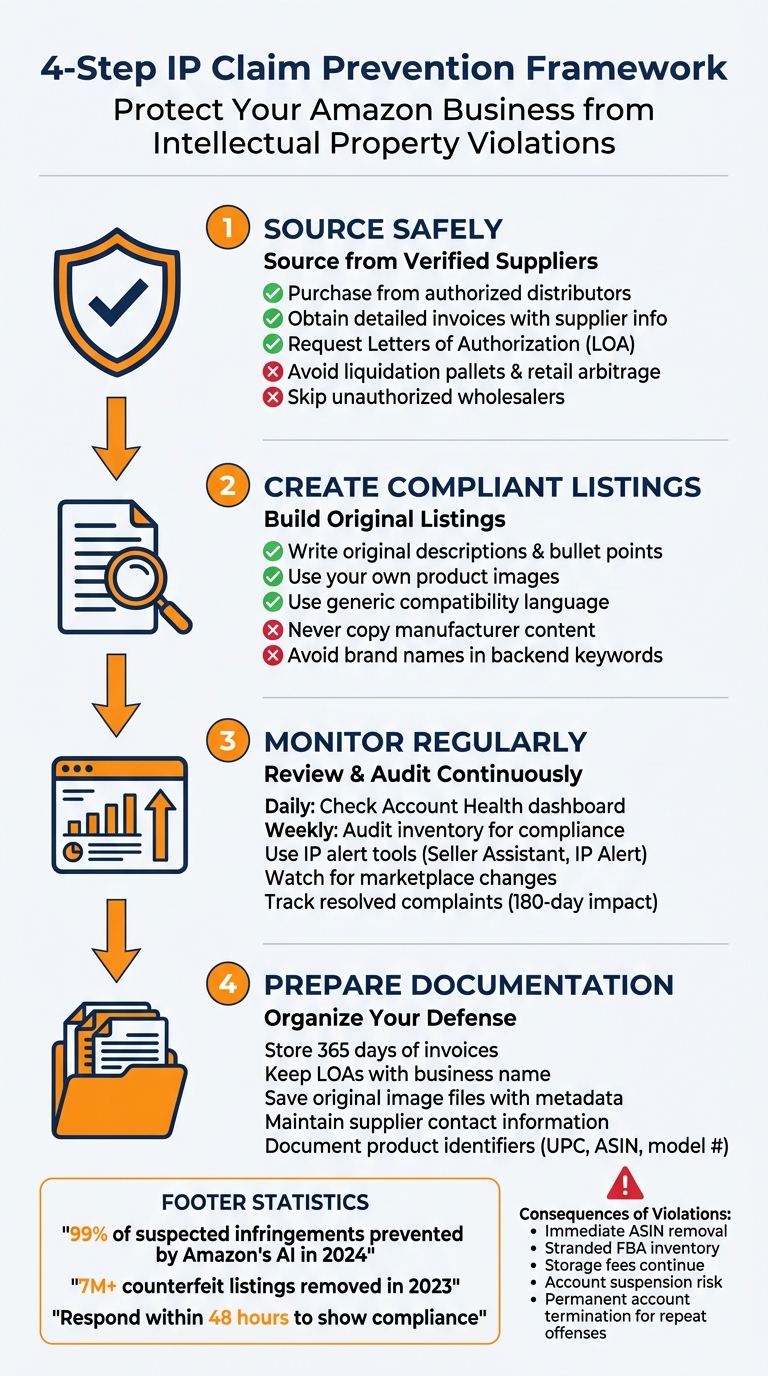
Amazon IP Claim Prevention Strategy: 4-Step Framework
Amazon‘s Intellectual Property Policies Explained
Amazon’s IP Policy Overview
Amazon’s intellectual property (IP) policy revolves around three key areas: Copyrights (protecting creative works like images and text), Trademarks (covering brand names, logos, and slogans), and Patents (securing inventions and product designs). As a seller, you’re both legally and contractually obligated to ensure your products and listings don’t infringe on these rights – whether intentional or not.
Common violations include selling counterfeit items, using copyrighted images or text from other listings or websites, and including trademarked terms in titles or backend keywords without permission. Sellers must familiarize themselves with IP laws and Amazon’s guidelines. If a claim arises, you’ll often need to provide detailed invoices, brand authorization letters, or licensing agreements to resolve it. Understanding these policies is crucial, as violations can lead to severe consequences, including enforcement actions that may significantly impact your business.
Penalties for Policy Violations
Amazon doesn’t take IP violations lightly. If your listing violates their policies, the ASIN is immediately removed, leaving your FBA inventory stranded while storage fees continue to rack up. Beyond platform-specific penalties, you could also face legal action from rights holders seeking damages. For repeat or serious offenses, Amazon may permanently deactivate your account, ending your ability to sell on the platform.
Amazon makes its position clear: "Amazon terminates the accounts of repeat infringers in appropriate circumstances". In 2023 alone, over 7 million suspected counterfeit listings were removed through Amazon’s brand protection programs. This highlights the seriousness of their enforcement efforts and the risks sellers face when policies are ignored.
How Amazon Detects and Handles IP Violations
Amazon uses a mix of advanced technology and tools to enforce its strict IP policies. Machine learning systems actively scan for counterfeits, inaccurate listings, and fraudulent activity, often catching issues before they even reach the marketplace. In 2024, these automated systems prevented 99% of suspected infringements before brands needed to report them. Amazon also monitors backend keywords for trademark violations, with competitor brand names being a frequent trigger for automated flags.
For brand owners, Amazon offers tools like the "Report a Violation" feature, available through its Brand Registry. This tool allows brands to search the catalog by ASIN, image, or order number to identify infringements. Through Project Zero, some brands can even remove counterfeit listings directly, bypassing manual reviews. Additionally, for utility patent disputes, the Patent Evaluation Express (APEX) program provides a faster and more cost-effective alternative to court proceedings by using neutral third-party evaluators. Once a violation is flagged, Amazon follows a "notice and takedown" approach – removing the listing first and allowing disputes to be addressed later.
sbb-itb-e2944f4
How to Prevent IP Claims
Safe Product Sourcing Practices
To stay in line with Amazon’s IP guidelines, start by sourcing products from verified and trustworthy suppliers. Aim to purchase directly from brands or authorized distributors to ensure a clear and traceable chain – from the manufacturer to the customer. Avoid risky sources like liquidation pallets or unauthorized wholesalers, as they often lack the documentation needed to prove authenticity. Similarly, retail arbitrage can be problematic since Amazon frequently does not accept retail receipts as valid proof of authenticity. Instead, focus on obtaining detailed invoices that include supplier information, product quantities, and identifiers. For added security, request a Letter of Authorization (LOA) from the brand or distributor, granting explicit permission to sell their products on Amazon.
Before committing to a product, take time to research the seller landscape for its listing. If a single seller dominates the ASIN or the brand itself is the main seller, it could indicate a high likelihood of aggressive IP enforcement.
Creating Listings That Follow the Rules
After sourcing your products responsibly, the next step is to ensure your listings comply with Amazon’s policies. Always create original product descriptions and bullet points instead of copying content from manufacturer websites or competitor listings. Even paraphrased content can lead to copyright claims. Use your own product images rather than reusing photos owned by the brand unless you have explicit written permission to do so.
Pay close attention to backend keywords. Amazon scans these fields just as thoroughly as titles and descriptions. When making compatibility claims, stick to generic language like "compatible with most smart devices" instead of naming specific brands. Before publishing a listing, double-check that all text and visuals are entirely original and meet Amazon’s requirements.
Regular Listing Reviews and Updates
Preventing IP claims requires ongoing effort. Regularly monitor your listings to catch potential issues early. Check your Account Health dashboard daily for any signs of "Suspected Intellectual Property Violations" or "Received Intellectual Property Complaints". Often, these alerts are triggered automatically by Amazon’s systems and can be resolved by updating listing details, such as correcting brand attribution.
Perform weekly audits of your inventory, particularly for items added using the "add-a-product" method, which doesn’t always guarantee brand approval. Review your listings to ensure no trademarked terms have been accidentally included. Additionally, stay alert to changes in the marketplace – brands that recently joined the Amazon Brand Registry or those enrolled in the IP Accelerator program (which has over 15,000 participating brands) may become more aggressive in enforcing their rights.
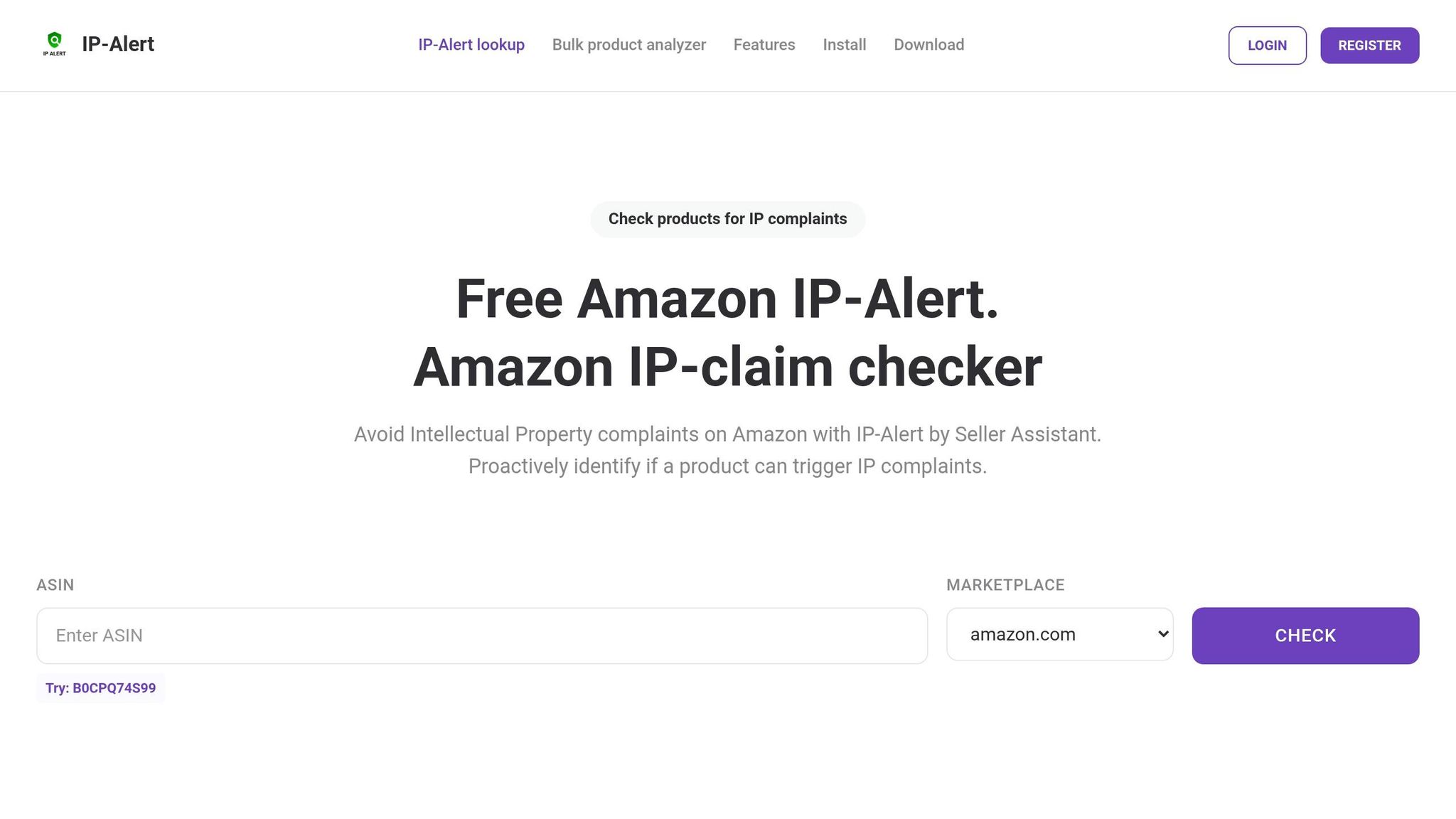
Consider using IP alert tools like Seller Assistant or IP Alert to receive real-time updates about brands known for strict enforcement. If you notice a sudden drop in the seller count for an ASIN or see one high-review seller dominating the listing, it could signal that the brand is actively targeting resellers. Keep in mind that while resolved IP complaints remain visible on your account, they generally stop impacting your Account Health Rating after 180 days.
Setting Up Documentation and Response Systems
Keeping Your Documentation Organized
Having well-organized documentation is crucial when dealing with IP claims on Amazon. It’s your first line of defense. Amazon reviewers place a high value on "clear, consistent, and verifiable evidence" rather than explanations or apologies. Sellers who can provide clean, organized documentation within 24 hours are more likely to resolve claims successfully.
To stay prepared, store all invoices, supplier emails, and authenticity proofs in a cloud-based system. Organize these by supplier, ensuring each invoice clearly shows the supplier’s business name, your Seller Central business name, purchase dates, and product identifiers like UPCs, model numbers, or ASINs. Keep invoices from the last 365 days readily available.
Additionally, secure Letters of Authorization (LOAs) that specifically name your business and confirm your selling rights on Amazon. Save original image files with metadata, design drafts, and contracts with photographers or designers, as these can help prove authenticity. High-quality photos of your inventory – including packaging, labels, and any unique authenticity features – add another layer of evidence.
"Think of documentation as insurance you hope you never need – but will be grateful for if you do."
- Dillon Carter, Co-Founder and COO, Aura
A common reason IP appeals fail is that the documentation doesn’t align with the specific type of infringement – whether trademark, copyright, or patent. To strengthen your case, keep screenshots of your listings before any claims arise. These can help demonstrate compliance or highlight any changes made during the resolution process.
Creating a Response Plan
When you receive an IP claim, act quickly and evaluate the issue within 60–120 seconds to determine whether it involves trademark, copyright, or patent concerns. Always verify the claim’s legitimacy through Seller Central under Performance > Account Health, rather than relying solely on buyer-seller messages. Before making changes, preserve all evidence, including the state of the listing, images, and packaging.
Responding within 48 hours is key to showing professionalism. Start by contacting the rights holder directly and requesting a retraction. A professional, non-defensive message with clear proof of authenticity can often resolve the issue and restore your listing within 24–48 hours.
If a retraction isn’t possible, submit a formal Plan of Action (POA) through Seller Central. A strong POA should address three main points:
- Root cause: Identify what went wrong in your process.
- Corrective actions: Explain what you did immediately to fix the issue.
- Preventive measures: Detail how you’ll avoid similar problems in the future.
Amazon typically reviews IP appeals within 2–5 business days.
"Amazon reviewers are not looking for storytelling. They are looking for clarity, relevance, and alignment."
To back up your appeal, compile a case file with itemized invoices, LOAs, and screenshots showing your listing before and after the claim. Keep in mind that while resolved IP complaints stop affecting your Account Health Rating after 180 days, they will remain visible on your account history permanently.
Tools and Resources for IP Protection
IP Alert Tools
Amazon’s Brand Registry provides automated tools to help block infringing listings. Sellers who enroll gain access to the Report a Violation feature – a centralized dashboard for identifying potential trademark, copyright, or patent infringements and submitting takedown requests. As of 2025, this feature also includes real-time status tracking, so you can follow the progress of enforcement actions step by step.
Many brands conduct weekly checks using the Brand Registry dashboard to detect issues early. Another useful addition is the Brand Catalog Lock feature, introduced in 2025, which safeguards your product listings by preventing unauthorized changes to key fields like titles, images, and bullet points.
Amazon also offers Transparency, a program designed to combat counterfeit products using unique serialized codes. These codes cost between $0.01 and $0.05 per unit. With Transparency Interoperability, brands can now link their existing manufacturing serial codes to Amazon’s system, removing the need for Amazon-specific labels.
These tools form the foundation for broader brand protection strategies, which are further supported by Amazon’s other programs.
Amazon Brand Registry and IP Accelerator
By enrolling in Amazon Brand Registry, you gain access to advanced IP protection powered by machine learning. This system works to identify and block unauthorized listings before they can go live. If you don’t already have a registered trademark, Amazon’s IP Accelerator connects you with vetted legal service providers to help file your trademark application. One of the standout benefits is provisional access to Brand Registry tools while your trademark application is still pending.
To date, over 33,000 brands have joined Brand Registry through IP Accelerator. U.S. trademark filing fees can reach up to $700, with additional services available depending on your needs. The program supports trademark filings in 22 offices worldwide and offers services in 18 languages.
"As a multi-brand enterprise, our ability to build and protect our brands is critical. With IP Accelerator, we are able to quickly enroll in Brand Registry and take advantage of the brand protection tools Amazon offers."
- Robinson Cheng, General Counsel, Anker Innovations
For sellers who meet high reporting standards, Project Zero offers the ability to instantly remove counterfeit listings through a self-service tool – no need to wait for Amazon to investigate. To qualify, sellers must maintain a 90% or higher acceptance rate on their Report a Violation submissions over six months.
In addition to Amazon’s tools, other specialized services can help strengthen your IP protection strategy.
How Emplicit Supports Account Health
Emplicit provides integrated marketplace management services to simplify IP claim prevention and keep your listings compliant. Their account health management system combines IP protection with broader sales strategies, ensuring tools like Brand Registry, Transparency, and Project Zero are fully implemented and maintained. This proactive approach shifts your focus from reacting to problems to preventing them altogether, allowing you to protect your catalog while focusing on business growth.
If IP disputes arise, Emplicit steps in to help with counter-notifications, gathering evidence of authorization, and managing the resolution process. This is especially helpful for sellers handling multiple brands or marketplaces, where constant monitoring and documentation can feel overwhelming. By integrating account health management with services like PPC optimization, listing management, and inventory tracking, Emplicit helps you build a strong Amazon business that stays protected while scaling effectively.
How to Avoid IP Complaints & Suspensions Selling on Amazon FBA
Conclusion
Protecting your Amazon business from IP claims requires a proactive and systematic approach. Amazon’s policy is clear: once a complaint is filed, they act immediately by removing listings, leaving you to prove your case. While handling a single claim might be feasible, repeated violations can lead to account suspension.
To safeguard your business, source products only from authorized channels. Steer clear of liquidation pallets and gray-market wholesalers. Instead, work directly with manufacturers or authorized distributors to maintain a transparent and verifiable supply chain. Keep detailed invoices from the past year that include supplier contact details, your business name, and product-specific identifiers. Additionally, create your own product listings with original photos and descriptions to reduce copyright risks.
"The best way to win against an IP complaint is to never receive one in the first place." – CJ Rosenbaum, AmazonSellersLawyer
This advice underscores the importance of thorough pre-sourcing research. Use IP alert tools and monitor seller forums for trends in IP complaints before committing to inventory. If you sell private label products, enrolling in Brand Registry can provide access to tools that help protect your brand and maintain control over your listings. These steps are essential for a comprehensive compliance strategy.
When an IP complaint does arise, Amazon typically expects a response within 7 days, but responding within 48 hours demonstrates a strong commitment to compliance. Keep in mind that resolved complaints no longer impact your account rating after 180 days. Effective account management systems can help you respond promptly and stay organized.
Emplicit’s account health management system offers a way to integrate IP protection with broader business strategies. By combining tools like Brand Registry and Transparency with services such as PPC optimization, listing management, and inventory tracking, you can build a compliant and scalable Amazon business that thrives.
FAQs
What’s the fastest way to tell if an IP claim is trademark, copyright, or patent?
The fastest way to figure out whether an IP claim involves a trademark, copyright, or patent is by carefully examining the claim details. Amazon’s infringement reporting process helps simplify this by allowing rights owners to clearly indicate the type of intellectual property at issue, making it easier to determine if the claim concerns trademarks, copyrights, or patents.
What proof does Amazon accept to clear an IP complaint?
Amazon usually requires invoices, letters of authorization, or trademark registration documents to address an IP complaint. The exact documentation depends on the type of infringement in question. Make sure all submitted documents are accurate and align with the details in your Amazon account to prevent any delays.
How can I check if a brand is likely to file IP complaints before I source inventory?
Before stocking up on inventory, make sure the products you’re considering are allowed for resale. Double-check whether the brand actively enforces its intellectual property (IP) rights on Amazon. Stick to buying from authorized suppliers, and always keep your invoices as proof that your goods are legitimate. It’s also smart to dig into the brand’s history with IP complaints and keep an eye on how they enforce their rights. This can help you avoid potential headaches down the road.