

Running an ecommerce marketplace without automation is inefficient and time-consuming. Automation uses software and AI to handle repetitive tasks like inventory updates, dynamic pricing, and customer interactions. This saves time, reduces errors, and allows businesses to focus on scaling. By 2026, automation trends include AI-driven tools for upselling and personalized marketing, integration platforms for seamless operations, and dynamic repricing to stay competitive.
Key points:
- Efficiency Gains: Automate inventory, pricing, and order management to save hours weekly.
- Customer Experience: Real-time updates and personalized communication improve satisfaction.
- Revenue Growth: Tools like dynamic repricing and automated marketing boost profits.
- Top Tools: Zapier, Shopify Flow, ChannelEngine, Klaviyo, and ShipStation streamline workflows.
- Preparation: Set up API access, review account health, and choose the right tools for your marketplace.
Automation is no longer optional – it’s essential for staying competitive in ecommerce.
Ep. 4 – Make Marketplace Optimization Repeatable with Automation | ChannelEngine & Sitation
sbb-itb-e2944f4
Key Benefits of Automation for Marketplaces
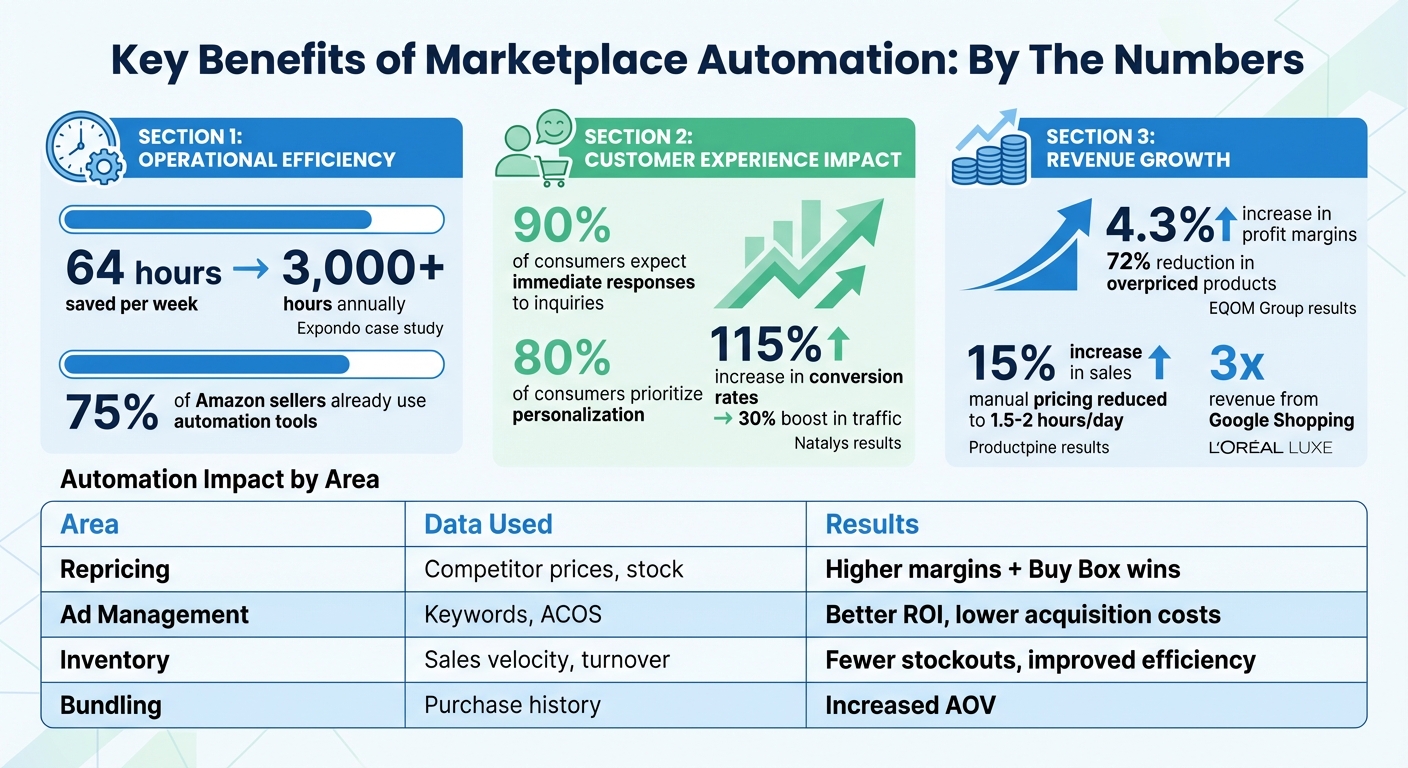
Key Benefits and ROI of Marketplace Automation: Statistics and Results
Automation has reshaped how marketplaces operate, enhancing efficiency, customer satisfaction, and revenue potential. With nearly 75% of Amazon sellers already utilizing automation tools, businesses that lag behind risk losing their competitive edge.
Streamlined Operations
Manual processes can be a major drain on time and resources. Automation steps in to handle repetitive tasks like updating prices across platforms, syncing inventory, and managing product listings. For example, real-time inventory synchronization ensures that when a product sells on one channel, stock levels are instantly updated across others. This prevents overselling and eliminates the need for error-prone spreadsheets, saving both time and money. A great example is Expondo, which adopted ChannelEngine in 2025 to automate stock, pricing, and content updates. The result? They freed up 64 hours a week, redirecting over 3,000 hours annually toward growth.
Automation also simplifies complex processes like category mapping and bulk content management. AI-driven tools match product attributes automatically, cutting down onboarding time, while bulk updates make it easy to adjust titles, images, and specifications across marketplaces. Automated diagnostics can even flag issues like listing rejections or data inconsistencies before they become bigger problems.
"Automation can enliven a team’s daily routine by making mundane tasks more efficient, faster and more satisfying. With automation tools, the team can focus on growth strategies and take on more creative tasks."
- Adrian Gmelch, Product Feed Manager, Lengow
These operational improvements create a solid foundation for better customer interactions.
Enhanced Customer Experience
Automation doesn’t just improve operations – it also transforms the customer journey. Speed and accuracy are key, especially when 90% of consumers expect immediate responses to their inquiries. Automated systems ensure real-time inventory accuracy, so customers only see available products, avoiding the frustration of discovering items are out of stock after they’ve decided to buy.
Beyond inventory, automation enhances the post-purchase experience. Features like automated returns processing, order updates, and shipping notifications keep customers informed and satisfied. Personalization, a critical factor for 80% of consumers, becomes scalable thanks to automation.
For instance, Natalys, a French fashion brand, optimized its product catalogs for different channels using automation in 2023. This strategy led to a 115% increase in conversion rates and a 30% boost in traffic.
Increased Revenue Through Data Insights
Automation doesn’t stop at efficiency and customer satisfaction – it also drives revenue by leveraging data for smarter decision-making. Dynamic repricing tools, for example, monitor competitor prices and stock levels in real time. By adjusting prices within preset profit margins, businesses can win the Buy Box more often. The EQOM Group saw this firsthand in 2025 when they adopted ChannelEngine’s dynamic repricer, achieving a 4.3% increase in profit margins, a 72% reduction in overpriced products, and more Buy Box wins.
Automation also helps businesses identify where to focus their marketing efforts. Performance-based grouping can segment products into categories like top sellers or underperformers, enabling more strategic resource allocation.
Take Productpine, a sustainable D2C marketplace, as an example. In 2023, they implemented Netrivals’ pricing automation tool, which led to a 15% increase in sales while cutting manual pricing tasks to just 1.5–2 hours per day.
Automated A/B testing is another way automation boosts revenue. L’OREAL LUXE used this approach in 2023 for its Google Shopping ads, comparing product images with and without pedestals. The result? Their revenue from Google Shopping tripled.
| Automation Area | Data Leveraged | Revenue Impact |
|---|---|---|
| Repricing | Competitor prices, stock levels | Higher profit margins and more Buy Box wins |
| Ad Management | Keyword performance, ACOS | Better ROI and lower acquisition costs |
| Inventory | Sales velocity, turnover rates | Fewer stock-outs and improved efficiency |
| Bundling | Purchase history, co-occurrence | Increased Average Order Value (AOV) |
These examples highlight how automation not only simplifies operations but also fuels growth, making it an essential tool for marketplaces looking to thrive in today’s competitive landscape.
Top Automation Tools for Marketplaces
Automation tools are game-changers for marketplace businesses, streamlining operations, improving customer experiences, and driving revenue. Picking the right combination of tools is no longer optional – it’s critical for staying ahead in a competitive landscape. These tools generally fall into three categories: workflow automation, customer engagement, and inventory management.
Workflow Automation Tools
When it comes to automating workflows, a few standout tools can save time and eliminate repetitive tasks:
- Zapier connects apps like Shopify, Slack, and Google Sheets through a trigger-action model, automating tasks like updating data or sending notifications.
- Shopify Flow is a Shopify-exclusive tool designed for Plus merchants. It simplifies tasks like fraud prevention, loyalty program management, and fulfillment routing – all without requiring technical know-how.
- ChannelEngine serves as middleware, linking backend systems like ERP, PIM, and WMS to multiple marketplaces via APIs. It automates uploads, pricing, and order synchronization across platforms.
For businesses juggling multiple warehouses, Extensiv Order Manager is a lifesaver. It automates inventory tracking and decides which warehouse should fulfill each order based on stock and location. This can save over 100 hours of manual work each month.
While these tools streamline backend operations, customer engagement platforms focus on building stronger connections with buyers.
Customer Engagement and Marketing Automation
Engaging customers effectively often comes down to using the right tools for automated and personalized communication:
- Klaviyo excels in email and SMS automation, offering data-driven personalization. Features like abandoned cart recovery and welcome series can deliver up to 30x more revenue per recipient. For example, Manly Bands introduced a creative two-part abandoned cart flow in January 2023, replacing a discount offer with a one-question survey. This approach boosted their placed order rate by 4.8x compared to their peer group.
- Platforms like Flashy and Omnisend integrate email, SMS, push notifications, and popups into one system. Engaging customers across three or more channels has been shown to increase purchase rates by 287% compared to single-channel strategies.
- Titan Fitness reduced costs and saved 75 developer hours by switching to automated email marketing.
For SMS-specific strategies, SMSBump automates text campaigns, while LiveRecover uses real people to respond to automated texts in real time. This approach is particularly effective in recovering abandoned carts, which affect about 70% of online shopping sessions.
These tools work hand-in-hand with inventory management solutions to ensure smooth operations from stock to delivery.
Inventory and Order Management Tools
Managing inventory and orders accurately is crucial for avoiding penalties and ensuring customer satisfaction. Tools like MESA for Shopify and ShipStation update stock levels across all sales channels instantly after a sale. They also deactivate listings when inventory falls below a set threshold, typically 2–5 units, to prevent unfulfilled orders.
Smart order routing is another key feature, optimizing fulfillment by directing orders to the warehouse with available stock. This reduces shipping times and simplifies delivery logistics.
In 2023, Maisons du Monde, a European furniture marketplace, used the Lengow platform to automate exclusion rules for out-of-stock products. This reduced manual catalog management and improved overall performance across multiple sales channels.
"To graduate from Automation 1.0 to 2.0, start by cloning content across regions to eliminate duplicate work. Reprice based on profitability, not just competition. And don’t just automate orders – returns are up to three times more impactful to your bottom line."
- Dex van Hofwegen, Director of Sales & Customer Success, ChannelEngine
To maximize efficiency, ensure all your tools are connected. For example, when a workflow automation tool updates your system, it should also trigger updates in your marketing and inventory platforms. Integration is key to creating a seamless, automated ecosystem.
Setting Up Automation on Major Marketplaces
Preparation and Requirements
Before diving into automation, it’s crucial to set up a solid foundation. Start by forming an LLC – this typically costs around $50 and simplifies accounting. Next, create official seller accounts on the marketplaces you plan to use. For instance, Amazon Seller Central requires a Professional Selling Plan, which costs $39.99 per month. Walmart Marketplace has its own registration process, so make sure to follow their specific guidelines.
API access is the key to unlocking automation. On Amazon, you’ll need access to the Selling Partner API, while Walmart uses OAuth 2.0 authorization, which involves generating a Client ID and Client Secret through their Developer Portal. If you’re selling branded products on Amazon, enrolling in the Brand Registry early is a smart move – it gives you access to automated brand protection and advanced analytics.
It’s also essential to review your account health before implementing automation. Tools like Amazon’s "Voice of the Customer" dashboard can help pinpoint existing issues with your listings or products that could disrupt your automation plans. Finally, decide how hands-on you’d like to be: will you handle the integration yourself (DIY), hire an agency to assist you (DWY), or opt for a fully managed service (DFY)?.
Once you’re ready, follow the specific integration steps for each marketplace to ensure a smooth setup.
Integration Steps for Each Marketplace
For Amazon, you can choose from several automation options. Use native tools like Automate Pricing and FBA, explore third-party apps available in the Selling Partner Appstore, or create a custom solution using the Selling Partner API. Automate Pricing, for example, works around the clock to adjust your prices and help you win the Featured Offer (Buy Box).
On Walmart, you’ll need to complete a three-step setup process before accessing automation features. You can manage your account manually through Seller Center, integrate directly via API (ideal for teams with developers), or use third-party solution providers. For bulk uploads, Walmart accepts .xlsx files under 5MB and requires key details like GTIN, Price, and Shipping Weight. Always test your connections using Walmart’s API Status Checker and API Sandbox before uploading your full product catalog.
If you’re selling on multiple platforms, tools like M2E Pro can centralize the management of inventory, pricing, and orders across Amazon, Walmart, and TikTok Shop. M2E Pro supports over 69,000 accounts, offers a 30-day free trial, and remains free for sellers with monthly sales under $1,000.
No matter the platform, securing API access is a critical first step for automation success.
| Marketplace | Primary Tool/Method | Monthly Cost | Key Requirement |
|---|---|---|---|
| Amazon | Selling Partner API / FBA | $39.99 | Professional Selling Plan |
| Walmart | Marketplace API / WFS | Varies | 3-step setup completion |
| Multi-Platform | M2E Pro / Solution Providers | Free–$1,000+ | API Access / Account Syncing |
When uploading your catalog for the first time, focus on your top-selling products to streamline the process and reduce risk.
Once you’ve completed the integration, be prepared to address common challenges that may arise.
Common Problems and How to Fix Them
Even with automation in place, you’ll need to keep an eye out for common issues. Data syncing errors are a frequent challenge. For instance, a mid-sized retailer using Sellbrite and ShipStation on Walmart improved order accuracy by 30% and cut fulfillment time by 40% in 2024 by fine-tuning their inventory sync settings. Another potential pitfall is variable shipping costs, which can hurt your margins if your automated pricing doesn’t account for them.
Account flags and suspensions can occur if your automation appears too mechanical. If you’re using bots for tasks like sharing or following, add random delays to mimic natural human behavior. Both Amazon and Walmart actively monitor for unnatural activity patterns.
Payout holds are another hurdle, especially for new accounts. Marketplaces often delay payouts for 14–30 days, which can create cash flow issues. Keep in mind that some automation agencies may still bill you during this period.
"If you’re not automating your Amazon or Walmart store, you’re either a masochist or just bad at math".
Matt Hall, founder of MarketerMatt, emphasizes the importance of thoroughly vetting agencies. He advises requesting live screen shares of recent results (from the past 3–6 months) instead of relying on screenshots, which can easily be manipulated.
Finally, watch out for category and attribute errors on Walmart. Incorrect category or subcategory selections can prevent your items from displaying properly. Double-check your selections during uploads to ensure all relevant attributes are included. Using software to monitor real-time KPIs and profits can also help detect fraud or inefficiencies, such as inaccurate work from virtual assistants.
Advanced Automation Strategies with Emplicit
Custom Automation Strategies for Growth
Emplicit goes beyond the basics of automation, offering tailored strategies designed to boost marketplace performance. Their custom solutions cover areas like PPC optimization, inventory forecasting, and account health monitoring, ensuring a personalized approach to meet unique business needs.
They offer three flexible engagement models to suit different operational goals:
- Full-Service Management: Handles complete account operations.
- Hybrid Support: Augments your team with specialized expertise.
- Strategic Advisory: Provides expert consulting while you retain control.
Each client benefits from a dedicated team, including a Strategic Account Director, Marketplace Manager, and specialists in PPC, content, and compliance. This team works to deliver measurable results fast. Within the first 90 days, clients often see marketplace revenue grow by 30–45% and ACoS drop by 15–20%. Proactive monitoring reduces compliance issues by 35%, recovering up to $300,000 in lost revenue.
Emplicit’s time-based pricing model is another standout feature. Unlike traditional agencies that charge based on sales or ad spend, Emplicit charges only for the work completed. This ensures predictable costs, even as your revenue scales.
These personalized strategies not only improve current marketplace performance but also set the stage for expansion into new channels.
Multi-Platform Automation for Wider Reach
Emplicit simplifies managing multiple marketplaces by offering unified oversight across platforms. Instead of juggling different dashboards and teams, you can oversee operations on Amazon (US and international), Walmart Marketplace, Target Plus, TikTok Shop, and eBay through a single point of contact.
Their 4D Growth Plan provides a structured roadmap for expansion:
- Diagnose: Pinpoint bottlenecks and challenges.
- Design: Develop a tailored strategy.
- Deploy: Execute the plan effectively.
- Dominate: Optimize for long-term success.
This approach has delivered impressive results. For example, AllGood experienced a 5x revenue increase in just three months, growing from $35,000 to $165,000 per month without higher agency fees. Similarly, Trtl Travel achieved 400% growth within a year, scaling from $3 million in revenue.
Emplicit’s expertise spans managing 40,000 unique products, $100M+ in ad spend, and $550M+ in total sales. Their inventory management system includes buffer stock recommendations and supply chain coordination to prevent stockouts across multiple fulfillment centers. On average, partners see 20–25% year-over-year growth with this integrated approach.
Scaling Automation with Expert Support
Once custom strategies and multi-platform solutions are in place, scaling becomes the next focus. Building an in-house team with marketplace expertise can take months, but Emplicit offers immediate access to seasoned professionals, saving time and resources.
The onboarding process is efficient and structured:
- Weeks 1–2: Discovery and strategy development.
- Weeks 3–4: Address critical improvements.
- Months 2–3: Full optimization and expansion into new initiatives.
For instance, Just Thrive sustained 20% year-over-year growth for four consecutive years using this method. Daily account monitoring ensures any issues are caught early, while expert appeal management swiftly resolves urgent problems. Their advertising strategies include carefully planned campaigns across all ad types, paired with weekly performance reports that provide actionable insights.
"Our time-based pricing model ensures you only pay for work performed, not a percentage of sales or ad spend, allowing costs to scale appropriately with your business needs." – Emplicit
This hands-on support ensures continuous improvement and adaptability, keeping businesses ahead in an ever-changing marketplace landscape.
Measuring ROI and Improving Automation Over Time
Key Metrics for Automation ROI
Tracking the right metrics is essential to gauge how well your automation efforts are paying off. Let’s break it down:
Account health metrics are critical for staying in good standing on marketplaces. For example, keeping your Order Defect Rate (ODR) low and ensuring timely shipments are non-negotiable. A backorder rate under 1% is crucial to avoid penalties that could jeopardize your ability to sell.
Profitability metrics help you see if automation is boosting your bottom line. Average Order Value (AOV) measures the success of your bundling strategies, while Sales Price Above Minimum (SPAM) evaluates whether your repricing tool is adding extra margin instead of just lowering prices. For instance, one marketplace using automated pricing saw a 15% increase in sales while cutting manual pricing work to just 1.5–2 hours a day.
Operational efficiency focuses on time savings and fulfillment speed. Take Expondo, for example – they automated stock, pricing, and content updates through ChannelEngine, reclaiming 64 hours per week, which adds up to over 3,000 hours annually. When managing inventory, calculate the Opportunity Cost by SKU to understand the revenue lost when items are out of stock. Multiply average daily sales by the sales price and the number of days an item is unavailable to get a clear picture of the financial impact.
Here’s a quick snapshot of key metrics:
| Metric Category | Key KPI | Purpose |
|---|---|---|
| Account Health | Order Defect Rate (ODR) | Tracks customer satisfaction and marketplace standing |
| Account Health | Late Shipment Rate | Measures how often "ship by" dates are missed |
| Profitability | Average Order Value (AOV) | Evaluates bundling and upselling strategies |
| Profitability | SPAM | Assesses revenue captured above minimum price levels |
| Efficiency | Hours Reclaimed | Quantifies time saved through automation |
| Inventory | Opportunity Cost by SKU | Calculates revenue lost due to stockouts |
By keeping an eye on these metrics, you can ensure automation not only saves time but also drives growth.
Using Account Health Tools for Long-Term Success
Account health tools are a game-changer, shifting automation from merely fixing problems to preventing them altogether. These tools can identify issues like listing rejections or backend data errors before they snowball into bigger problems. For example, Amazon’s Voice of the Customer dashboard offers automated feedback loops to resolve product issues before they lead to penalties.
"CommerceIQ has enabled my team to operate at the pace needed to win in the market. Issues that would take weeks to identify are now being flagged and resolved on the same day."
- Stephen Mischel, Ecommerce Sales Team Lead at Bayer
Automated profit recovery systems also bring big wins. They can dispute all eligible chargeback claims, not just the major ones, boosting recovered revenue by 30–50%. Additionally, setting inventory thresholds to reserve stock for pending payments helps avoid seller-initiated cancellations. Prioritizing time-sensitive orders like Seller Fulfilled Prime shipments over standard ones can protect your ratings and cash flow. These proactive strategies keep your account in good shape while ensuring steady operations.
Continuous Improvement for Sustained Growth
Automation isn’t a “set it and forget it” strategy – it requires constant fine-tuning. Moving from Automation 1.0 (basic task automation) to Automation 2.0 (outcome-driven optimization) means shifting focus to profitability margins rather than just reacting to competitors.
Regular A/B testing is key for refining your automation. For example, L’OREAL LUXE experimented with ad images for the Armani Privé collection on Google Shopping, tripling their revenue. Similarly, French fashion brand Natalys automated catalog optimization rules, leading to a 115% increase in conversion rates and a 30% traffic boost.
Rather than juggling multiple tools, invest in integrated systems that connect your ERP, PIM, and WMS. This ensures consistent data across platforms and reduces errors. About 75% of Amazon sellers already use automation tools, but the most successful ones rely on systems with self-healing capabilities that automatically fix errors and keep operations running smoothly. Regularly reviewing and updating your automation workflows ensures they stay aligned with evolving business needs and market conditions.
Conclusion
Automation has reshaped fulfillment, turning it from a burdensome cost center into a tool for driving growth by reducing inefficiencies and speeding up market expansion. One company, for instance, managed to reclaim 64 hours per week through automation, allowing them to focus that time on scaling their business.
The evolution from basic automation (Automation 1.0) to more strategic, advanced solutions (Automation 2.0) is a game-changer. While basic automation helps streamline operations, more advanced strategies – like profit-based repricing – can lead to sustainable growth. A great example is EQOM Group, which not only improved profit margins but also secured more Buy Box wins through such strategic automation. This highlights the importance of having expert guidance to fully leverage these tools.
"Automation isn’t about replacing people – it’s about eliminating the repetitive, error-prone work that slows teams down and costs money." – Etail Solutions
The numbers speak for themselves: 98% of ecommerce shoppers say delivery performance influences their brand loyalty, while 84% won’t return after just one bad delivery experience. With human error responsible for 62% of fulfillment and inventory problems, automation is no longer optional – it’s a necessity to keep accounts healthy and maintain customer trust.
Bringing in experts can make all the difference when it comes to bridging the gap between strategy and execution. Companies like Emplicit provide tailored automation solutions for platforms like Amazon, Walmart, TikTok Shops, and Target, covering areas such as PPC optimization and account health management.
FAQs
How does automation enhance the customer experience in ecommerce marketplaces?
Automation transforms the shopping experience by simplifying processes, cutting down mistakes, and speeding up service – all while tailoring interactions to individual customers. For example, real-time inventory updates ensure shoppers always see accurate stock levels, eliminating the annoyance of discovering an item is unavailable after trying to purchase it. Similarly, dynamic pricing tools adjust prices instantly to stay competitive, giving customers access to great deals without delay.
On top of that, AI-powered content optimization enhances product visibility by refining titles, descriptions, and translations, making it easier for shoppers to find exactly what they’re looking for. Automated systems also take the hassle out of returns and refunds by providing instant updates, which helps build trust with customers. Altogether, these tools work to create a smoother, more dependable shopping experience, boosting satisfaction and encouraging loyalty.
Emplicit uses these automation tools to help brands deliver effortless shopping experiences on platforms like Amazon, Walmart, and Target. By automating repetitive tasks, businesses can shift their focus to connecting with customers, crafting tailored promotions, and resolving problems quickly – leading to stronger relationships and happier customers.
What are the best tools to automate workflows in ecommerce marketplaces?
To make managing marketplaces like Amazon, Walmart, and Target more efficient, automation tools are a game-changer. Start by organizing your workflows with tools like Google Sheets, Notion, or Trello to lay the groundwork for your operations. Once you’ve got a solid plan, consider using marketplace-focused workflow tools such as Shopify Flow, WooCommerce, or BigCommerce. These can take care of repetitive tasks like processing orders and updating inventory levels.
For inventory and order management, platforms like SellerChamp, Skubana, and Cin7 are excellent options. They help maintain accurate stock levels, automate fulfillment processes, and even send alerts when it’s time to reorder. When it comes to customer communication, tools like Klaviyo, Omnisend, and Mailchimp make email campaigns easier, while Gorgias and Tidio provide real-time chat support to keep your customers happy. For shipping, solutions like ShipStation and EasyShip can automate tasks like creating shipping labels and selecting carriers.
Back-office tasks such as bookkeeping and analytics can also be streamlined with tools like QuickBooks, A2X, and Google Analytics. These free up your time to focus on growing your business. If you need help integrating and optimizing these tools into one cohesive system, Emplicit can provide tailored solutions to meet your unique needs.
How can I evaluate the success and ROI of automation in my marketplace operations?
To gauge how well automation is working in your marketplace, focus on metrics that highlight both efficiency and growth. Key indicators include time saved on repetitive tasks (like updating inventory), error reduction, cost savings from reduced labor hours, buy-box win percentage, average order value (AOV), conversion rates, and overall revenue growth.
Calculating ROI is straightforward if you break it down. First, add up your automation-related expenses – this includes software licenses, setup fees, training, and ongoing support costs. Next, measure your benefits: multiply the hours saved by the hourly wage of your team, factor in the cost savings from avoiding errors (like fewer returns or refunds), and include any revenue boosts from faster workflows or better visibility. Plug these numbers into the formula: ROI = (Net Gain ÷ Total Investment) × 100. This will give you a clear percentage to evaluate your investment’s impact. Regularly monitoring these metrics can help you spot trends and ensure your automation is driving profits.
Emplicit offers tools to streamline this process, from building a metrics framework to integrating data sources and generating actionable reports, so you can fully leverage the benefits of marketplace automation.