

Tracking ads across multiple platforms is key to understanding where your marketing dollars are working. This guide breaks down how to monitor campaigns on channels like Amazon, TikTok, Facebook, and Google, ensuring you can measure ROI accurately and make smarter budget decisions.
Key Takeaways:
- Why it matters: Most consumers use several platforms before purchasing. Without proper tracking, you risk wasting money on underperforming channels.
- Top metrics to track: Impressions, CTR, ROAS, conversion rates, and customer lifetime value (CLV) are essential for evaluating ad performance.
- Challenges: Data discrepancies, privacy regulations (like iOS 14.5), and mismatched metrics across platforms make tracking complex.
- Solutions: Tools like Triple Whale, Hyros, and RedTrack centralize data, automate tracking, and improve accuracy.
- Attribution models: Move beyond last-click models to multi-touch attribution for a clearer picture of the customer journey.
Quick Tip:
Start by standardizing UTM tags, aligning time zones, and using server-side tracking to recover lost data. These steps help ensure your tracking is precise and actionable.
Read on to learn about tools, techniques, and real-world examples that show how to improve your ad tracking and scale effectively.
Key Metrics for Multi-Platform Ad Performance
Impressions, Clicks, and CTR
Impressions indicate how often your ad appears across various platforms, while Reach highlights the unique number of people who see it. If you’re tracking visibility, Cost Per Mille (CPM) – the cost for every 1,000 impressions – is key, especially for campaigns aimed at building brand awareness. These metrics are particularly useful for gauging performance at the top of the marketing funnel, where potential customers are just starting to learn about your brand.
Click-Through Rate (CTR) measures how engaging your ad is. If you’re seeing a lot of impressions but a low CTR, it might signal issues with your creative elements, such as the ad copy, visuals, or even pricing. Meanwhile, Cost-Per-Click (CPC) reveals how much you’re paying for each click, and Detail Page Views (DPV) on platforms like Amazon help determine whether those clicks are translating into genuine interest. Together, these metrics provide a foundation for evaluating how well your ads are setting the stage for conversions.
Conversion Rates and ROAS
Conversion Rate (CVR) tells you what percentage of clicks result in purchases, offering insight into how effectively your ads are driving sales. For Amazon advertisers, Advertising Cost of Sale (ACoS) – calculated by dividing ad spend by ad revenue – helps measure the efficiency of your campaigns. Similarly, Total ACoS (TACoS), which divides ad spend by total sales (including organic), shows whether your ads are contributing to overall business growth.
Return on Ad Spend (ROAS) is another critical metric, calculated as revenue divided by ad spend. While industry averages range from 2.75x for general ecommerce to 4.0x–10.0x for B2B campaigns, a brand with a 25% profit margin typically needs at least a 4.0 ROAS just to break even.
"ROAS alone isn’t enough. You need to understand where the gaps are in Google’s model and how to rebuild your performance lens around real outcomes, not just what the ad platform says." – AttributionApp
A great example of using these metrics is Ultima Replenisher‘s 2025 campaign. By leveraging Amazon Marketing Cloud, they tracked TACoS and customer acquisition costs across sponsored ads, Fire TV, and Prime Video. Their data revealed that video ads boosted new-to-brand rates from 38% to 75%, driving a 305% year-over-year increase in new customers and raising their market share from 8.7% to 9.3%. These insights underline the value of pairing efficiency metrics with customer-focused strategies.
Customer Lifetime Value and Attribution
Metrics like Customer Lifetime Value (CLV) and accurate attribution are essential for long-term success. New-to-Brand (NTB) metrics, which track purchases from customers who haven’t bought from you in the past 12 months, help distinguish growth from repeat business. Advertisers who used Amazon Attribution insights to optimize their campaigns saw an average 18% increase in NTB sales.
CLV, which measures the total revenue a customer generates over time, offers a broader perspective. For instance, a 1:1 ROAS might be acceptable if that customer eventually generates four times the initial revenue. Meanwhile, the Brand Halo effect tracks how ads for one product can boost sales across your entire catalog.
Attribution windows also play a critical role. Amazon Attribution uses a 14-day, last-touch model, meaning conversions are only counted if they happen within 14 days of a click. Other platforms, like Google Ads, often use longer windows of 30 or 90 days, while some rely on 24-hour view-through windows. These variations can lead to discrepancies, especially since the average customer interacts with a brand more than six times before making a purchase. Understanding how each channel contributes at different stages of the buyer journey helps you allocate your budget more effectively.
Here’s a quick overview of these key metrics and their roles:
| Metric Category | Key Metrics | Purpose |
|---|---|---|
| Visibility | Impressions, Reach, CPM | Gauge brand awareness and top-of-funnel performance |
| Engagement | CTR, CPC, Detail Page Views | Measure how well ads spark interest |
| Conversion | CVR, ROAS, ACoS, TACoS | Evaluate efficiency and sales impact |
| Growth | New-to-Brand Sales, Brand Halo | Track customer acquisition and cross-product influence |
Cross-platform measurement and attribution
Tools for Multi-Platform Ad Tracking
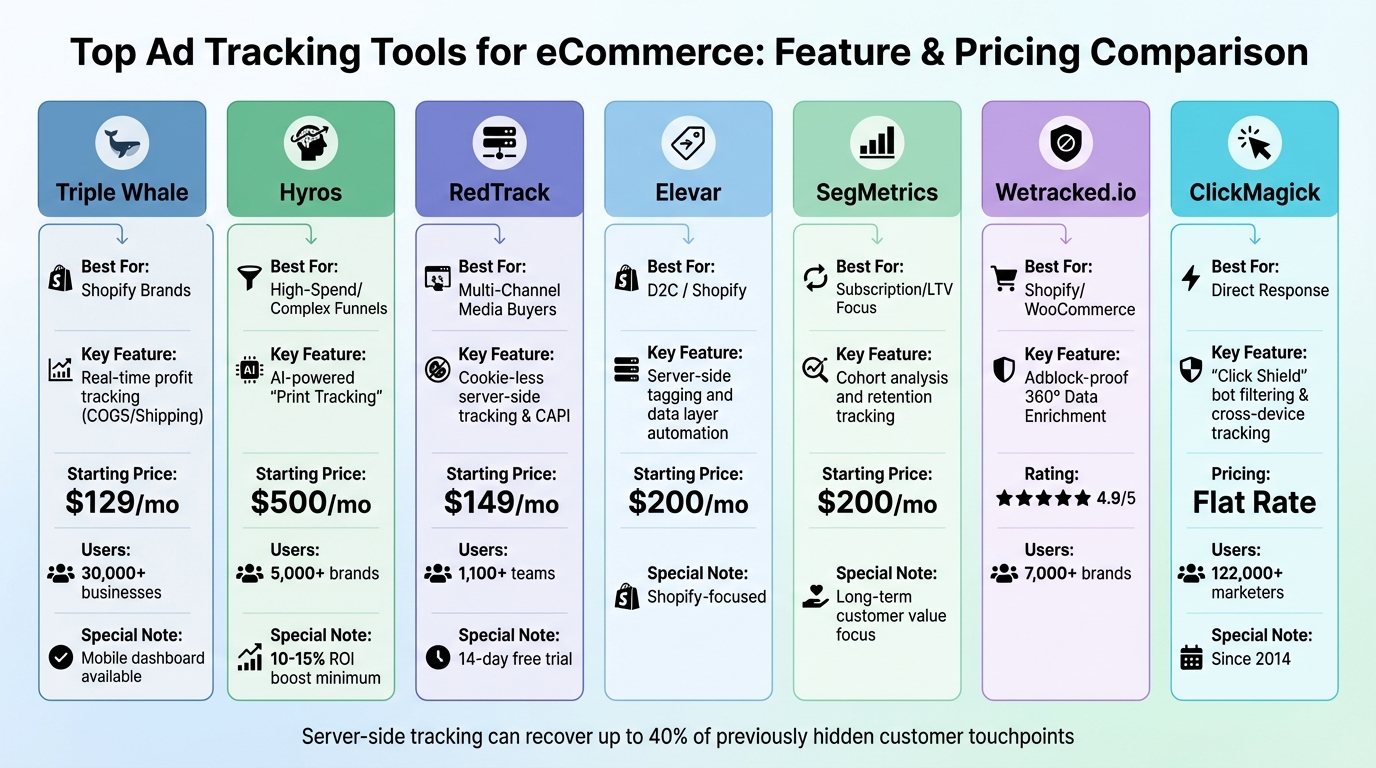
Top Multi-Platform Ad Tracking Tools Comparison for eCommerce
Top Ad Tracking Tools for eCommerce
The right tracking tools can significantly improve your return on ad spend (ROAS), with some reports showing boosts of 20–40% through better attribution and optimization. With changes in privacy regulations like iOS 14.5+, many platforms now rely on server-side tracking and first-party data collection to recover up to 40% of previously hidden customer touchpoints.
Triple Whale is a standout choice for Shopify merchants, with over 30,000 businesses using its real-time profit tracking. This feature factors in costs like COGS and shipping, offering a clear view of profitability. Plans start at $129/month, with premium options going up to $449/month. Its mobile dashboard makes it easy to monitor performance on the go, which is especially handy for high-volume, low-ticket eCommerce operations.
For businesses managing complex campaigns with multiple touchpoints, Hyros excels with its AI-powered "Print Tracking" technology. Tony Robbins’ team, for example, used Hyros to increase ad spend by 43% for Business Mastery and more than double it for Unleash the Power Within. Starting at $500/month, Hyros has helped over 5,000 brands achieve at least a 10–15% boost in ROI. However, premium plans can exceed $3,000/month, making it a better fit for advertisers with significant budgets.
RedTrack offers cookie-less, server-side tracking starting at $149/month and includes a 14-day free trial. Used by over 1,100 teams, it consolidates data from platforms like Google, Meta, TikTok, and LinkedIn into a single dashboard, saving marketers from the hassle of manual data aggregation. Swapnali Z., COO, shared:
"Redtrack is a must-have if you are running an eCommerce business".
Wetracked.io uses cookie-proof digital fingerprints for accurate tracking, even with browser restrictions. It boasts a 4.9/5 rating from over 7,000 brands. Meanwhile, ClickMagick, trusted by over 122,000 marketers since 2014, offers flat-rate pricing and includes "Click Shield" technology to block bots and protect your ad budget.
For subscription-based businesses prioritizing long-term customer value, SegMetrics specializes in cohort analysis and retention tracking, starting at $200/month. Similarly, Elevar, priced from $200/month, focuses on server-side tagging and automating data layers for direct-to-consumer Shopify brands.
| Tool | Best For | Key eCommerce Feature | Starting Price |
|---|---|---|---|
| Triple Whale | Shopify Brands | Real-time profit tracking (COGS/Shipping) | $129/mo |
| Hyros | High-Spend/Complex Funnels | AI-powered "Print Tracking" for accuracy | $500/mo |
| RedTrack | Multi-Channel Media Buyers | Cookie-less server-side tracking & CAPI | $149/mo |
| Elevar | D2C / Shopify | Server-side tagging and data layer automation | $200/mo |
| SegMetrics | Subscription/LTV Focus | Cohort analysis and retention tracking | $200/mo |
| Wetracked.io | Shopify/WooCommerce | Adblock-proof 360° Data Enrichment | Not Listed |
| ClickMagick | Direct Response | "Click Shield" bot filtering & cross-device tracking | Flat Rate |
Each tool offers unique benefits – choosing the right one depends on your campaign goals and technical needs.
How to Choose the Right Tracking Tool
To select the best tracking tool, start by pinpointing your biggest attribution challenges. If iOS 14 privacy updates are causing you to lose visibility into conversions, prioritize tools like RedTrack or Elevar that offer server-side tracking. For campaigns with multiple touchpoints, platforms like Hyros or ClickMagick with advanced identity resolution are ideal.
Integration with your eCommerce platform is another critical factor. Tools like Triple Whale and Elevar are tailored for Shopify, offering seamless integrations that automatically track key metrics like Add-to-Cart events and New Orders. If your campaigns span platforms like Amazon, TikTok Shops, and your website, look for tools that connect with multiple eCommerce systems and CRMs like HubSpot or Salesforce.
Consider your technical resources as well. Solutions like Triple Whale are plug-and-play, while platforms like RedTrack offer more advanced customization but may require developer support. Many tools provide 14-day trials, so you can test them alongside your current setup to measure accuracy improvements before committing.
Maintaining a consistent attribution window is crucial. A 7-day click model ensures fair comparisons across platforms and avoids inflated metrics. Verify that your tool can attach an "ad_id" or UTM parameters to URLs, enabling precise tracking of which ads drive clicks.
Integration with Emplicit‘s PPC Management Services
Emplicit’s PPC management services take ad tracking to the next level by integrating with tools like Triple Whale and RedTrack. This creates a unified reporting system across platforms like Amazon, TikTok Shops, Walmart, and Target, tying ad spend directly to revenue and downstream sales.
By automating data consolidation, Emplicit ensures accurate feedback loops, sending precise conversion data back to ad platforms. This improves the performance of auto-optimization algorithms, leading to better targeting and higher ROAS. For instance, when RedTrack captures conversions missed by Meta’s native tracking, it feeds that data back to Facebook Ads Manager, enhancing campaign effectiveness.
Emplicit’s account managers also implement server-side tracking and Conversion APIs (CAPI) to bypass ad blockers and privacy settings. This ensures budget decisions are based on complete data. Additionally, they standardize attribution windows across platforms like Google Ads, Meta, and TikTok to prevent issues like time zone discrepancies and currency mismatches.
Attribution Modeling for Multi-Platform Campaigns
Single-Touch vs. Multi-Touch Attribution
Attribution modeling is all about figuring out which marketing touchpoints deserve credit for driving sales. Single-touch models, like last-click attribution, assign 100% of the credit to the final interaction before a purchase. While this approach is straightforward, it often skews results by overemphasizing the last-click channel and undervaluing earlier touchpoints in the customer journey. For example, last-touch attribution can inflate platforms’ reported ROAS by 40% to 60%.
On the other hand, multi-touch attribution (MTA) spreads the credit across all the interactions a customer has before converting. Considering that most buyers engage with 5–10 digital touchpoints before making a purchase, MTA offers a clearer picture of how different channels work together. Imagine a customer discovering your brand on TikTok, researching it on Google, and finally converting through a Facebook retargeting ad. A single-touch model would only credit the last interaction, ignoring the critical role of earlier touchpoints in building awareness and interest.
Choosing the right attribution model depends on your business goals. For instance, Position-Based (U-Shaped) attribution, which gives 40% credit to both the first and last interactions and 20% to everything in between, is a solid choice for eCommerce brands with ad spends under $10,000/month. For businesses with higher ad spends – typically over $50,000/month – Data-Driven models use machine learning to assign credit based on actual conversion probabilities. Google Ads, for instance, recommends having at least 600 conversions per month to make these models reliable.
Using Data to Improve Attribution Models
Getting attribution right starts with clean, reliable data. One key step is enforcing consistent UTM naming conventions across all platforms to avoid fragmented data.
Another essential practice is server-side tracking, which helps capture conversions lost to privacy changes and ad blockers. This can recover up to 40% of previously hidden touchpoints.
Identity resolution takes things a step further by linking a customer’s interactions across devices and sessions. By combining login-based IDs, CRM data, and hashed emails, you can consolidate actions from the same user – whether they’re browsing on a phone, tablet, or laptop.
Brands that adopt advanced attribution models often see tangible benefits, including a 28% boost in conversion rates and up to 32% savings on marketing costs. Choosing the right model for your sales cycle is critical. For longer purchase cycles, Time Decay attribution gives more weight to recent interactions, while Linear attribution offers an even distribution of credit across all touchpoints. Whichever model you choose, stick with it for at least three months to gather enough data to spot meaningful trends.
By combining these data-driven practices, Emplicit helps refine attribution accuracy within its integrated PPC solutions.
Emplicit’s Role in Attribution Strategy
Emplicit takes a proactive approach to attribution, ensuring that campaign data across multiple channels is both accurate and actionable. By consolidating data from various marketplaces and your eCommerce site into a unified system, Emplicit helps eliminate the gaps and inconsistencies that often arise in multi-platform campaigns.
The team standardizes attribution windows and enforces strict UTM governance across all platforms, reducing the risk of data discrepancies.
Additionally, Emplicit uses incrementality testing to validate attribution findings. As Causality Engine puts it:
"There’s no perfect attribution model. They’re all wrong. Some are just less wrong than others. The question is: which one is least wrong for your business?"
By conducting hold-out tests – pausing specific channels temporarily – Emplicit measures the true incremental impact of each platform. This approach helps distinguish channels that drive new demand from those that merely capture existing demand at the last click.
Emplicit’s account managers work closely with clients to create custom attribution strategies tailored to their goals. Whether you’re focused on acquiring new customers, increasing lifetime value, or balancing brand awareness with conversions, they build models that guide ad spend effectively and align with your business objectives.
sbb-itb-e2944f4
Common Multi-Platform Tracking Challenges and Solutions
Dealing with Data Discrepancies
One of the biggest headaches in multi-platform tracking is dealing with data discrepancies. Imagine pulling reports from Google Ads, Facebook, and TikTok only to discover that the numbers don’t add up. Frustrating, right?
A major culprit here is time zone differences. Google Ads uses your account’s time zone, Facebook sticks with the time zone you set when creating your account, and LinkedIn reports everything in UTC. On top of that, platforms define metrics differently – TikTok’s "Cash Spend" doesn’t include promotional credits, while Facebook’s "Amount Spent" does, and Google’s "Cost" metric follows its own logic. Attribution windows also vary: Google credits conversions within 30 days of a click, while Facebook and TikTok default to a 7-day window.
These inconsistencies can seriously affect data accuracy. Manually consolidating data from platform dashboards often results in only 70% to 85% accuracy, compared to the 95% to 99% accuracy achieved with automated tools. Privacy updates, like iOS changes and cookie restrictions, further complicate things – platform-native analytics can miss as much as 30% to 40% of conversions. In fact, only 38% of global marketers feel confident in their ability to measure ROI effectively across both digital and traditional channels.
The fix? Standardization. Start by consolidating all platform data into a single time zone – ideally, the time zone your business operates in. Use a consistent attribution window, such as a 7-day click standard, to avoid inflated conversion data. Also, separate "Platform Spend" (for daily optimization) from "Card Charges" (for monthly accounting), understanding they’ll never match perfectly due to billing thresholds and processing lags. For privacy-related data loss, server-side tracking tools like Facebook’s Conversions API can help recover a significant chunk of missing conversions. Tackling these discrepancies lays the groundwork for addressing compliance and other tracking challenges.
Staying Compliant with Platform Policies
Data discrepancies aren’t the only challenge – compliance with privacy regulations is another major hurdle. Explicit user consent is required for cookie tracking, but platforms interpret "consent" differently. Google’s AdSense network, for instance, operates on over 11.1 million websites, creating extensive cross-site tracking that’s now under regulatory scrutiny.
The shift away from third-party cookies means businesses need to focus on first-party data and server-side tracking solutions. Tools like Facebook’s Conversions API allow conversion data to flow directly from your server to Facebook, bypassing browser-based limitations. Similarly, Amazon’s Marketing Cloud offers "clean rooms" where you can analyze pseudonymized data without violating privacy rules.
Staying compliant is critical for accurate ad tracking and complements the data consolidation efforts mentioned earlier. Emplicit’s PPC team keeps up with platform policy changes across Amazon, TikTok Shops, Walmart, and other marketplaces. By enforcing strict UTM governance and implementing privacy-compliant tracking systems, they help clients avoid account suspensions and ensure reliable performance measurement.
Overcoming Integration Challenges
Integration is another sticking point in multi-platform tracking. Each platform speaks its own language – Google calls it "Cost", Facebook says "Amount Spent", and TikTok uses "Cash Spend". Add in time zone mismatches, inconsistent currency conversions, and varying attribution windows, and the task becomes even more daunting.
Automated data connectors can simplify this process by managing API authentication, pulling data daily, and updating automatically when platforms change their APIs. This can save a lot of time – marketers typically spend 8 to 12 hours each month manually consolidating data, but automation cuts that effort dramatically.
Setting up these tools involves mapping metrics to align platform-specific terms into standardized columns and normalizing currencies to ensure consistent exchange rates. Scheduling regular data refreshes, such as at 6 AM local time, ensures that reports are ready when your team starts the day.
For brands juggling campaigns across Amazon, TikTok Shops, Walmart, and their own eCommerce platforms, Emplicit offers a solution. They consolidate tracking data into unified dashboards, eliminating the manual effort of reconciling metrics and providing a clear, comprehensive view of performance across platforms.
Advanced Ad Performance Optimization Techniques
Using Real-Time Data for Campaign Adjustments
Real-time tracking has revolutionized how campaigns are managed, allowing marketers to identify and fix problems within hours – long before they spiral into costly issues. For example, if your Google Ads are exceeding the daily budget, you can immediately tweak bids or adjust daily caps to avoid overspending.
One major benefit of this approach is the ability to reallocate budgets on the fly. With real-time tracking, you can shift spending to channels delivering better ROAS (return on ad spend). Automated data systems can even feed conversion data back into ad platforms, enabling instant audience and bid optimizations.
To make the most of this, automate hourly data updates and set up alerts for anomalies. For instance, if cost-per-acquisition shoots up by 20% or impressions drop by 30%, you’ll know right away and can act fast. Aligning all platform data to your operating time zone ensures accurate comparisons, while using a consistent 7-day click attribution window across platforms makes it easier to evaluate performance and reallocate budgets effectively.
These real-time insights also pave the way for improving creative elements based on immediate feedback.
Optimizing Ad Creative Based on Data
Data offers a clear window into which creative elements are driving results. Take H&R Block, for instance. By analyzing its full-funnel strategy with Amazon Marketing Cloud, the company discovered that adding online video to its display ads boosted conversion rates by 47%. Including Prime Video in the mix pushed that lift to 66%, and the complete multi-platform strategy achieved a 144% higher conversion rate compared to display-only campaigns.
Metrics like video completion rates can help pinpoint where viewers lose interest. If a significant number of viewers drop off around the 15-second mark, it might be time to shorten the video or move the call-to-action earlier. Similarly, click-through rates can reveal which headlines and visuals are grabbing attention, while conversion rates show which combinations are effectively driving purchases.
To track creative performance accurately across platforms, use standardized UTM parameters with consistent naming conventions (e.g., using utm_content to differentiate A/B test versions). Regularly test variations in headlines, images, and call-to-action buttons – A/B testing often leads to a 10% to 30% improvement in click-through or conversion rates. Additionally, setting frequency caps (e.g., 3 to 5 views per week for ecommerce) and rotating ad creatives can prevent fatigue and keep engagement levels high.
Scaling Campaigns with Emplicit’s Custom Strategies
Once you’ve identified the creative assets that work best, scaling your campaigns becomes the next challenge. Efficiency is key here, and that means moving away from manual spreadsheets to automated solutions that compile data from multiple sources. For instance, Booyah Advertising transitioned over 600 reports into an automated platform, achieving 99.9% data accuracy while cutting their daily budget-tracking time by half. This shift allowed them to access updated performance metrics for more than 100 clients in just 10 to 30 minutes.
Emplicit takes this a step further by consolidating tracking data across platforms into unified dashboards, eliminating the need for tedious manual reconciliation. Their PPC team uses standardized attribution models and real-time pacing alerts to avoid overspending or underdelivering, ensuring campaigns stay on track. Once effective creative formulas are identified through A/B testing, Emplicit’s custom strategies enable brands to scale confidently without sacrificing performance. By leveraging server-side tracking and first-party data, they also navigate privacy restrictions to recover retargeting audiences that might otherwise be lost.
This combination of accurate data, streamlined workflows, and strategic know-how empowers brands to scale their ad spend efficiently while maintaining strong ROAS. Whether you’re managing a handful of campaigns or hundreds, these techniques ensure you’re always one step ahead.
Conclusion
Key Points Recap
Tackling the challenges of tracking across multiple platforms has become a priority for thriving in eCommerce. Multi-platform ad tracking is no longer a luxury – it’s a necessity for driving profitable growth. Server-side tracking plays a pivotal role here, especially since privacy updates can cause platform-native analytics to underreport up to 40% of conversions. Without accurate data, making informed decisions about ad spend becomes a gamble.
The transition from single-touch to multi-touch attribution is another game-changer. By accounting for the entire customer journey – spanning social media, email, and marketplaces – this approach provides a more complete picture, rather than crediting just one interaction. Automation further streamlines this process, saving marketers 8–12 hours each month on manual data exports while boosting accuracy from 70–85% to an impressive 95–99%. Shifting focus to profit-driven metrics like ROI, ACoS, and TACoS – rather than just clicks and impressions – helps reveal what’s truly driving profitability when factors like costs of goods sold and shipping are included.
This highlights a major gap in confidence when it comes to attribution.
"Only 38% [of marketers] feel confident they can measure ROI holistically across traditional and digital channels – proof that attribution remains a critical gap." – Ashley R. Cummings, Shopify
With these insights, you’re now equipped to make smarter, data-driven decisions to refine your campaigns.
Next Steps for eCommerce Growth
To take your eCommerce business to the next level, start by implementing these strategies. Standardize UTM parameters across all campaigns to maintain clean, consistent data. Align platforms to a single time zone to avoid discrepancies in date ranges. Use automated data connectors to consolidate tracking into a single dashboard, eliminating manual effort and improving accuracy.
For brands selling on Amazon alongside their own websites, consider leveraging Emplicit’s tailored PPC management solutions. Their expertise in integrating cross-channel data ensures optimal performance across platforms like Amazon, TikTok Shops, Walmart, and Target. By using standardized attribution models, they help drive revenue growth while reducing ACoS. Partnering with professionals who understand both the technical and strategic aspects of tracking and optimization allows you to scale your business confidently without compromising on performance.
FAQs
What’s the best way to choose an ad tracking tool for my business?
To find the best ad tracking tool for your business, start by pinpointing your goals. Are you aiming to boost return on ad spend (ROAS), track multi-touch attribution across platforms like Google, TikTok, and Amazon, or streamline your reporting process? Knowing what you want to achieve will help narrow your options.
Then, think about the platforms you advertise on and the size of your campaigns. If you’re running large-scale or multi-channel campaigns, you might need tools with advanced features like server-side tracking or AI-powered identity stitching to navigate privacy restrictions. When evaluating tools, focus on factors like how easy they are to integrate, whether their pricing grows with your needs, and how user-friendly their reporting features are. Tools with real-time dashboards and clear visualizations can make your data easier to act on.
If this feels like too much to handle, consider working with a full-service e-commerce partner like Emplicit. They specialize in setting up tailored tracking solutions, improving ad performance, and simplifying reporting across platforms like Amazon, TikTok Shops, Walmart, and your own website. The right tracking tool can give you the insights to make smarter decisions and grow your business.
What are the biggest challenges in tracking ads across multiple platforms, and how can they be addressed?
Tracking ad performance across multiple platforms isn’t exactly a walk in the park. For starters, manually gathering data from platforms like Google, Meta, TikTok, and LinkedIn can eat up a ton of time and often leads to errors. These inconsistencies make it harder to trust the numbers. Then there’s the challenge of piecing together impressions, clicks, and conversions from different dashboards – it’s like trying to solve a puzzle without all the pieces. Privacy regulations and cross-device tracking limitations only add to the complications, reducing the accuracy of the data. On top of that, many marketing teams don’t have the expertise to implement effective attribution models. No wonder only a small fraction of marketers feel confident about measuring ROI across all their channels.
So, how do you tackle these hurdles? Automation is a game-changer. By using platform APIs to pull data into a single dashboard, you can save time and reduce errors. Standardizing UTM parameters and switching to first-party tracking not only keeps you compliant with privacy laws but also boosts the reliability of your data. Multi-touch attribution models – like position-based or data-driven methods – can give you a much clearer picture of how each channel contributes to your success. And if you’re looking for expert help, Emplicit delivers customized ecommerce solutions, including PPC management and tailored strategies, to simplify ad tracking and help your business grow without the headaches.
What makes multi-touch attribution essential for evaluating ad performance?
Multi-touch attribution plays a key role in understanding your customers’ journey. Unlike models that credit just one touchpoint, this method evaluates the value of every interaction a customer has with your ads. This means you can see which efforts genuinely contribute to conversions.
By breaking down the performance of each touchpoint, you gain clearer insights into what’s working. This helps you allocate your advertising budget more effectively, fine-tune your strategies, and improve your campaigns to get the best return on investment across all platforms.