

Product bundling is a proven strategy for ecommerce businesses to increase sales, improve customer satisfaction, and manage inventory effectively. By grouping complementary products into a single package – often at a discounted price – you can simplify customer decisions, boost average order value (AOV), and clear slow-moving stock.
Key Takeaways:
- Why It Works: Bundling simplifies buying decisions and appeals to customers’ desire for savings.
- Types of Bundling:
- Pure Bundling: Products sold only as a bundle.
- Mixed Bundling: Items available individually or as part of a discounted bundle.
- Build-Your-Own Bundles: Customers customize bundles from pre-selected items.
- Benefits:
- Customers buying bundles often spend 2.7x more over their lifetime.
- Brands like HiSmile report 80% of orders coming from bundles, with a 4x increase in cart size.
- Helps clear stagnant inventory by pairing slow-moving items with popular ones.
- How to Succeed:
- Use data like market basket analysis to identify natural product pairings.
- Offer discounts that balance customer appeal with profitability (e.g., 10–20% for high-margin items).
- Test and refine bundles using metrics like conversion rates and AOV.
Bundling isn’t just about increasing revenue – it’s about offering a better shopping experience while optimizing inventory management. Whether you’re new to bundling or looking to refine your approach, this guide covers everything you need to know.
5 Common Challenges When Creating Product Bundles
Main Types of Product Bundles
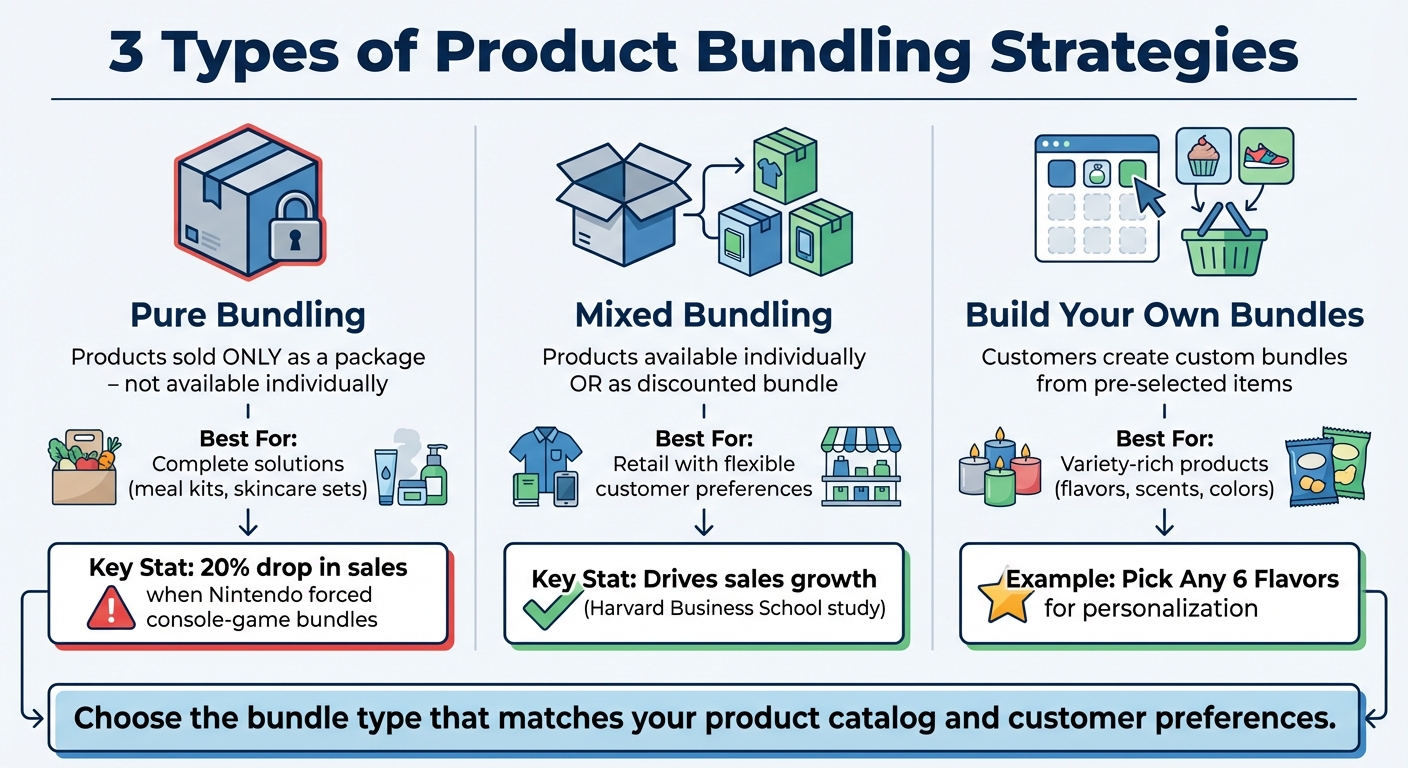
Three Types of Product Bundling Strategies for Ecommerce
Picking the right type of product bundle can make a significant difference in driving sales and meeting customer expectations. Each bundling approach caters to unique goals and customer preferences. Here are the three main types of product bundles, which will later tie into strategies for selection, pricing, and fine-tuning.
Pure Bundling
In a pure bundling setup, products are sold only as a package – they’re not available for individual purchase. This works well when the items are designed to complement each other, like a multi-step skincare routine or a DIY project kit. The key here is that every item in the bundle contributes to a complete solution.
However, pure bundling comes with risks. For example, a 20% drop in sales was observed in a Harvard Business School study on Nintendo. The company required customers to buy games exclusively with consoles, and the strategy backfired. This shows that pure bundling is most effective when the products naturally fit together as a single, cohesive offering.
Mixed Bundling
Mixed bundling gives customers options. Products can be bought individually or as part of a discounted bundle. Imagine a lipstick and lip liner – shoppers can grab just one or buy both together at a lower price. This flexibility encourages purchases while still promoting the value of the bundle.
The same Nintendo study highlighted the benefits of mixed bundling, showing it can drive sales growth. This approach works particularly well with consumable goods, where customers might want to try one product first before committing to a larger bundle.
Build Your Own Bundles
Build-your-own bundles take personalization to the next level. Customers can mix and match items from a pre-selected group to create their own package. Think of a snack company offering a "Pick Any 6 Flavors" deal or a coffee brand allowing customers to choose three roasts for one price.
This method shines for businesses offering a wide variety of products, like different flavors, colors, or scents. It not only engages customers by letting them tailor their purchase but also provides valuable insights into which combinations are most popular.
| Bundle Type | How It Works | Best For |
|---|---|---|
| Pure | Products sold exclusively as a package | Complete solutions (meal kits, skincare sets) |
| Mixed | Products sold individually or bundled | Retail with flexible customer preferences |
| Build Your Own | Customers create custom bundles | Variety-rich products (flavors, scents, etc.) |
How to Create Product Bundles That Work
Crafting effective product bundles requires smart product selection, strategic pricing, and ongoing optimization. Here’s how to create bundles that increase sales without compromising your profit margins.
Selecting Products for Bundling
Start with market basket analysis to identify items customers frequently purchase together. These natural pairings are ideal for bundling because they reflect actual buying habits, not assumptions.
Next, identify your key products – those with high conversion rates, dependable demand, and healthy margins. These products serve as the "anchor" for your bundle. Pair these with slower-moving inventory or lower-margin items using margin blending. For instance, if you sell cameras, bundle a high-margin camera body with a memory card that doesn’t sell as well on its own.
Focus on complementary products that solve a specific problem or complete a set. For example, shampoo and conditioner or a phone case paired with a screen protector. This approach makes the bundle feel practical and appealing rather than a random combination. Additionally, pairing fast-selling products with slower-moving ones can help clear inventory.
Consider using virtual bundles, which are assembled only when an order is placed. This method keeps inventory flexible and reduces storage costs compared to pre-packaged bundles.
Once your product pairings are set, it’s time to focus on pricing strategies that encourage conversions while safeguarding your margins.
Pricing Strategies for Bundles
Pricing plays a critical role in whether customers buy your bundle or pass it by. Research indicates that a 20% discount often isn’t enough to sway customers, but a 45% discount can significantly increase the likelihood of choosing the bundle over individual items.
Follow these margin-based guidelines: if your gross margins are above 50%, you can offer discounts between 10–20%. For margins below 50%, stick to smaller discounts of 5–10% to protect profitability. Always factor in the true cost of the bundle, including Cost of Goods Sold (COGS), shipping, fulfillment, and marketing expenses.
Highlight the original prices of individual items next to the bundle price. This creates an anchoring effect, reinforcing the perceived value of the discount. Use A/B testing to determine whether your audience responds better to dollar savings ("Save $20") or percentage discounts ("Save 25%").
A great example comes from cookware brand HexClad, which used Amazon Brand Analytics to identify buying patterns. By creating virtual bundles, they boosted sales, with bundles eventually accounting for 30% of their total Amazon revenue. This shows how combining data-driven product selection with strategic pricing can lead to impressive results.
Remember to track contribution profit per bundle, not just revenue. As Conjura points out, "Higher bundle revenue does not automatically mean higher bundle profit". Large sales volumes can sometimes hide shrinking margins.
Once your pricing is set, the next step is to test and refine your bundles to maximize their effectiveness.
Testing and Improving Bundle Performance
Testing is essential to identify which bundles succeed and which fall flat. Use tools like Optimizely or VWO to run A/B tests with randomized control groups – customers who don’t see bundle offers – over a defined period to ensure reliable results.
Key metrics to track include:
- Conversion rate: How often the bundle is purchased compared to how many times it’s shown.
- Average Order Value (AOV): The average amount customers spend when buying the bundle.
- Attachment rate: How often the bundle is added to the cart versus individual products.
- Inventory turnover: How quickly the items in the bundle sell.
You can calculate a Bundle Effectiveness Score by multiplying the bundle’s conversion rate by its AOV to measure both volume and revenue performance.
On Amazon, about 35% of purchases are influenced by recommendations, many of which function as bundles. This highlights the importance of optimizing your bundles for maximum impact.
Experiment with different discount structures, product combinations, and presentation styles. For example, try offering "one-click" bundle upgrades or "Complete the Look" suggestions at checkout to increase AOV. Limited-time offers can also create urgency, leveraging Loss Aversion to encourage quick decisions. In fact, 62% of consumers say discounts and deals are their top priority when shopping.
Keep your bundles simple – too many options can overwhelm customers, leading to decision fatigue and abandoned carts. Clearly communicate the value and benefits of each bundle to make the purchase decision easy and appealing.
Strategies to Increase Revenue with Product Bundles
Building on effective bundle creation and testing, these strategies help maximize the potential of product bundling. By refining high-performing bundles, you can increase order sizes, move inventory faster, and offer a more tailored shopping experience.
Upselling and Cross-Selling with Bundles
Bundling opens up opportunities for both cross-selling and upselling. Cross-selling involves pairing a main product with complementary items – think a camera bundled with a memory card. Upselling, on the other hand, encourages customers to add premium options, such as combining a cleanser with a luxury moisturizer.
Where you display these bundles matters. Position them strategically: just below the main product description, on collection pages as value packs, or even as one-click upgrades during checkout. Highlighting individual prices alongside the bundle price can emphasize savings through price anchoring.
For example, HiSmile reported that over 80% of its sales came from bundled orders, which also increased the average cart size by four times.
These upselling and cross-selling techniques lay the groundwork for using bundles to manage inventory and tailor offers to customer preferences.
Using Bundles to Clear Inventory
Bundles can be a game-changer for clearing out slow-moving or seasonal stock without diminishing your brand’s value. A smart approach is to pair less popular items with bestsellers to encourage faster turnover. Instead of heavy discounts, you can frame slow-moving products as a "Free Gift" with a minimum purchase – like, "Spend $75, get this $15 notebook FREE." Adding urgency with phrases like "Last-Chance Bundle" or "Final Stock" can further drive sales without signaling a clearance sale.
Timing is critical. Bundle seasonal items before their demand wanes to avoid them becoming unsellable. Poor inventory management, including overstocking, can cost businesses up to 11% of their annual revenue. To maintain profitability, aim for modest discounts (15–25%) off individual item prices and use tools like market basket analysis to ensure the bundles feel thoughtfully curated.
Personalized Bundling for Customer Segments
Tailored bundles designed for specific customer groups can increase revenue and improve satisfaction. AI-powered tools can analyze customer purchase history, browsing habits, and preferences to recommend bundles in real time. Allowing customers to build their own bundles adds an extra layer of personalization, and features like progress bars can encourage them to complete their bundle.
Segment-specific bundles work well, such as skincare sets for sensitive skin or gourmet food kits suited to different budgets and cooking skills. Offering bundles at various price points ensures accessibility while encouraging customers to consider higher-value options.
"By providing an enhanced, personalized customer experience, product bundles make shopping easier and boost key ecommerce metrics like AOV and LTV." – Recharge
You can also use loyalty program data to create exclusive VIP bundles or offers based on member preferences. Testing limited-quantity bundles before a full launch can help gauge demand and fine-tune your approach.
sbb-itb-e2944f4
Best Practices for Bundles on Ecommerce Platforms
Creating successful bundles on ecommerce platforms requires careful attention to the rules and optimization strategies specific to each marketplace. Whether you’re working with Amazon, Walmart, or Shopify, these practices can help your bundles stand out while staying compliant.
Optimizing Bundle Listings
To make your bundles appealing, your listings need to clearly communicate their value. Start with titles that are straightforward and descriptive. For Amazon, try this format: [Main Product Title] + "Bundle with" + [Component Product Titles]. In the first bullet point, explicitly state that the product is a bundle and list all components included.
The main image should feature all the items in the bundle – only show what’s actually included. Giving your bundle a catchy, benefit-focused name, like "Ultra Smooth Package" or "Beach Vacation Kit", can also help shoppers quickly understand its value.
Each bundle must have its own unique SKU and a valid product identifier like a UPC, GTIN, or ASIN. Using a UPC from one of the individual components for the entire bundle is against marketplace policies and can get your listing removed. If you need a new UPC, you can purchase one from GS1 for about $30 without any annual renewal fees. When categorizing your bundle, use the category of the most expensive item unless it’s a media product (e.g., books or DVDs). In that case, use the category of the second most expensive non-media item.
Once your listings are optimized, make sure your inventory system is robust enough to handle the demands of bundling.
Managing Inventory for Bundles
Managing inventory for bundles can be tricky, but it’s essential to avoid overselling or stock-outs, both of which can hurt your bottom line. Automated inventory systems that sync bundle availability with the stock levels of individual components are a must. Poor inventory management can lead to revenue losses of up to 11% annually.
"Most brands don’t fail because the bundle concept is bad – they fail because the inventory management architecture behind the bundle was never built to support it." – Tina Donati, Head of Marketing, Simple Bundles
Decide between physical and virtual bundling based on your fulfillment needs. Physical bundling allows for quicker shipping, while virtual bundling offers more flexibility. Platforms like Amazon automatically adjust the availability of Virtual Product Bundles based on the stock levels of the lowest-quantity item in your FBA inventory.
To avoid selling a bundle when one or more components are out of stock, set up safety stock rules that account for the most constrained item in the bundle. Don’t forget to double-check and sync the weights and dimensions of your bundles. If shipping systems default to the dimensions of individual components, you could face unexpected carrier surcharges.
With a solid inventory system in place, you’re ready to promote your bundles effectively.
Promoting Bundles with PPC Campaigns
PPC campaigns are a powerful way to boost the visibility of your bundles, but each platform has its own rules. For instance, Amazon’s Virtual Product Bundles can’t use Sponsored Product ads but can be promoted through Sponsored Brand ads. Sponsored Brand ads are great for building brand awareness and telling your story, while Sponsored Product ads can help drive traffic to individual items, leading customers to discover your bundles.
Highlight discounts in your campaigns by showing both the original price and the bundle price to emphasize savings. Keep an eye on metrics like Advertising Cost of Sale (ACoS), Return on Ad Spend (ROAS), and the "Attachment Rate" – this tells you how often customers choose the bundle over individual items.
To maximize profitability, pair high-margin items with low-margin ones in your campaigns while still offering attractive discounts. Discounts are a big draw: 62% of shoppers say deals are their top priority when deciding what to buy. Regularly update your keyword strategy by identifying high-performing terms and adding negative keywords to filter out irrelevant traffic that could waste your ad budget.
Measuring and Scaling Product Bundling Success
Once you’ve nailed down the basics of creating and testing bundles, the next step is all about measurement and scaling. These steps are crucial for turning bundling into a consistent revenue driver.
Key Metrics to Track Bundle Performance
To figure out which bundling strategies are working and which might be hurting your bottom line, focus on these key metrics:
- Average Order Value (AOV)
- Bundle Profit Margin
- Contribution Profit (factoring in advertising, shipping, and returns)
As Conjura points out, "Higher bundle revenue does not automatically mean higher bundle profit". In other words, a bundle that looks great on the surface might not actually be adding to your profits.
Beyond these, keep an eye on conversion rates and overall sales volume. You can combine these by multiplying the conversion rate by AOV to calculate a Bundle Effectiveness Score. This score gives a clearer picture of how well your bundles are performing.
Also, track inventory turnover and sell-through rates to see how quickly bundled items move compared to standalone products. Fast-moving bundles can help cut holding costs and clear out slow-moving inventory. On the customer side, metrics like Repeat Purchase Rate and Customer Lifetime Value can show if your bundles are building loyalty. And don’t forget to monitor return rates specific to bundles – high return rates might signal issues like poor product compatibility or unclear descriptions.
These metrics provide the insights needed to refine and scale your bundling strategy effectively.
Scaling Bundling Strategies for Growth
Scaling bundling strategies isn’t about guesswork – it’s about making decisions backed by data. Here’s how to do it:
- Market Basket Analysis: Identify products that customers often buy together. These natural pairings make for high-demand bundles.
- A/B Testing: Experiment with different bundle configurations, pricing strategies, and messaging to pinpoint what works best before rolling it out widely.
- Virtual Bundling: This approach lets you bundle products digitally without physically packaging them together, offering greater inventory flexibility. Updating warehouse systems to break down bundle SKUs into individual picks can streamline this process.
Expanding your bundling strategy to platforms like TikTok Shops, Walmart, and Target can also boost visibility. However, remember that a bundle that thrives on your direct-to-consumer site might need tweaks to pricing or components when introduced on other marketplaces. Additionally, AI tools can help deliver personalized bundle recommendations based on customer browsing habits and purchase history, making the bundles even more appealing.
How Emplicit Can Help
Scaling bundling strategies across multiple platforms can be complex, but that’s where Emplicit steps in. They specialize in full-service ecommerce solutions to optimize bundling efforts on platforms like Amazon, TikTok Shops, Walmart, and Target. Their expertise spans:
- PPC Campaign Optimization: Ensuring your bundles get noticed.
- Compelling Listings: Crafting descriptions and visuals that drive sales.
- Inventory Management: Avoiding overselling and maintaining stock levels.
Emplicit’s USA-based account managers work closely with brands to identify top-performing bundle opportunities. They help implement testing frameworks and scale successful configurations across your entire catalog. Whether you’re just starting with bundling or looking to expand an existing program, Emplicit’s omnichannel approach can help deliver measurable growth tailored to your brand’s needs.
Conclusion: Growing Your Business with Product Bundling
Product bundling has proven to be an effective way to boost growth in ecommerce. By combining complementary products, setting smart pricing, and clearly communicating the value, bundling becomes a tool that not only increases revenue but also enhances the shopping experience. Plus, it can simplify operations, making it a win-win for both businesses and customers.
The benefits extend beyond just higher sales. Bundling helps address operational challenges, like clearing out slow-moving inventory, cutting per-unit fulfillment costs, and introducing customers to items they might not have considered otherwise. A great example of this success is HiSmile, which saw 80% of all orders shift to bundled products – a clear indicator of how bundling can reshape a business model.
To make bundling work, data is your best friend. Using tools like market basket analysis, running A/B tests, and keeping an eye on metrics like bundle conversion rates and inventory turnover can help you fine-tune your strategy. Whether you’re offering pre-set bundles for special promotions, flexible mixed bundles, or letting customers build their own, the key is to base your approach on what your customers actually want.
Scaling these strategies takes expertise. Expanding bundles across platforms involves fine-tuning inventory management, optimizing product listings, and running targeted promotions. This is where a partner like Emplicit can step in. Their USA-based team specializes in spotting bundling opportunities, managing inventory challenges, and running PPC campaigns that get your bundles in front of the right audience at the right time.
Start small, test thoroughly, and build on what works. With the right bundling strategy, you can increase average order value, improve customer lifetime value, and create a more efficient and profitable ecommerce operation. It’s not just about selling more – it’s about building a business that’s better aligned with your customers’ needs.
FAQs
What are the key advantages of product bundling for ecommerce businesses?
Product bundling can be a powerful tool for ecommerce businesses, offering several advantages that go beyond just increasing sales. For starters, bundling helps boost average order value (AOV) by encouraging customers to buy multiple items together, often at a discounted price. This makes the offer more enticing and can nudge shoppers toward larger purchases.
It’s also a smart way to manage inventory. By pairing slow-moving items with popular ones, you can clear out stock that might otherwise sit idle. Additionally, bundling can serve as a low-risk way to introduce new products, as shoppers perceive they’re getting extra value.
From the customer’s perspective, bundles are appealing because they offer convenience and savings – two things shoppers love. This approach can also streamline your operations by cutting down on marketing and distribution costs, as you’re promoting and shipping multiple items together in one package.
In short, product bundling isn’t just about selling more – it’s about creating win-win situations that improve sales, optimize inventory, and leave customers feeling satisfied and loyal.
How do I choose the right products to bundle together?
Start by diving into your sales data and studying customer behavior. Pinpoint products that are often bought together or naturally complement one another. For instance, a camera could be bundled with a memory card or a protective case – items that enhance the main purchase.
You can also try different bundle types to see what works best. Consider cross-sell bundles, which pair related but distinct items, or mixed bundles, which combine varied products that work well together. Testing out these combinations and gathering customer feedback will help you figure out which bundles appeal most to your audience and boost your average order value.
The key is to focus on bundles that genuinely add value and make sense for your customers.
What are the best strategies for pricing product bundles to boost profitability?
To price product bundles in a way that boosts profitability, aim for discounts that strike a balance – enticing enough to encourage purchases but not so steep that they erode your profit margins. For instance, offering a modest percentage discount on a bundle can motivate customers to buy more, while also increasing your average order value (AOV).
Another key factor is pricing based on the perceived value of the bundled items. When a bundle costs less than the sum of its individual components, customers feel they’re getting a deal, which can drive sales while still protecting your profits.
Finally, take customer behavior and purchasing trends into account. This can help you nudge customers toward higher-margin bundles. Leveraging data insights ensures your pricing strategy encourages sales without compromising your contribution margins.