

Shoppers today don’t stick to just one platform. They discover products on TikTok, research them on Amazon, and complete purchases on Walmart. By integrating these platforms, businesses can create a connected shopping experience that meets customers wherever they are. Here’s the breakdown:
- Amazon: Ideal for informed buyers and large purchases. Its logistics network ensures fast, reliable delivery.
- TikTok Shop: Excels in discovery through viral content and creator trust. It’s where shoppers find products they didn’t know they wanted.
- Walmart: Combines online convenience with physical stores for quick fulfillment, appealing to value-conscious shoppers.
Why it matters:
- Omnichannel shoppers buy 1.7x more often than single-channel users.
- U.S. social commerce is projected to hit $118 billion by 2027.
- A unified strategy boosts sales and operational efficiency while reducing friction in the customer journey.
The key? Use TikTok for discovery, Amazon for logistics, and Walmart for local convenience. Together, they create a powerful ecosystem for modern shopping habits.
1. Amazon
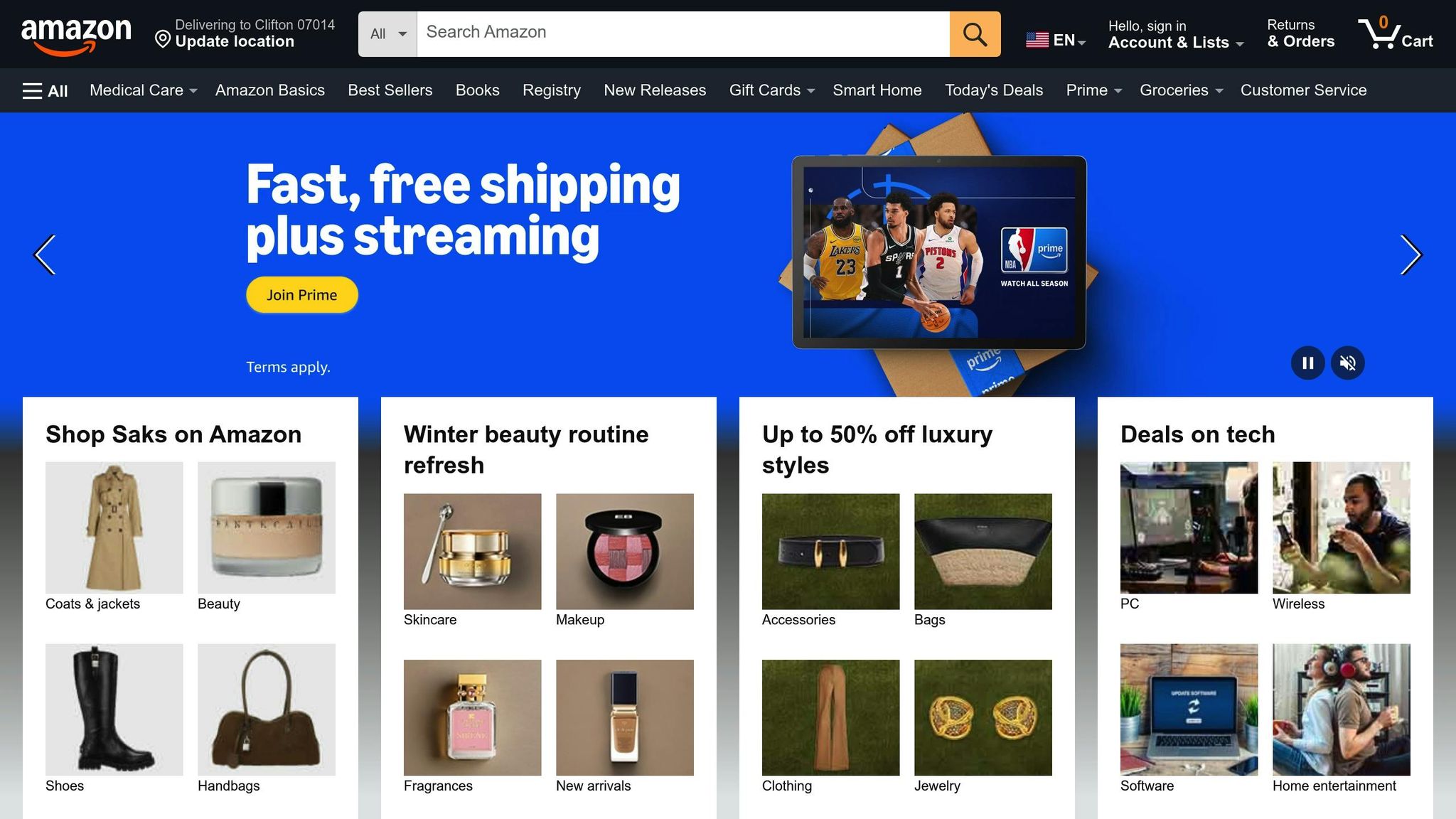
Fulfillment and Logistics
Amazon’s logistics network is a cornerstone of its omnichannel success. With Multi-Channel Fulfillment (MCF), sellers can manage their inventory in one centralized pool to handle orders from Amazon, external platforms like Walmart and eBay, and even their own websites. This approach ensures an impressive on-time delivery rate of over 97%. By consolidating inventory, sellers can simplify operations and fulfill orders across multiple channels seamlessly.
MCF also offers unbranded packaging at no extra cost, which helps maintain a consistent brand presence on non-Amazon platforms. For marketplaces like Walmart, where specific carrier requirements exist, sellers can opt out of Amazon Logistics and choose alternative carriers to remain compliant. Notably, through January 14, 2027, Amazon has waived the 5% surcharge for blocking its logistics services, and eligible sellers can enjoy up to 15% savings on MCF fulfillment fees.
Customer Engagement and Experience
Amazon goes beyond just selling products – it creates a full ecosystem of engagement. The Prime membership bundles fast shipping with entertainment options like Prime Video and Music, fostering what analysts call a "lock-in" effect that keeps customers loyal to the platform.
A standout example of this integration is NESCAFÉ’s Prime Day 2025 campaign. They ran streaming ads on Prime Video featuring QR codes that directed viewers to an interactive Brand Store. This strategy reached 3.2 million unique viewers and drove a 20.7% boost in brand consideration among coffee shoppers. Similarly, TheraBreath leveraged a "couch-to-cart" approach by combining Prime Video, display, and search ads. The result? A 37% increase in new-to-brand customers and a 44% rise in dollar sales.
Omnichannel Integration Capabilities
Amazon’s Marketing Cloud (AMC) is the backbone of its omnichannel capabilities. By analyzing anonymized signals from Amazon Ads and first-party data, AMC can map out a customer’s entire journey – from discovering a product on TikTok to considering it on Walmart and ultimately purchasing it on Amazon. For instance, Poppi, a prebiotic soda brand, used AMC to refine its media strategy, resulting in a 16x increase in new-to-brand customers and a 12x jump in conversions at Whole Foods Market within a month.
To further streamline operations, Amazon supports over 100 third-party integrations with tools like ShipStation and Veeqo. These platforms automatically sync orders, inventory, and tracking details across sales channels. This level of automation is crucial, especially since 55% of companies still rely on manual processes to manage omnichannel logistics. Moreover, with 22% of online shoppers abandoning carts due to slow delivery times, these integrations help ensure a smoother and faster customer experience. Amazon’s tools solidify its role as a key player in creating a unified, cross-platform shopping journey.
2. TikTok Shops
Customer Engagement and Experience
TikTok is changing how people find and shop for products. Instead of searching for specific items like you would on Amazon or Walmart, TikTok users stumble upon products while enjoying entertaining videos. The platform calls this approach "discovery commerce" – where shopping feels like a natural part of scrolling through content. On average, users spend over an hour a day on TikTok, and 71% say they’ve been inspired to shop while exploring their "For You Page".
One major factor driving this behavior is the bond users form with their favorite creators. These parasocial relationships – where audiences feel personally connected to influencers – build trust. In fact, 60% of TikTok users trust product recommendations from creators.
"When we’re watching social media, we’re really connecting with our influencers that we love and have a parasocial relationship with. That reduces a lot of friction around purchasing" – Dr. Jenny Radesky, Associate Professor at the University of Michigan
This emotional connection often leads to impulsive purchases, something traditional retail experiences can’t replicate.
The results speak for themselves. In March 2025, Lidl’s U.K. branch used TikTok’s live shopping and creator videos to promote a limited-edition Dubai Style chocolate bar. All 6,000 units sold out in just 90 minutes. Similarly, L’Oréal Paris hosted a 12-hour live shopping event during TikTok Shop Super Brand Day, achieving a 6.24x increase in gross merchandise value compared to the previous period. ASOS also found success targeting 18–24-year-olds with unboxing and "get ready with me" videos. Over half of these transactions came from new customers, with nearly 50% of buyers falling into the 18–24 age range.
While TikTok excels at engaging users and driving discovery, its ability to sustain customer trust relies heavily on its order fulfillment capabilities.
Fulfillment and Logistics
TikTok’s logistics infrastructure is still a work in progress, but it complements the platform’s discovery-driven shopping experience. To address some gaps, many sellers rely on established fulfillment services like Amazon Multi-Channel Fulfillment (MCF) and Walmart Fulfillment Service (WFS). These partnerships bring reliable delivery standards to TikTok orders, helping to build consumer confidence. For instance, Amazon MCF provides unbranded packaging for TikTok purchases, keeping the focus on the seller’s brand.
A key feature of TikTok Shop is its in-app checkout, which keeps users from having to leave the app to complete their purchases. This streamlined process plays a big role in the platform’s success – by 2026, 23.4% of U.S. buyers are expected to make purchases through livestream shopping. However, small businesses have faced some early challenges, such as issues with shipping labels and automated order cancellations. These hiccups highlight areas where TikTok’s logistics network still needs improvement.
Omnichannel Integration Capabilities
TikTok doesn’t just stop at discovery and engagement – it also integrates with other platforms to create a seamless shopping journey. For example, TikTok’s partnership with Amazon allows users to link their accounts and view real-time pricing, Prime eligibility, and delivery estimates directly within TikTok ads. This "Buy with Prime" feature eliminates the need to switch apps, making the checkout process smoother. Sellers can also sync their inventory across platforms by using tools that connect TikTok Shop with Walmart Fulfillment Service.
TikTok serves as a powerful discovery tool, especially for younger audiences. Nearly 40% of Americans – and a striking 64% of Gen Z – now use TikTok’s search function to research products. Often, users start their shopping journey on TikTok and then head to Amazon or Walmart to finalize their purchases. This integration creates a cohesive customer experience, with TikTok driving product discovery and established marketplaces handling fulfillment.
"I think Amazon is going to have a competitor like they’ve never seen before" – Arelis Caban-Oberst, Marketing and E-commerce Strategist
Omnichannel Ecommerce Explained: Boost Your Online Store Performance
sbb-itb-e2944f4
3. Walmart
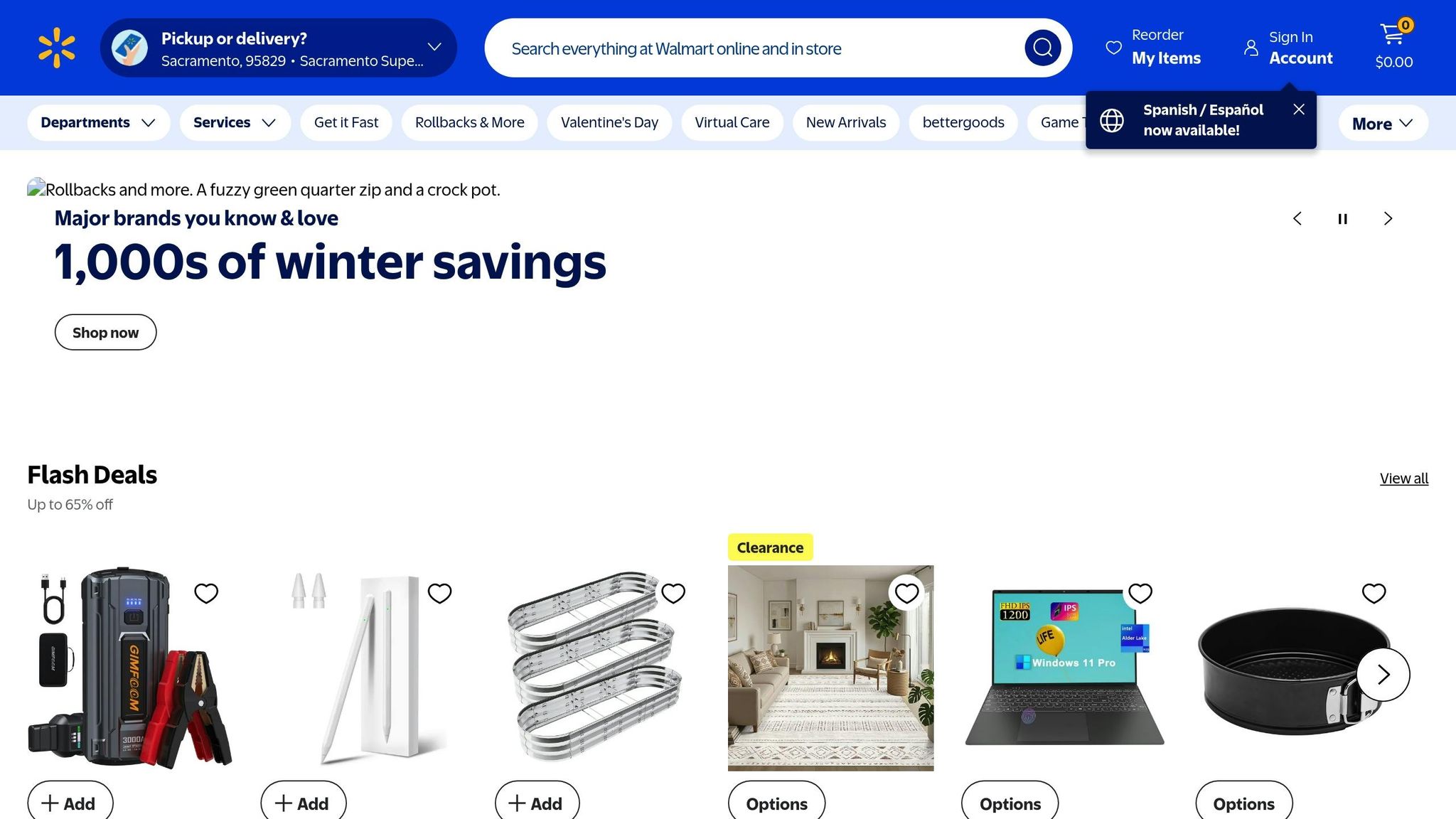
While Amazon dominates the digital space and TikTok excels in discovery, Walmart leverages its extensive network of physical stores to provide quick and reliable fulfillment.
Fulfillment and Logistics
With over 4,500 stores across the U.S., Walmart has a logistical advantage that few can match. In fact, 90% of Americans live within just 10 miles of a Walmart location. These stores double as fulfillment hubs, enabling ultra-fast delivery and convenient pickup options for customers.
Walmart Fulfillment Services (WFS) takes care of everything from storage to packing and shipping for marketplace sellers. It offers 2-day shipping nationwide and next-day delivery in major cities like Los Angeles, New York, Chicago, Houston, and Atlanta. This service has helped sellers achieve an average 50% increase in Gross Merchandise Volume while charging about 15% less in fulfillment fees compared to leading competitors.
For sellers who operate across platforms, Multichannel Solutions (MCS) provides a seamless way to fulfill orders from Amazon, eBay, TikTok, and more – using Walmart’s supply chain. Orders are shipped in unbranded packaging, maintaining a neutral presence. Another perk? Walmart waits 12 months before applying long-term storage fees, while many competitors start at 6 months. Customers can even return Marketplace items at any Walmart store, making the returns process smooth and convenient.
But Walmart isn’t stopping at logistics – it’s also transforming the shopping experience with cutting-edge AI.
Customer Engagement and Experience
Walmart is diving into AI-driven commerce, where virtual assistants take on the task of shopping for customers. In January 2026, Walmart partnered with Google to integrate its inventory with the Gemini AI assistant through the Universal Commerce Protocol. This allows customers to shop through conversational interactions, with the AI using their combined online and in-store purchase history to offer personalized recommendations.
"The transition from traditional web or app search to agent-led commerce represents the next great evolution in retail. We aren’t just watching the shift, we are driving it." – John Furner, President and CEO of Walmart U.S.
Walmart’s proprietary AI model, Wallaby, enhances personalization by creating tailored homepages for each shopper. To engage younger audiences, Walmart has ventured into platforms like Roblox, Unity, and ZEPETO, where virtual items purchased in these spaces come with real-world counterparts. In April 2025, Walmart introduced a tech-forward store in Cypress, Texas, featuring QR codes in aisles. Shoppers can scan these codes to explore an expanded online marketplace, make purchases via the Walmart app, and even arrange professional installation – all without leaving the store.
Omnichannel Integration Capabilities
Walmart’s ability to blend online and offline shopping creates a seamless experience for customers. Its physical stores act as fulfillment centers, reducing the distance between inventory and shoppers. This setup allows Walmart to deliver locally curated products in under three hours – and sometimes in as little as 30 minutes. By relying on its store network rather than centralized warehouses, Walmart achieves remarkable delivery speeds.
In 2025, Walmart’s U.S. e-commerce operations became profitable, serving approximately 270 million customers weekly through over 10,750 stores and online platforms. The company reported fiscal year 2025 revenue of $681 billion, proving that its strategy of uniting digital and physical retail pays off. By linking customer accounts, Walmart ensures that online and in-store purchase histories are synced, so when an item is listed as "in stock", it’s locally available for immediate pickup or same-day delivery.
Advantages and Disadvantages
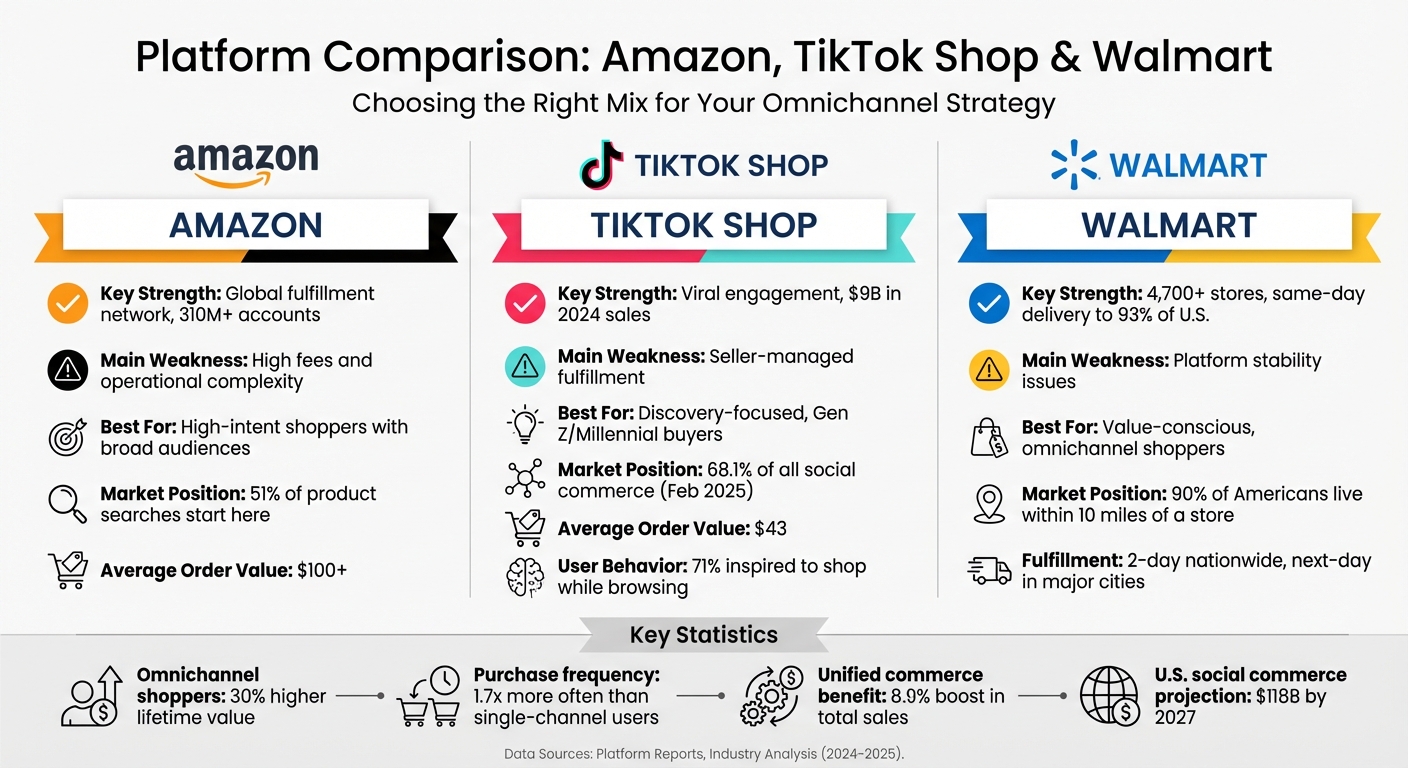
Amazon vs TikTok Shop vs Walmart: Platform Comparison for Omnichannel Retail
Every platform – Amazon, TikTok Shop, and Walmart – brings its own set of strengths and challenges. Knowing where each one shines and where it struggles can help you craft a strategy that plays to their unique advantages.
Amazon is a giant, boasting over 310 million accounts and driving 51% of product searches. But for smaller brands, the platform’s high operational fees can be a significant hurdle.
TikTok Shop is changing the game with discovery-based shopping. With an average order value of $43 – much lower than Amazon’s $100+ – it has achieved $9 billion in U.S. sales, capturing 68.1% of all social commerce by February. However, TikTok Shop relies on external fulfillment solutions, which can complicate logistics for sellers.
Walmart blends its physical stores with its digital platform seamlessly. Its same-day delivery service reaches 93% of U.S. households, and its 4,700+ stores double as fulfillment hubs, making services like Buy Online, Pick Up In-Store (BOPIS) incredibly convenient. That said, Walmart has faced challenges with platform stability.
Here’s a quick breakdown of the key points:
| Platform | Key Strength | Main Weakness | Best For |
|---|---|---|---|
| Amazon | Global fulfillment network, 310M+ accounts | High fees and operational complexity | High-intent shoppers with broad audiences |
| TikTok Shop | Viral engagement, $9B in 2024 sales | Seller-managed fulfillment | Discovery-focused, Gen Z/Millennial buyers |
| Walmart | 4,700+ stores, same-day delivery to 93% of U.S. | Platform stability issues | Value-conscious, omnichannel shoppers |
Omnichannel shoppers are a major opportunity for brands, with a 30% higher lifetime value compared to single-channel customers. Additionally, businesses that use unified commerce platforms report an average 8.9% boost in total sales. By combining Amazon’s logistics expertise, TikTok’s discovery-driven approach, and Walmart’s local convenience, brands can create a seamless and unified shopping experience. This balanced strategy leverages the strengths of each platform, making it easier to meet the diverse needs of today’s shoppers.
Conclusion
Expanding your presence across Amazon, TikTok Shops, and Walmart is about meeting customers where they prefer to shop. By integrating these platforms, you can leverage Amazon’s unmatched logistics, TikTok’s viral discovery potential, and Walmart’s combination of online convenience and physical store accessibility. The payoff? Shoppers who use multiple channels boast a 30% higher lifetime value and make purchases 1.7 times more often compared to single-channel customers.
Businesses adopting a unified commerce strategy report impressive outcomes, including an 8.9% rise in total sales and a 5% improvement in operational efficiency. Take Canadian luggage retailer Bentley as an example: after transitioning to a unified commerce system in 2023, they achieved 129% year-over-year revenue growth and a 74% increase in online sales within just one year.
These numbers drive home the value of a connected approach. It’s time to move beyond fragmented systems. Managing platforms like Amazon, TikTok, and Walmart separately leads to inefficiencies. Instead, centralize inventory, customer data, and order management. This not only prevents issues like overselling but also ensures consistency in pricing and customer experience. Real-time inventory visibility enables features like buy online, pick up in-store (BOPIS), offering convenience without compromising stock accuracy.
Understanding your customer’s journey is key. For instance, they might discover your product on TikTok, research it on Amazon, and complete their purchase on Walmart. Build strategies that capitalize on these strengths – use Amazon for high-intent buyers, TikTok for discovery and engagement, and Walmart for value-conscious shoppers seeking quick, local fulfillment.
Emplicit is a partner that specializes in managing multi-platform strategies like these. From marketplace management to PPC optimization, inventory tracking, and account health monitoring, they ensure your brand remains competitive and consistent across Amazon, TikTok Shops, Walmart, and beyond.
Today’s shoppers expect a seamless experience – 75% think about shopping multiple times a week. They don’t see a divide between online and offline channels. Treating each platform as a silo means missed opportunities. Embracing omnichannel integration ensures you’re ready to meet modern shopping habits head-on.
FAQs
How do Amazon, TikTok, and Walmart work together to create a seamless shopping experience?
A smooth shopping experience allows customers to transition effortlessly between platforms like Amazon, TikTok Shop, and Walmart. Whether they’re scrolling through short-form videos, shopping online, or walking into a store, the process feels seamless. By connecting product details, inventory, and checkout systems, these platforms create a consistent path from discovery to purchase.
Amazon plays a key role by offering shared inventory and unified customer profiles, which enable easy navigation across its website, app, and partner platforms. TikTok takes this a step further with in-app purchasing powered by Amazon-sponsored ads. This means users can watch a product demo and buy it instantly without leaving the app. Meanwhile, Walmart integrates online and in-store shopping by syncing data, so customers can use the same cart and preferences across all channels.
Emplicit supports brands in simplifying this integration. They handle everything from managing product listings and PPC campaigns to keeping inventory aligned across platforms. Their expertise ensures consistent product information, pricing, and messaging wherever customers engage, helping businesses create a truly unified shopping experience.
What makes TikTok an effective platform for discovering new products?
TikTok’s algorithm is designed to serve up short, engaging videos that align with each user’s specific interests. This makes the platform a lively and interactive space for product reviews and viral trends, offering brands a direct way to connect with a large and highly engaged audience in the U.S.
Here’s a standout stat: 76% of purchases on TikTok come from new customers. That’s a huge opportunity for businesses looking to expand their reach. On top of that, some brands have seen revenue attribution increase by as much as 8.8x, proving TikTok’s ability to drive product discovery and attract new customers in a big way.
How does Walmart use its stores to improve order fulfillment?
Walmart’s massive network of roughly 4,700 stores doubles as a sophisticated system of micro-fulfillment centers. These stores handle inventory from distribution hubs, process online orders, and either ship directly to customers or prepare items for curbside and in-store pickup. By directing orders to the nearest store with available stock, Walmart slashes delivery times – sometimes offering same-day service or even deliveries within just a few hours.
But speed isn’t the only thing Walmart is innovating. The company is turning its stores into digital hubs packed with advanced services like drone deliveries, direct-to-fridge drop-offs, and even in-store health and auto-care options. This blend of physical locations with cutting-edge digital tools allows for real-time inventory tracking, smarter order routing, and a seamless shopping experience across all channels.
For brands working with Emplicit, Walmart’s fulfillment capabilities become a powerful asset. Through well-managed listings, fine-tuned inventory strategies, and expert marketplace services, products can reach customers across the U.S. quickly and reliably.