

Predictive maintenance powered by AI is transforming warehouse operations by reducing downtime, cutting repair costs, and extending equipment lifespan. By using real-time IoT sensor data and machine learning, warehouses can identify potential issues before they escalate, saving time and money.
Key Takeaways:
- Cost Savings: Reduces downtime by 20–30% and repair costs by 15–20%.
- Faster ROI: Most systems pay for themselves in 12–24 months.
- Improved Efficiency: Focuses maintenance on actual needs, avoiding unnecessary repairs or replacements.
- Enhanced Safety: Identifies risks early, reducing accidents during emergency fixes.
AI-driven systems monitor equipment health continuously, ensuring timely interventions and better reliability. For warehouses relying on high-demand equipment like conveyors or automated systems, this approach minimizes disruptions and boosts productivity. With 60% of warehouses adopting AI by late 2025, this technology is becoming essential for staying competitive.
Quick Overview:
- Technologies Used: IoT sensors, machine learning, real-time monitoring systems.
- Benefits: Reduced downtime, lower maintenance costs, extended asset life.
- Implementation Steps: Start with critical assets, integrate with existing systems, refine AI models continuously.
- Examples: Ingredion saved $1.6M; CP Kelco avoided 84 hours of downtime and saved $446K.
By investing in predictive maintenance, warehouses can achieve measurable financial returns while ensuring smoother operations and better safety.
Delivering Insights: AI-driven predictive maintenance
sbb-itb-e2944f4
What Is Predictive Maintenance and How Does AI Enable It?
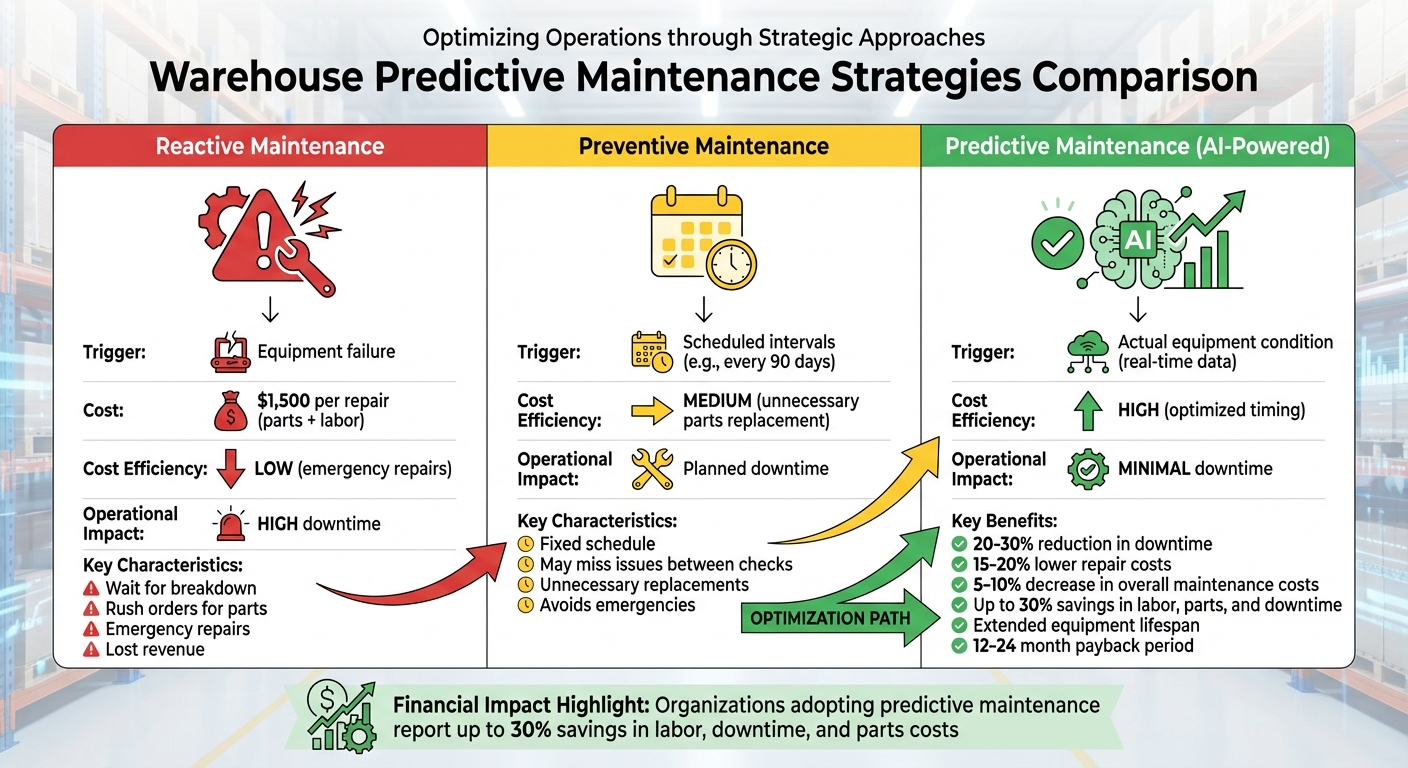
Reactive vs Preventive vs Predictive Maintenance: Cost and Downtime Comparison
Predictive maintenance (PdM) is a condition-based strategy that uses real-time data from equipment to estimate wear and tear, allowing maintenance to be scheduled at the perfect time. Instead of relying on fixed schedules or waiting for a breakdown, PdM continuously monitors equipment health and triggers action only when necessary.
AI takes PdM to the next level by not just identifying symptoms but uncovering the root causes of potential issues. For instance, while traditional tools might flag high vibration levels, AI digs deeper, analyzing patterns across data like vibration, temperature, and oil quality. This helps pinpoint issues such as bearing wear, misalignment, or lubrication problems. In warehouse distribution centers, this means critical equipment gets the attention it needs before failure occurs, avoiding the disruptions and costs associated with reactive maintenance. This process hinges on specific technologies that transform constant streams of data into actionable insights.
"Traditional predictive maintenance tools detect symptoms; AI detects root causes." – Tractian
The financial stakes are high. Industrial manufacturers lose an estimated $50 billion annually due to unexpected equipment failures. By adopting PdM, businesses can increase equipment uptime by 10%–20%, cut maintenance planning time by 20%–50%, and reduce overall maintenance costs by 5%–10%. These benefits come from replacing infrequent manual checks with continuous monitoring.
Technologies That Power Predictive Maintenance
AI-driven predictive maintenance depends on three key technologies working together:
- IoT Sensors: These sensors collect data on temperature, vibration, pressure, oil condition, and thermal signatures.
- Machine Learning Algorithms: These algorithms analyze both historical and live data to detect anomalies and differentiate between normal operations and potential failures.
- Real-Time Monitoring Systems: These systems process sensor data instantly and integrate insights into maintenance platforms, such as CMMS or ERP systems, to create actionable work orders.
For example, Ingredion implemented AI-powered PdM, saving $1.6 million in production costs and avoiding 168 hours of unplanned downtime. Similarly, CP Kelco used AI insights to save $446,000 and prevent 84 hours of downtime by converting data into planned maintenance tasks.
Proactive vs. Reactive Maintenance: What’s the Difference?
To understand why AI-driven approaches are more efficient, it helps to compare the timing and cost-effectiveness of different maintenance strategies:
- Reactive Maintenance: This approach waits for equipment to break down, leading to emergency repairs, rush orders for parts, and significant downtime. A single reactive repair can cost around $1,500 in parts and labor, not including lost revenue.
- Preventive Maintenance: This method follows a fixed schedule, like replacing parts every 90 days or after a specific number of operating hours. While it avoids emergencies, it can lead to unnecessary part replacements and may miss issues that arise between scheduled checks.
- Predictive Maintenance: By relying on real-time data, this strategy ensures tasks are performed only when needed. It extends equipment lifespan, reduces labor and parts costs, and transforms unexpected failures into shorter, planned maintenance windows.
| Maintenance Strategy | Trigger | Cost Efficiency | Operational Impact |
|---|---|---|---|
| Reactive | Equipment failure | Low (emergency repairs) | High downtime |
| Preventive | Scheduled intervals | Medium (unnecessary parts) | Planned downtime |
| Predictive (AI) | Actual condition | High (optimized timing) | Minimal downtime |
Organizations adopting condition-based frameworks have reported up to 30% savings in labor, downtime, and parts costs.
Measuring ROI: Financial and Operational Metrics
To measure ROI effectively, consider metrics like Simple Payback, NPV, and IRR. These tools help quantify both immediate cost savings and the long-term operational benefits of AI-driven maintenance systems. They provide clear insights into how predictive maintenance translates into measurable financial outcomes.
When evaluating labor savings, use fully loaded hourly rates, which include benefits, payroll taxes, recruitment, training, and liability costs – not just base wages. For example, U.S. warehousing wages increased nearly 25% between 2019 and 2023. A simple formula for calculating labor savings is: Hours Saved per Day × Days per Year × Fully Loaded Hourly Rate. Beyond labor, ROI should also factor in throughput protection, which reflects the contribution margin from additional orders shipped due to improved equipment uptime. In industries like automotive manufacturing, unplanned downtime can cost as much as $22,000 per minute.
However, it’s crucial to account for potential downsides like false positives. Incorrect predictions that lead to unnecessary interventions can eat into savings. Running sensitivity tests with varied inputs is a smart way to refine these calculations.
Lower Maintenance Costs
Predictive maintenance powered by AI significantly reduces the most expensive aspects of traditional maintenance: emergency repairs, expedited part shipments, and unnecessary scheduled replacements. By catching problems early, predictive models can lower repair costs by 15–20%. For example, a medical-device manufacturer implemented an Advanced Troubleshooting (ATS) system using historical failure data and sensors. This initiative led to an 18% to 25% reduction in maintenance costs and improved customer satisfaction by minimizing equipment downtime.
Early detection also eliminates premium costs like overtime labor, rush shipments, and collateral damage. Predictive maintenance saves over 10% per predicted breakdown by avoiding these extra expenses. Additionally, it reduces the need for "just-in-case" spare part inventories, freeing up capital and improving procurement efficiency.
"Predictive maintenance can be very valuable. In situations with very high cost or safety issues associated with a breakdown… operators need the closest estimate possible of when a breakdown might occur." – McKinsey
Reduced Downtime
Minimizing downtime is another powerful way AI-driven predictive maintenance contributes to ROI. In most cases, it can reduce downtime by 20–30%. For instance, conveyor systems in large warehouses typically experience annual downtime of 5–8% without predictive analytics. In 2023, a manufacturer applied predictive models to material handling equipment across two distribution centers, saving $400,000 annually in downtime costs by using sensor data to prevent breakdowns.
The financial benefits grow with the size and throughput of the facility. For example, reducing just 10 minutes of unplanned downtime per day on a high-value electronics line can result in savings of over $220,000 daily. These savings go beyond the immediate issue, as preventing one equipment failure often avoids cascading problems that could disrupt other operations and lead to widespread outages. For conveyor-heavy warehouse sites, the typical payback period for predictive maintenance is 12–24 months.
Longer Equipment Lifespan and Better Asset Use
AI-driven maintenance doesn’t just cut costs – it also improves the reliability and performance of assets. By ensuring machines operate within their optimal parameters and receive timely maintenance, predictive systems extend equipment lifespan. This delays costly capital expenditures on replacements. Additionally, assets nearing failure often operate outside specifications, which can compromise product quality and create safety risks. AI acts as a safeguard by flagging these issues early.
Over time, the financial benefits compound. Shifting from reactive repairs to proactive maintenance allows teams to focus on high-value preventative tasks rather than emergency fixes. Companies using condition-based maintenance frameworks have reported significant cumulative savings. To maximize ROI, focus predictive maintenance efforts on critical assets – like main conveyors or sorters – where failures would immediately disrupt production.
Operational Benefits and Competitive Advantages
AI-powered predictive maintenance bolsters operational strength, delivering better uptime, enhanced safety, and a stronger market edge. For instance, warehouses leveraging these systems can confidently tackle peak periods, like Black Friday, without worrying about unexpected equipment failures. This reliability becomes a game-changer when competitors are grappling with sudden breakdowns. Let’s dig into how this translates into improved uptime, safety, and customer satisfaction.
Better Uptime and Operational Reliability
AI excels at forecasting the Remaining Useful Life (RUL) of equipment and sending real-time alerts. This allows maintenance to be scheduled during slower periods, ensuring machines stay operational when they’re needed most. Operators can even redistribute workloads to maintain steady throughput while repairs are underway. The result? A proactive approach that slashes downtime by 30%–50%.
"Maximize uptime and improve overall equipment effectiveness (OEE) by using AI to forecast when machinery needs maintenance." – Intel
Beyond just preventing downtime, AI systems catch small issues – like a motor malfunction in a conveyor – before they escalate into full-blown failures. Unlike traditional tools that only highlight symptoms, AI dives into complex data patterns to pinpoint root causes. This precision ensures that repairs are done right the first time, significantly cutting Mean Time to Repair (MTTR).
Improved Safety and Lower Risk
AI isn’t just about efficiency – it’s also about safety. Predictive maintenance identifies risks like overheating or misalignment well before they lead to dangerous equipment failures. This is a big deal, considering that 70% of workplace injuries occur during reactive maintenance when technicians are rushing to fix unexpected breakdowns.
"70% of workplace injuries occur during reactive maintenance." – Emily Newton, Editor in Chief, Revolutionized
By shifting to planned, condition-based maintenance, repairs happen in controlled environments rather than in crisis mode, reducing the likelihood of mistakes and accidents. AI even spots micro-anomalies that human senses might miss, enabling early interventions. For example, a chemical company using predictive maintenance on its extruders saw an 80% drop in unplanned downtime and saved $300,000 per asset – all while enhancing workplace safety.
Improved safety doesn’t just protect employees; it also strengthens the overall reliability of operations.
Better Customer Experience and Market Position
When equipment stays up and running, warehouses can guarantee on-time deliveries – even during high-demand periods. This reliability allows businesses to promise tighter delivery windows and handle spikes in order volumes without compromising customer satisfaction. Companies using predictive tools have reported a 20%–50% boost in service levels.
Such operational reliability sets businesses apart. By late 2025, 9 out of 10 warehouses will use AI or advanced automation, but those with well-developed predictive maintenance programs will stand out by offering faster, more consistent service.
"The data show that intelligent warehouses outperform not only in volume and accuracy, but in adaptability." – Javier Carrillo, CEO of Mecalux
In a competitive market, this kind of edge can make all the difference.
How to Implement Predictive Maintenance and When to Expect ROI
Using AI-driven predictive maintenance can cut downtime and deliver measurable returns on investment (ROI). The process might seem daunting at first, but starting small, proving its value, and then scaling up can make it manageable. Many businesses see ROI in a relatively short time.
Steps for Implementing AI-Driven Maintenance
Begin by identifying the most critical assets in your operation – those whose failure would immediately disrupt production. Equipment like main conveyors, sorters, or automated storage systems that run over 1,500 hours annually are ideal candidates for your pilot program. These high-usage assets tend to offer quicker payback.
Next, focus on your data infrastructure. Collect data from IoT sensors (such as vibration, temperature, and ultrasound), your Warehouse Management System (WMS), Computerized Maintenance Management System (CMMS), and historical maintenance records. Clean and standardize this data before feeding it into AI models, as incomplete or inaccurate data will lead to unreliable predictions.
System integration is another crucial step. Connect your AI solution to existing ERP or Digital Work Management systems. This setup ensures that alerts from the AI automatically trigger work orders and spare parts requests, streamlining the process and eliminating delays.
"The challenges of predictive maintenance are not rooted in the technology itself, but rather stem from… data infrastructure and [failure] to operationalize predictive maintenance on the shop floor." – BCG
Change management is equally important. Involve your maintenance technicians and operators from the start. Designate "super users" to advocate for the system on the shop floor and establish feedback loops so data scientists can fine-tune the AI models. Clear communication between data teams and technicians ensures that AI recommendations are actionable.
Finally, commit to ongoing model refinement. Initially, fine-tune the AI to improve precision and recall. Schedule quarterly validations to minimize model drift, especially as demand patterns and product mixes evolve. With these steps in place, the benefits and ROI of predictive maintenance become apparent.
Typical Payback Periods
For material handling equipment and conveyors, ROI is typically achieved within 12 to 24 months. Some advanced AI systems can start streaming live data within hours, identifying early-stage faults in the first week and enabling full-scale deployment in as little as 90 days.
Several factors influence how quickly you’ll see returns. For example, using AI models across similar assets speeds up deployment. If uptime directly correlates to higher sales, the payoff is faster. Additionally, well-documented failure modes for critical assets can lead to quicker results.
Real-world examples highlight the potential savings. Trenitalia equipped 1,500 locomotives with sensors, reducing downtime by 5% to 8% and cutting their $1.3 billion annual maintenance costs by 8% to 10%, saving around $100 million annually. Ingredion saved $1.6 million in production costs and avoided 168 hours of downtime. CP Kelco prevented 84 hours of downtime and saved $446,000 by turning AI insights into planned maintenance.
The upfront investment pays off through three primary channels: reducing labor costs by minimizing emergency repairs, protecting against downtime during peak periods, and extending asset lifespans to delay expensive replacements. With cloud inference costs dropping by 70% since 2020, achieving ROI is now more accessible than ever.
Conclusion
AI-powered predictive maintenance is revolutionizing warehouse operations while delivering tangible financial benefits. Facilities adopting this approach report 20–30% reductions in downtime, 15–20% lower repair costs, and 5–10% decreases in overall maintenance expenses. With payback periods typically ranging from 12 to 24 months, it’s an investment that quickly justifies itself.
But it’s not just about saving money. Predictive maintenance fundamentally changes how warehouses operate. By shifting from reactive problem-solving to proactive planning, teams can work more efficiently, improving workforce utilization and job satisfaction. Equipment lasts longer, workplace safety improves, and operations become more dependable – directly enhancing customer satisfaction and helping businesses meet service level agreements.
"The data show that intelligent warehouses outperform not only in volume and accuracy, but in adaptability. As peak season approaches, companies that have invested in AI aren’t just faster – they’re more resilient." – Javier Carrillo, CEO, Mecalux
With 60% of warehouses already integrating AI and declining cloud costs making adoption more accessible, the barriers to entry are lower than ever. These financial and operational advantages are driving a shift in competitive strategy across the industry.
For warehouses grappling with labor shortages, rising costs, and growing customer demands, predictive maintenance offers a clear path to long-term success. The technology is proven, the benefits are well-documented, and implementation is straightforward. The question isn’t whether it works – it’s whether you can afford to wait while others gain the edge with greater uptime, reduced costs, and enhanced resilience.
FAQs
How does AI-powered predictive maintenance enhance warehouse safety?
AI-driven predictive maintenance is transforming warehouse safety by tackling equipment issues before they escalate into failures. Using machine learning, these systems analyze sensor data – like vibration, temperature, and power consumption – to identify early signs of wear or potential malfunctions. This allows maintenance teams to plan repairs ahead of time, cutting down on the risks tied to unexpected breakdowns and last-minute fixes.
By minimizing unplanned downtime, workers face fewer hazards, such as exposure to moving parts, sudden energy releases, or spills. Additionally, AI systems deliver real-time alerts for dangerous conditions, like overheating motors or excessive strain on equipment. This enables operators to act swiftly, reducing the likelihood of accidents. These proactive measures not only lower injury rates but also foster a safer, more controlled work environment, all while helping businesses stay aligned with safety regulations.
What are the first steps to implement AI-driven predictive maintenance in warehouse operations?
To kick off AI-driven predictive maintenance in your warehouse, start by setting clear objectives and pinpointing the critical equipment you need to monitor. For instance, your goal might be to cut down on unplanned downtime or streamline maintenance expenses by concentrating on high-value machinery.
The next step is to install advanced sensors – think vibration monitors, temperature sensors, or oil-analysis tools – to gather real-time data from the equipment you’ve identified. Make sure this data is stored in a centralized, well-organized system, where it’s properly labeled and ready for analysis.
With your data in place, deploy an AI-powered analytics tool to spot anomalies and generate actionable insights. These insights should then be seamlessly integrated into your maintenance workflows, giving technicians clear, prioritized tasks to tackle potential problems before they escalate. When paired with proper training and processes, this strategy can greatly improve efficiency and boost the return on investment for your warehouse operations.
What challenges should warehouses consider before adopting AI-driven predictive maintenance?
AI-driven predictive maintenance comes with a host of advantages, but it’s not without its challenges. One of the biggest hurdles is the upfront cost. Setting up the necessary sensors, data infrastructure, and machine-learning platforms can quickly add up, often costing anywhere from tens of thousands to hundreds of thousands of dollars. For smaller or midsize businesses, this kind of expense can put a strain on cash flow, especially if the return on investment (ROI) takes longer than expected.
Another major issue lies in data quality and system integration. If the sensor data is incomplete or inaccurate, it can lead to false alarms or, even worse, missed failures – both of which undermine the reliability of AI predictions. On top of that, integrating AI tools into existing warehouse systems isn’t always straightforward. It often requires specialized expertise and significant IT resources, which can not only slow down the rollout but also drive up costs. And let’s not forget the ongoing work – regular maintenance and updates to the AI models are essential to keep everything running smoothly, adding another layer of complexity to operations.