

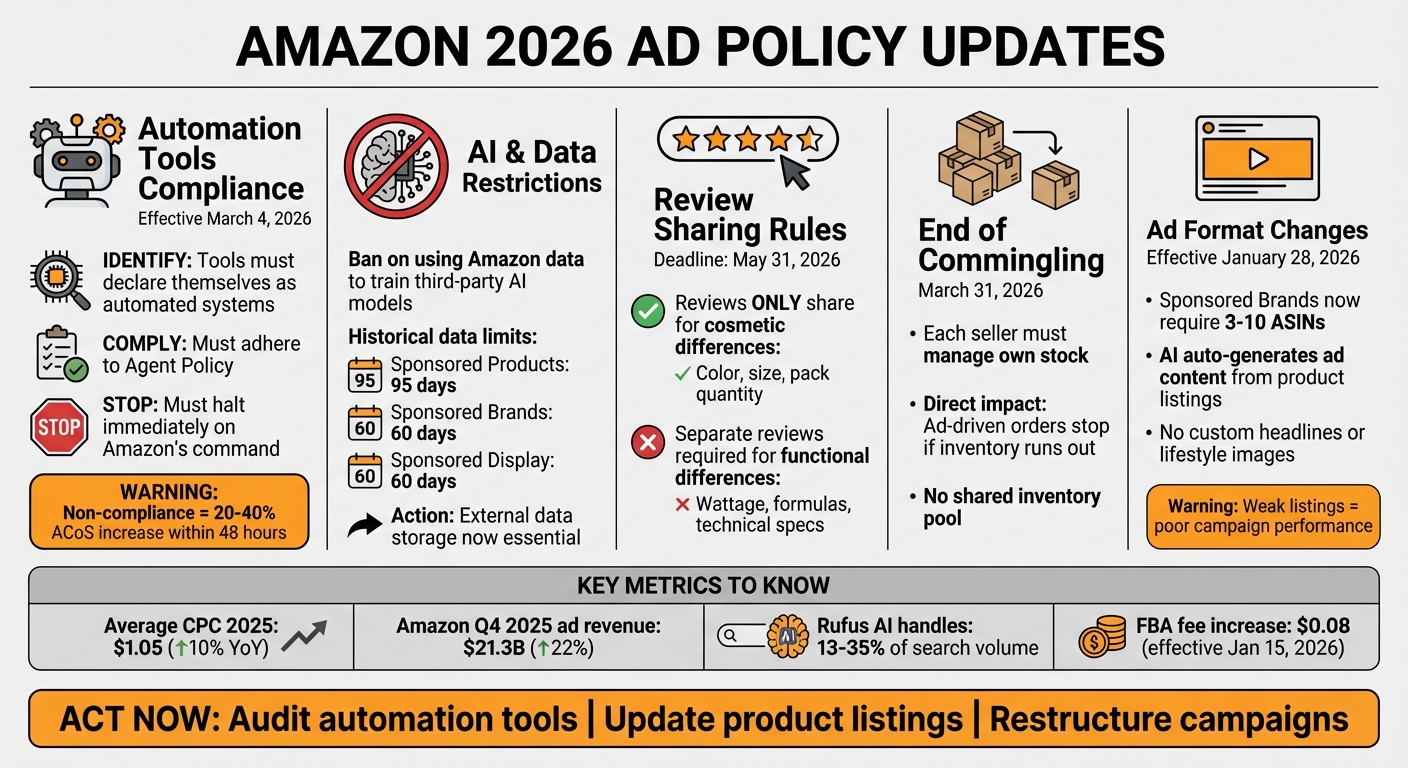
Amazon‘s 2026 ad policy updates are reshaping how sellers operate. If you’re still using outdated strategies, you risk higher costs, campaign rejections, and account issues. Here’s what’s changed and what you need to do:
- Automation Tools: Starting March 4, 2026, all automated tools must comply with new rules, including identifying themselves, following Amazon’s policies, and stopping on command. Non-compliance could freeze campaigns and increase ACoS by 20–40% within 48 hours.
- AI Restrictions: Sellers can no longer use Amazon’s data to train third-party AI models. Historical ad data is now limited to 60–95 days, making external data storage essential.
- Review Rules: Reviews can only be shared among variations with cosmetic differences (e.g., color, size). Functional differences require separate review bases by May 31, 2026.
- End of Commingling: As of March 31, 2026, inventory commingling ends. Each seller must manage their own stock, directly impacting ad-driven orders if inventory runs out.
- Ad Formats: Sponsored Brands now require 3–10 ASINs, and AI auto-generates ad content based on product listings. Weak listings can hurt campaign performance.
What to do now: Audit your automation tools for compliance, update product listings for AI-driven ad formats, and restructure campaigns to align with Amazon’s new policies. Sellers who act quickly can avoid penalties and protect their profitability.
Amazon 2026 Ad Policy Updates: Key Changes and Compliance Requirements
Amazon Seller Updates – January 2026
sbb-itb-e2944f4
What Changed in Amazon’s 2026 Ad Policies
In early 2026, Amazon introduced four major updates that reshaped how sellers interact with the platform. These changes demand adjustments in tools, review strategies, and inventory management to avoid penalties, with strict enforcement for non-compliance.
New Limits on AI and Machine Learning Use
Amazon’s updated Business Solutions Agreement (Section 4.2) now bans the use of Amazon’s data, materials, or services to train or enhance third-party AI models. This means sellers can no longer scrape advertising performance data to create predictive algorithms or reverse-engineer Amazon’s bidding systems.
Additionally, access to historical advertising data has been restricted. Sponsored Products data is now limited to 95 days, while Sponsored Brands and Sponsored Display data are capped at 60 days. Sellers relying on year-over-year optimization must save historical data externally before it disappears from Amazon’s reporting tools.
Amazon’s own AI tools, however, remain available. For instance, the Rufus shopping assistant now handles between 13% and 35% of Amazon’s search volume. Similarly, Amazon’s predictive budget model can overspend a declared daily budget by up to 25% when it detects high purchase intent. As Lisa Jones from Seller Labs aptly noted:
"Amazon built the pipes. They didn’t build the brain. Speed without context is just making expensive mistakes faster."
Business Solutions Agreement Updates
The March 4, 2026, update to the Business Solutions Agreement introduced Section 19, outlining rules for “Agents” – automated tools, AI systems, or bots accessing Amazon Services. This includes tools like repricers, PPC automation software, browser extensions, and fulfillment scripts.
Every automated tool must meet these requirements:
| Requirement | What It Means | Your Action |
|---|---|---|
| Identify | Tools must declare themselves as automated systems | Verify API headers identify as bots |
| Comply | Tools must adhere to the Agent Policy | Ensure vendor compliance documentation is up to date |
| Stop | Tools must halt access immediately upon Amazon’s request | Confirm a "kill switch" is implemented |
Chuck Kessler from Canopy Management highlighted the importance of compliance:
"If your tools can’t stop on command, you have a compliance problem."
Sellers were given just two weeks – from February 18, 2026 – to audit their automation tools. Continuing to use Amazon Selling Services after March 4 automatically signaled acceptance of these terms.
Amazon also introduced changes to how product reviews are shared across variations, altering how sellers manage reviews.
Review Sharing and Product Variation Rules
As of February 12, 2026, Amazon restricted the pooling of reviews across product variations. Reviews now only share among variations that differ in cosmetic attributes, such as color, size, or pack quantity. Variations with functional differences – like wattage in electronics, formulas in supplements, or other technical specifications – must build separate review bases for each child ASIN.
The enforcement period for these rules ends on May 31, 2026. Sellers are encouraged to use programs like Amazon Vine to secure ASIN-specific reviews before the deadline. Aggregating reviews under a single parent ASIN is no longer allowed for products with functional differences.
Amazon also made sweeping changes to its inventory practices to improve catalog accuracy.
End of Commingling Inventory
On March 31, 2026, Amazon permanently ended commingling inventory. Previously, identical products from multiple sellers were stored together at fulfillment centers, allowing Amazon to ship the nearest unit to the customer, regardless of the seller.
Under the new policy, every seller must assign unique identifiers to their inventory. While this change reduces counterfeit risks and improves catalog accuracy, it also ties advertising campaigns directly to a seller’s specific stock. If inventory runs out, ad-driven orders stop immediately, as there’s no longer a shared inventory pool to fulfill them.
How These Policy Changes Affect Sellers
The recent policy updates are reshaping how sellers manage their ad campaigns, with immediate effects on approvals, costs, and creative flexibility.
Higher Risk of Campaign Rejections and Suspensions
Under the new Business Solutions Agreement, effective March 4, 2026, all automated tools must meet strict identification and control standards. Sellers relying on third-party PPC tools that fail to comply could face serious consequences, such as API blocks, campaign suspensions, or even losing their advertising privileges altogether.
Changes in CPC and Ad Performance Metrics
Cost-per-click (CPC) rates have been steadily climbing, reaching an average of $1.05 in 2025 – a 10% increase compared to the previous year. Competitive categories are seeing even sharper increases in 2026, with mid-teens percentage hikes. Adding to the complexity, Amazon’s updated attribution model now prioritizes "discovery moments" and shortens conversion windows for shoppers already in the purchase funnel. This can lead to fewer reported conversions for upper-funnel campaigns, even if their actual performance remains unchanged.
Amazon’s predictive budget model has also introduced a new twist: it can overspend daily campaign budgets by up to 25% when it detects high purchase intent. Combine this with a $0.08 increase in FBA fulfillment fees (effective January 15, 2026), and sellers are feeling the pinch. Products priced under $15 are particularly vulnerable, making it essential to reevaluate unit economics to maintain profitability.
"Amazon PPC is no longer a keyword auction. The budget rules, bidding algorithms, attribution models, and ad formats have all been rebuilt for a customer matching model. The sellers losing ground in 2026 are running 2023 playbooks."
Updated Ad Format and Content Requirements
As of January 28, 2026, Sponsored Brands Product Collections have undergone significant changes. Sellers no longer have manual creative control – custom headlines and lifestyle images have been replaced by AI-driven content that pulls directly from product listings. Campaigns now require at least 3 ASINs and can include up to 10, meaning campaigns with fewer products cannot add new ad groups.
Additionally, AI-powered Prompts became widely available on March 25, 2026. These prompts automatically display contextual information to shoppers based on product listing data, with engagement billed at standard CPC rates. Campaigns are automatically enrolled in this feature. Because ad content is now auto-generated, the quality of your product listings plays a critical role in campaign success. Weak or outdated descriptions can lead to poorly performing ads, resulting in lower click-through rates. To adapt, sellers need to audit and optimize their product listings immediately to stay competitive in this new environment.
These changes demand a proactive approach to ensure compliance and protect ad performance in an evolving marketplace.
How to Stay Compliant with Amazon’s Ad Policies
Navigating Amazon’s constantly changing ad policies requires proactive steps to ensure your advertising operations stay compliant. The updates effective March 2026 aren’t optional – they’re enforceable rules that can lead to campaign shutdowns or account suspensions if ignored. Here’s how to act now and stay ahead.
Audit and Update Your Campaigns
Start by reviewing the Prompts tab in each ad group. As of March 25, 2026, Amazon has been auto-generating AI-powered prompts for Sponsored Products and Brands campaigns, pulling details directly from product listings. While this sounds convenient, these prompts aren’t always accurate, so it’s crucial to edit any misleading content.
Next, reorganize your Sponsored Brands Collections to include at least 3 ASINs (and no more than 10). This adjustment helps meet Amazon’s new performance requirements and avoids errors during ad group creation. You’ll need to choose between "Automatic mode", where Amazon’s AI selects products, or "Manual mode", where you make the selections yourself. Remember, this choice is permanent for each ad group, so make it carefully.
Additionally, ensure all PPC tools used in your campaigns comply with the updated Business Solutions Agreement. Confirm with your software providers that their tools self-identify as agents, as non-compliance could result in API blocks or account restrictions.
Don’t forget to review your ad creative. Amazon’s new standards require headlines to use sentence case (capitalize only the first word and proper nouns). Avoid using superlatives like "the best", language that pressures buyers such as "Last chance", or fake functionality like non-clickable button shapes. Images must meet a minimum resolution of 72 ppi and should not include letter-box or pillar-box formats.
After updating your campaigns, shift your focus to refining your bidding strategies for better alignment with Amazon’s new ad model.
Adjust Bids and Keyword Strategies
Amazon’s automated bidding system now requires 30 conversions within a 30-day period to function effectively. Review a 30-day performance report to identify campaigns with fewer than 15 conversions per month. Low-performing campaigns should be merged into broader segments to provide Amazon’s algorithms with the data they need to optimize bids.
"The old playbook is broken. Hyper-segmented campaigns starve Amazon’s algorithms of the conversion data they need to optimize bids effectively." – Ash Metry, Founder & CEO, Keywords.am
To streamline your campaigns, divide them into three main categories:
- Brand Defense: Focus on exact match branded terms.
- Mid-Funnel Consideration: Use phrase, broad, or competitor targeting.
- Upper-Funnel Exploration: Opt for automatic targeting.
This structure ensures that each campaign gathers enough conversion data to enable effective machine learning optimization.
Set portfolio-level budget caps to manage Amazon’s predictive budget model, which can overspend daily budgets by up to 25% when it detects high purchase intent. Keep a close eye on key metrics like CTR and ROAS. A low CTR can signal poor ad relevance and limit impressions. Allow campaigns at least four weeks to stabilize before making any major adjustments to bids.
Track Account Health and Fix Issues Quickly
Once your campaigns are updated and bids optimized, monitoring becomes essential to avoid unexpected penalties. Regularly check your Account Health Dashboard, ideally on a daily basis, as Amazon’s AI-driven moderation flags violations based on keyword triggers or sudden sales spikes. For serious issues like counterfeit claims or safety concerns, you’ll have just 12 to 24 hours to respond before facing account deactivation.
If you’re using Fulfilled by Merchant (FBM), ensure returns are processed within 4 calendar days. Missing this deadline results in an automatic refund to the buyer, which is nearly impossible to dispute. Set internal alerts at 72 hours to inspect and document returns before the deadline.
Keep all authorization letters, supplier invoices, and safety certificates readily available. Most appeals now require these documents, and policy violations may remain visible on your dashboard for up to 180 days even after resolution. It’s also smart to prepare "Plan of Action" templates that address the root cause of violations, detail corrective actions taken, and outline future preventive measures.
Working with Experts for Policy Management
Once you’ve updated your campaigns and fine-tuned your strategy, having expert support can make navigating compliance smoother and help fuel growth.
Amazon’s 2026 policy updates bring a level of complexity that often exceeds the capabilities of internal teams. With the shift from keyword auctions to customer-matching models, stricter AI restrictions, and revamped ad formats, older strategies simply don’t cut it anymore. Sellers attempting to manage these changes on their own risk higher costs per click, campaign rejections, and even account suspensions.
How Emplicit Supports Amazon Compliance

Emplicit takes a proactive approach to monitoring account health, addressing potential policy violations before they escalate. For example, when the March 4, 2026 Business Solutions Agreement updates were implemented, their team conducted preemptive audits of clients’ PPC tools to ensure compliance with new AI and machine learning restrictions. In one case, they identified a non-compliant third-party tool, prepared appeal documents, and helped a client regain full API access within just 48 hours.
Emplicit’s PPC management services are tailored to meet the demands of the 2026 updates. They adjust Sponsored Brands Product Collections to align with the new 3–10 ASIN minimum, transition single-ASIN campaigns to Sponsored Products, and introduce portfolio-level budget caps to avoid overspending under the revised budget rules. One client saw impressive results with Emplicit’s single-keyword ad groups and New-to-Brand bid boosts, achieving a 25% improvement in ACoS and doubling new customer orders.
They also optimize listings for AI-driven surfacing, an essential step after the removal of custom headlines and images from Sponsored Brands Product Collections on January 28, 2026. A fashion brand client, for instance, experienced a 35% increase in conversions after switching to Sponsored Brands Video and incorporating Sponsored Products into new placements like Alexa Plus on Echo Show. On average, Emplicit’s clients see a 30–45% boost in marketplace revenue within their first 90 days and a 35% drop in listing compliance issues.
But success doesn’t stop at Amazon – effective strategies should span all marketplaces for cohesive growth.
Expanding Across Multiple Marketplaces
Emplicit’s expertise extends beyond Amazon, offering streamlined compliance and performance management on platforms like TikTok Shops, Walmart, and Target. They provide a unified dashboard that applies Amazon-level compliance standards across these channels. For example, a mid-sized brand partnered with Emplicit to overhaul their Amazon PPC campaigns following the BSA updates while expanding to TikTok Shops. The result? A 2.5× increase in ad revenue, 100% compliance, and an ACoS under 25%. Another seller transitioning from Amazon to Walmart used Emplicit’s strategies to maintain 98% compliance while increasing omnichannel revenue by 60% [context].
Emplicit’s time-based pricing model ensures predictable costs by charging only for work completed – no percentages of sales or ad spend. Their implementation process begins after a two-week discovery phase, with clients typically seeing results by weeks 3–4. On average, businesses recover between $150,000 and $300,000 in lost revenue opportunities and achieve sustained year-over-year growth of 20–25%.
Conclusion
Amazon’s 2026 ad policy updates represent a major transformation in how sellers interact with the platform. Key changes include the introduction of formal "Agent" requirements for automated tools under the March 4 Business Solutions Agreement, new restrictions on AI training, and a shift from keyword auctions to customer matching models. Additionally, with inventory commingling ending on March 31 and stricter rules for review sharing now in effect, sellers must adapt quickly to these changes. The adoption of AI-driven ad formats further signals that strategies from 2023 are no longer effective.
The numbers tell the story: average CPC rose to $1.05 in 2025, reflecting a 10% year-over-year increase. Meanwhile, Amazon’s Q4 2025 ad revenue reached $21.3 billion, a 22% jump. Rufus AI now manages an estimated 13% to 35% of search volume, and a small group of fewer than 8,000 sellers – just 1.6% of the total – accounts for 50% of Amazon’s $300 billion US third-party GMV. These changes demand swift and strategic action.
"Amazon PPC is no longer a keyword auction. The budget rules, bidding algorithms, attribution models, and ad formats have all been rebuilt for a customer matching model. The sellers losing ground in 2026 are running 2023 playbooks." – Ecombrainly
Compliance is no longer just about avoiding penalties – it’s now a pathway to growth and a key competitive edge. Sellers who audit their tools, optimize listings for AI-driven algorithms, and adjust to the new shopping-signal attribution model will outperform those who don’t. The stakes are high: non-compliant automation could increase ACoS by 20–40% within 48 hours and delay organic ranking recovery by 9–12 weeks. These risks highlight the urgency of adapting to Amazon’s evolving marketplace.
Whether you manage campaigns in-house or partner with a service like Emplicit, focus on these priorities: ensure third-party tool compliance, restructure campaigns to align with ASIN and AI-driven ad formats, monitor account health weekly, and prepare for the permanent end of commingling. Sellers who treat these updates as opportunities rather than obstacles will position themselves for success in Amazon’s AI-driven landscape.
FAQs
How do I check if my PPC automation tool meets Amazon’s new “Agent” rules?
Amazon’s updated "Agent" rules, effective March 4, 2026, bring specific requirements for PPC automation tools. To ensure your tool aligns with these changes, here’s what you need to do:
- Identify as Automated: Your tool must clearly identify itself as an automated system during all interactions with Amazon.
- Immediate Access Termination: The tool should have the capability to stop accessing Amazon immediately if requested.
- Follow Data Use Guidelines: Ensure your tool complies with Amazon’s restrictions on how data is used, including limitations on AI training.
Take a moment to review your tool’s documentation or settings. Verifying compliance now can help you avoid potential account restrictions in the future.
What’s the best way to keep ad performance history now that Amazon limits data to 60–95 days?
To keep your ad performance history intact despite Amazon’s 60–95 day data retention limit, make it a habit to export and save detailed reports regularly. This allows you to maintain a long-term view of your campaign performance. Additionally, consider using third-party tools or dashboards to monitor key metrics like impressions, clicks, and ACoS in real time. These tools ensure you always have access to historical data for deeper analysis and informed decision-making.
How should I restructure listings and campaigns now that Sponsored Brands ads are AI-generated?
Sponsored Brands ads are shifting to an AI-generated format, and starting January 28, 2026, there are new requirements to meet. Each product collection in these campaigns must include at least 3 ASINs.
To adapt successfully, focus on organizing cohesive product groups. Grouping products that complement each other can improve ad relevance and appeal. Additionally, pay close attention to headlines and images – these elements should align with AI algorithms while remaining engaging for shoppers.
By restructuring your listings and campaigns now, you’ll ensure your ads remain compliant and continue to perform well under these updated guidelines.