

Amazon is making big changes to its delivery and fulfillment systems in 2026, and sellers need to stay ahead to avoid disruptions. Here’s a quick breakdown of the key updates and their impact:
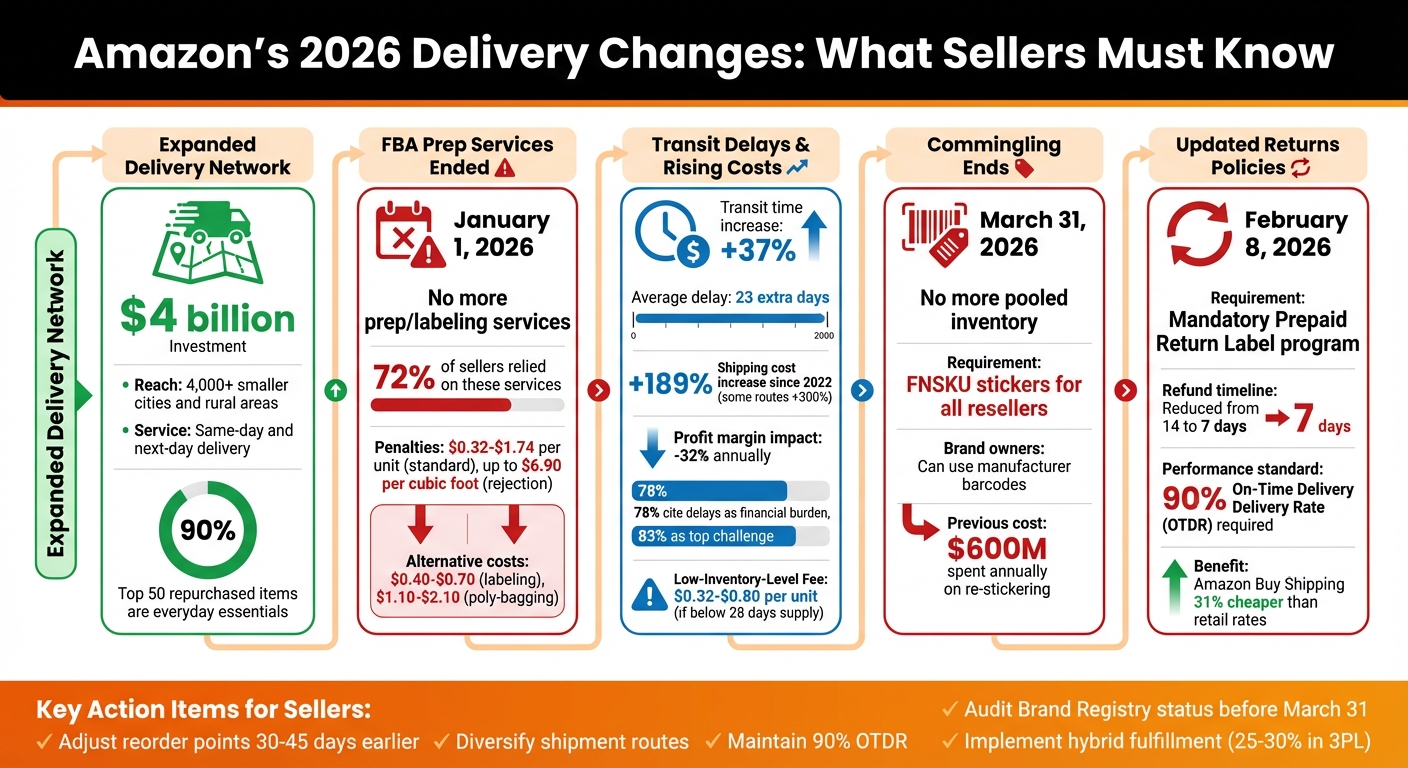
- Expanded Delivery Network: Amazon is investing $4 billion to triple its delivery reach, bringing same-day and next-day services to over 4,000 smaller cities and rural areas. AI-driven demand forecasting is helping stock products closer to customers.
- FBA Prep Services Ended: As of January 1, 2026, Amazon no longer offers prep and labeling services for U.S. inbound shipments. Sellers must ensure all items are prepped and labeled before arriving at fulfillment centers or face penalties.
- Transit Delays and Rising Costs: Shipping delays have increased by 37%, and transit times now average 23 extra days. Shipping costs are up by 189% since 2022, cutting into seller profit margins.
- Commingling Ends: Starting March 31, 2026, Amazon will phase out commingling inventory. Sellers must label all products with FNSKU stickers unless they are brand owners using manufacturer barcodes.
- Updated Returns Policies: From February 8, 2026, all seller-fulfilled orders must use Amazon’s Prepaid Return Label program, with faster refund processing and stricter compliance requirements.
Key Takeaway: Sellers must adjust their logistics, improve inventory management, and comply with stricter standards to maintain account health and profitability.
Amazon 2026 Delivery Changes: Key Updates and Deadlines for Sellers
Amazon‘s 2026 Delivery Changes
Amazon’s latest delivery updates for 2026 are reshaping how sellers operate in three key areas: expanded delivery networks, changes to Fulfillment by Amazon (FBA) prep services, and growing concerns over shipping delays. Let’s break down what these changes mean for your business.
Same-Day and Next-Day Delivery Expansion
Amazon is pouring $4 billion into transforming its delivery network, converting existing stations into hybrid hubs to support same-day and next-day delivery in over 4,000 smaller cities and rural areas. By using AI-driven demand forecasting, Amazon is stocking products that align with local needs. Everyday essentials – like groceries, household supplies, and pet products – are seeing explosive growth, with rural areas leading the charge. In fact, over 90% of the top 50 repurchased same-day items in rural areas fall into these categories, doubling their growth rate in Q1 2025.
Doug Herrington, CEO of Worldwide Amazon Stores, summed it up perfectly:
Everybody loves fast delivery. So, whether you live in Monmouth, Iowa, or in downtown Los Angeles, now you’re going to have the same fantastic Amazon customer experience: the ability to get the wide variety of items you need to keep your household running every day, delivered the same or next day.
For sellers using Fulfillment by Amazon (FBA), this regionalized network is a game-changer. The distance between fulfillment centers and customers has been cut by nearly 10% year-over-year, boosting efficiency and setting the stage for even more streamlined operations.
The End of FBA Prep and Labeling Services
Starting January 1, 2026, Amazon officially discontinued its FBA prep and labeling services for all U.S. inbound shipments. This move aligns with Amazon’s broader shift toward automation, as manual tasks like poly-bagging and labeling slow down robotics-driven fulfillment processes. For sellers, this change is significant – nearly 72% of them relied on these services for at least a quarter of their inventory.
Now, every unit must arrive at fulfillment centers fully prepped with FNSKU labels, poly-bagging, or bubble wrap applied in advance. Non-compliant items face steep penalties, including rejection, return, or disposal at the seller’s expense. Inbound defect fees now range from $0.32 to $1.74 per unit for standard items, with hefty rejection fees reaching up to $6.90 per cubic foot. Larger items aren’t spared either, with fees climbing to $5.72 for bulky products.
Sellers have a few options to adapt: handle prep work in-house, partner with third-party logistics providers, or coordinate with manufacturers to apply labels during production. Typical costs include $0.40–$0.70 for FNSKU labeling and $1.10–$2.10 for poly-bagging. Brooks Golba, VP of Fulfillment & Logistics Solutions at Qualfon, highlighted the urgency:
Starting January 1, 2026, Amazon will no longer offer prep and item labeling services for U.S. FBA shipments. Every unit arriving at an Amazon fulfillment center must be fully prepped… prior to arrival.
While these changes aim to streamline fulfillment, they also place added pressure on sellers to ensure compliance.
Rising Transit Times and Shipping Costs
Shipping delays have become a growing headache. In 2026, transit times increased by 37% compared to pre-pandemic levels, with FBA sellers facing an average of 23 extra days for inventory to reach fulfillment centers. These delays are more than just an inconvenience – they’re cutting into profitability. A recent survey found that 78% of sellers say these delays are a major financial burden, while 83% cite them as their top business challenge.
The impact extends to the Inventory Performance Index (IPI), which can restrict storage capacity during critical sales periods. Out-of-stock situations are becoming more common, and when inventory runs dry, competitors often swoop in to claim the Buy Box. In fact, 42% of sellers reported losing the Buy Box due to transit delays. Worse, products that go out of stock see sharp ranking declines, making recovery both time-consuming and expensive. To add to the strain, Amazon now imposes Low-Inventory-Level Fees ranging from $0.32 to $0.80 per unit if the Historical Days of Supply metric dips below 28 days – even for items stuck in transit.
One seller shared a tough lesson: a split shipment left 400 units stranded, triggering $450 in fees in just one morning. To combat these issues, some sellers are strategically splitting shipments across multiple entry points to reduce delays and maintain inventory levels.
Adding to the challenge, shipping costs on major routes have skyrocketed – up 189% on average since 2022, with some routes seeing increases as high as 300%. This has slashed annual profit margins by 32% for many sellers. These rising costs and transit delays are forcing sellers to rethink their logistics strategies to stay competitive and protect their bottom lines.
New Compliance Requirements
As Amazon continues to refine its delivery operations, it’s also introducing updated compliance protocols to better regulate seller performance. Two key policies affecting inventory management and returns have been revised, aiming to improve traceability and create a consistent customer experience. Sellers need to act quickly to avoid penalties and maintain their account health.
Commingling Ends in March 2026
Starting March 31, 2026, Amazon will officially phase out commingling – the practice of pooling identical products from multiple sellers under the same manufacturer barcode. Previously, Amazon used this method to ship the closest available unit of a product. Now, the company is transitioning to virtual tracking, which assigns orders to a specific seller’s inventory and tracks returns accordingly.
After the March 31 deadline, Amazon will no longer pool inventory. Instead, brand representatives can continue using manufacturer barcodes without additional labeling, while resellers must apply FNSKU stickers to all products. Any inventory missing the required barcode after this date will be classified as defective. These updates align with Amazon’s broader efforts to tighten control over seller inventory and enhance operational precision.
Dharmesh Mehta, Amazon’s Vice President of Selling Partner Services, explained the rationale behind this change:
Advancements in logistics (better network placement) and technology (virtual tracking of individual units) eliminated the need for physical pooling to maintain shipping speeds.
Brand owners reportedly spent $600 million in a single year on "re-stickering" products to opt out of commingling and safeguard their brand quality. To comply with the new requirements, sellers must handle all labeling themselves or work with third-party providers. Key preparation steps include auditing Brand Registry status, updating barcode preferences in Seller Central under "Fulfillment by Amazon" settings, and ensuring all shipments meet the new standards before March 31, 2026.
Updated Returns and Refunds Policies
In addition to inventory changes, Amazon is revamping its returns process. Starting February 8, 2026, all U.S. seller-fulfilled orders must participate in Amazon’s Prepaid Return Label program, removing the long-standing exemption for high-value items. Refund processing times will also be reduced from 14 days to just 7 days, and buyer–seller messaging during returns will no longer be allowed, streamlining the process. These updates are part of Amazon’s effort to create a more efficient and standardized customer experience.
Amazon is also enforcing stricter delivery performance standards. Sellers must maintain at least a 90% On-Time Delivery Rate (OTDR) to avoid listing suppression. To meet these standards, sellers are encouraged to enable tools like Shipping Settings Automation (SSA) and Automated Handling Time (AHT). Using Amazon Buy Shipping can also help, as it offers rates that are, on average, 31% lower than retail ground shipping rates.
Gabriela Torres from BellaVix highlighted the importance of these changes:
Effective February 8, 2026, all U.S. seller-fulfilled orders must use Amazon’s Prepaid Return Label program. The long-standing exemption for high-value items is gone.
Amazon has also introduced the "Refund at First Scan" policy, which automatically processes refunds for eligible returns as soon as the buyer drops off the item at a carrier location. Sellers are required to issue refunds within two days of receiving a return. If they fail to do so, Amazon may issue the refund on their behalf. For returns involving damaged or materially different items, sellers can file reimbursement claims through the SAFE-T program, though these claims are often capped at 50% of the item’s value.
To minimize potential losses, sellers should regularly audit product weights and dimensions, document packaging and item conditions before shipping, and consider offering returnless refunds for low-cost items where return shipping costs exceed the item’s value.
sbb-itb-e2944f4
How Sellers Can Adapt
Amazon’s upcoming 2026 delivery changes demand immediate action. Sellers who view logistics as a competitive tool rather than just a cost will be better positioned to protect their margins. To stay competitive and avoid penalties, it’s crucial to update inventory strategies, refine delivery processes, and partner with experienced service providers.
Better Inventory Management
With Amazon phasing out FBA prep services and reducing storage limits from six months to five months of forecasted sales, sellers must rethink their inventory strategies. Relying solely on Amazon is no longer feasible, and hybrid fulfillment models are becoming the go-to solution. A smart approach involves keeping 25–30% of inventory in a U.S.-based third-party logistics (3PL) warehouse and staggering shipments to FBA. This helps mitigate stockouts, especially with shipping delays from Asia to North America now averaging 37% longer.
Amazon Warehousing & Distribution (AWD) has introduced auto-replenishment options that can help sellers avoid the Low-Inventory-Level Fee, which ranges from $0.32 to $0.80 per unit if inventory falls below 28 days. Diversifying shipment routes – using ports like Houston, Savannah, and New York instead of depending solely on LA/Long Beach – has cut stockout incidents by 41%. For those sourcing from China, nearshoring final assembly to Mexico under USMCA rules significantly reduces transit times, from 40–67 days to just 1–5 days. To stay ahead, sellers should adjust reorder points 30–45 days earlier and conduct regular preparation audits to minimize delays.
Improving Delivery Performance
Strong delivery metrics are essential for maintaining listing visibility and sales momentum. A 90% On-Time Delivery Rate (OTDR) is a critical benchmark. To achieve this, sellers can activate SSA and AHT while using Amazon Buy Shipping, which simplifies rate management and provides "OTDR Protection" against carrier delays.
In 2025, Morris Sitt, Ecommerce Manager at We Supply DIY, saved $75,000 to $100,000 in operational costs by switching to Veeqo for multi-channel fulfillment and discounted shipping rates. Amazon’s Fulfillment Insight Dashboard in Seller Central also helps sellers identify and fix inefficiencies, such as "handling time gaps", which can improve delivery estimates and boost Buy Box performance. For those with multiple warehouses, Amazon automatically optimizes delivery dates based on the facility closest to the customer.
Working with Ecommerce Service Providers
Meeting Amazon’s 2026 compliance requirements – like FNSKU labeling and the Prepaid Return Label mandate effective February 8 – can take valuable time away from scaling your business. Full-service providers now handle tasks such as monitoring account health, optimizing restock limits, and filing SAFE-T reimbursement claims for damaged returns. They also synchronize multi-channel inventory across platforms like Amazon, Walmart, and direct-to-consumer sites to prevent overselling.
Emplicit, for example, specializes in marketplace management, offering services like PPC optimization, AI-driven listing updates (tailored for tools like Amazon’s Rufus assistant), and inventory strategies that balance FBA with 3PL buffers. Their team helps sellers diversify sourcing, audit catalog structures ahead of the February 12, 2026 review-sharing split, and maintain strong OTDR benchmarks to protect both visibility and profit margins. For brands expanding to platforms like TikTok Shops and Target, centralized account management prevents operational inefficiencies that could lead to compliance penalties.
Conclusion
Amazon’s 2026 updates are pushing sellers to rethink and refine their operations. With independent sellers now responsible for over 60% of Amazon’s sales, keeping delivery performance strong has become more important than ever.
Sellers who planned ahead – diversifying fulfillment methods and maintaining extra inventory – were better equipped to handle shipping delays and stock shortages. Dharmesh Mehta, Amazon’s Vice President of Worldwide Selling Partner Services, highlighted one key change:
In 2026, we will slightly increase our average fee rates… about $0.08 per unit sold in our store, or less than 0.5% of an average item’s selling price.
At the same time, Amazon has tightened its compliance rules. For instance, the FBA claims window has been reduced from 18 months to just 60 days, and stricter FNSKU labeling requirements leave little room for error.
To navigate these updates, sellers need to act fast. Leveraging automation to maintain delivery standards, adjusting reorder timelines by 30–45 days, and conducting regular inventory audits are key steps to avoid disruptions. Amazon’s $4 billion commitment to expanding its rural delivery network by 2026 underlines its focus on faster delivery, which will inevitably raise customer expectations.
Whether managing logistics internally or working with experts like Emplicit for compliance, inventory management, and multi-channel coordination across platforms like Amazon, Walmart, and TikTok Shops, the time to adapt is now. Staying proactive is essential to avoid falling behind.
FAQs
What should sellers do to prepare for the end of Amazon’s FBA prep services?
To get ready for Amazon’s decision to end its FBA prep services on January 1, 2026, sellers need to take charge of their product preparation processes. Start by closely reviewing Amazon’s guidelines for packaging, labeling, and safety to ensure your SKUs meet their standards. From there, develop a detailed plan that includes the necessary tools – like label printers, poly-bag sealers, and bubble wrap – and establish quality control measures to guarantee compliance. It’s also crucial to track the time between completing prep and the arrival of shipments at Amazon warehouses to maintain fast delivery speeds and Prime eligibility.
If managing product prep on your own isn’t practical, outsourcing to a third-party prep provider might be the solution. These providers can help simplify the process, cut down on costs, and ensure full compliance with Amazon’s requirements. For example, Emplicit offers services such as labeling, bundling, and protective packaging, while also providing inventory management and account monitoring to keep shipments on schedule.
Don’t forget to update your workflows and standard operating procedures (SOPs) to reflect these changes. This includes generating Amazon-approved FNSKU labels, performing final compliance checks before shipping, and using Amazon’s tracking tools to ensure everything runs smoothly. By building a dependable prep system – whether in-house or with the help of a third-party provider like Emplicit – sellers can avoid disruptions, maintain quick delivery times, and turn this shift into an opportunity to stay ahead in the marketplace.
How can sellers effectively manage increasing shipping costs on Amazon?
To tackle increasing shipping expenses, sellers can tap into Amazon’s tools designed to save costs and refine their fulfillment strategies. A great starting point is Amazon Buy Shipping, which offers discounted carrier rates and allows you to compare shipping options to identify the most budget-friendly choice. For inbound shipments, using partner LTL (less-than-truckload) carriers can help consolidate pallets, lower per-unit freight costs, and speed up inventory restocking.
It’s also worth revisiting your delivery settings. Set realistic transit times – like five days for standard shipping or eight days for economy – to avoid unnecessary premium services unless absolutely needed. Automating payments through Amazon’s shipping tools can simplify billing, improve cash flow management, and eliminate the risk of late-payment fees.
Outside of Amazon’s ecosystem, there are more ways to save. Consolidate orders, batch shipments, and plan ahead for peak-season surcharges, which often spike during the holidays. Collaborating with a service like Emplicit can further enhance efficiency by optimizing inventory placement, automating carrier selection, and offering real-time cost analysis to keep your logistics on track and your expenses under control.
What does the phase-out of commingling mean for managing inventory on Amazon?
The move away from commingling means sellers now need to label every product with a unique FNSKU (Fulfillment Network Stock Keeping Unit) and maintain separate inventory pools, rather than sharing storage bins with other sellers. This adjustment improves traceability and strengthens brand protection, ensuring your products remain distinct and aren’t mixed with items from other sellers.
That said, this change brings extra responsibilities. You’ll need to label each unit individually and fine-tune your inventory management practices. While this requires more effort upfront, it also gives you greater control over your stock. With careful planning to balance inventory levels, this added control can provide significant benefits for your business over time.