

Localized Amazon listings in Europe are essential for success. European shoppers value listings in their native language and tailored to their preferences. Localization goes beyond translation – it aligns product details, visuals, and compliance with local expectations. Here’s what you need to know:
- Why it matters: 76% of online shoppers prefer buying in their native language, and 40% won’t buy from a foreign-language site.
- Localization vs. translation: Localization adapts tone, keywords, formatting, and visuals to match local habits, not just language.
- Key benefits: Boosts sales, improves search visibility, and ensures compliance with strict European regulations.
- Practical tips:
- Use native keyword research to optimize search terms.
- Tailor visuals for local audiences and regulations.
- Adjust measurements, currency, and formatting for each market.
- Ensure compliance with EU rules like GPSR, VAT, and EPR.
Localization isn’t optional for sellers aiming to grow in Europe. It’s the difference between reaching your audience and being overlooked.
How to Scale Your Presence in the Amazon Store Across New European Countries
sbb-itb-e2944f4
Key Elements of a Localized Amazon Europe Listing
Creating a localized listing involves much more than just translating text. Every detail – from titles to visuals to pricing – needs to align with the expectations of the specific market you’re targeting. Overlooking even one aspect can quickly erode trust with potential buyers.
Writing Titles, Bullet Points, and Descriptions for Local Markets
Your product title is crucial. It’s the first thing both shoppers and Amazon’s algorithm notice. Start with the core product identity and include local search terms early in the title. Avoid keyword repetition or unnecessary filler phrases, as European shoppers often find this off-putting, which can negatively affect your ranking.
Bullet points should work hard to connect with the audience. Instead of listing generic features, emphasize benefits that cater to local preferences. For instance, German shoppers often prioritize technical details and durability, so your bullet points for this market should focus on specifications and quality guarantees. In contrast, Italian buyers might respond better to a more emotional and engaging tone. These aren’t minor adjustments – they reflect how different audiences approach buying decisions.
"Localization adjusts the content – from product titles to A+ visuals – so it fits how people in that region actually shop, read, and decide." – Perfality
Localization also involves combining translation with keyword research in the target language. Search terms differ greatly between markets. For example, while "running shoes" translates to "Laufschuhe" in German, many shoppers there might actually search for "Sportschuhe" instead. Missteps in keyword usage can leave your listing virtually invisible.
Once your text is optimized, the next step is adapting your visuals to match local expectations.
Adapting Visual Content for European Audiences
A photo that resonates with U.S. shoppers – like one featuring American-style homes or outdoor settings – might feel irrelevant to French or Spanish buyers. Use images with local models, familiar surroundings, and environments that reflect everyday life in the target market.
Tailoring visuals isn’t just about engagement; it’s also about compliance. Some European countries require specific safety icons, recycling symbols, or regulatory markings on packaging. These elements should also appear in your product images, as failing to include them could result in listing suppression.
Adjusting Measurements, Currency, and Formatting
Beyond text and imagery, successful localization requires attention to core details like measurements and pricing. European markets use the metric system – centimeters, kilograms, liters. If your listing mentions a product that’s "12 inches wide" or "2.2 lbs", it’s likely to confuse shoppers. Convert these measurements to metric before publishing.
Currency and pricing formats also vary. Most EU countries display prices in euros (€), while the UK uses British pounds (£). Additionally, pricing must account for VAT (value-added tax). In Germany, for example, the displayed price should include the 19% VAT. Post-Brexit, the UK has its own VAT rules, with a standard rate of 20%. Even number formatting changes: in Germany and France, what’s written as $1,299.99 in the U.S. becomes €1.299,99. Errors in these details make your listing look unprofessional and can quickly undermine trust.
"A perfectly localized listing signals that you are a professional, credible seller who understands and respects the local market." – FLEX. Logistics
Keyword Research and Content Optimization for European Markets
Once you’ve tailored your text and visuals for a European audience, the next step is to focus on localized keywords. Why? Because simply translating U.S. keywords often misses the mark. As LEaF Translations explains:
"You translate text, you localize keywords."
Search behavior is influenced by cultural nuances, not just language. For instance, a German shopper searching for a phone case is more likely to type "Handyhülle" rather than "Telefonhülle." Understanding these differences is crucial for reaching the right audience.
How to Conduct Native Keyword Research
A great place to start is Amazon’s autocomplete feature. Open the relevant Amazon marketplace (like amazon.de, amazon.fr, or amazon.it), type in a broad category term in the local language, and add letters systematically to see suggestions. These autocomplete results reflect actual high-intent search behavior.
Another effective method is using a reverse ASIN lookup on top-performing local competitors. Tools like Helium 10 Cerebro can identify the exact keywords driving their organic traffic. These terms are already validated by Amazon’s algorithm, making them a reliable foundation for your keyword strategy. Once you’ve built a robust keyword list, collaborate with translators to incorporate these terms naturally into your content.
Armed with your keyword glossary, you can then optimize both your backend search terms and your listing structure for maximum visibility.
Optimizing Backend Keywords and Search Terms
Most European Amazon marketplaces allow up to 249 bytes in the backend search term field. Use this space wisely to include synonyms, common misspellings, abbreviations (like "ANC" for Active Noise Cancelling), and regional variations . Keep these guidelines in mind:
- Separate keywords with spaces, not commas.
- Avoid duplicating keywords already in your title or bullet points, as Amazon ignores repeats.
- Never include competitor brand names – doing so risks account suspension.
- Pay attention to compound words in Germany. For example, "Bio-Baumwollbabydecke" is treated as one indexable term. Make sure your keyword tools recognize these compounds instead of splitting them.
Once your backend keywords are optimized, focus on structuring your listing to match local search behaviors.
Structuring Listings Around Local Search Behavior
Amazon’s A10 algorithm prioritizes keywords placed at the beginning of titles, so always lead with your highest-volume local term. After that, weave secondary keywords naturally into your bullet points and product descriptions. Avoid forcing terms into the text, as this can make your listing seem unnatural.
Remember, terminology varies significantly between markets. Localizing your keyword placement ensures your product aligns with native search habits. For example, UK shoppers search for "pushchair" or "pram" instead of "stroller", "nappy" instead of "diaper", and "trainers" instead of "sneakers." A listing optimized for U.S. terms alone might be invisible to British shoppers.
| Product (U.S. Term) | UK Equivalent | Search Impact |
|---|---|---|
| Stroller | Pushchair / Pram | "Stroller" rarely appears in UK organic results |
| Diaper | Nappy | UK shoppers won’t find "diapers" easily |
| Sneakers | Trainers | Using "sneakers" could miss your target audience in the UK |
| Pacifier | Dummy | Local terminology is key for conversions |
Compliance and Trust-Building for European Markets
Amazon Europe Localization: Key Differences by Market
Compliance plays a critical role in successfully listing and selling products in European markets. Without meeting the necessary requirements, even the most well-prepared and localized listings can face sudden deactivation. And in Europe, the regulatory standards are particularly stringent.
Meeting European Regulatory Requirements
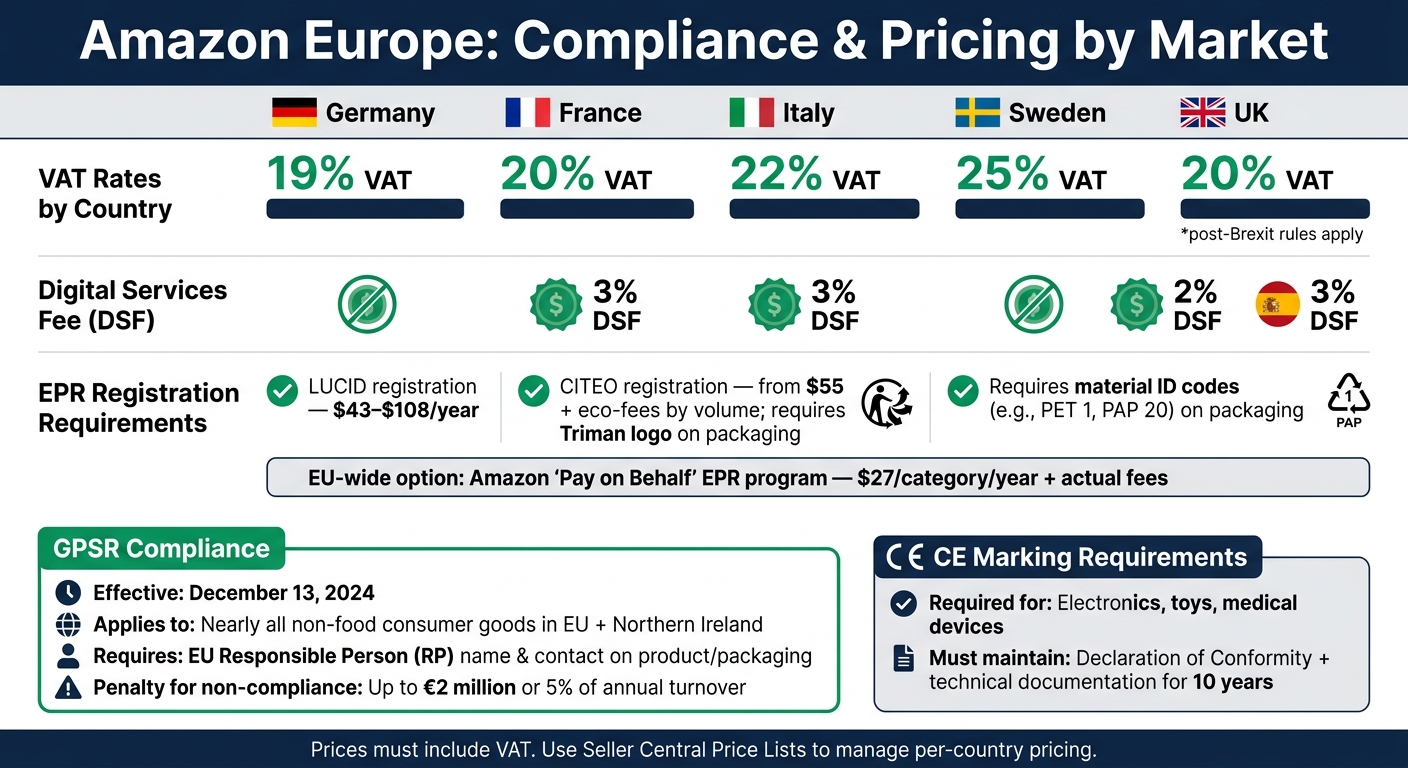
The General Product Safety Regulation (GPSR), effective from December 13, 2024, applies to nearly all non-food consumer goods sold within the EU and Northern Ireland. A key requirement under GPSR is the need for an EU Responsible Person (RP) – an EU-based entity whose name and contact information must be displayed on the product, its packaging, or accompanying documents. Non-compliance can result in severe penalties, including fines of up to €2 million or 5% of annual turnover, and Amazon has been actively removing listings that fail to meet these standards since the regulation’s implementation.
"GPSR compliance is not a one-time document submission. It is a set of synchronized data points – label, declaration, Seller Central record, and customs filing – that must all agree before the shipment moves." – FLEX Fulfillment
Certain product categories, such as electronics, toys, and medical devices, require CE marking. Sellers must maintain a Declaration of Conformity and complete technical documentation, including test results and risk assessments, for at least 10 years. Additionally, Extended Producer Responsibility (EPR) mandates country-specific registration. For instance, Germany uses LUCID (fees range from $43 to $108 annually), and France uses CITEO (starting at $55, plus eco-fees based on volume). France also requires the Triman logo and recycling instructions on packaging, while Italy demands material identification codes like "PET 1" or "PAP 20".
These rigorous measures not only protect consumers but also help create clarity in pricing strategies across markets.
Displaying Prices and Offers Correctly
European shoppers expect prices to include VAT, which varies by country – Germany applies 19%, France 20%, Italy 22%, and Sweden 25%. Because of these differences, using a single price across all marketplaces isn’t feasible. Instead, calculate retail prices separately for each market to maintain margins and meet local expectations.
Some countries also impose a Digital Services Fee (DSF): France, Italy, and Spain charge 3%, while the UK applies a 2% fee. This surcharge is calculated on Amazon’s referral and FBA fees, so it directly impacts your bottom line. To simplify pricing adjustments, you can use Price Lists in Seller Central to tailor prices for each country, rather than managing entirely separate storefronts.
Aligning Operations with Your Localized Listings
Operational alignment is just as important as regulatory compliance when building trust. A localized listing sets customer expectations that must be matched by your operations. This includes offering customer service in the local language and adhering to consumer protection laws, such as Germany’s Widerrufsrecht (guaranteeing a 14-day return policy) and France’s Code de la consommation. For example, if a customer in Hamburg reads a German-language listing but receives an English-only response to a return request, their trust in your business can quickly erode.
"Many sellers lose accounts due to compliance issues – not poor sales." – Chirag Bharihok, Ecom Ranker
To ensure smooth operations, you’ll need a valid EORI number for EU customs clearance, and the RP details in Seller Central must precisely match what’s printed on your product labels. Mismatched information is a common reason for listing deactivations but can be easily avoided. For those scaling across multiple EU markets, Amazon’s "Pay on Behalf" EPR program is worth considering. It covers eco-contributions for $27 per EPR category annually, plus the actual fees.
Conclusion: Growing Your Brand with Localized Strategies
Key Takeaways for Effective Localization
Achieving success on Amazon Europe hinges on how well your brand resonates with local audiences. The difference between a high-converting listing and one that falls flat often lies in its ability to reflect local language nuances, search habits, and audience expectations.
Instead of relying on direct translations, focus on native keyword research to align with how local customers search. Compliance is another critical piece – it’s not just a box to check but the backbone of any localization strategy. Beyond that, adapting visuals, measurements, and tone to fit the local context ensures your listings feel relevant and relatable.
"The brands that struggle internationally almost always have the same problem: they optimized for their home market and assumed it would travel. It doesn’t." – Nectar
These adjustments can be the deciding factor between a thriving listing and one that remains stagnant. To close the gaps – whether technical or cultural – expert support can make all the difference.
How Expert Support Can Simplify Localization
Given the complexities of managing localization across Europe – each market with its own language, tax rules, compliance standards, and audience preferences – handling it internally can lead to costly oversights. Missing native keywords, compliance missteps, or culturally mismatched listings can slow your growth.
This is where working with a full-service ecommerce provider becomes a game-changer. Emplicit offers brands the tools and expertise to navigate these challenges seamlessly. From optimizing listings and managing PPC campaigns to ensuring compliance and maintaining account health, they provide an integrated approach that simplifies scaling across European marketplaces.
"The brands winning internationally aren’t just present. They’re operationally optimized at every layer of the marketplace stack." – Nectar
FAQs
What’s the fastest way to localize one product across multiple EU marketplaces?
The fastest way to expand your listings to multiple European marketplaces is through Amazon’s Build International Listings (BIL) tool. This tool automatically copies and translates your U.S. listings. While it’s a quick solution, machine translations often miss the subtle details that resonate with local shoppers. If you want listings that truly connect with your audience, professional translations are the way to go. These translations incorporate region-specific keywords, local preferences, and ensure compliance with regulations. Companies like Emplicit can help you scale your localized listings effectively across international markets.
How do I find native keywords that Europeans actually search on Amazon?
To find the keywords that Europeans actually use, you need to do more than just translate terms – you’ll need to dive into localized research for each specific marketplace. Start by using Amazon’s autocomplete feature in the local language to uncover what shoppers are genuinely searching for. Tools like Helium 10 or your Search Term Report can provide additional data-backed insights to refine your strategy. Don’t forget to account for linguistic quirks – like German compound words or differences between British and American English. Always double-check your keyword choices with Amazon’s autocomplete to make sure they align with local search habits.
What EU compliance issues most often cause Amazon listings to be suppressed?
Amazon listings in the EU can face suppression when product safety or required documentation falls short. Here are some common reasons this happens:
- Missing EU Responsible Person (RP) Documentation: Under the General Product Safety Regulation (GPSR), having an EU Responsible Person is mandatory.
- EPR Registration Numbers: Extended Producer Responsibility (EPR) rules require registration numbers like Germany’s LUCID or France’s Citeo.
- Certifications: Listings often lack essential certifications such as CE marking, RoHS, or WEEE compliance.
- Labeling and Documentation Issues: Problems like incorrect labeling, missing safety data sheets, recycling logos, or traceability information in the local language can also trigger suppression.
These compliance gaps can prevent your products from reaching customers, so it’s critical to address them proactively.