
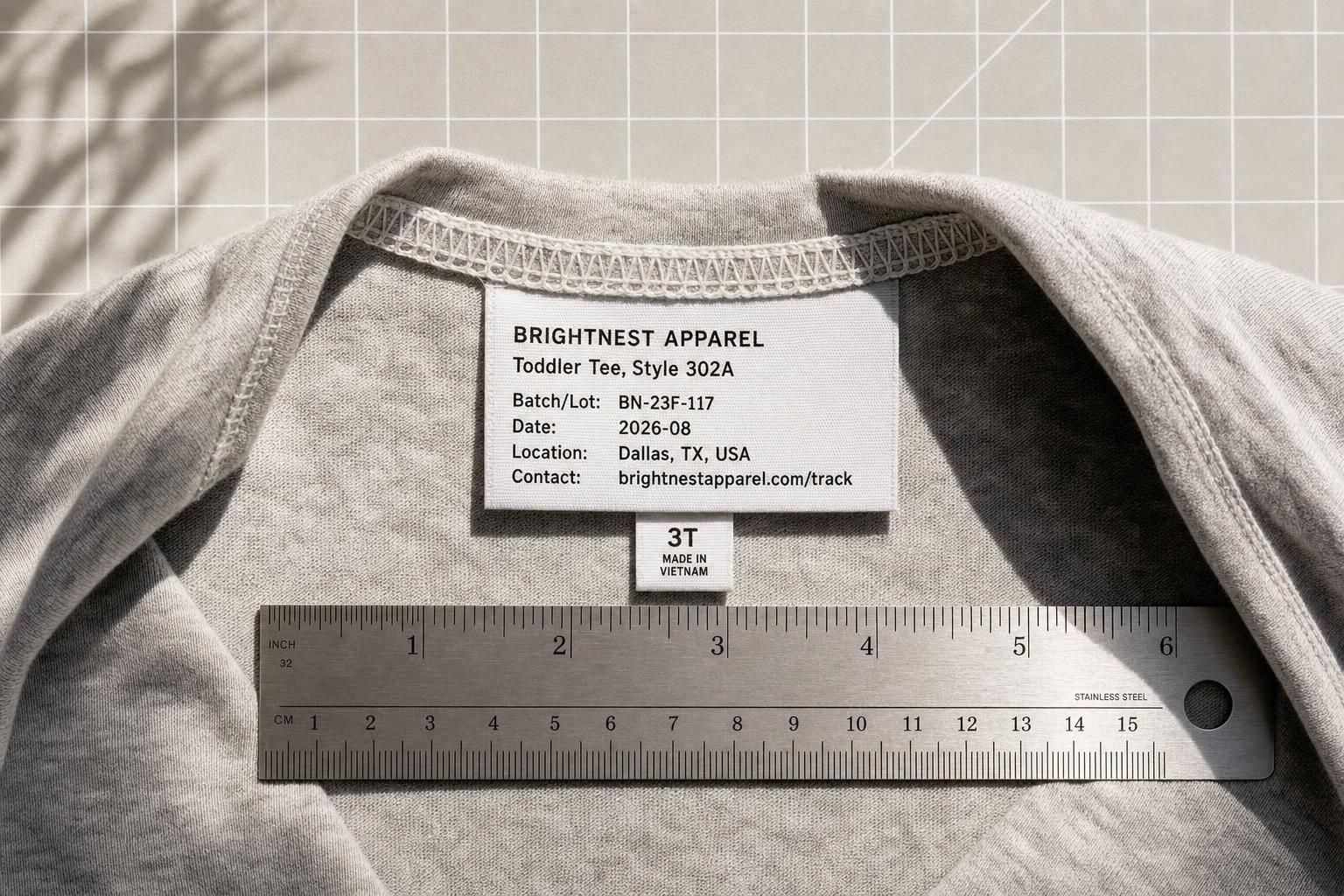
If I sell children’s apparel on Amazon in the U.S., I need a permanent tracking label on the garment. This rule applies to children’s products for ages 12 and under made on or after August 14, 2009. If the label is missing, removable, unreadable, or doesn’t match my records, Amazon can suppress the ASIN or ask for compliance documents.
Here’s the short version:
- Who it applies to: U.S. sellers of children’s apparel and child-sized accessories for kids 12 and under
- What the label must show: maker, production site, production date, and batch or lot ID
- Where it goes: on the garment itself, and on packaging when it makes sense
- What does not work: hangtags, paper tags, or stickers that come off
- What records must match: the label code, CPC, lab test reports, SKU, and ASIN files
- Main risk: bad age grading, reused batch codes, and weak recordkeeping can lead to listing flags or removal
I’d treat the tracking label as the link between the product in hand and every compliance file behind it. A short code like ABC-CN01-0926-B14 can work if I keep a clear internal key and use that same code everywhere.
A few facts matter here:
- CPSIA Section 103 covers children’s products for ages 12 and under
- The label must stay legible after normal wear and washing
- Amazon may ask for a Children’s Product Certificate (CPC) and lab reports before or after a listing goes live
- Label mistakes can turn a small file check into a recall or enforcement issue
| Item | What I need to do |
|---|---|
| Product scope | Confirm the item is a children’s product |
| Label content | Include maker, factory/site, date, and lot or batch |
| Label type | Use a permanent sewn-in or tested heat-transfer label |
| Placement | Put it on the garment; packaging too when it makes sense |
| Record match | Use the same code across label, CPC, test report, SKU, and ASIN |
| Pre-listing check | Review label photos, age grade, and document links |
Bottom line: if I’m selling kids’ clothing on Amazon, the safest path is to label each production run clearly, keep the code consistent across all records, and check it before inventory ships.
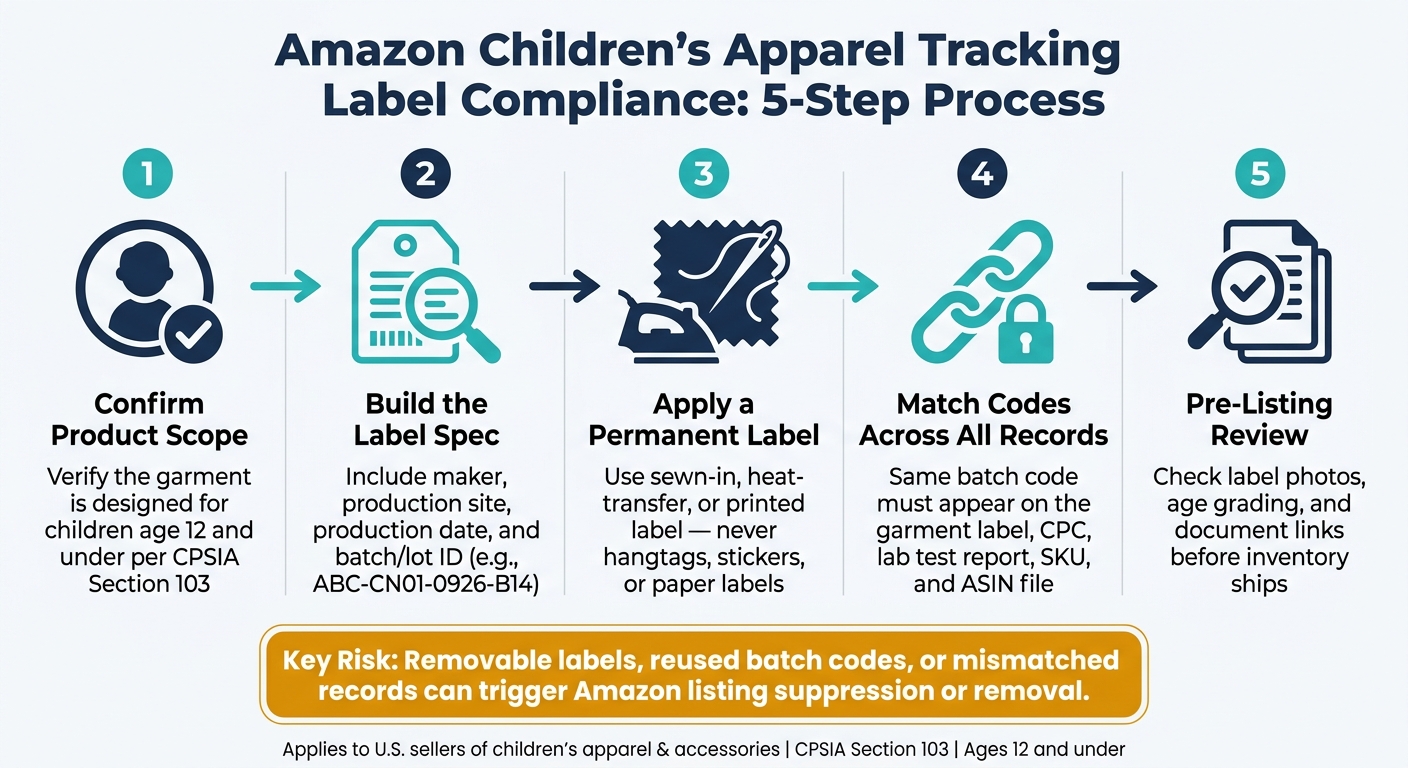
Amazon Children’s Apparel Tracking Label Compliance: 5-Step Process
CPSIA Tracking Label Guide For Importers & Amazon Sellers
sbb-itb-e2944f4
Which Garments Require CPSIA Tracking Labels
CPSIA Section 103 applies to children’s products – consumer products designed or intended primarily for children 12 years of age or younger. For apparel, that means children’s clothing and child-sized accessories that are sized and marketed for kids 12 and under. Adult apparel does not usually need CPSIA tracking labels.
For Amazon listings, the key issue is whether Amazon will view the item as a children’s product. Use the CPSC factors to make that call: manufacturer intent, Amazon listing language, age grading, images, category placement, and size range.
If the garment falls within scope, the tracking label needs to connect that item to one specific production run.
For matching adult/child sets, label only the children’s garments and keep those ASINs separate from the adult ASINs. That way, the label works as a compliance record, not just another tag.
Tracking labels are only for safety traceability. They do not replace fiber content, care, or RN labels, which follow different rules. The next step is knowing the minimum information the label should include.
Required Fields on a Garment Tracking Label
Section 103 calls for traceability, not a fixed template. In practice, most compliant garment tracking labels include the following:
| Field | What It Covers |
|---|---|
| Manufacturer / importer / private labeler | Company name or a documented internal code |
| Production location | Country plus city/state/province, or a factory code that maps to the production site |
| Date of production | Month and year at minimum |
| Batch / lot / run identifier | Unique code for the specific production run |
| Internal traceability fields | Style number, PO number, color code, or similar traceability data |
Many brands use short alphanumeric strings such as "ABK-HCM-2406-L17" as long as they keep a clear internal key that explains what each part means. The label also needs to be permanent and legible through normal wear and laundering. A hangtag or adhesive sticker that peels off or washes out doesn’t count.
How Tracking Labels Connect to CPC and Test Records
The tracking label code is the bridge between the physical garment and the seller’s compliance paperwork. Each factory production run should have its own batch or lot code, and that same code should appear on the garment’s tracking label. The CPC for that product line should point to the same batch or lot code – or codes – and the matching test reports from accredited labs.
In plain terms, one code should tie together:
- The garment
- The ASINs and SKUs
- The factory details
- The CPC
- The lab test reports
When Amazon asks for records, that code tells you exactly which inventory is involved.
How to Build a Compliant Garment Tracking Label
Label Content and Format
A compliant garment tracking label doesn’t need to be fancy. It needs to be traceable.
The CPSC doesn’t require one set format, which gives sellers some room to work. The key is to use one traceable code that links the garment to the responsible entity, production site, production month and year, and lot.
A simple structure like Brand – Factory – Date – Batch works well. For example, ABC – CN01 – 0926 – B14 is easy to read if each part maps to a clear meaning in your internal key. For the date, you can use MM/YYYY or YYMM. Month and year are enough.
What matters most is consistency. Use the same code across:
- the label
- the CPC
- the test report
- the SKU
- the ASIN file
If the code changes from one record to another, it stops being useful. And if the label fades or becomes hard to read after normal use, that creates trouble too.
Once the code is set, keep it unchanged across all production and compliance records.
The label also needs to match the importer, manufacturer, or private labeler listed in your CPC and test records.
Where to Place Labels on Garments and Packaging
The label must be permanent and readable after normal wear. In plain terms, it should still be there and still be legible after washing, handling, and regular use.
Common placement spots include the neck area, waistband, side seam, or inside the care label, as long as the tracking details remain readable after repeated washing and handling.
Placement should make inspection simple. If someone needs to check the garment and match it to your records, they shouldn’t have to hunt for the code.
For children’s apparel, place the label on the garment itself and, when practical, on the packaging too. That’s an area where sellers sometimes slip up. A hangtag or a removable sticker on the outer bag is not enough. The garment needs its own permanent, non-removable label.
Before production begins, confirm that the label holds up through washing and handling.
Sewn-In, Heat-Transfer, and Printed Labels: A Format Comparison
Choosing the label format affects two things at once: how well the label lasts, and how easy it is to support your compliance records during an Amazon documentation request. Each option has trade-offs based on garment type, production volume, and how often the item will be washed.
| Format | Durability | Readability After Washing | Production Cost | Best Fit |
|---|---|---|---|---|
| Sewn-in (woven or printed fabric) | Highest – resists peeling, fraying, and fading | Excellent when thread or ink is colorfast | Moderate | Basic apparel, children’s clothing, everyday wear |
| Heat-transfer | Good when applied correctly and wash-tested | Can degrade with high heat or frequent washing | Lower per unit at scale | Performancewear, minimalist designs, activewear |
| Adhesive sticker (packaging only) | Low on garments; acceptable on outer packaging | Not suitable for garment use if removable | Lowest | Packaging only |
Sewn-in labels are usually the easiest option to defend in a compliance review because they’re built into the garment and hard to remove. Heat-transfer labels can also work well, but they should be wash-tested on the actual fabric before mass production. Fabric type and application quality both affect how long the label lasts.
Pick the format that fits your fabric, wash cycle, and inspection process. Then keep that same code tied to your ASIN and SKU compliance files.
Next, map each label code to its ASIN, SKU, and compliance file before the listing goes live.
Pre-Listing Compliance Check for Amazon Apparel ASINs
Run this check before a listing goes live and again before replenishment ships. The goal is simple: make sure the style is ready before inventory hits Amazon.
Internal Checklist Before Production and Listing Activation
First, confirm whether the garment is a children’s product under CPSIA. That means it is designed or intended mainly for children 12 and under. This decision affects which compliance files you need, so document it in your compliance file and connect it to the ASIN.
Next, add the same traceability code, placement, and durability rules to the tech pack before production starts. That gives the factory clear direction from day one.
Then review samples to make sure the label is there, easy to read, and permanently attached. Take photos of the installed label and store them in the ASIN file. If the label is heat-transfer or printed, wash-test a sample to check that it stays legible. When it makes sense, match packaging or hangtags to the same production code too.
Once the style is approved, link the code to the ASIN and SKU before inventory ships.
How to Link Label Codes to ASINs, SKUs, and Compliance Files
Map each tracking code to a single row in a master compliance table. At a minimum, the table should tie the same traceability code to:
- Amazon ASIN
- Merchant SKU
- Factory ID
- Production date
- CPC file path
- Lab test report identifiers
When Amazon asks for documents, this table helps you find the right files fast.
Use one code format across every record. If the label uses a code like F01-2025-08-STYLE123, that exact string should also appear in the CPC, test report filenames, and master table. No shortcuts, no alternate versions. If the factory, material, or production date changes, create a new code. Keep older records too, because past inventory can still come under review later.
That record set is what you use when Amazon asks for proof.
How Emplicit Supports Seller Compliance Operations
As brands grow across more factories and seasons, Emplicit helps keep tracking codes, listings, and compliance files in sync so Amazon requests can be handled faster. Once the code map is in place, the next issue is label errors that break traceability.
Avoid Common Amazon Listing and Account Risks
Tracking Label Mistakes That Cause Compliance Problems
A label spec can be correct on paper and still fail in practice. That usually happens when the code is incomplete, hard to read, or attached to the wrong product.
Most tracking label problems come from the same few mistakes:
- Using removable stickers, hangtags, or paper labels
- Leaving out required CPSIA fields
- Reusing codes after a production change
Removable stickers and hangtags don’t meet CPSIA traceability rules. If the label is missing key CPSIA details, such as the production date, manufacturer or factory information, or a batch or lot ID, Amazon may not be able to match the garment to the CPC or test report. When that happens, the result is often a manual compliance review or listing suppression.
Age grading is another place sellers get tripped up. Putting a youth size 6 graphic tee in an adult category to sidestep children’s product rules doesn’t work. Amazon checks the listing copy, sizing, and design against the stated age grade, and mismatches can trigger a listing flag or removal.
Reusing the same code across different production runs is also a problem. It breaks traceability and can make a recall much larger than it needs to be.
Label Errors, Amazon Consequences, and Corrective Actions: A Comparison Table
| Label Error | Likely Amazon Outcome | Corrective Action |
|---|---|---|
| Removable sticker, hangtag, or paper label used as the tracking label | Listing removal or compliance flag | Rework with a sewn-in, heat-transfer, or printed permanent label |
| Missing production date or batch/lot identifier | Manual compliance review or listing suppression | Add the required CPSIA fields to the label specification before production starts |
| Uninterpretable or undocumented code | Documentation request; label treated as insufficient | Document the code legend in the compliance file and use the same code on the label, CPC, and test report |
| Wrong age grade or category placement | Listing flag or removal; safety policy issue | Correct the age grading, update the listing, and align the CPC and product documentation |
| Reused batch code after a factory, material, or design change | Traceability gap and broader recall exposure | Assign a new batch code whenever production changes in a meaningful way |
When the label, code, and records match, Amazon’s review is usually just a paperwork check instead of a bigger compliance issue.
Conclusion: A Minimum Process Sellers Should Follow Every Time
Every children’s garment ASIN should go through the same five-step baseline before it goes live. The process is simple, but skipping even one part can lead to an ASIN flag, a document request, or a paused listing.
- Confirm the product is made for children age 12 and under
- Build the required CPSIA fields into the label spec before production
- Place permanent labels in clear, readable spots on the garment and packaging where practicable
- Match each batch code to the correct CPC and lab test report
- Review label photos, age grading, and listing content before publishing
Skip a step, and Amazon can flag the ASIN, ask for documents, or pause the listing.
FAQs
How do I know if Amazon will treat my apparel as a children’s product?
Amazon uses details in your listing – like age recommendations and safety warnings – to decide if apparel counts as a children’s product.
If your item lands in a gated category such as Baby Products, the rules can get tighter. That may mean added safety steps and paperwork, including a Children’s Product Certificate (CPC).
To stay compliant, review the product details in Seller Central, check Account Health for any flags, and make sure your labeling lines up with federal standards for children’s items.
Can I use a factory code instead of the full manufacturer and location on the label?
No. A factory code by itself can’t replace the full manufacturer name and production location on the label.
For children’s products, CPSIA requires tracking labels to show:
- company name
- production location
- manufacturing date
- batch number
Amazon also requires clear, accurate manufacturer information. If the label is incomplete, you can run into customs delays and Amazon listing suspensions.
What should I do if I change factories, materials, or production dates?
Keep your physical product documentation and Amazon listing in sync. Label details like the manufacturer’s address, fiber content, and tracking data should match your compliance certificates, test reports, and the info in your Amazon account.
Update the related product attributes, keep clear records of any changes, and confirm the new label photos before new inventory leaves the factory.