

Navigating Amazon’s labeling rules is critical for international sellers. Mistakes like missing barcodes, incorrect safety warnings, or incomplete "Country of Origin" details can lead to shipment rejections, stranded inventory, and lost sales. Each region – whether the U.S., EU, UK, or Canada – has its own unique requirements, from bilingual labels in Canada to CE or UKCA marks in Europe. Starting January 1, 2026, Amazon U.S. sellers must handle all FBA labeling themselves, making compliance even more important.
Key Points:
- Labels must meet Amazon’s universal standards (e.g., FNSKU barcodes, suffocation warnings).
- Regional rules vary: CE/UKCA marks in Europe, bilingual labels in Canada, and CPSIA tracking for U.S. children’s products.
- Errors can result in customs issues, rejected shipments, and financial losses.
- Proactive steps like supplier training, automated tools, and expert help reduce risks.
Staying compliant ensures smooth operations, avoids penalties, and protects your seller account.
Amazon FBA Packaging, Prep, and Labeling Requirements | Seller University
sbb-itb-e2944f4
Amazon’s Core Labeling Requirements
Every Amazon seller must understand and follow the platform’s universal labeling rules. These standards apply across all marketplaces and are the backbone of FBA compliance. Mistakes here are costly – 32% of FBA shipment rejections happen because of missing or unreadable FNSKU labels, while 24% stem from incorrect poly bag warnings.
FNSKU and Barcode Requirements
The FNSKU (Fulfillment Network Stock Keeping Unit) is Amazon’s unique barcode that links each product directly to your seller account. Unlike a UPC or EAN barcode that identifies the product itself, the FNSKU ensures that your inventory doesn’t get mixed with other sellers’ items in the same warehouse bin.
Every product you send to Amazon must have a scannable FNSKU barcode. To meet Amazon’s standards:
- Use a thermal printer with at least 300 DPI to ensure labels are smudge-free and scannable.
- Stick to standard label sizes, such as 1" x 2" or 1" x 3".
- Place the label on a flat, smooth surface – avoid edges, seams, or flaps that could distort the barcode.
- Cover any existing manufacturer barcodes completely to avoid scanner confusion.
"The FNSKU is Amazon’s unique identifier for your product and connects the item specifically to your seller account."
- Spencer Padway, CEO, Search Nurture
Use white matte labels with removable adhesive to avoid glare from glossy finishes, which can interfere with scanning. Before sealing your shipment, test-scan a sample with a smartphone app or handheld scanner to confirm readability. Starting January 1, 2026, Amazon discontinued its label service in the U.S., meaning sellers must now handle FNSKU labeling themselves before shipping inventory to fulfillment centers.
Safety and Warning Labels
Poly bags with openings of 5 inches or more require a suffocation warning. This warning must remain visible and legible even after the bag is sealed. Font size requirements depend on the bag’s size:
| Bag Size (Total Length + Width) | Minimum Font Size |
|---|---|
| 60 inches or more | 24 pt |
| 40–59 inches | 18 pt |
| 30–39 inches | 14 pt |
| Less than 30 inches | 10 pt |
Bundles and multi-packs must include labels like "Sold as Set" or "Do Not Separate" to prevent warehouse staff from breaking them apart. For products with a shelf life – such as food, supplements, or topicals – expiration dates must be displayed in MM-DD-YYYY or MM-YYYY format with clear prefixes like "EXP" or "BEST BY." These items need at least 90 days of shelf life remaining when they arrive at the fulfillment center.
Fragile items (e.g., glass products) require "Fragile – Handle with Care" labels on the outer carton. Liquids or gels should have "This Side Up" orientation arrows if positioning is critical. Heavy cartons also need special markings: those weighing 50–100 lbs must display "Team Lift", while cartons over 100 lbs should say "Mech Lift."
Packaging Standards
Amazon has strict packaging rules to ensure products arrive intact and remain scannable. Poly bags must be at least 1.5 mil thick and clear enough for barcode scanning. Multi-unit cartons cannot exceed 50 lbs, and no side can be longer than 25 inches. Fragile products should be wrapped in at least 2 inches of bubble wrap for added protection.
Labels must stay visible and intact during shipping. Place pallet labels on the outside of clear stretch wrap at eye level on all four sides. Ensure your FNSKU label fully covers any existing manufacturer barcodes to prevent scanning errors. If a shipment arrives with unscannable or incorrect labels, Amazon charges a relabeling fee of $0.20 to $0.40 per unit.
These universal guidelines are the foundation before diving into region-specific requirements.
Labeling Requirements by Region
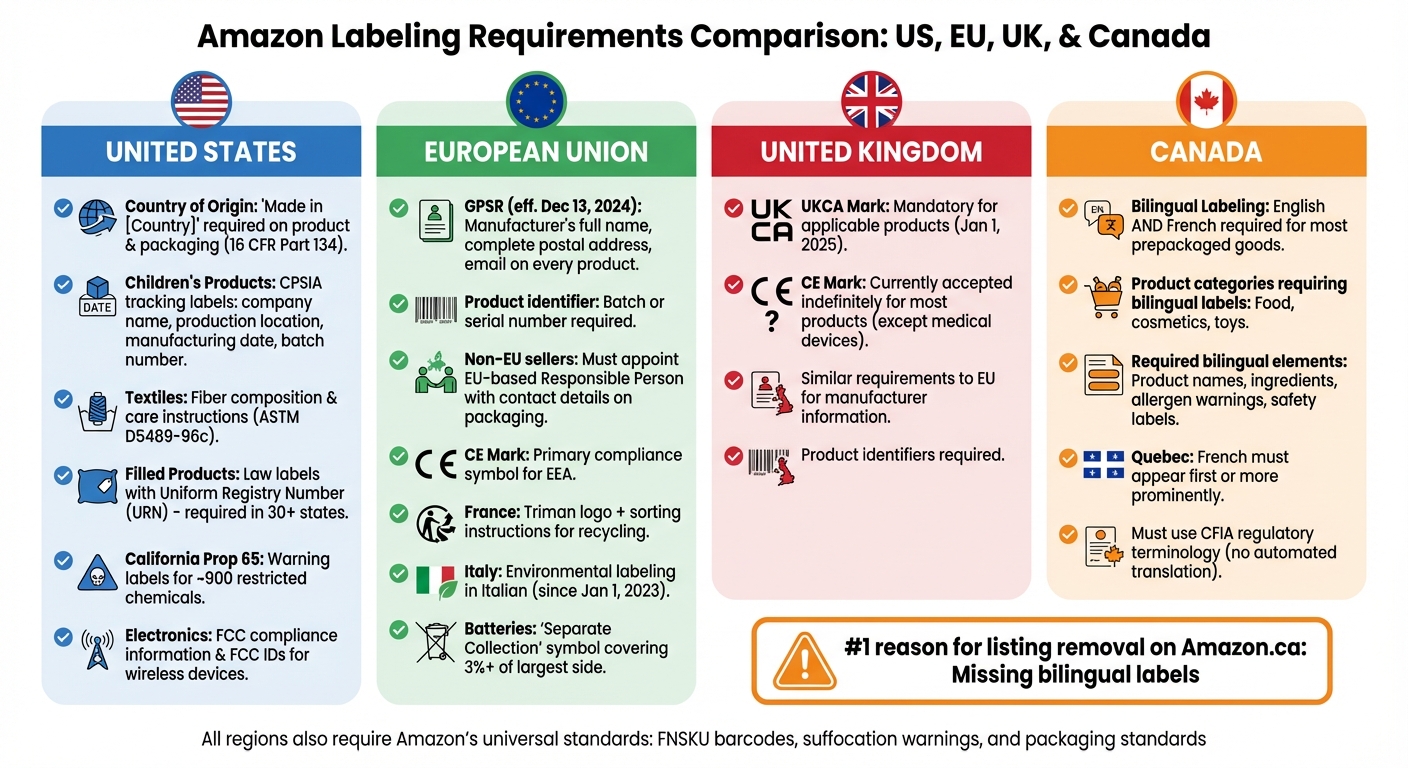
Amazon Labeling Requirements by Region: US, EU, UK, and Canada Compliance Guide
Amazon’s core labeling standards are just the baseline – different regions have their own rules that can vary significantly. What works in one country might fail in another. For example, something acceptable in the U.S. could be rejected in the EU, and Canadian marketplaces come with their own unique demands. Knowing these regional differences is key to avoiding costly missteps and ensuring your inventory keeps moving.
United States Labeling Requirements
In the U.S., sellers must follow additional rules beyond Amazon’s universal requirements like FNSKU and safety labels. One major requirement is country of origin labeling, as mandated under 16 CFR Part 134. This means products must clearly state "Made in [Country]" on both the packaging and the item itself.
For children’s products, the CPSIA requires tracking labels that include details like the company name, production location, manufacturing date, and batch number. Textiles must list fiber composition and care instructions per ASTM D5489-96c. Products with filling materials – think mattresses, stuffed toys, or upholstered furniture – need law labels displaying a Uniform Registry Number (URN), which is required in over 30 states.
California’s Proposition 65 adds another layer of complexity. If your product contains any of roughly 900 restricted chemicals, it must carry a warning about potential cancer or reproductive harm. Additionally, electronics need FCC compliance information, including FCC IDs for wireless devices. These U.S.-specific rules build on Amazon’s global requirements, so double-check your product category to ensure compliance before shipping.
Other regions have their own standards that sellers must navigate.
European Union and United Kingdom Standards
The General Product Safety Regulation (GPSR), effective December 13, 2024, has replaced the older directive in the EU. Now, every product sold in the EU must include the manufacturer’s full name, complete postal address (not just the country), and email. A simple website URL won’t cut it. Products also need a clear identifier, like a batch or serial number.
Non-EU sellers face an extra step: they must appoint an EU-based Responsible Person whose contact details are displayed on the product or packaging. The CE mark continues as the primary compliance symbol for the European Economic Area, while the UK uses the UKCA mark. However, the UK currently allows CE-marked goods indefinitely for most products, excluding medical devices.
"The UK government has released guidance stating that for all products apart from medical devices, CE marking will be accepted in the UK indefinitely."
Some countries tack on additional requirements. For instance, France mandates the Triman logo and sorting instructions for recycling, while Italy requires environmental labeling in Italian for all household packaging as of January 1, 2023. Batteries sold in the EU must also display the "Separate Collection" symbol, covering at least 3% of the largest side. These country-specific rules are layered on top of broader EU regulations, so it’s essential to review each marketplace’s guidelines before expanding.
Canada, Australia, and Japan Guidelines
In Canada, bilingual labeling is a common reason for listings being removed on Amazon.ca. Most prepackaged goods – such as food, cosmetics, and toys – must include all required information in both English and French. This includes product names, ingredients, allergen warnings, and safety labels. In Quebec, French often must appear first or more prominently than English.
"Food products must be labelled with all the information required by applicable Canadian law in both French and English."
- Amazon Enforcement Letter
Relying on automated translation tools is risky. Legal claims and allergen warnings must align with the CFIA‘s regulatory terminology. A notable example: in 2022, a top-selling protein cookie brand had its ASIN suspended on Amazon.ca because the back label was in English only, despite being compliant in the U.S. The seller lost two weeks of sales while reprinting bilingual labels.
For other regions like Australia and Japan, sellers must also account for local language, safety, and certification requirements. Always verify regional guidelines before launching in a new marketplace.
Navigating these regional differences is essential for staying compliant and keeping your operations running smoothly across Amazon’s global marketplaces.
How to Ensure Labeling Compliance
Staying on top of Amazon’s labeling requirements across different regions might seem like a daunting task, but it doesn’t have to be. The secret lies in setting up systems that catch mistakes before products ship, rather than scrambling to fix issues after they’ve been rejected at a fulfillment center. Many compliance problems arise because labeling is often treated as an afterthought instead of being a core part of the workflow from the beginning.
Training Suppliers for Compliance
Your suppliers play a critical role in ensuring compliance. Unfortunately, many overseas manufacturers aren’t familiar with Amazon’s specific labeling requirements, especially for tracking labels and permanent Country of Origin markings. Fredrik Gronkvist, Co-founder of Compliancegate.com, emphasizes this point:
"Keep in mind that the vast majority of manufacturers outside the United States are not aware of tracking labeling requirements. You can therefore not rely on your overseas suppliers to ensure that your products are correctly labeled".
To address this, provide your suppliers with a detailed compliance checklist for every order. This checklist should include essential details like the product name, model number, manufacturer’s full mailing address, contact information, and a clear "Made in [Country]" marking. It’s also crucial to specify that labels must be durable and permanent – whether engraved, printed with waterproof ink, or sewn into the product. Temporary stickers that peel off during transit will almost certainly lead to rejections at Amazon’s warehouse.
Tauqir Ashraf, an Amazon Consultant, suggests:
"Talk to your supplier too. Ask them to add the origin label during manufacturing. That saves time. It reduces packaging errors".
Encourage suppliers to include origin labels during manufacturing to streamline the process and minimize errors. Before inventory leaves the factory, request clear photos of all compliance markings and tracking labels. This step helps identify discrepancies between the product and your documentation early on. For children’s products, ensure that tracking labels include batch numbers and the exact date and location of manufacture. Every detail on the physical product must align perfectly with your compliance documentation – like CPC certificates, test reports, and your Amazon listing.
Using Technology and Tools
Once your suppliers are following clear labeling standards, technology can take things a step further by automating the process. Manual labeling is prone to errors, especially when shipping products to multiple countries. Automated labeling systems are a game-changer for high-volume sellers managing large inventories. Using a Warehouse Management System (WMS), you can automate label generation based on real-time shipment details, ensuring every pallet and carton is correctly marked for its destination.
Blair Forrest, Founder of AMZ Prep, highlights a key change:
"As of January 1, 2026, Amazon no longer provides FBA prep or labeling services in the U.S. Sellers are fully responsible for pallet labeling, carton labeling, and FNSKU labeling before inventory leaves the origin facility".
Investing in reliable thermal or laser printers – such as DYMO or Rollo models – can ensure your barcodes are smudge-proof and scan consistently. Amazon US now requires PDF417 barcodes for pallet labeling to work with updated scanning systems.
Keep a centralized digital folder for all your test reports, declarations, and certificates organized by SKU. This setup allows you to respond quickly to Amazon audits or customs checks. For specific regional needs, tools like "e-tichetta" can create environmental labels required in markets like Italy. Additionally, using barcode scanning software to verify FNSKU and pallet ID labels before shipping can catch potential errors early on.
Working with Experts
Navigating compliance for multiple regions like the U.S., EU, and Canada can be complex, and not all businesses have the necessary expertise in-house. Professional consultants can bridge the gap between your team and overseas manufacturers who might not fully grasp detailed requirements, such as CPSIA tracking labels. Consultants also help with audit readiness, organizing key documents – like test reports, certificates of origin, and safety data – by ASIN and region. This organization ensures you can respond to compliance requests without delay.
Experts can conduct pre-shipment quality inspections at factories to review labels before products leave the production line, avoiding costly mistakes later. Tauqir Ashraf explains the benefits of structured compliance systems:
"Sellers who use structured systems for compliance avoid risk, keep accounts secure, and build long-term trust with buyers who expect transparency".
Full-service providers like Emplicit offer comprehensive support, covering inventory management, account health monitoring, and regional compliance for Amazon, Walmart, and other marketplaces. These teams stay updated on policy changes and can set up real-time alerts for shifts in Amazon’s rules or global regulations.
Taking a proactive approach can prevent listing removals, shipping delays, or even account suspensions. Martín Ramírez from Signify cautions:
"Missing the mark in either [FBA Prep or Regulatory Compliance] can trigger listing removals, warehouse delays, or full account suspensions".
Consequences of Non-Compliance
Failing to meet labeling requirements can have immediate and far-reaching effects. Shipments with unreadable barcodes or missing Country of Origin labels are often rejected by fulfillment centers or detained by customs before even reaching Amazon’s warehouse. This creates what Amazon refers to as "inaccessible inventory" – your products are physically stuck in limbo, unavailable for sale, while you’re still paying storage fees but earning nothing.
Stranded Inventory and Shipment Rejections
One of the most common challenges sellers face is rejected shipments. For instance, if your pallet exceeds the 1,500-pound weight limit or if labels are placed under the stretch wrap instead of on the outside, Amazon’s receiving team will refuse the entire shipment. A real-world example? A protein cookie seller on Amazon Canada lost two weeks of sales because their labels weren’t bilingual. Amazon’s enforcement letter made it clear: "Food products must be labeled with all the information required by applicable Canadian law in both French and English".
International shipments face even stricter scrutiny. Missing safety marks like CE or UKCA on products can lead to border seizures, resulting in the complete loss of stock and hefty fines from customs authorities. And starting January 1, 2026, U.S. sellers will be required to personally manage all FBA labeling, making accurate compliance even more critical. Blair Forrest, Founder of AMZ Prep, highlights the risks: "A little distortion or error can result in pallet rejection and return".
These issues don’t just stop at operational headaches – they snowball into major financial losses.
Financial and Operational Impact
Non-compliance can quickly drain your budget. Sellers face disposal fees for non-compliant items, re-shipping costs, and extra prep expenses. These can range from $0.40 per unit for FNSKU labeling to $50.00 per pallet for palletizing. After January 1, 2026, non-compliant units will no longer be reimbursed if they’re lost or damaged within Amazon’s network. On top of that, non-compliance fees can soar to $6.90 per cubic foot, and fulfillment fees are set to increase by an average of $0.08 per unit starting January 15, 2026.
Beyond these direct financial hits, labeling mistakes cause receiving delays, which prevent products from going live during crucial sales periods. This often leads to "out-of-stock" statuses that hurt your organic search rankings and Buy Box eligibility. Repeated violations can result in performance warnings, restricted access to certain categories (gating), or even total account suspension. In extreme cases, Amazon might remove specific product listings (ASINs) or permanently close accounts for ongoing non-compliance. These risks emphasize why following strict labeling standards is so important.
How to Prevent Compliance Issues
The best way to avoid these problems is by adopting proactive measures to streamline your labeling process. Regular audits of your labeling practices are a good starting point. Use the Compliance Reference Tool in Seller Central to verify the specific documentation and labeling requirements for each ASIN and region before shipping. Keep all compliance-related documents – like test reports, certificates of origin, and safety data – stored in a centralized digital folder organized by SKU and region. This ensures you can respond to Amazon audits within hours instead of days.
Invest in thermal or laser printers and use the PDF417 barcode format for pallet labels to reduce scanning errors. Place labels on all four sides of the pallet, on the outside of the stretch wrap, and at eye level. For shipments to Canada, ensure all mandatory details are included in both English and French – this is the most common reason listings are removed on Amazon.ca.
Consider working with full-service providers like Emplicit, who can help monitor policy changes and manage compliance across multiple regions. Their teams handle inventory management, account health, and regional compliance for platforms like Amazon and Walmart. They also set up real-time alerts for updates to Amazon’s policies or global regulations. These steps not only help cut costs but also ensure smoother international operations, reducing the risk of listing removals, shipping delays, and account suspensions.
Conclusion and Next Steps
Staying on top of labeling compliance is more than just a regulatory requirement – it’s a safeguard against costly disruptions and a stepping stone for expanding your business internationally. The difference between seamless cross-border operations and frequent shipment rejections often boils down to how effectively compliance is embedded into your daily processes. As Amazon consultant Tauqir Ashraf explains:
"Compliance with Amazon’s country of origin rules acts as a shield for sellers, because it prevents risk, secures operations, and builds trust at every level of the business".
This perspective underscores the importance of adopting concrete strategies to ensure compliance is integrated into every aspect of your business.
Key Takeaways
Here’s a recap of the essential points covered earlier: achieving three-level synchronization is critical. Your product, packaging, and digital listings must all display consistent compliance details. This includes aligning Country of Origin markings, safety certifications, and language requirements across every touchpoint. For example, sellers targeting the UK market should note that the UKCA marking becomes mandatory for applicable products starting January 1, 2025. In the U.S., children’s products must feature permanent tracking labels on both the product and packaging. These aren’t optional guidelines – they’re enforceable rules that Amazon’s automated systems actively monitor.
Common errors to avoid include relying on Google Translate for allergen warnings or incorrectly listing your shipping warehouse as the Country of Origin instead of the manufacturing location. Steps like professional translations and supplier verifications are critical to preventing ASIN suspensions and customs issues.
Building a Compliance Plan
To sidestep potential pitfalls, it’s essential to have a solid compliance plan in place. Start by using Amazon’s Compliance Reference Tool in Seller Central to identify specific requirements for each ASIN and marketplace before shipping. Organize all relevant compliance documents – certificates, test reports, etc. – in a centralized digital folder sorted by SKU and region. This will allow you to respond to Amazon audits in hours rather than days.
Work with your manufacturers to print labels directly onto products during production using permanent, waterproof ink. This avoids the risk of temporary stickers peeling off during transit. For sellers operating across multiple countries, consider language clustering – combining languages like French, Italian, and German on a single label for streamlined PAN-EU distribution. Assign a team member to track weekly regulatory updates or partner with Emplicit for comprehensive compliance management. Their services cover everything from monitoring inventory and account health to PPC campaigns and listing optimization, helping you grow while staying compliant across platforms like Amazon, Walmart, and TikTok Shops.
Taking proactive steps in compliance today can protect your revenue, maintain your search rankings, and safeguard your reputation in the long run.
FAQs
Do I need both a UPC and an FNSKU?
Yes, if you’re using Amazon FBA to fulfill your products, you’ll need both a UPC (or another manufacturer barcode) and an FNSKU. Here’s why:
- UPC: This barcode identifies your product at the manufacturer level. It’s a universal code used across retailers and supply chains.
- FNSKU: This is a unique, scannable label created by Amazon. It helps Amazon track your specific inventory within their fulfillment centers.
Both are essential for ensuring smooth inventory management and tracking in Amazon’s system.
What labels need to be on the product versus the packaging?
Product labels need to clearly display the manufacturer or importer address, the country of origin, and any mandatory warnings or usage instructions in the official language(s) of the destination country. These details must be firmly affixed to both the product itself and its packaging to ensure compliance with local regulations.
How do I manage labels for the US, EU/UK, and Canada at once?
When handling labels for different regions, it’s crucial to meet each area’s specific requirements to avoid compliance issues.
- United States: Ensure your labels include accurate UPCs or FNSKUs, along with clear carton labels.
- Canada: Labels must be bilingual, featuring both English and French to meet regulatory standards.
- EU/UK: Use country-specific languages, include necessary warnings, and add symbols like the CE mark where applicable.
To streamline this process, consider creating localized templates or using professional labeling tools. These approaches help maintain compliance without adding unnecessary complexity.