

Localized SEO on Amazon is about optimizing product listings for international markets – not just translating text. Different regions use unique search terms, measurements, and pricing formats. For instance, "flashlight" in the U.S. is "torch" in the U.K., and Japan uses byte-based character limits for listings. With global marketplaces like Japan’s Amazon.co.jp drawing 974M visits and Germany’s Amazon.de seeing 440M, sellers have opportunities to expand their reach. However, U.S.-specific keywords often fail in other regions, making localized keyword research critical.
Key tools and techniques include:
- Helium 10: Offers keyword research across 24+ marketplaces, reverse ASIN lookup, and tracking features starting at $99/month.
- Viral Launch: Tracks hourly rank changes and provides deep market insights, with plans starting at $69/month.
- Keywords.am: Focuses on backend keyword optimization and direct integration with Seller Central, starting at $49/month.
- AMZScout: Provides AI-driven listing optimization and competitor analysis, starting at $29/month.
- Keywordtool.io: Generates long-tail keywords and optimizes backend search terms to meet regional requirements.
Tracking tools like Sellics and SellerApp help monitor performance metrics such as conversion rates and keyword rankings, ensuring your localized strategy delivers results.
To succeed, sellers must go beyond translation, tailoring listings to align with local preferences, search behavior, and marketplace standards. Regular updates and tools like reverse ASIN lookup, auto-complete research, and competitor analysis are essential for staying competitive.
BEST Amazon Keyword Tool for Rank Tracking (Oct. 2025 Update)
sbb-itb-e2944f4
How Emplicit Supports Amazon Localized SEO
Emplicit goes beyond simple translation to deliver a tailored approach to Amazon localized SEO. Their ecommerce services – like listing optimization, keyword research, and PPC management – are fine-tuned to fit the unique characteristics of each market. This includes adapting language, measurement units (imperial or metric), and local preferences that shape shopping habits.
At the heart of their strategy is listing optimization. Instead of copying U.S. listings for international markets, Emplicit rebuilds them from the ground up, focusing on regional search terms and customer expectations. For example, a product listing on Amazon.com might feature keywords specific to U.S. shoppers, prices ending in .99, and imperial measurements, while its localized version would reflect the preferences and standards of the target market.
Their regional keyword research uses marketplace-specific data to uncover high-performing search terms in each country. This ensures listings resonate with local audiences. Additionally, Emplicit supports sellers with account health monitoring through tools like the Account Health Score Analyzer, helping avoid policy violations that could disrupt international sales.
Emplicit also excels in managing omnichannel strategies, ensuring consistency across Amazon’s global network while adapting to local market needs. Their USA-based account managers develop custom strategies to help businesses scale across multiple Amazon marketplaces, tapping into new opportunities.
This localized approach lays the groundwork for the specialized tools and strategies that drive successful Amazon SEO on a global scale.
Localized Keyword Research Tools
Localized keyword research requires tools that can decode search behavior in specific regions. Platforms like Helium 10, Viral Launch, and Keywords.am offer different ways to understand what customers are searching for across various countries.
Helium 10
Helium 10 supports keyword research across 24+ Amazon marketplaces. The platform processes over $7 billion in monthly Amazon Gross Merchandise Volume (GMV) and boasts more than 860,000 Chrome Extension users.
The Cerebro tool allows you to reverse-search up to 10 competitor ASINs at once. This reveals which keywords drive their sales, both organic and paid, making it especially effective for localized strategies. For instance, you can uncover the German or British keywords your competitors rank for in their respective markets. Filters like high click shares or Amazon’s Choice badges help pinpoint effective regional strategies.
Magnet generates keyword variations with filters for search volume, competing products, and title density, helping you discover untapped niches. Meanwhile, the Keyword Tracker monitors rankings over time, and the Market Tracker analyzes long-term trends to identify seasonal shifts early. For example, it can highlight 30-day search volume changes in specific markets, giving you a chance to act before competitors.
"We save 15+ hours a week, every week with Helium 10." – Mike Kim, Founder, Hemlock Park
Pricing starts at $99/month for the Platinum plan (billed annually), $279/month for Diamond with access to multiple regions, and custom Enterprise plans starting at $1,499/month.
Viral Launch
Viral Launch is ideal for sellers who need detailed performance insights and frequent updates. One standout feature is hourly rank tracking on higher-tier plans, which lets you monitor how changes like price adjustments or title updates impact rankings in real-time. This is especially useful when optimizing localized listings, as it allows you to test regional keywords and quickly identify what works. The platform also provides deep historical market data to uncover longer-term trends in specific marketplaces.
With Amazon’s A10 algorithm now giving 15-20% weight to external traffic, Viral Launch’s tracking tools help sellers understand the complete picture of what drives visibility.
Pricing ranges from $69/month for the Essentials plan to $199/month for Pro Plus Ads. The hourly tracking feature makes it an excellent choice for those who want to see the immediate effects of their localized SEO efforts.
Keywords.am
Keywords.am specializes in listing optimization and publishing workflows rather than offering an all-in-one suite. It uses the TFSD framework (Title, Features, Search Terms, Description) to ensure keywords are fully indexed and optimized for conversions in specific markets. This ensures backend keyword optimization aligns seamlessly with regional variations.
The platform automates backend search term optimization, filling them to the limit without duplication, ensuring complete indexing across different marketplaces. Additionally, it offers direct Seller Central integration, allowing you to push localized updates instantly without needing to manually copy and paste across accounts.
"The gap isn’t access to tools. It is choosing the right ones." – Ash Metry, Founder & CEO, Keywords.am
These tools collectively help sellers fine-tune their localized keyword strategies for better results across diverse markets.
Listing Optimization Techniques
Optimizing listings for local markets goes beyond simple translation. Studies show that 76% of online shoppers prefer product information in their native language, and 40% will avoid purchasing from websites in a different language. The real challenge lies in tailoring every aspect of your listing – titles, bullet points, backend search terms, and descriptions – to align with how local customers search and shop.
Translation alone doesn’t cut it. Instead, localization adapts each listing element to reflect local search behavior, often using the TFSD framework (Title, Features, Search Terms, Description). Regional nuances also play a role – Japan’s Amazon, for instance, uses byte-based character limits (200 bytes equals about 66 characters), and measurement units need to align with local norms (imperial for the US, metric for the EU and UK).
AMZScout
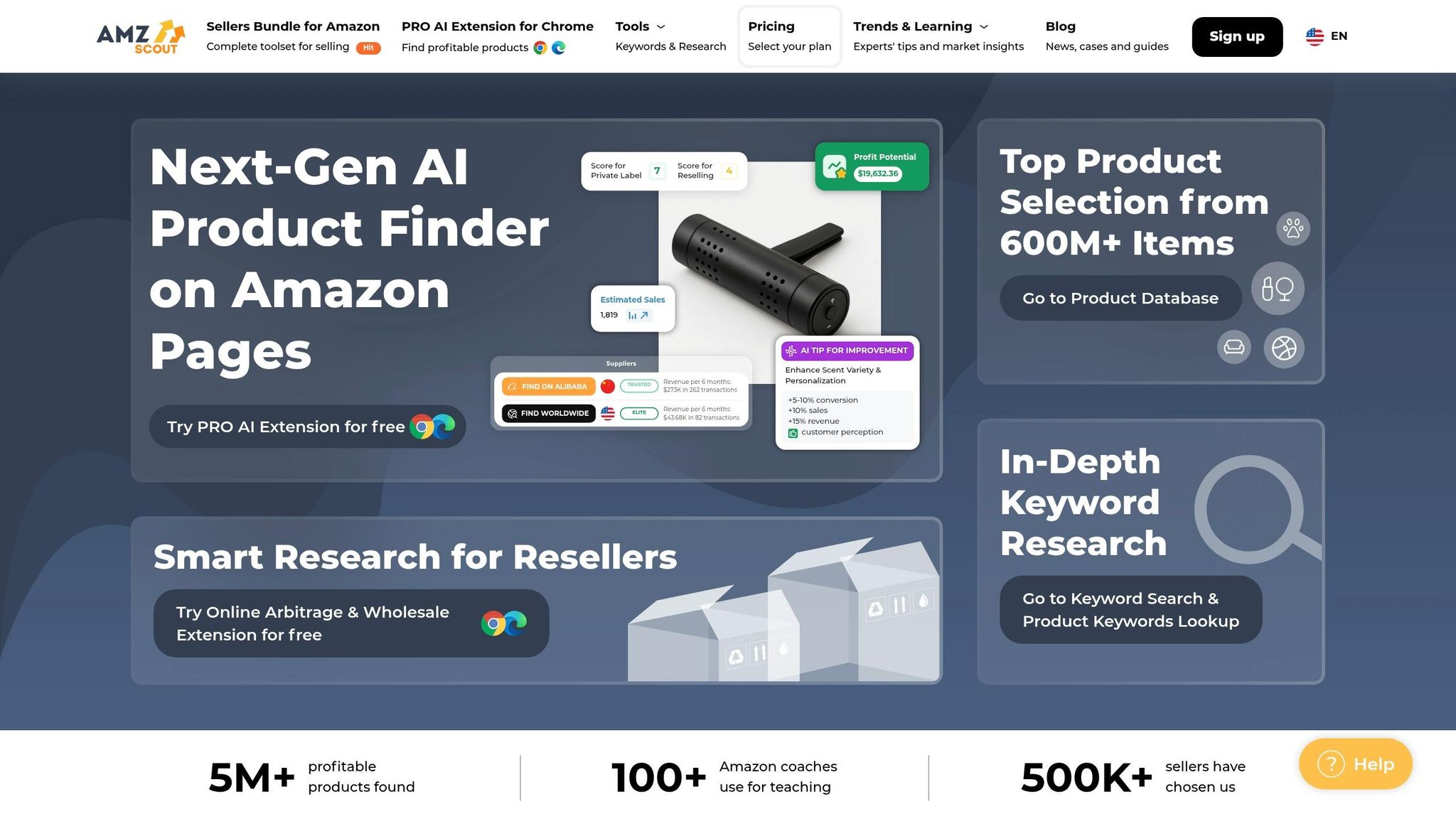
AMZScout provides a cost-effective toolset for listing optimization, starting at $29/month or a $1,600 lifetime deal. Its AI Listing Builder simplifies the process by generating content with market-specific keywords, making it easier to create localized listings quickly.
The Reverse ASIN Lookup feature is particularly useful for analyzing competitors in specific regions. By reviewing which keywords regional competitors target and how they rank, this tool offers insights into what strategies are already successful in a given market. This is invaluable when entering new marketplaces.
Another standout feature is the AI Review Analyzer, which examines customer reviews to uncover regional buyer preferences and concerns. This insight allows sellers to fine-tune descriptions to address what matters most to local audiences. Additionally, AMZScout includes a Keyword Tracker to monitor your search rankings and compare them with competitors over time.
Keywordtool.io
Keywordtool.io excels at refining listings with localized keyword suggestions directly sourced from Amazon’s auto-complete data. One of its strengths is identifying long-tail keywords – phrases with three or more words – that often convert 2-3x higher than broader terms, even if their search volume is lower.
A key feature is its ability to create market-specific negative keyword lists. These lists help prevent listings from appearing for irrelevant or prohibited terms in international markets. For example, terms like "organic" may have stricter regulatory requirements in the EU compared to the US, and improper usage could lead to compliance issues.
The tool also helps prioritize keywords in titles by identifying the most critical ones to include in the first 80 characters, ensuring visibility across all devices. This is especially important for mobile shoppers, who make up a growing portion of Amazon’s traffic. Additionally, Keywordtool.io assists in optimizing backend search terms while adhering to Amazon’s strict 250-byte limit – exceeding this limit could cause Amazon to ignore the entire field.
"Direct translation of keywords? Fails. Localization adapts your listing to local search, language, and culture." – Ash Metry, Founder & CEO, Keywords.am
A smart strategy is to validate keywords with PPC campaigns before finalizing your organic listings. Running automatic campaigns for 2-4 weeks in a new market can reveal which terms drive actual conversions. This ensures you’re focusing on keywords that deliver results, not just those with high search volume.
These techniques lay the groundwork for tracking and improving your localized SEO performance with specialized tools.
Tracking Localized SEO Performance
Once you’ve localized your content, it’s crucial to track its performance using real-time metrics. This helps identify markets where you’re thriving and areas that need improvement.
Some key metrics to monitor include sales velocity (units sold per day), conversion rate (successful products typically fall between 8–15%), and Share of Voice, which measures your search visibility compared to competitors. Notably, conversion rates exceeding 15% often correlate with top-10 search rankings, providing insights into both your listing performance and potential gaps in competitor strategies. These metrics form the foundation for using specialized tools to refine your localized SEO efforts.
Sellics
Now part of Perpetua, Sellics combines paid advertising insights with organic performance tracking. One of its standout features is Share-of-Voice tracking, which shows how much search visibility your brand captures compared to competitors. It also highlights the "halo effect", where targeted ad campaigns in one market can positively influence your organic rankings over time. Sellics offers custom pricing based on monthly ad spend, starting at $695/month for brands spending up to $5,000/month.
SellerApp
SellerApp takes these metrics further with a results-driven dashboard that links keyword performance to overall listing quality. It tracks keyword rankings, traffic, and listing optimization across more than 18 international marketplaces, including major regions in North America, Europe, the Middle East, and Asia.
Key features include:
- Keyword Tracker: Automates tracking for thousands of keywords with daily and weekly updates, alerting you to ranking shifts.
- Index Checker: Confirms whether Amazon has indexed specific keywords for your listings.
- Listing Quality Index (LQI): Assigns a weighted score based on the optimization of titles, bullet points, images, and backend keywords.
SellerApp’s managed services have delivered impressive results. For instance, Simple Mixes grew their Amazon sales by 6.5X while cutting ACoS by 57% using SellerApp’s tools. Similarly, Reelskin increased ad revenue by 941% through data-driven strategies. Pricing starts at $39/month for the Pro-Lite plan, with the Professional plan available at $199/month.
"As we scaled into eight figures, we needed more than a dashboard. SellerApp became a decision-making layer across our business. It didn’t just help us optimize ad performance, it gave us the clarity to manage growth." – Eytan Weiner, Founder, Quantum Networks
Both Sellics and SellerApp help sellers identify "striking distance" keywords – those ranking in positions 15–40 (usually on page two). By focusing PPC efforts on these keywords, sellers can push their products onto the first page of search results. This approach is especially effective when entering new localized markets, where organic rankings are still gaining traction.
Localized SEO Tools Comparison
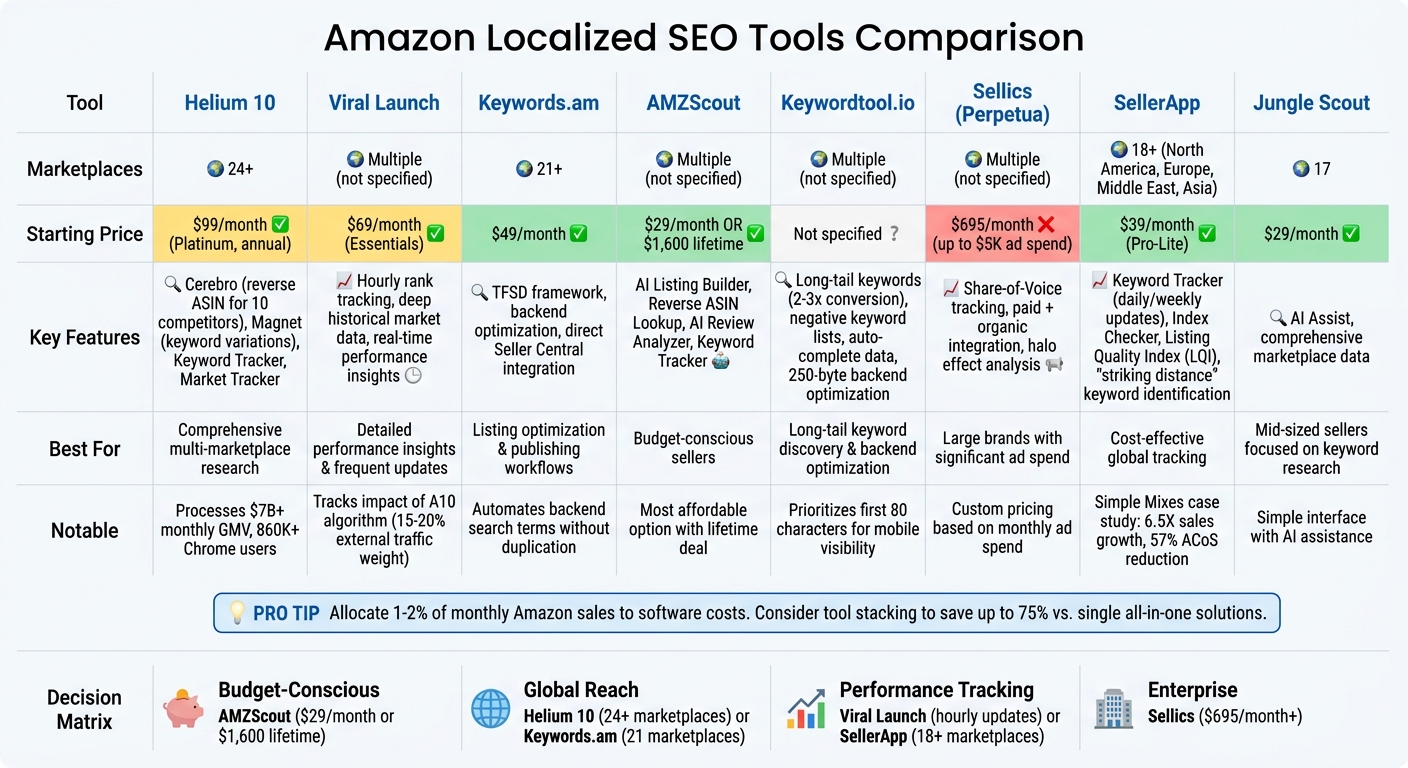
Amazon Localized SEO Tools Comparison: Features, Pricing, and Marketplace Coverage
When it comes to localized SEO, choosing the right tool depends on factors like your budget, target markets, and the level of detail you need for localization. Here’s how some of the leading tools stack up:
Keywords.am provides access to over 21 marketplaces, starting at $49/month. If you’re looking for global reach, Helium 10 offers similar capabilities, but you’ll need the Diamond plan at $229/month to unlock its full potential.
For sellers who prefer simplicity without sacrificing functionality, Jungle Scout supports 17 marketplaces and includes features like AI Assist. This makes it a great choice for mid-sized sellers focused on keyword research. Plans start at $29/month, with higher tiers offering comprehensive marketplace data.
If you’re budget-conscious, AMZScout offers a $1,600 lifetime deal, which eliminates the need for ongoing payments. On the other hand, Data Dive specializes in detailed keyword research and competitor analysis but is limited to the U.S. marketplace, with pricing at $299/month.
For larger brands, Sellics (now part of Perpetua) focuses on Share-of-Voice tracking and integrating paid and organic performance. It starts at $695/month for brands spending up to $5,000 per month on ads. SellerApp, with pricing starting at $39/month for the Pro-Lite plan, supports tracking across 18+ international marketplaces, making it a cost-effective option for global sellers.
A useful rule of thumb is to allocate 1–2% of your monthly Amazon sales to software costs. Many sellers are now turning to tool stacking – combining general research tools like Helium 10 with specialized platforms like Keywords.am for listing optimization. This strategy not only improves localized SEO but can also cut costs by up to 75% compared to relying on a single all-in-one tool.
These insights provide a foundation for understanding how to maximize your localized SEO efforts using the right mix of tools.
Advanced Localized SEO Methods
Building on earlier keyword research techniques, advanced strategies like Reverse ASIN Lookup can sharpen your localized SEO efforts.
Reverse ASIN Lookup
Reverse ASIN lookup is a powerful way to uncover the exact keywords your competitor’s products rank for, both organically and through paid ads. By starting with a successful product, you can reverse-engineer its search traffic to identify high-performing terms.
"Instead of guessing what terms customers use, you reverse-engineer the search traffic of top-performing competitors." – SellerSprite Success Team
This method is especially useful for localized SEO since search behavior varies significantly by region. For instance, keywords driving sales in the US may differ entirely from those in Germany or the UK. Reverse ASIN lookup can pinpoint these regional differences. To get the most accurate data, focus on 3–10 mid-tier competitors that align with your product type and price point. Avoid large brands like Amazon Basics, as their branded terms can distort your results. Always analyze child ASINs (specific variations like "Red, Large") rather than parent ASINs to get precise ranking data.
Once you’ve gathered competitor keywords, perform a gap analysis to find terms they rank for that you might have overlooked. Use a scoring formula to prioritize these keywords: Relevance (1-5) × Intent (1-5) × Opportunity (1-5). Focus on terms scoring 60 or higher. Don’t forget to set your reverse ASIN tool to the target regional marketplace, as search volume and competition can vary widely between regions.
You can also combine this method with Amazon’s auto-complete data to further refine your localized keyword strategy.
Amazon Auto-Complete for Local Markets
Amazon’s auto-complete feature is another great way to uncover region-specific search terms. It’s simple: type a seed keyword into the search bar while browsing the relevant regional marketplace (e.g., Amazon.de for Germany or Amazon.co.uk for the UK). The auto-complete suggestions reflect trending, high-volume search phrases that real customers are using in that area.
Keep in mind that regional marketplaces often have unique constraints. For example, product titles in Japan are limited to 200 bytes (roughly 66 characters) due to the use of multi-byte characters. To stay ahead of seasonal trends and shifting consumer behavior, repeat this research every 60–90 days.
Regional Competitor Analysis
Digging deeper into competitor insights can help you fine-tune your listings to meet local customer expectations. Analyzing how competitors adapt their listings across various marketplaces can reveal effective strategies. For example, study how top sellers structure their titles, highlight specific features in bullet points, and tailor descriptions to different audiences. Research indicates that listings with benefit-driven bullet points and structured titles rank 40% higher for primary keywords.
When evaluating competitors, focus on listings that share your product type, use case, and price point across multiple regions. Pay attention to how they handle measurements (imperial vs. metric), currency formats, and regional preferences. Also, examine their backend search term strategies, noting synonyms and regional keyword variations they use. These backend insights often reveal optimization opportunities you might not have considered. By leveraging this data, you can create a more complete and effective localized keyword strategy.
Conclusion
Excelling at localized SEO on Amazon means combining effective tools with a well-planned approach. Platforms like Helium 10 and Viral Launch help with keyword research, while solutions such as Sellics and SellerApp assist in tracking performance and adapting to regional needs. Techniques like reverse ASIN lookup and Amazon’s auto-complete research reveal the search terms customers use in different areas, and competitor analysis highlights how top sellers tailor their listings to resonate with local buyers.
Localization requires more than just translating text – it’s about adapting measurements, using imagery and messaging that align with local preferences, and understanding regional shopping habits.
Amazon’s built-in features also play a big role. For example, Build International Listings (BIL) simplifies the process of syncing offers across regions, and Global Sponsored Products allows you to manage cross-border ad campaigns from one dashboard.
"The translations under suggested keywords are an incredible addition. It seems like a small thing, but it saves me a ton of time each time I manage campaigns." – Ronnie Gesser, President of EZ SOX
A phased strategy can make expansion more manageable. For instance, you could dedicate Week 1 to market research, Week 2 to keyword research, Week 3 to localizing your listings, and Week 4 to launching and monitoring. This 30-day plan keeps your efforts organized and measurable. Keep in mind, localization isn’t a one-and-done process – markets shift, and consumer behavior changes, so regular updates are essential to staying competitive.
FAQs
How do I choose the best Amazon marketplace to localize for first?
If you’re planning to expand into Amazon marketplaces, Emplicit suggests prioritizing regions with high demand, fewer language challenges, and easier compliance processes.
The UK stands out as an excellent starting point. It boasts a large, well-established market, a population comfortable with online shopping, and relatively simple regulations. However, keep in mind that VAT registration is now a requirement due to Brexit.
Germany is another promising option, offering significant market potential. That said, it comes with added complexities, such as the need for German language support and more detailed localization efforts.
What’s the fastest way to validate localized keywords before rewriting my listing?
The fastest way to confirm if your localized keywords will work is by using tools that assess search volume, competition, and relevance for your specific audience. Tools designed for keyword research, combined with features like Amazon autocomplete and competitor analysis, can help you spot promising keywords. Once you’ve tested these, keep an eye on metrics like search volume and conversion rates. This will help you fine-tune your strategy and ensure the keywords are performing well before updating your listing.
Which localized SEO metrics should I track to know it’s working?
To understand how well your local SEO efforts are performing, keep an eye on key metrics like impressions, clicks, click-through rate (CTR), conversion rate, and the spend-to-sales ratio. These numbers reveal how effectively your listings are attracting and converting local customers. Plus, they provide valuable insights to improve both visibility and sales strategies.