

Amazon retargeting usually works best when I split shoppers by intent, not just by traffic size. The four groups in this guide are simple: product viewers, cart abandoners, past buyers, and brand shoppers. In plain terms, cart abandoners and past buyers often convert best, product viewers give me more scale, and brand shoppers sit in the middle.
If I want cleaner PPC results, I focus on a few rules up front:
- Use short lookback windows for high-intent groups like cart abandoners
- Exclude recent buyers so I do not pay to chase people who already converted
- Separate recovery from repeat-purchase campaigns
- Match bids and budgets to intent, not just audience size
- Judge performance by profit, ROAS, ACoS, and repeat orders, not clicks alone
This article boils down to one idea: each audience needs its own message, window, exclusions, and budget. That is how I cut wasted spend and keep Amazon retargeting tighter.
Quick Comparison
| Segment | Who they are | Intent | Common window | Main goal |
|---|---|---|---|---|
| Product viewers | Shoppers who visited an ASIN page but did not buy | Medium to high | 7–30 days | Bring back interested visitors |
| Cart abandoners | Shoppers who added to cart but did not check out | High | 7–14 days | Recover near-buyers |
| Past buyers | Shoppers who already bought from the brand | High | 20–45 days, 7–21 days, or 90–365 days based on product type | Repeat orders and cross-sells |
| Brand shoppers | Store visitors, Sponsored Brands clickers, and multi-ASIN browsers | Medium | 7–30 days | Re-engage brand-aware shoppers |
If you want the short version, here it is: cart abandoners are often the best recovery audience, past buyers are the best repeat-revenue audience, product viewers help with scale, and brand shoppers help pull back mid-funnel traffic.
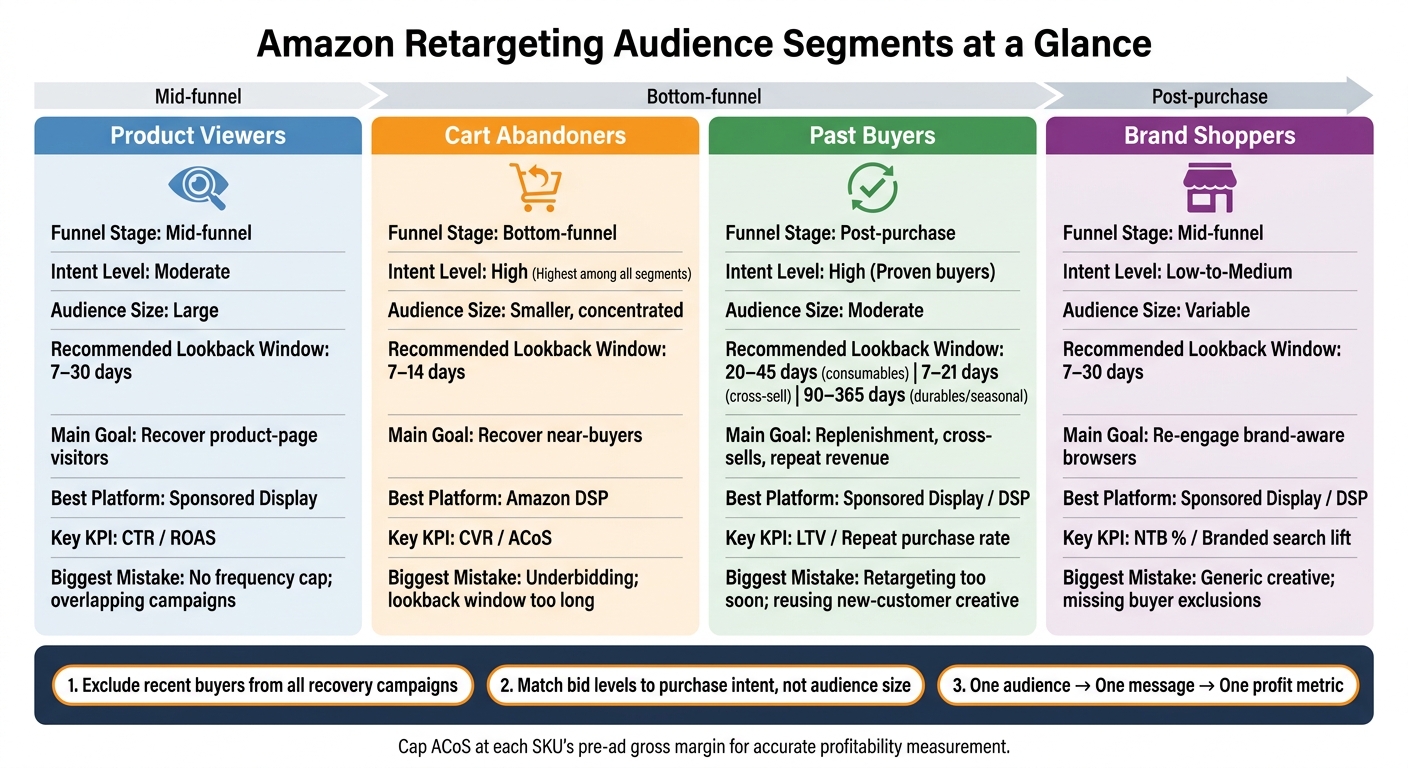
Amazon Retargeting Audience Segments: Quick Comparison Guide
Amazon AMC Audiences Tier List
sbb-itb-e2944f4
Product viewers and cart abandoners: two high-intent audiences at different stages
Product viewers and cart abandoners are both warm traffic, but they don’t drive the same ROI. Yes, both shoppers reached a product page. But one stopped at the view, while the other went as far as adding the item to cart. That gap matters. It changes intent, audience size, and expected return.
Start with product viewers, since this is the larger segment.
Product viewers: when to use them and how they work
A shopper enters this audience when they visit a specific ASIN’s product detail page and don’t complete a purchase. Amazon uses first-party data to build this audience for Sponsored Display and Amazon DSP. Since the trigger is a product page view, reach is broader, but intent is less concentrated than it is with cart abandoners.
This is usually where you put budget when you want to bring back shoppers who showed interest but weren’t ready to buy yet. They may need a few more touchpoints before they convert.
A few setup mistakes show up again and again:
- Using lookback windows that are too long
- Not excluding recent purchasers
- Skipping exclusions and letting campaigns overlap
If you want to go after shoppers who are closer to the finish line, cart abandoners need their own budget and their own message.
Cart abandoners: how to recover shoppers closest to purchase
Cart abandoners added a product to their cart but didn’t check out. That’s why this audience is usually the closest to purchase. The tradeoff is simple: scale is smaller, but conversion rate and ROAS tend to be higher.
Amazon DSP is often a strong fit for this group because it allows tighter frequency management. The biggest risk here isn’t overcomplicating the setup. It’s underbidding and losing the final conversion.
Product viewers vs. cart abandoners: side-by-side comparison
| Factor | Product Viewers | Cart Abandoners |
|---|---|---|
| Audience definition | Visited a specific ASIN page, did not purchase | Added product to cart, did not check out |
| Typical audience size | Larger audience | Smaller, more concentrated audience |
| Intent level | Mid-to-high; browsing but not yet committed | Highest; closest to checkout |
| Expected ROAS | Moderate; requires more touchpoints to convert | Typically higher due to proximity to purchase |
| Best use cases | Broader retargeting of detail page visitors | Recovering near-buyers |
| Best fit | Sponsored Display | Amazon DSP |
| Main setup risk | Overly long lookback windows, failing to exclude recent purchasers, overlapping campaigns | Underbidding and missing the final conversion |
With intent sorted, the next step is matching each segment to the right goal and budget.
Past buyers and brand shoppers: repeat revenue and mid-funnel demand
After product viewers and cart abandoners, the next two audiences matter for repeat revenue and mid-funnel recovery: past buyers and brand shoppers.
Product viewers and cart abandoners usually get most of the attention because they’re close to a first purchase. That makes sense. But if you’re trying to build revenue over time, these two segments deserve just as much focus. They already know your brand. At this stage, the job isn’t to persuade them from scratch. It’s to give them a good reason to return.
Past buyers: how to drive replenishment, cross-sells, and repeat revenue
Past buyers are shoppers who completed at least one purchase from your brand or product catalog within a set lookback window.
Amazon’s Sponsored Display documentation describes purchases remarketing as a way to "help you drive repeat purchases, increase repeat orders, and cross-sell to existing customers based on historical purchase behavior."
The key is simple: match the offer to the repurchase or cross-sell cycle.
- For consumables, use a 20–45 day window.
- For accessory cross-sells, use 7–21 days.
- For seasonal or high-ticket items, use 90–365 days.
Three mistakes show up again and again in past-buyer campaigns.
First, brands retarget too soon after delivery. If someone just got their order and sees a restock ad a few days later, it feels off. That creates friction instead of driving sales.
Second, brands reuse the same creative they use for new-customer campaigns. Past buyers don’t need a brand intro. They need a reason to come back, like a bundle, a new flavor, or a loyalty offer.
Third, the audience is often too broad. If you lump in buyers of loosely related products, the offer starts to feel random, and spend gets wasted. Segmenting by ASIN or by tight category groups keeps recommendations tied to what people actually bought.
Past buyers are a retention play. Brand shoppers are more of a re-entry play.
Brand shoppers: how to re-engage people who browsed your brand
Brand shoppers haven’t purchased yet, but they haven’t just skimmed past you either. This group includes Store visitors, Sponsored Brands clickers, and multi-ASIN browsers. That makes them a strong fit for line extensions and new product launches.
For Store traffic recovery, Sponsored Display or DSP ads can bring back visitors who explored your Store and left without buying. The landing destination matters here. Instead of sending everyone to the same page, route them to subpages like bestsellers, bundles, or category-based collections that line up with what they browsed. Lead with a clear brand-specific hook, not a generic pitch.
Two issues come up most often with this audience.
The first is weak creative differentiation. If brand shopper ads look exactly like prospecting ads, they miss the mark. Mid-funnel audiences need contrast. Reviews, badges, and certifications can help move them from consideration to purchase.
The second is missing buyer exclusions. If you don’t exclude recent buyers, brand shopper campaigns can spend impressions on people who already converted. That pushes frequency up and can hurt incremental ROAS. A simple exclusion window for recent purchasers – often 0–14 days or 0–30 days, depending on the product – helps keep the campaign aimed at actual non-buyers.
Past buyers vs. brand shoppers: side-by-side comparison
| Factor | Past Buyers | Brand Shoppers |
|---|---|---|
| Audience definition | Purchased your product or catalog within a set lookback window | Store visitors, Sponsored Brands clickers, and multi-ASIN browsers |
| Funnel position | Bottom-funnel; highest proven intent | Mid-funnel; brand-aware but not yet converted |
| Primary goal | Replenishment, cross-sells, repeat revenue | Line extensions, store recovery, new product trial |
| Typical lookback window | 20–45 days (consumables); 7–21 days (cross-sell); 90–365 days (durables/seasonal) | 7–30 days |
| Conversion behavior | Typically the highest conversion rates among retargeting segments | Lower than past buyers, higher than cold audiences |
| Recommended bidding | More aggressive bids justified by strong conversion rates and LTV | Bids between prospecting and past-buyer levels |
| Primary ROI metrics | ROAS, ACoS, repeat purchase rate | ROAS/ACoS, new-to-brand orders, branded search volume lift |
| Main setup risk | Retargeting too soon, reusing new-customer creative, over-broad audience targeting | Generic creative, missing buyer exclusions, overly broad audience definitions |
These differences shape your bid levels, budget split, and exclusion rules.
How your segment choice affects PPC ROI and campaign structure
Audience choice shapes bids, budgets, exclusions, and profit. So segment choice isn’t just about targeting. It’s a budget and campaign structure call too.
Match each segment to the right business goal
Product viewers help you win back people who visited a product page. Cart abandoners are usually the strongest recovery segment for shoppers who got close to buying. Past buyers can drive repeat purchases and cross-sells. Brand shoppers are useful for bringing back people who browsed your brand.
When you line up the segment with the goal, reporting gets cleaner. It also helps push budget toward the audience most likely to pay back.
Use exclusions, budgets, and lookback windows to cut wasted spend
Without exclusions and frequency caps, the same shoppers can get hit by ads across multiple campaigns. That can wear people out and burn budget fast. Once someone buys, remove them from recovery campaigns.
Budget should follow purchase intent, not just audience size. A smaller cart-abandoner audience will often earn more budget than a much larger product-viewer group.
Judge retargeting by margin, not ACoS alone. Cap ACoS at each SKU’s pre-ad gross margin.
All four Amazon retargeting segments: consolidated comparison
| Segment | Funnel Stage | Intent Level | Recommended Window | Main KPI | Strongest Use Case | Biggest Setup Mistake |
|---|---|---|---|---|---|---|
| Product Viewers | Mid-funnel | Moderate | 7–30 days | CTR / ROAS | Recovering product-page visitors | No frequency cap |
| Cart Abandoners | Bottom-funnel | High | 7–14 days | CVR / ACoS | Recovery for near-buyers | Window too long, which hurts freshness |
| Past Buyers | Post-purchase | High | 30–90+ days | LTV / Repeat purchase rate | Replenishment and cross-sells | Using too short a lookback window |
| Brand Shoppers | Mid-funnel | Low-mid | 7–30 days | NTB % | Bringing back brand browsers | Generic creative |
The next risk is execution: overlap, weak exclusions, and stale windows.
Common setup mistakes and key takeaways
Mistakes that hurt retargeting performance
Once your segments are set, the biggest problem is usually audience overlap. Cart abandoners, product viewers, and past buyers shouldn’t all end up in the same active flow. Keep recovery campaigns separate from retention campaigns, and use exclusions so each shopper lands in one audience at a time.
Another common miss is using the same ad for every segment. That one-size-fits-all approach cuts relevance and weakens conversions. Someone who left a cart needs a different message than someone who bought 30 days ago.
Creative shapes the response, but measurement tells you if a segment is making money. Your lookback window should match the buying cycle. If it’s too long, intent starts to fade. If it’s too short, you lose scale. And when you measure results, focus on ROAS, ACoS, and repeat-purchase revenue, not clicks.
Key takeaways for building a cleaner retargeting program
A clean setup keeps things simple: one audience, one message, and one profit metric per campaign. Match each segment to the shopper’s intent. Keep recovery campaigns apart from repeat-purchase campaigns. Use exclusions from the start, not as a last-minute fix.
The best retargeting programs keep each segment separate, each message specific, and each budget tied to profit.
FAQs
How do I choose the right lookback window?
Pick a lookback window that fits both your conversion goal and Amazon’s attribution window. Sponsored Products use 7 days. Sponsored Brands and Sponsored Display use 14 days.
For retargeting, match the window to the way people buy. For example, you might use 180 days for past engagers, while excluding shoppers who purchased in the last 90 days.
One more thing: wait until the full attribution window has passed before you judge results or change bids. If you move too early, you can end up reacting to data that isn’t complete yet.
Which segment should get the most budget first?
Start with bottom-of-funnel segments, especially branded searchers and other high-intent audiences. They tend to convert better than broader, non-branded campaigns.
A common starting point is 40% to 60% of your total budget, with 40% to 50% going to your highest-converting campaigns. The idea is simple: put more of your spend behind audiences that already show clear buying intent.
When should I exclude recent buyers?
Exclude recent buyers when you want your retargeting budget focused on new customers or cross-sell opportunities, not people who already converted.
This cuts wasted ad spend and puts more of your budget in front of higher-potential audiences who are more likely to engage for the first time or check out other products.