

If you want cleaner search control, Amazon usually wins. If you want more placement variety across browse, item pages, and homepage spots, Walmart stands out.
I’d sum it up this way: Amazon has more ad competition, more control, and deeper reporting. Walmart has fewer sellers, more browse-led discovery, and simpler placement options. That changes where ads show, how shoppers find products, and how I’d think about budget on each platform.
Here’s the short version:
- Amazon has over 2,000,000 sellers vs. about 160,000 on Walmart Marketplace
- Amazon leans hard on search
- Walmart leans more on search, browse, item pages, and homepage discovery
- Amazon offers more placement controls, including bid modifiers up to +900%
- Walmart gives fewer levers and less placement-level reporting
- Amazon display can reach shoppers on and off Amazon
- Walmart display ties into its store and online shopper base, including 150 million weekly in-store customers
- In grocery, Walmart holds 31.6% of U.S. online grocery sales vs. Amazon’s 22.6%
What that means for me:
- I’d use Amazon when I want tighter search control and more detail in reports
- I’d use Walmart when I want more discovery-based placement coverage beyond search
- I’d watch Amazon CPCs closely because competition is heavier
- I’d treat Walmart scale with more care because results can be less steady across categories
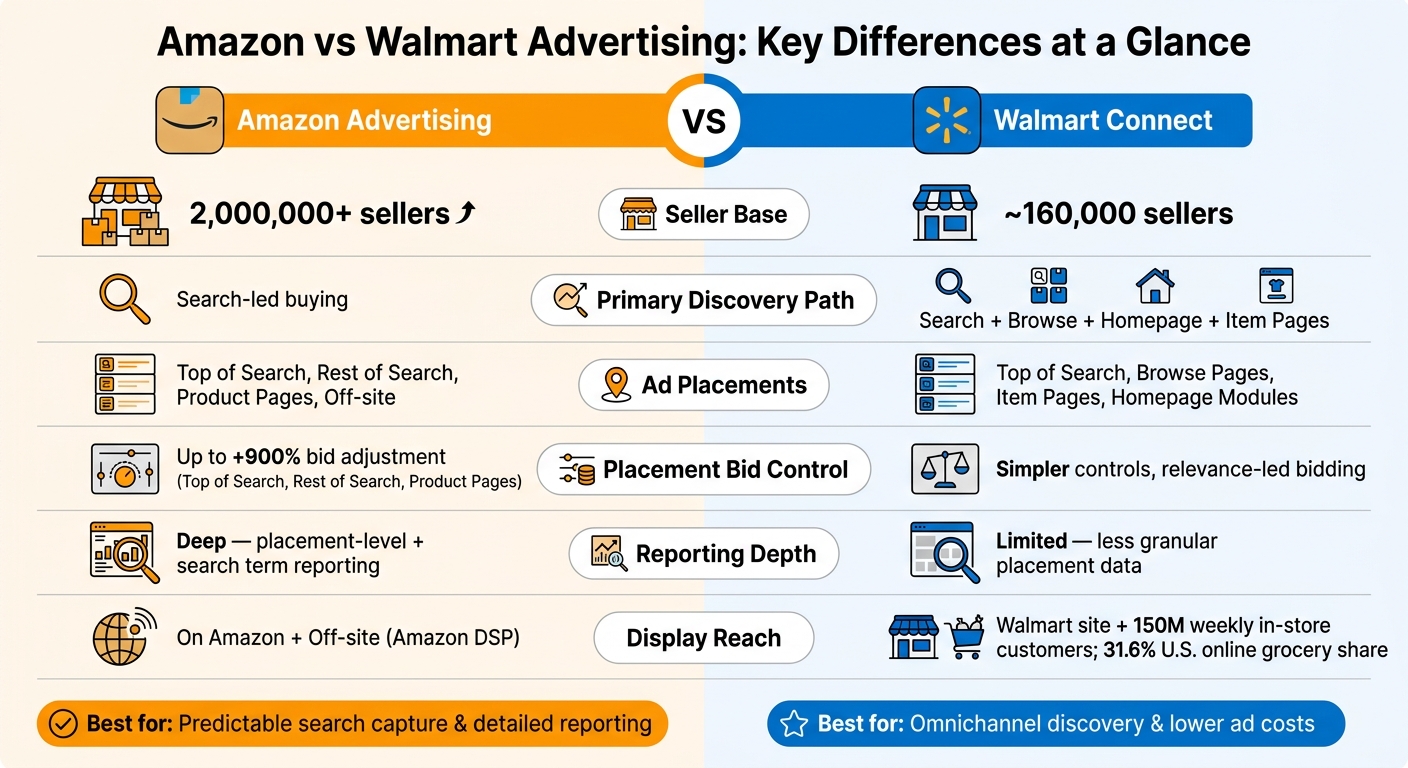
Amazon vs Walmart Advertising: Key Differences at a Glance
Walmart has MORE Ads than Amazon WTF Why Walmart is No Savior to Amazon Sellers | 417k SellerReviews
sbb-itb-e2944f4
Quick Comparison
| Area | Amazon | Walmart |
|---|---|---|
| Seller count | 2,000,000+ | 160,000 |
| Main discovery path | Search | Search + browse + homepage |
| Top placements | Search, product pages, some homepage, off-site | Search, browse, item pages, homepage |
| Placement control | More control | Fewer controls |
| Reporting | Deeper placement data | Less granular |
| Display reach | On Amazon + off Amazon | Walmart site + store-linked audience |
| CPC pattern | Higher, more crowded | Lower in many cases, but less steady at scale |
In other words: Amazon is built more for search-led buying, while Walmart gives you more ways to show up during product discovery.
Amazon vs Walmart Ad Placements Side by Side
Amazon and Walmart overlap on the main ad spots, but they don’t show up in the same way. Walmart has browse and homepage inventory. Amazon, meanwhile, has a broader sponsored setup and more off-site reach.
Here’s the placement breakdown:
| Placement Location | Amazon Ad Types | Walmart Ad Types |
|---|---|---|
| Top of search | Sponsored Products, Sponsored Brands | Sponsored Products |
| Rest of search | Sponsored Products | Sponsored Products |
| Product / item pages | Sponsored Products, Sponsored Display | Sponsored Products, Display Ads |
| Browse / category pages | Not available | Sponsored Products |
| Homepage | Sponsored Brands (limited) | Display Ads, Homepage Modules |
| Off-site retargeting | Sponsored Display, Amazon DSP | Walmart Connect Display |
Amazon Placements: Search, Product Pages, and Display
Amazon’s main formats are Sponsored Products, Sponsored Brands, and Sponsored Display. Sponsored Products show up in search results and on product pages. Sponsored Brands take over top-of-search banner space. Sponsored Display goes a step further by reaching shoppers both on Amazon and off Amazon, which is something Walmart Connect does not match.
Walmart Placements: Search, Browse, Homepage, and Item Pages
Walmart Connect puts Sponsored Products in search results, browse grids, and item pages. It also runs display ads in homepage modules. The big difference is browse placement. Amazon doesn’t offer that slot.
That gap starts to matter more when you look at inventory depth and how shoppers move through each marketplace.
How Inventory Depth and Shopper Behavior Affect Placement Strategy
Amazon and Walmart pull shoppers through different paths. That changes which ad placements do the heavy lifting.
Amazon’s Larger Catalog Means More Search Competition
Amazon has a much larger seller base, so keyword competition is tougher. The platform leans heavily on search, and that pushes advertisers into a more crowded auction. Top-of-search gets a lot of attention, but the cost can climb in a hurry. Amazon lets advertisers increase bids by up to +900% for top-of-search placements, and suggested bids often come in 20–50% above what many sellers can profitably afford.
So don’t build bids around Amazon’s defaults. Set max CPC using this formula: Target ACOS × Product Price × Conversion Rate.
When search CPCs get too expensive, product page placements start to make a lot more sense. They put your brand on competitor detail pages right when shoppers are weighing options side by side. That’s a big moment. And it’s one reason placement control matters so much on Amazon.
Walmart Shoppers Use Browse and Item Pages More Often
Walmart works a bit differently. Shoppers there find products more often through browse paths and item pages, so those placements matter more.
In plain English: on Walmart, you usually need a broader mix. Search still matters, but browse, item-page, and homepage placements are all part of the main discovery path. They’re not just extra inventory sitting on the side.
The catch is that Walmart’s auction dynamics are less mature in many categories, which can make scaling harder to predict. That means placement mix on Walmart matters just as much as search bidding.
Here’s a side-by-side look at the main discovery differences:
| Factor | Amazon | Walmart |
|---|---|---|
| Primary discovery path | Keyword search | Search + browse + homepage |
| Top-of-search bid adjustment | Up to +900% | Simpler controls |
| Blended avg. CPC (2026) | ~$1.18 | Lower; less predictable at scale |
| Auction dynamics | Highly competitive | Less mature in many categories |
| Shopper mindset | Search to filter | Browse to discover |
Those placement gaps lead straight into the next issue: how much control and reporting each platform gives advertisers.
Placement Controls, Bidding, and Reporting on Each Platform
That same gap shows up in bidding and reporting, too.
Amazon Offers More Placement Controls and Detailed Reporting
Amazon gives Sponsored Products advertisers three bidding strategies: Dynamic bids – down only (default), Dynamic bids – up and down, and Fixed bids. On top of that, you can set placement-level bid adjustments of up to +900% for Top of Search, Rest of Search, and Product Pages.
Those adjustments stack. So before you push placement bids too high, check the ceiling with this formula: effective max CPC = base bid × (1 + placement adj%) × (1 + dynamic raise%).
That matters because Amazon’s reporting goes deeper. Placement-level reports show how search results and product detail pages perform, which makes it easier to shift budget based on what the data says.
More control gives advertisers more room to fine-tune spend.
Walmart Has Simpler Controls and Less Reporting Depth
Walmart Connect uses a relevance-led bidding model. In plain English, product relevance does most of the heavy lifting, and bid works more like a secondary lever. Walmart has added auto-bidding and keyword harvesting, but its auction is still simpler and less mature, so CPCs can be less predictable at scale.
Its reporting is getting better, but it still doesn’t give the same placement-level detail as Amazon. That makes it harder to see exactly where conversions come from or move budget fast with the same confidence.
| Feature | Amazon Advertising | Walmart Connect |
|---|---|---|
| Bid strategies | Fixed, Dynamic bids – down only, Dynamic bids – up and down | Auto-bidding and manual keyword bidding |
| Placement controls | Up to +900% for Top of Search, Rest of Search, and Product Pages | Fewer placement levers |
| Reporting depth | High: placement-level and search term reporting | More limited and less granular |
Next: where sponsored ads win and where display ads add coverage.
Sponsored vs Display Ads: Which Platform Gives You More Reach
Where Sponsored Ads Win vs Where Display Ads Add Coverage
Now that bidding and reporting are out of the way, the next gap is reach.
Amazon sponsored ads are often the safer pick for high-intent search traffic. You can bid on terms that show strong buying intent and, if the account is set up well, get steadier returns. Sponsored Products average 4.4x ROAS. That makes Amazon a good fit when you want more predictable intent capture.
Walmart sponsored ads, on the other hand, often come with lower CPCs and less competition. That sounds great, and it can be. The trade-off is that scaling is tougher in many categories. So the simple split looks like this:
- Use Amazon sponsored ads for more predictable high-intent capture.
- Use Walmart sponsored ads for lower-competition traction.
Sponsored ads catch demand that already exists. Display does something else: it helps you get in front of people beyond search intent.
Amazon display expands reach both on Amazon and off-platform. Walmart display brings a different kind of reach. It connects brands to 150 million weekly in-store customers who also shop online. That’s a big plus for brands in groceries, essentials, or CPG, where Walmart has 31.6% of U.S. online grocery sales compared with Amazon’s 22.6%.
Conclusion: The Main Placement Differences to Remember
Amazon is a better match for predictable search capture, stronger reporting, and a more mature auction. The downside is higher CPCs and tougher competition.
Walmart is a better match for broader omnichannel reach, lower ad costs, and access to shoppers who move between in-store and online buying. The downside is less granular data and scaling that can be harder to predict.
FAQs
Which platform is better for new product discovery?
It depends on your goals.
Walmart is often the better place to start when you’re launching new products. Why? Seller saturation is lower, so it can be easier to get first-page visibility without pouring as much money into ads.
Amazon is stronger when your main goal is reaching high-intent shoppers. The trade-off is simple: it’s more competitive, and new items usually need a bigger advertising budget to get seen.
When should I prioritize sponsored ads over display ads?
Prioritize sponsored ads – especially Top of Search – when the goal is immediate growth, a product launch, rank gains, or branded-term defense.
Why? These placements put your product in front of shoppers with the highest buying intent and the most visibility. They tend to work best for high-intent keywords that already convert well.
For efficiency-focused goals like product discovery, cross-selling, or low-cost traffic testing, use broader display placements or non-Top-of-Search options instead.
And don’t judge results by visibility alone. Check performance by comparing ACoS and ROAS against your campaign averages. That gives you a much better read on whether the placement is actually pulling its weight.
How should I split budget between search and browse placements?
On Amazon, don’t split your budget by a fixed formula. Split it based on what each campaign is trying to do.
For new campaigns, start with a 0% placement adjustment. That gives you a clean baseline. From there, check your placement reports and see where the money is doing its best work. If Top of Search is leading, shift more spend there.
To lean harder into high-intent traffic, a 50% to 100% bid multiplier can make sense. On the other hand, weaker placements like Product Pages or Rest of Search may call for multipliers that are 30% to 50% lower.