
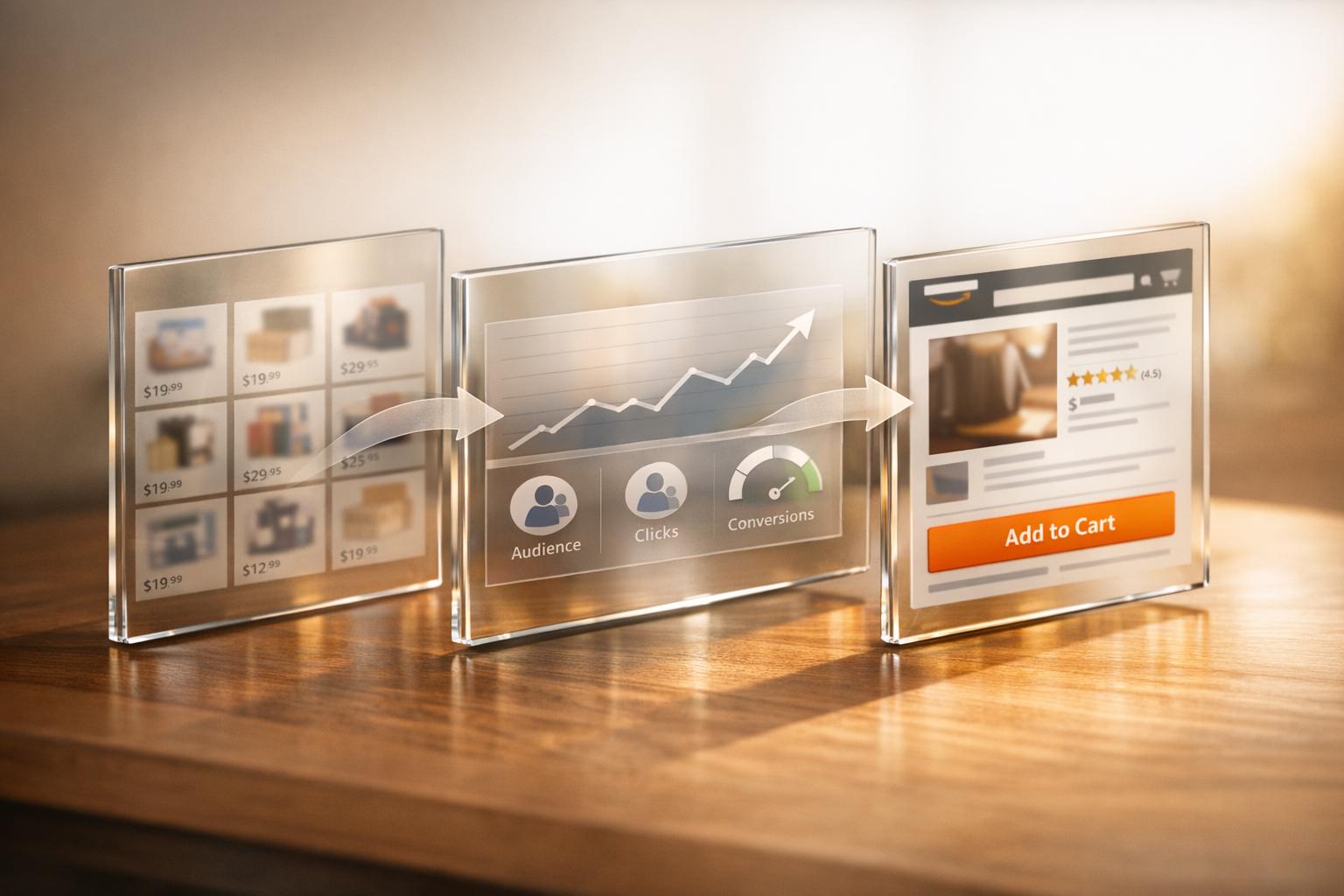
Want to boost sales by targeting competitor audiences on Amazon? This case study breaks down how a Health and Household brand used Amazon DSP and Sponsored Display ads to win over shoppers from competitors. By leveraging behavioral data, segmenting audiences based on recency and activity, and creating tailored ad campaigns, the brand achieved:
- 3–5× higher conversion rates for recent competitor viewers.
- A 264.1% increase in organic sales during a full-funnel campaign.
- New-to-brand growth by converting competitor purchasers.
- Reduced TACoS by 15–25% compared to search-only campaigns.
Key Strategies:
- Focused on high-intent shoppers who browsed or purchased from competitors.
- Used Amazon DSP for off-site targeting and Sponsored Display for on-site visibility.
- Created custom ad creatives highlighting better pricing, reviews, and features.
This approach not only improved ad ROI but also boosted organic rankings and long-term growth. Ready to learn how it worked? Let’s dive in.
Brand Background and Competitive Challenges
Brand Profile and Market Context
This case study focuses on a brand in the crowded Health and Household category – a space where products often feel interchangeable. To stand out, the brand crafted a tailored brand story and premium A+ content. These efforts aimed to address common shopper concerns by using distinct visuals and carefully written copy. Before committing to significant ad spending, the brand validated its approach with A/B testing to ensure effectiveness.
Core Business Goals
The brand outlined three primary goals: increase monthly revenue from $12,000 to $149,000, keep TACoS below 14%, and bring in new customers. All of this needed to be achieved without sacrificing a strong conversion rate. However, these ambitions were set against a backdrop of fierce competition and aggressive market dynamics.
Key Challenges in the Competitive Landscape
The brand faced several hurdles despite having clear objectives. Competitors had already secured a strong foothold, with established reviews and higher organic rankings making it difficult for the brand to gain visibility. Adding to the challenge, competitors actively targeted the brand by running Sponsored Products and Sponsored Display ads directly on its product detail pages. This tactic diverted an estimated 10% to 15% of potential conversions before shoppers could finalize their purchases.
Another issue was the brand’s reliance on lower-funnel Sponsored Products campaigns. This strategy left them out of reach of high-intent shoppers who were already engaging with competitors’ products.
"If you are not running product targeting campaigns, your competitors almost certainly are – on your listings." – CSB Concepts
These competitive pressures highlighted the importance of shifting focus toward shoppers already captured by rival brands’ marketing efforts.
sbb-itb-e2944f4
How the Brand Approached Competitor Retargeting
Audience Segmentation and Targeting
Rather than casting a wide net over all Amazon shoppers, the brand zeroed in on those most likely to switch. Using Amazon Marketing Cloud (AMC), the team ran SQL queries to pinpoint shoppers who had viewed both the brand’s products and a competitor’s but ultimately chose to purchase from the competitor. This approach helped them focus on high-value prospects.
They divided their audience into three main groups:
- Competitor product viewers: Shoppers who browsed rival listings but didn’t buy.
- Competitor purchasers: Those who bought from a competitor in the past 30–90 days.
- Similar product viewers: Shoppers who interacted with products similar to the brand’s catalog.
Each group was further segmented by recency: 0–7 days, 8–30 days, and 31–90 days. This allowed the team to prioritize the freshest audiences, who are typically more likely to convert, and tailor their messaging accordingly. This structured segmentation became the backbone of their ad strategy.
Ad Tools and Campaign Design
The brand used two primary tools to execute their campaign: Amazon DSP and Sponsored Display.
- Amazon DSP: This tool provided access to behavioral data from over 200 million Prime members, enabling the brand to target competitor-loyal shoppers both on and off Amazon.
- Sponsored Display: Ads were strategically placed on competitor product detail pages, targeting shoppers as they actively evaluated rival products.
"DSP is the stronger option for data-driven competitor targeting at scale. Sponsored Display fits brands that want accessible, on-Amazon visibility with lower investment thresholds."
- i2o Retail Team
The strategy combined the strengths of these tools: DSP built initial awareness and attracted competitor audiences into the funnel, while Sponsored Display reinforced the messaging closer to the point of purchase. To optimize spending, the brand used a tiered budget approach, allocating the largest share to high-intent competitor ASIN targeting and a smaller portion to broader remarketing campaigns.
Ad Creative and Brand Positioning
What set this campaign apart was its creative execution. Instead of reusing standard product images, the team developed custom lifestyle creatives aimed specifically at competitor audiences. Ad headlines emphasized clear advantages like better star ratings, competitive pricing, and features that addressed known shortcomings in rival products.
This strategic approach paid off. Custom lifestyle images in Sponsored Display ads have been shown to improve click-through rates (CTR) by 25% to 40% compared to auto-generated creatives. Similarly, purpose-built DSP creatives consistently achieved higher engagement and conversion rates.
"The performance gap between purpose-built DSP creative and recycled assets is consistently 2-3x in CTR and 1.5-2x in CVR."
- Jake Schwarzbaum, Co-Founder and CEO, Velocity Sellers
Amazon DSP vs Sponsored Display What Scaling Brands Get Wrong
Results and Business Impact
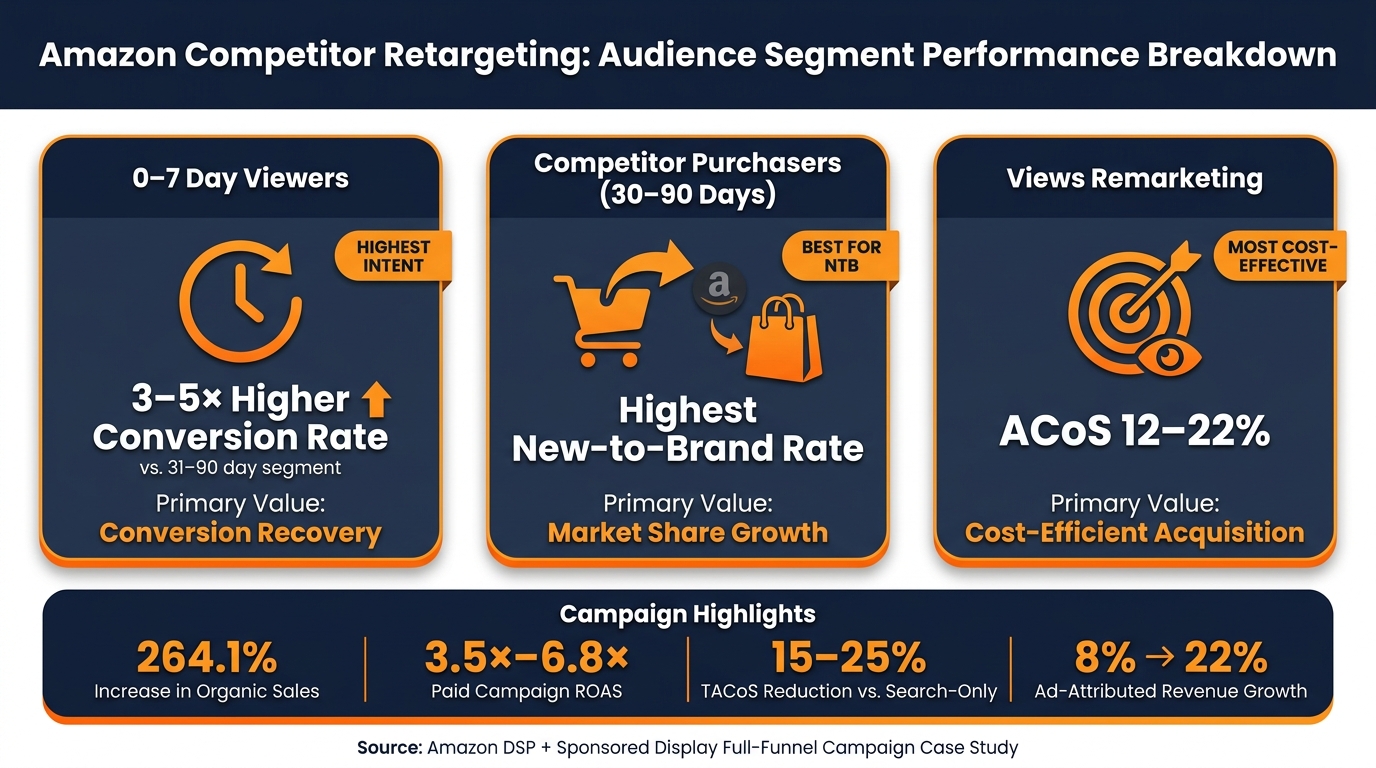
Amazon Competitor Retargeting: Audience Segments & Performance Metrics
These strategies led to clear, measurable business outcomes.
Performance Metrics and ROI
The campaign delivered impressive results across key metrics. Organic sales saw a significant boost, driven by increased traffic and engagement with DSP and Sponsored Display ads. For instance, RT7 Digital reported a full-funnel Amazon DSP campaign for a water filter pitcher brand (November 12–December 31, 2025) that achieved a 264.1% increase in organic sales and a 30% rise in total revenue, generating nearly 3 million impressions in less than two months. Paid campaign ROAS ranged between 3.5× and 6.8×, while optimized competitor conquesting increased ad-attributed revenue from approximately 8% to 22%. Additionally, full-funnel display strategies resulted in a blended TACoS that was 15–25% lower than search-only campaigns.
Audience Segment Performance
The segmentation strategy proved to be a game-changer, with different audience groups showing varied levels of success. The 0–7 day segment emerged as a standout, converting at rates 3–5× higher than the 31–90 day segment.
"The 0–7 day pool converts at 3–5× the 31–90 day pool. Treating them as one audience kills the campaign’s apparent ROI." – Jake Schwarzbaum, Co-Founder and CEO, Velocity Sellers
Another highlight was the competitor purchaser segment – shoppers who had bought from a rival in the past 30–90 days. This group delivered the highest new-to-brand rate, confirming the campaign’s success in attracting new customers rather than recycling existing ones. Meanwhile, views remarketing consistently achieved an ACoS of 12–22%, marking it as one of the most cost-effective segments.
| Audience Segment | Standout Metric | Primary Value |
|---|---|---|
| 0–7 day viewers | 3–5× higher conversion rate vs. 31–90 day | Conversion recovery |
| Competitor purchasers (30–90 days) | Highest new-to-brand rate | Market share growth |
| Views remarketing | ACoS 12–22% | Cost-efficient acquisition |
These segment-specific achievements fed into broader business advances.
Broader Business Benefits
The synergy between Amazon DSP, Sponsored Display, and precise audience segmentation not only delivered immediate wins but also set the stage for sustained growth. The spike in paid traffic provided Amazon’s algorithm with fresh engagement signals, boosting organic rankings for key search terms. This created a ripple effect, driving more organic clicks and reducing dependency on paid campaigns over time.
The campaign also generated actionable insights beyond advertising. For example, competitor purchaser trends revealed which product features appealed most to switchers, offering valuable guidance for product and pricing teams. Additionally, defensive retargeting on the brand’s ASINs effectively blocked competitor ads, preventing an estimated 10–15% of potential conversions from being lost.
Key Takeaways and Best Practices
Drawing from the campaign results, here are some essential strategies for effective competitor retargeting.
Audience Selection and Data Refinement
The success of a competitor retargeting campaign starts with choosing the right targets. Instead of going after category leaders with thousands of reviews, focus on competitor ASINs where your brand has an advantage – like better ratings, lower prices, or stronger product content. As Ash Metry, Founder & CEO of Keywords.am, explains:
"Most sellers waste spend by targeting strong competitor ASINs that resist conquest. Target weak listings instead."
Rather than casting a wide net, narrow your focus to 5–10 specific competitor ASINs. Use tools like Amazon Marketing Cloud (AMC) to create custom segments. For example, target shoppers who viewed several competitor products but didn’t buy. Timing also matters: use a 7-day lookback window for impulse buys, 14–30 days for mid-range products, and 60–90 days for higher-priced items. Make sure to exclude recent purchasers (at least a 30-day window) to avoid wasting ad spend on converted customers.
Campaign Execution and Management
Keep your campaigns organized by separating offensive (competitor conquest) and defensive (brand protection) efforts. Combining these can muddy performance data and make optimization harder. For key competitors, set up single-ASIN ad groups to fine-tune bids and track performance more clearly.
Creativity plays a big role too. Use custom lifestyle images and benefit-focused headlines in your ads. These personalized creatives often boost click-through rates by 20% to 40% compared to generic assets. Purpose-built display ads can also deliver 1.5–2× higher conversion rates. Start with "dynamic bids – down only" to control costs, then shift to fixed bids once profitability is consistent.
Scaling and Future Opportunities
Once your initial campaigns are performing well, consider scaling up. Add demographic or lifestyle filters, such as targeting users who browsed competitor skincare products and have a household income of $100K or more. If your brand generates 30,000+ detail page views per month, Amazon DSP offers even more precise targeting, including placements beyond Amazon’s platform.
Don’t overlook video ads. Sponsored Display now supports video in select placements, and some brands have seen 2.2–3.1× higher CTR compared to static ads. Budget allocation is also key: brands with under $1M in revenue should dedicate 10–20% of their ad budget to retargeting. Brands in the $1M–$5M range can invest more aggressively in Sponsored Display remarketing and explore DSP opportunities.
These strategies not only improve campaign performance but also open doors for partnerships that can drive long-term growth.
How Emplicit Can Help
Pulling off a successful competitor retargeting campaign requires careful planning – from refining your audience to managing bids and testing creatives. Emplicit offers a full suite of Amazon advertising services, including customized PPC strategies, listing optimization, and audience targeting tailored to your market. Whether you’re just starting with Sponsored Display or ready to scale with DSP and AMC, Emplicit’s team can help you build and execute a strategy that aligns with your business goals.
FAQs
How do I choose competitor ASINs to retarget?
When choosing competitor ASINs, rely on a data-driven approach instead of making random guesses or automatically targeting market leaders. Focus on listings that share a high keyword overlap with your product. You can identify these by using tools like reverse ASIN lookups or analyzing Search Term Reports.
Once you’ve identified potential competitors, dig deeper to find their weaknesses. Keep an eye out for issues like:
- Poorly written or unoptimized titles
- Low customer ratings or negative reviews
- Missing features like A+ content
Then, prioritize competitors where your product has a clear edge. For example, maybe your product offers a better value proposition, such as a more competitive price or consistently higher reviews. This strategy ensures you’re going after opportunities where you can outshine the competition.
What lookback window should I use for competitor audiences?
When creating competitor audiences, a lookback window of 30 to 90 days is typically used. The ideal duration depends on factors like your product’s sales cycle and the specific stage of the purchase funnel you’re aiming to target. Emplicit develops customized strategies to evaluate your category and competitors, helping you choose a lookback period that effectively captures shoppers considering competitor products and redirects their attention to your brand at the right moment.
Do I need Amazon DSP and AMC to do this?
Amazon DSP plays a key role in retargeting competitor audiences by utilizing Amazon’s first-party purchase data. This allows you to target customers who have shown interest in or interacted with competitor products.
Although using Amazon Marketing Cloud (AMC) isn’t mandatory, it can be a game-changer for experienced sellers. AMC provides access to deeper audience insights, helps create custom audiences, and facilitates multi-touch attribution analysis. With the right guidance, such as that from Emplicit, you can use these tools to develop strategies that drive growth both on and off Amazon.