

If I want steady conversion lift, I’d use coupons. If I want a short sales spike, I’d use deals – but only after checking margin down to the dollar.
Here’s the short version:
- Coupons usually support steady clicks and conversions
- Deals usually drive more urgency and bigger short-term volume
- Coupons often give me more control over margin
- Deals often bring higher cost pressure from flat fees, deeper discounts, and ad spend
- The five checks that matter most are CTR, CVR, contribution margin, price perception, and competitor response
- Post-promo results matter a lot: one Prime Day spike can look big, but the better question is whether sales stay up after the event
A few numbers stand out right away:
- During Amazon deal events, 35%–45% of shoppers make unplanned purchases
- Many sellers use 20%–25% coupons as a middle ground between conversion lift and margin pressure
- Deals often push closer to 40% off, which can hurt profit if fees and ad support stack up
- In one case from the article, GOSHI saw an 11x jump in daily sales during Prime Day 2023 and kept a 13.3% lift after
Quick comparison
| Metric | Coupons | Deals |
|---|---|---|
| CTR | Steady search visibility from the green badge | Often stronger during promo windows due to event placement |
| CVR | Good for day-to-day conversion support | Often stronger when urgency is high |
| Contribution margin | Usually easier to control | Often tighter due to flat fees and deeper discounts |
| Price perception | Helps avoid changing list price | Can train shoppers to wait for event pricing |
| Competitor response | Often milder | Often sharper, with more ad and price pressure |
If I had to boil the article down to one rule, it’s this: don’t judge coupons and deals by sales lift alone – judge them by post-promo profit and what happens after the promo ends.
sbb-itb-e2944f4
Amazon Coupons: Steady Visibility With Controlled Margin Impact
Coupons put a steady discount signal in front of shoppers, which can help support conversion without the rush of a big event. That makes them a clean starting point when you want to measure incremental lift before stacking them up against event-driven deals.
How Coupons Affect CTR and Conversion Rate
Coupons can lift CTR on crowded category pages, but they usually won’t rescue a listing with weak reviews or shaky basics. If the product page isn’t doing its job, the coupon only gets you so far.
A better way to judge performance is to compare the listing against its own no-promotion period. Then look at similar products with close review counts, ratings, and pricing. That gives you a fairer read than looking at the coupon in isolation.
Coupon Margin Math and Price Perception
Before launch, model the full cost picture: face-value discount, redemption fee, referral fee, FBA, and PPC support. On Amazon, the headline discount is only part of the story. The extra fees can eat into margin fast if you don’t map them out first.
Coupons can also help move inventory without changing the official list price, which helps protect price perception. That’s one reason sellers lean on them instead of permanent price cuts.
For many products, a 20% to 25% coupon hits a workable middle ground between conversion lift and margin. Go deeper, and you may pull in more deal hunters than loyal buyers.
How Competitors Typically React to Coupons
Competitors often respond in fairly predictable ways:
- Match the visible savings
- Cut list price
- Increase sponsored bids on your branded terms
That more even response makes coupons useful as a baseline, especially before you test the sharper swings that deals tend to trigger.
Amazon Deals: Stronger Urgency, Greater Margin Pressure and Operational Demands
Coupons tend to drive a steady bump. Deals do something different: they create short bursts of demand. That’s why you can’t judge them on CTR and CVR alone. You also need to watch margin and what happens after the event ends.
How Deals Affect CTR, Conversion Rate, and Sales Spikes
Deals can appear on Amazon’s dedicated Deals page, while coupons usually show up in search with green badges. That extra visibility, mixed with time pressure, can push shoppers to act fast. During Amazon deal events, about 35–45% of users make unplanned purchases.
The bigger question is simple: does that short spike stick?
GOSHI gives a good example. The brand saw an 11x increase in daily sales revenue during Prime Day 2023, and then kept a 13.3% permanent lift in daily sales after the event. That’s the number to care about. The giant peak looks great in a dashboard, but the lasting lift tells you whether the deal did more than create a one-day rush.
Deal Fees, Discount Depth, and Break-Even Risk
A big sales jump can still be a bad deal if the fee setup and discount cut too deeply into margin.
Lightning Deals and 7-Day Deals come with a flat fee on top of the discount, while coupons use a per-redemption charge. And if the goal is to drive fast action, a 40% discount is a common benchmark. Put those pieces together – flat fee, heavy discount, and paid ad support – and you can end up in a spot where revenue climbs while profit shrinks.
Before setting discount depth, model contribution margin carefully. That means factoring in:
- COGS
- Referral fees
- FBA fees
- Expected ad spend
- The risk of a sales drop after the promotion ends
If that math doesn’t work before launch, the spike may not be worth much.
How Competitors React During Deal Periods
There’s also the workload side of deals, and it can hit hard.
During deal windows, competitors often react by increasing their own discount depth or spending more on ads tied to your branded terms. At the same time, shoppers use price-tracking apps and watch their carts closely, comparing options as prices shift. So even if your deal pulls traffic in, a competitor’s counterpunch can send that traffic somewhere else before your promotion wraps up.
That’s why deals need earlier planning for both inventory and ads. If you stock out, you lose the rank gains you fought for and hand market share to competitors.
Coupons vs. Deals: Side-by-Side Benchmarking for Similar Products
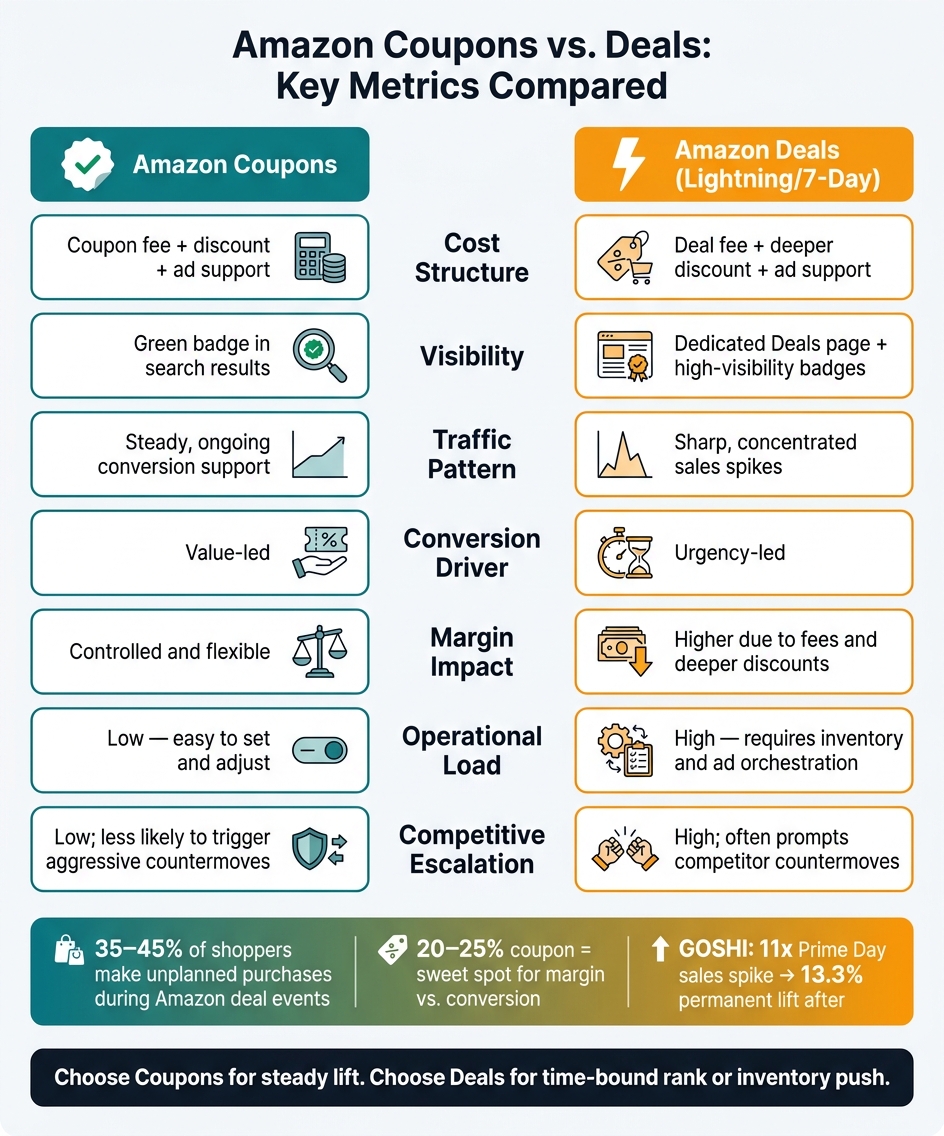
Amazon Coupons vs Deals: Key Metrics Compared
Use the five metrics above to figure out which promotion makes sense for the SKU.
Comparison Table: Coupons vs. Deals Across Key Metrics
| Metric | Amazon Coupons | Amazon Deals (Lightning/7-Day) |
|---|---|---|
| Cost Structure | Coupon fee + discount + ad support | Deal fee + deeper discount + ad support |
| Visibility | Green badge in search results | Dedicated "Deals" page + high-visibility badges |
| Traffic | Steady, ongoing conversion support | Sharp, concentrated sales spikes |
| Conversion Driver | Value-led | Urgency-led |
| Margin Impact | Controlled and flexible | Higher due to fees and deeper discounts |
| Operational Load | Low – easy to set and adjust | High – requires inventory and ad orchestration |
| Competitive Escalation | Low; less likely to trigger aggressive countermoves | High; often prompts competitor countermoves |
At this point, the choice is pretty simple: does the product need a steady lift, or does it need a short burst?
When to Use Coupons and When to Use Deals
Tie the promo type to the SKU’s job. That might mean steady lift, inventory clearance, or an event-based rank push.
Coupons tend to work best when the goal is steady conversion lift. They’re a good fit for keeping a listing competitive day to day, testing price sensitivity, or helping with customer acquisition without the heavier lift that comes with a scheduled event.
Deals fit better when you have a clear, time-boxed goal. Think moving a product up in organic rank, clearing aging inventory, or making the most of a traffic-heavy event like Prime Day. Trtl and The DB Method both saw daily revenue jump 25x to 26x their regular run-rates during Prime Day 2023.
Choose coupons for steady conversion lift. Choose deals for a time-bound rank or inventory push.
A Simple Benchmarking Method for Smaller Teams
For smaller teams, the goal isn’t fancy reporting. It’s tracking the numbers that show what changed before, during, and after the promotion.
The minimum set of metrics includes:
- impressions, CTR, sessions, CVR, units ordered, net sales
- margin per unit, total profit, organic rank movement, and competitor price and promo changes
Don’t look only at the live promo window. The pre- and post-promotion periods matter just as much. Connoisseurs, for example, saw daily revenue reach 9x their regular run-rate during Prime Day 2023, and their top SKU held a 42% week-over-week sales increase after the event ended.
That post-promotion read is what helps you tell the difference between a gain that sticks and a short-lived spike.
Conclusion: Match the Discount Type to the Growth Goal
When you look at CTR, CVR, margin, price perception, and competitor response, one thing becomes clear: the best promo is the one that matches the SKU’s job right now.
Coupons and deals are not the same lever. Coupons are better for controlled lift. Deals are better for short-term volume. Mix them up, and that’s usually where margin starts to slip.
Use the promo the SKU needs at this moment. Go with coupons for acquisition or price testing. Use deals for rank pushes or liquidation, but only when the listing is ready and inventory can handle the jump in demand.
Key Points to Apply in Promotion Planning
Benchmark coupons and deals separately. They come with different fee setups, traffic patterns, and margin tradeoffs, so judging them by raw sales lift alone can point you in the wrong direction. Compare them on net contribution margin instead, and factor in Amazon fees, ad spend, and COGS before choosing either format.
Keep an eye on competitor moves during the promotion window and after it ends, not just your own dashboard. Once a deal wraps up, check whether rank and sales gains stuck. That post-sale ripple effect is often what tells you whether you got a lasting win or just a short burst.
This call works best when margin math, inventory, and ad support are handled together. Emplicit offers Amazon marketplace management, including PPC optimization, listing optimization, inventory management, and account health support, so discount decisions stay tied to profit.
FAQs
How do I choose coupons or deals?
Start with your business goal.
If you need fast rank movement and can handle a high volume of sales, put short-term, urgency-driven formats like Lightning Deals at the top of the list. They can drive a sharp spike in demand, but they also bring more pressure because the event is scheduled and traffic can come in all at once.
If your main goal is customer acquisition or testing how shoppers respond to different price points, coupons are the safer bet. They can help support conversion without the same operational pressure as a timed promotion.
It also helps to match the promo type to your product economics. Calculate your break-even point first, then tighten up your listing basics before you run anything. That means your images, copy, pricing, and offer should already be in good shape so the promo has a better shot at paying off.
What margin should I calculate first?
Calculate contribution margin first. Before you get aggressive with discounts, make sure the sale still leaves a positive contribution after every cost layer: COGS, landed costs, referral fees, fulfillment costs, and expected ad support.
Starting with contribution margin instead of discount depth keeps the math honest. More sales only help if the extra volume makes up for the lower margin and still protects your bottom line.
How long should I track results after a promo?
Track results past the redemption window to see if performance sticks.
For flash sales, look at what happened during the promotion first. Then check what changed after it ended: sales velocity, organic rank, ad efficiency, and customer behavior. For broader pricing or offer changes, the picture usually gets clearer over three to six months as the market settles and shifts in revenue and profit start to show.